

Business
100% road tax waiver for electric cars, new rules for 2, 3 and 4 wheelers – what Delhi govt’s draft EV policy says – The Times of India

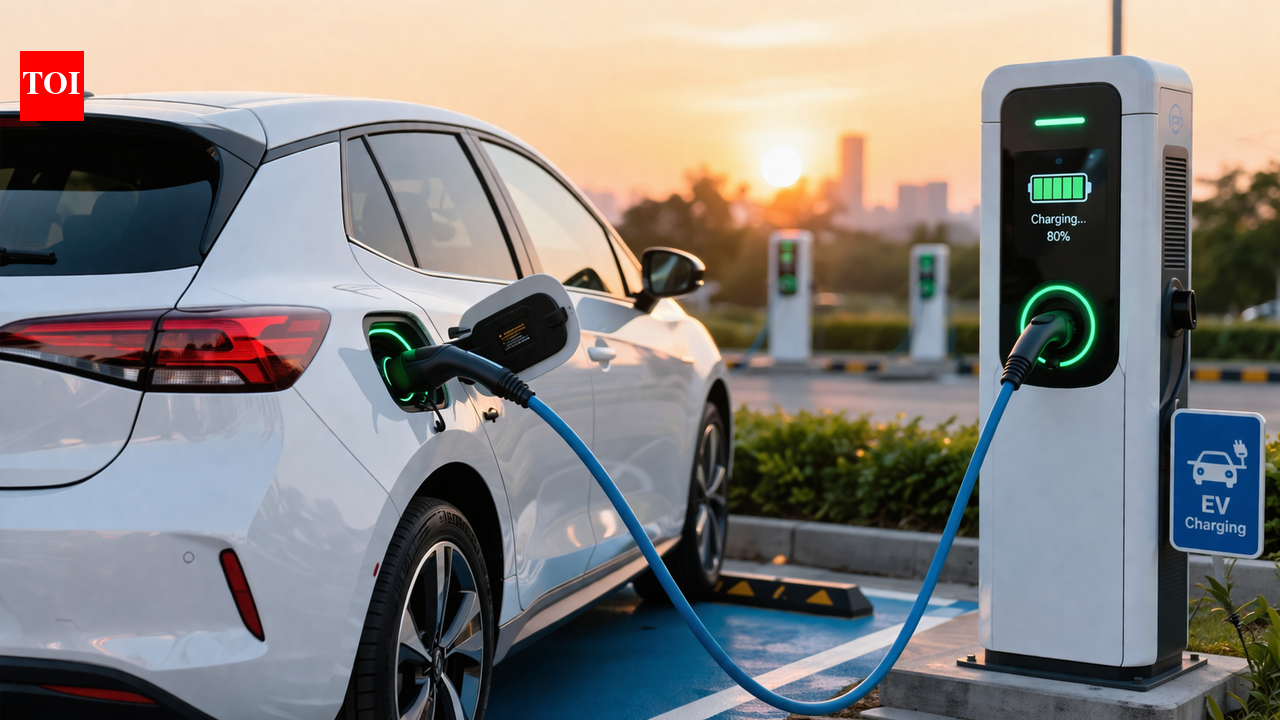
The Delhi government has unveiled the draft Electric Vehicle (EV) Policy 2026–2030, outlining a roadmap to curb air pollution and promote clean mobility in the national capital. With vehicular emissions contributing nearly 23% of the city’s pollution, the policy focuses on accelerating the shift to electric vehicles while strengthening the ecosystem needed to support their widespread adoption.The new draft builds on the earlier EV policy introduced in August 2020, which had a three-year term ending in August 2023 and has since been extended. Officials say the updated framework seeks to expand on previous efforts to curb vehicular pollution and accelerate the transition to cleaner transport. The draft offers incentives like a 100% road tax waiver for electric cars, along with benefits and updated rules for two-, three-, and four-wheelers. It also aims to expand charging infrastructure, build a stronger EV ecosystem, and encourage a gradual move away from petrol and diesel vehicles. Focused on cutting emissions, which make up about 23% of Delhi’s pollution, the policy is linked to the Right to Clean Air under Article 21, highlighting a stronger push to improve air quality in the capital.
Here’s what Delhi government’s new EV draft policy has proposed:
- Full tax exemption for affordable EV carsElectric cars priced up to Rs 30 lakh will get 100% exemption on road tax and registration fees till March 31, 2030. The policy states, “Electric cars with ex-showroom price above (Rs) 30 lakh registered in Delhi shall not be granted any exemption from road tax and registration fees.” However, vehicles priced above this threshold will not be eligible for such benefits. The draft also proposes a 50% exemption for strong hybrid vehicles.
- What’s new for 2 wheelers?
The government has also listed out intensives for two wheelers. To be eligible for incentives, the ex-factory price of an electric two-wheeler must not exceed Rs 2.25 lakh.
In the first year from the date of notification, buyers will receive Rs 10,000 per kWh, capped at Rs 30,000. This incentive reduces to Rs 6,600 per kWh (up to Rs 20,000) in the second year, and further to Rs 3,300 per kWh (up to Rs 10,000) in the third year. - Push for electric three-wheelers
From January 1, 2027, only electric three-wheelers will be allowed for new registrations in Delhi. Furthermore, the Government of National Capital Territory of Delhi (GNCTD) is also set to provide the following incentives to encourage the adoption of electric-rickshaws in the national capital:
- Slow transition to electric vehicles
The draft has proposed phased electrification of school bus fleets. This applies to all school buses, owned, leased, or hired.
10% electric within 2 years
20% within 3 years
30% by March 31, 2030Furthermore, it also mandates electrification of government fleets. All hired or leased vehicles under the Delhi government will be only electric from the date of notification, except exempted categories. New buses inducted by the
Transport Department and DTC will also be electric, with provisions for cleaner alternatives like hydrogen if introduced.Additionally, all new N1 category trucks procured by government bodies and civic agencies will be only electric. Here’s the incentive structure, based on the year of registration:
Year of Registration Incentive Year 1 (from date of notification) Rs 1,00,000 Year 2 (from date of notification) Rs 75,000 Year 3 (from date of notification) Rs 50,000 - Restrictions on conventional fleet operators
Fleet aggregators and delivery service providers will not be allowed to induct new petrol or diesel vehicles after notified timelines, with limited exceptions for certain categories till December 2026. - Expansion of EV charging and swapping infrastructure
Land-owning agencies will identify sites for public charging and battery swapping stations All new buildings and infrastructure projects must be EV charging-ready DelhiTransco Limited will handle planning, deployment, and reliability of charging networks - Battery waste management and recycling push
Strict compliance with Battery Waste Management Rules and Extended Producer Responsibility (EPR) Establishment of battery collection centres across Delhi through partnerships. - Creation of a dedicated EV Fund
A separate EV Fund will be set up under the Transport Department to finance implementation, supported by budget allocations, grants, cess, and other sources. Furthermore, a committee led by the Transport Minister will oversee implementation of the policy and management of the EV Fund. Transport Department to act as nodal agency Environment Department to track emission reductionsUrban bodies to support infrastructure rollout Education Department to ensure compliance and run awareness campaigns. - Fully digital implementation system
All processes including approvals, applications, disbursements, and grievance redressal will be conducted in a paperless digital format. - Public feedback
The government has also invited public feedback for the proposed reforms. In an official circular, the government said, “The draft Delhi Electric Vehicle (EV) Policy 2026 is hereby uploaded on the official website of Transport Department, GNCTD for the information of general public. All stakeholders including general public are invited to submit their feedback/comments within 30 days from the date of publication through the following modes: 1. By e-mail: evpolicy2026@gmail.com 2. By Post: Joint Commissioner (EV), Transport Department, Govt. of NCT of Delhi, 5/9 Underhill Road, Delhi- 110054.”
It further clarified, “All inputs/representations may kindly be submitted only through the above- mentioned modes. In this regard, the public is humbly requested to avoid visiting the office premises, as the same may cause unnecessary crowding. No objections or suggestions received after the expiry of the said period shall be considered.”Earlier this year, on March 20, CM Rekha Gupta flagged off 300 new electric buses and announced the launch of interstate bus services connecting Delhi with Ghaziabad. A foundation stone was also laid for a new Delhi Transport Corporation office near the IP depot.Meanwhile, health minister Pankaj Kumar Singh had noted the pace of adoption, stating, “After our government came to power, we registered more than 1 lakh EV vehicles. There are many reasons why EVs are not advancing further. The previous government did not provide subsidies for EVs. We are providing those subsidies, but if the previous government had given subsidies, perhaps the people of Delhi would have made more efforts to adopt EVs.“

A new government ad campaign is trying to persuade gamers to apply for air safety roles.
Source link

A trade body for European airports has warned over a “systemic” shortage of jet fuel ahead of the peak summer season if the Strait of Hormuz does not reopen in the weeks ahead.
Airports Council International (ACI), which represents more than 600 airports, wrote a letter to the European commissioners for energy and transport and tourism.
The body’s director-general Olivier Jankovec wrote in the letter: “At this stage, we understand that if the passage through the Strait of Hormuz does not resume in any significant and stable way within the next three weeks, systemic jet fuel shortage is set to become a reality for the EU.
“The fact that we are entering the peak summer season… is only adding to those concerns.”
Supplies of jet fuel – which is used to fly planes – from the Middle East have been disrupted since the US-Israel’s war with Iran because of Iran’s effective closure of the Strait of Hormuz, a critical international shipping route.
This has led to soaring prices and warnings that flights could be affected because of Europe’s reliance on fuel imports from around the world.
Analysts have also said higher jet fuel prices can be quicker to pass through to airfares than road fuel and household energy costs.
Ryanair’s boss Michael O’Leary said earlier this month that if the war continues, then there was a risk of “disruptions in Europe in May and June”, adding that “maybe 10%, 20%, 25% of our supplies might be at risk”.
Sir Keir Starmer has been visiting allies in the Gulf for talks on how to support what he described as a “fragile” ceasefire between the US and Iran, which was agreed this week.
He spoke to US President Donald Trump about the need for a “practical plan” to get shipping going through the Strait of Hormuz amid suggestions Tehran wants to charge vessels for passage.
In its letter, the ACI says jet fuel supply for the next six months needs to be urgently monitored by the European Commission, including identifying action that can be taken to increase production within the EU.
It also asks them to consider temporarily lifting restrictions and regulations that limit the ability to import jet fuel.
“This crisis has exposed the reduced refining capacity of the EU for jet fuel production, and its acute dependence on imports from other world regions,” Mr Jankovec warned on behalf of the body.
Susannah Streeter, chief investment strategist for Wealth Club, said: “Carriers have had to deal with a more than doubling of fuel costs since the conflict erupted and the threat of shortages lingers.
“As the war has put a chokehold on supplies from the Middle East, it has caused other nations which produce jet fuel to impose export bans, causing trade to seize up further.
“It will take time to unwind panic positions, and for jet fuel prices to stabilise, so airlines are likely to continue to pass on the cost to passengers for the foreseeable future.”
The FTSE 100 closed little changed on Friday ahead of peace talks between the US and Iran this weekend.
“Investors remained cautious as they kept a close eye on developments surrounding the fragile ceasefire between the US, Israel and Iran,” said David Morrison, an analyst at Trade Nation, adding that investors were pausing “to catch their collective breath heading into the weekend”.
The FTSE 100 closed down just 2.95 points at 10,600.53. The FTSE 250 ended up 145.38 points, 0.7%, at 22,351.02, and the AIM All-Share rose 8.13 points, 1.1%, to 777.48.
For the week, the FTSE 100 was 2.3% higher, the FTSE 250 was up 3.1%, and the AIM All-Share climbed 5.3%.
US vice president JD Vance warned Iran not to “play” Washington but said he hoped peace talks set to start in Pakistan would have a “positive” outcome.
“If the Iranians are willing to negotiate in good faith, we’re certainly willing to extend the open hand. If they’re going to try to play us, then they’re going to find the negotiating team is not that receptive,” he said.
Washington and Tehran have agreed to a two-week truce after more than five weeks of war. However, they remain far apart in their public announcements of goals in the peace talks, in which Mr Vance will head the US delegation.
Key sticking points include Iran’s de facto control over the strategic Strait of Hormuz, US demands that Iran give up its stockpile of highly enriched uranium, and Iran’s aim to prevent further US and Israeli attacks.
For equity markets, Barclays analyst Emmanuel Cau thinks the path of least resistance remains higher.
“Having said that, we are hopeful but not naive,” Mr Cau said.
“Hostilities have not completely ceased and upcoming talks in Pakistan will be critical for further progress, which may not be a smooth process. And we note that stocks look somewhat more hopeful of a happy ending than oil, with equity indices now outperforming the pull-back seen in oil futures.”
Mr Cau added it also feels “reasonable” to expect that the oil shock will leave lasting scars on both growth and inflation relative to pre‑war expectations, in particular for Europe.
“So grinding higher may not be all plain sailing,” Mr Cau said.
Brent oil traded lower at 96.14 dollars a barrel on Friday afternoon, down from 97.36 dollars at the time of the equities close in London on Thursday.
In European equities on Friday, the CAC 40 in Paris closed up 0.4%, while the DAX 40 in Frankfurt rose 0.3%.
In New York, markets were mixed. The Dow Jones Industrial Average was down 0.2%, while the S&P 500 was 0.3% higher, and the Nasdaq Composite was up 0.8%.
The yield on the US 10-year Treasury was flat at 4.30% on Friday. The yield on the US 30-year Treasury stretched to 4.90% on Friday from 4.89% on Thursday.
Investors were also weighing US inflation figures, which showed the impact of the Middle East crisis.
Data published by the US Bureau of Labour Statistics on Friday showed the US consumer price index inflation rate accelerated to 3.3% in March, in line with the FXStreet-cited consensus, from 2.4% in February.
The index for energy rose 10.9% in March, the largest monthly increase in the index since September 2005.
The petrol index increased 21.2% over the month, the largest monthly increase since the series was first published in 1967, which accounted for nearly three-quarters of the monthly all-items increase.
Core inflation, excluding food and energy, was up 2.6% on-year in March, higher than 2.5% in February, but below the consensus of 2.7%.
Analysts took encouragement from the softer-than-expected core inflation figure.
“Gasoline price hikes prompted a jump in headline inflation, but core pressures were more benign than feared. We have much greater confidence that inflation will be transitory this time around, given the lack of demand impetus and weaker corporate pricing power versus 2022,” analysts at ING said.
Arielle Ingrassia, associate director at wealth manager Evelyn Partners, agreed: “For now, this looks like an energy-led reacceleration with contained spillovers, rather than a fully entrenched second-round inflation dynamic.
“However, if energy prices remain elevated, the risk is that these effects broaden over time through costs, pricing and ultimately inflation expectations.”
The pound rose to 1.3472 dollars on Friday afternoon from 1.3437 dollars on Thursday. Against the euro, sterling ebbed to 1.1482 euros from 1.1484 euros.
The euro stood higher against the greenback at 1.1735 dollars from 1.1705 dollars. Against the yen, the dollar was trading higher at 159.10 yen compared to 158.97 yen.
On London’s FTSE 100, Convatec led the risers, up 4.5%, after Thursday’s capital markets day.
Panmure Liberum said there was a “palpable sense of confidence” at what it called an “impressive” CMD. Goldman Sachs, meanwhile, said it came away from the CMD with a “broadly positive impression and increased confidence” in medium-term financial targets.
Burberry rose 2.1% after Italian peer Brunello Cucinelli reported stronger-than-expected first-quarter results, while a higher copper price gave Antofagasta, up 3.0%, a boost ahead of next week’s production figures.
Oil majors BP and Shell, down 1.1% and 0.8% respectively, were on the back foot amid the easing oil price, while hopes for peace in the Middle East and Ukraine sent defence manufacturers BAE Systems and Babcock International down 3.3% and 1.8%.
On the FTSE 250, AO World jumped 7.0% as it forecast profit in line with previously upgraded guidance, “despite material cost headwinds”.
But B&M European Value Retail fell 4.6%, after it said interim chief financial officer Helen Cowing has stepped down from her role, having only held the position since December 1.
Cowing, formerly interim CFO at Mobico Group, had replaced Mike Schmidt, who stepped down in the wake of an accounting error.
The company said group financial controller Peter Waterhouse has been appointed as interim CFO with immediate effect.
JPMorgan analyst Borja Olcese noted that Waterhouse will be B&M’s third CFO in three years, after a chief executive change last year as well.
“This sequence of key management change needs to be regarded in the context of several profit warnings (three material cuts to FY26 profit outlook in a matter of four months).
“Altogether, the sequence of events seems concerning to us, and suggests risk of further kitchen sinking – we note weak company fundamentals persist,” the analyst added.
Gold traded at 4,775.63 dollars an ounce on Friday, down from 4,791.50 dollars at the same time on Thursday.
The biggest risers on the FTSE 100 were Convatec, up 10.0p at 234.0p, Endeavour Mining, up 146.0p at 4,902.0p, Antofagasta, up 111.0p at 3,788.0p, Kingfisher, up 8.1p at 308.2p and Burberry, up 24.0p at 1,157.4p.
The biggest fallers on the FTSE 100 were Metlen Energy & Metals, down 3.1p at 32.2p, BAE Systems, down 75.0p at 2,194.0p, Sage Group, down 18.2p at 817.6p, Hiscox, down 30.0p at 1,577.0p and Compass, down 0.5p at 27.5p.
Monday’s global economic calendar has the US existing home sales figures.
Monday’s domestic corporate calendar has a trading statement from London-based money transfer services provider, Wise.
Contributed by Alliance News


Transfer rumors, news: Arsenal eyeing Newcastle’s Gordon

Dua Lipa hits major career high ahead of wedding with Callum Turner
100% road tax waiver for electric cars, new rules for 2, 3 and 4 wheelers – what Delhi govt’s draft EV policy says – The Times of India

-
 Business1 week ago
Jaguar Land Rover sees sales recover after cyber attack
-
Uncategorized1 week ago
[CinePlex360] Please moderate: “Trump signals p
-

 Entertainment1 week ago
Joe Jonas shares candid glimpse into parenthood with Sophie Turner
-

 Tech1 week ago
Our Favorite iPad Is $50 Off
-

 Fashion1 week ago
India-Bangladesh textile trade reset: 5 shocks to watch now
-

 Sports1 week ago
UConn Final Four run could trigger a $50M furniture giveaway for Massachusetts-based Jordan’s Furniture
-
 Business1 week ago
The best cash ISAs and savings accounts in April paying highest interest rates
-
 Business1 week ago
Video: Why Is the Labor Market Stuck?