

Politics
Trump order imposes additional 25% tariff on goods from India

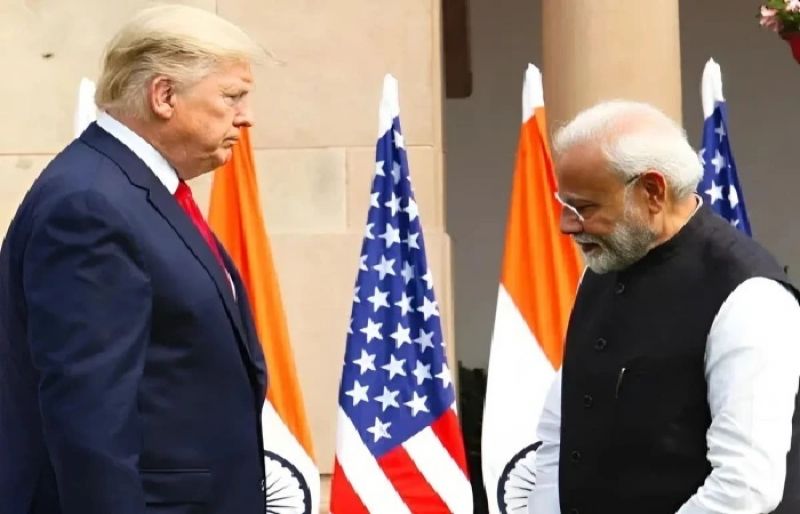

US President Donald Trump issued an executive order on Wednesday imposing an additional 25% tariff on goods from India, saying the country directly or indirectly imported Russian oil, adding to 25% tariffs already announced.
In an executive order issued from the White House, the US president said: “I find that the government of India is currently directly or indirectly importing Russian Federation oil.
“Accordingly, and as consistent with applicable law, articles of India imported into the customs territory of the United States shall be subject to an additional ad valorem rate of duty of 25%.”
The US president further said he determined it “necessary and appropriate” to impose an additional ad valorem duty on imports of articles of India since it was directly or indirectly importing Russian oil.
The order maintains exemptions for items targeted by separate sector-specific duties such as steel and aluminum, and categories that could be hit like pharmaceuticals.
The move threatens to further complicate US-Indian relations and comes shortly after a Indian government source said Indian Prime Minister Narendra Modi would visit China for the first time in over seven years later this month.
US-India ties are facing their most serious crisis in years after talks with India failed to produce a trade agreement.
The White House move, first signaled by Trump on Monday, follows meetings by Trump’s top diplomatic envoy Steve Witkoff in Moscow aimed at pushing Russia to agree to peace in Ukraine.
Trump has threatened higher tariffs on Russia and secondary sanctions on its allies, if Russian President Vladimir Putin does not move to end the war in Ukraine.
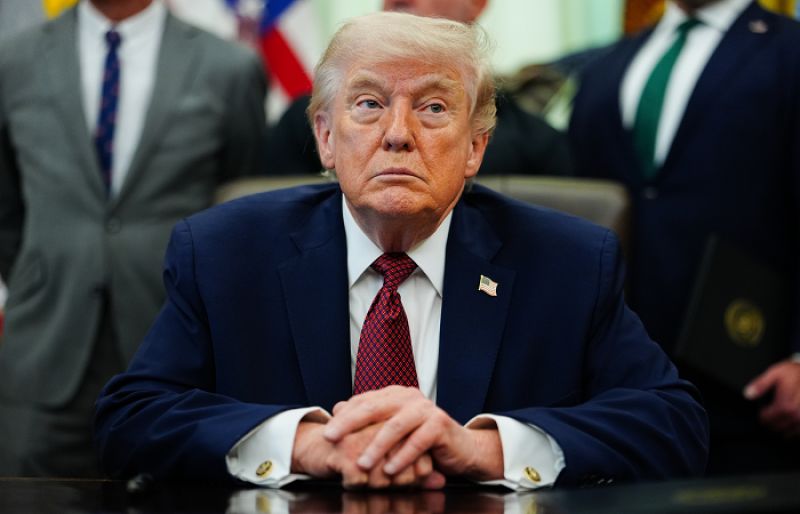
By extending a ceasefire indefinitely with Iran, President Donald Trump appears to be searching for a way out of a costly war, but Tehran may be unwilling to give him a win.
Trump has insisted on maintaining a naval blockade, which Iran is demanding must end before it can consider any agreement to end the conflict launched on February 28 by Israel and the United States.
For Trump, who boasts of his prowess to secure big deals quickly through his team of business buddies, negotiating with Iran’s Islamic republic presents an ultimate contrast — methodical, unyielding diplomats ready to fight for the long haul against what they see as a deceitful enemy.
Trump had raised hopes of progress at a second round of talks in Pakistan, with Vice President JD Vance designated to fly out, but Iran refused to confirm its attendance and Vance stayed home.
With a two-week ceasefire set to end, and Gulf Arab allies of the United States bracing for potential new Iranian strikes, Trump said he was extending the ceasefire because Iran’s leadership, decimated by the war, was “fractured” and needed time to come up with a proposal.
“He really could have doubled down and engaged in more reckless military action. But so far he has stopped digging himself into a deeper hole,” said Alex Vatanka, a senior fellow at the Middle East Institute who studies Iran.
For Trump, who campaigned on promises to shun military interventionism, the war has proven politically disastrous, facing opposition from even his Republican base.
Iran responded to being attacked by exerting control over the Strait of Hormuz, the gateway for one-fifth of the world’s oil, making American consumers pay more at the pump months before congressional elections.
– Seeking to exhaust all options –
Despite suffering losses, Iran’s clerical state is not on the verge of collapsing and will not surrender, said Danny Citrinowicz, a former Israeli intelligence expert on Iran now at Tel Aviv University’s Institute for National Security Studies and the Washington-based Atlantic Council.
Trump “does not want escalation. I am not saying there is not going to be one, but he is trying to really exhaust any political option,” he said.
“I think Trump is fed up with this war and more than that he understands, despite what he is saying, that the price is only going to intensify. It’s not going to decrease,” Citrinowicz said.
But Iranian leaders are deeply suspicious of Trump, whose negotiators were discussing a deal with them days before the United States and Israel attacked — a pattern also seen last June, with the two sides talking just before an Israeli bombing campaign then.
Both Trump and Iran’s ruling clerics are sensitive to any suggestion of backing down.
In declaring the naval blockade during the ceasefire, Trump had forced Iran to respond, undermining his own diplomacy “for the sake of optics and looking strong,” Vatanka said.
In one potential off-ramp, Vatanka said that the United States could maintain the blockade but not enforce it rigorously.
“The Iranians would know if it’s not being enforced because that is easy to measure,” Vatanka said.
Iran could call it a win but if they insist on a full opening, “that tells me they’re more interested in the optics than actually getting a deal. It would be a mistake on their part,” Vatanka said.
– How big a blockade? –
Trump has not indicated any let-up on the blockade so far. Senator Lindsey Graham, a Republican who long advocated for striking Iran, indicated the blockade could now serve as the key US means of pressure.
Graham wrote on X that he had concluded after speaking with Trump on Wednesday that “the blockade will be growing and that it could become global soon.”
Sina Toossi, a senior fellow at the progressive Center for International Policy, said Trump had a choice on the blockade — lifting it, which would reinforce to Iran how much leverage it had gained, or keeping it and risking ending the ceasefire.
“The prevailing view in Tehran is that time is on its side and that a prolonged conflict would impose mounting costs on the US and the global economy,” he said.

- Phelan clashed with Hegseth, other military leaders.
- Hegseth has fired top officials from across the military.
- Firing of Navy secretary comes amid US naval blockade of Iran.
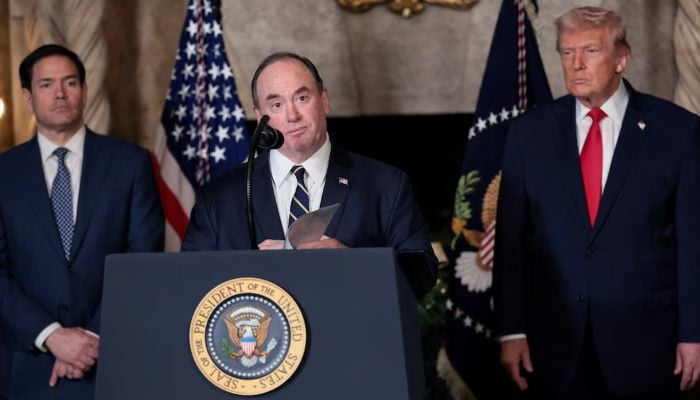
WASHINGTON: Navy Secretary John Phelan has been fired, a US official and a person familiar with the matter said on Wednesday, in another wartime shakeup at the Pentagon coming just weeks after Defence Secretary Pete Hegseth ousted the Army’s top general.
The Pentagon announced his departure in a brief statement, saying he was leaving the administration “effective immediately.” But it did not provide a reason or say whether it was his decision to go.
His firing was first reported by Reuters.
The sources, who spoke on condition of anonymity, said Phelan was dismissed in part because he was moving too slow to implement reforms to speed shipbuilding and because he had fallen out with key Pentagon leadership.
One source cited bad relationships with Hegseth, Hegseth’s deputy, Steve Feinberg, as well as the Navy’s number 2 civilian, Hung Cao, who the Pentagon said will now take over as acting Navy secretary.
The source also cited an ethics investigation into Phelan’s office.
A billionaire seen as having close ties to President Donald Trump, Phelan is the first administration-picked service secretary to be fired since Trump came back into office last year.
His departure fits within a broader context of upheaval at all levels of leadership at the Pentagon under Hegseth’s watch, including the firing last year of the chairman of the Joint Chiefs of Staff, Air Force General CQ Brown, as well as the chief of naval operations and Air Force vice chief of staff.
On April 2, Hegseth fired Army Chief of Staff Randy George without citing a reason. Two US officials said the decision was tied to tensions between Hegseth and Army Secretary Daniel Driscoll.
Senator Jack Reed, the top Democrat on the Senate Armed Services Committee, called Phelan’s dismissal “troubling.”
“I am concerned it is yet another example of the instability and dysfunction that have come to define the Department of Defence under President Trump and Secretary Hegseth,” Reed said.
The latest departure comes during a tense ceasefire with Iran, as the US flows more naval assets into the Middle East.
The US military is relying on naval assets to carry out a blockade of Iran, which President Donald Trump is hoping will pressure Tehran to negotiate an end to the conflict on his terms.
The Navy is under intense pressure to expand its fleet. China’s shipbuilding industry now dwarfs the US, which was once a global powerhouse.
Trump’s $1.5 trillion defence budget request for fiscal year 2027 includes over $65 billion to procure 18 warships and 16 support ships made by General Dynamics and Huntington Ingalls Industries.
It is part of what the Pentagon is calling the “Golden Fleet” initiative, which officials say is the largest shipbuilding request since 1962.


- No fixed timeline announced for truce: source.
- Trump says US to continue blockade despite truce extension.
- Iran says talks will be held after lifting of US naval blockade.
A second round of US-Iran talks could take place as early as Friday, the New York Post reported on Wednesday, citing President Donald Trump.
“It’s possible!” Trump reportedly told the Post by text message, when asked about sources in Pakistan — which mediated the first round of talks — saying that a second round was “expected in Islamabad within the next 36 to 72 hours.”
Trump on Tuesday extended a two-week truce in the war just as it was about to expire. A digital news outlet in Pakistan reported the three-day time frame for more talks without a source or further details.
However, Reuters, citing a source, reported that no fixed timeline has been announced for any long-term extension.
The US source said Trump was willing to extend the ceasefire with Iran by another three to five days. “It is not going to be an open-ended ceasefire,” the source added.
Uncertainty continues to cloud the second round of peace talks, as Washington and Tehran remain at odds on several issues, most notably the Strait of Hormuz.
Tehran closed the strait for all traffic after the US and Israel began strikes across Iran on February 28. Apart from closing Hormuz, Tehran also launched strikes against Israel and US bases across the Middle East.
The fighting ended on April 8 when Prime Minister Shehbaz Sharif announced a two-week ceasefire and invited both sides to Islamabad for talks, which concluded without a deal on a permanent end to the conflict.
Islamabad, however, continued its effort to bring both sides back to the negotiating table and ensure an extension in the ceasefire.
Ceasefire extended
Late Tuesday, US President Donald Trump announced extending the Iran ceasefire until an Iranian proposal was submitted and discussions were concluded.
Trump, in a post on Truth Social, said he was acting at the request of Pakistan to hold off attacks until Iranian leaders and representatives could come up with what he called a unified proposal.
However, Trump said the US Navy would continue its blockade of Iranian maritime trade, a measure Tehran considers an act of war.
While Washington has announced members of its delegation for the second round of talks, Tehran says it would return to the negotiating table only after the US lifts the naval blockade of its ports.
“As soon as they lift the blockade, the next round of negotiations will be held in Islamabad,” Aljazeera quoted Iran’s Ambassador to the UN Amir-Saeid Iravani as saying.
Meanwhile, Pakistani authorities said that Islamabad was in constant touch with the Iranian leadership and was pursuing the path of diplomacy and dialogue.
“Formal response from Iranian side about confirmation of delegation to attend Islamabad Peace Talks is still awaited,” Information Minister Attaullah Tarar wrote in a post on X on Tuesday.
Iran hails Pakistan’s efforts to end war
Iran’s foreign ministry spokesperson Esmaeil Baqaei said on Wednesday that the Islamic republic appreciates Pakistan’s efforts to end the Middle East war, without commenting on a ceasefire extension announced by the United States.
Iranian state broadcaster IRIB reported that Baqaei was asked by journalists to comment on the truce extension, which US President Donald Trump said he approved following a request by Pakistani mediators.
“While appreciating Pakistan’s efforts to end the imposed war and establish peace”, Baqaei stressed that Tehran “is taking the necessary measures to safeguard Iran’s national interests and security”


Revoking China PNTR may lead to higher tariffs borne by US firms: AAFA

2025-26 NBA Playoff Odds: Spreads, Lines for First-Round Series

Trump seeks exit from war as Iran signals resistance to deal

-

 Fashion7 days ago
France’s LVMH Q1 revenue falls 6%, shows resilience amid Iran war
-

 Entertainment1 week ago
Is Claude down? Here’s why users are seeing errors
-

 Tech1 week ago
The Deepfake Nudes Crisis in Schools Is Much Worse Than You Thought
-

 Sports1 week ago
PSL 11: Peshawar Zalmi win toss, opt to field first against Quetta Gladiators
-

 Tech1 week ago
Bremont Is Sending a Watch to the Moon’s Surface
-

 Tech1 week ago
Human-machine teaming dives underwater
-
 Business1 week ago
Standard Life buys rival in £2b deal to create savings giant
-
 Business1 week ago
BP sees ‘exceptional’ oil trading result as Iran war sends crude costs soaring