

Tech
The Best Carpet Cleaners We’ve Found, Tested in Busy Households

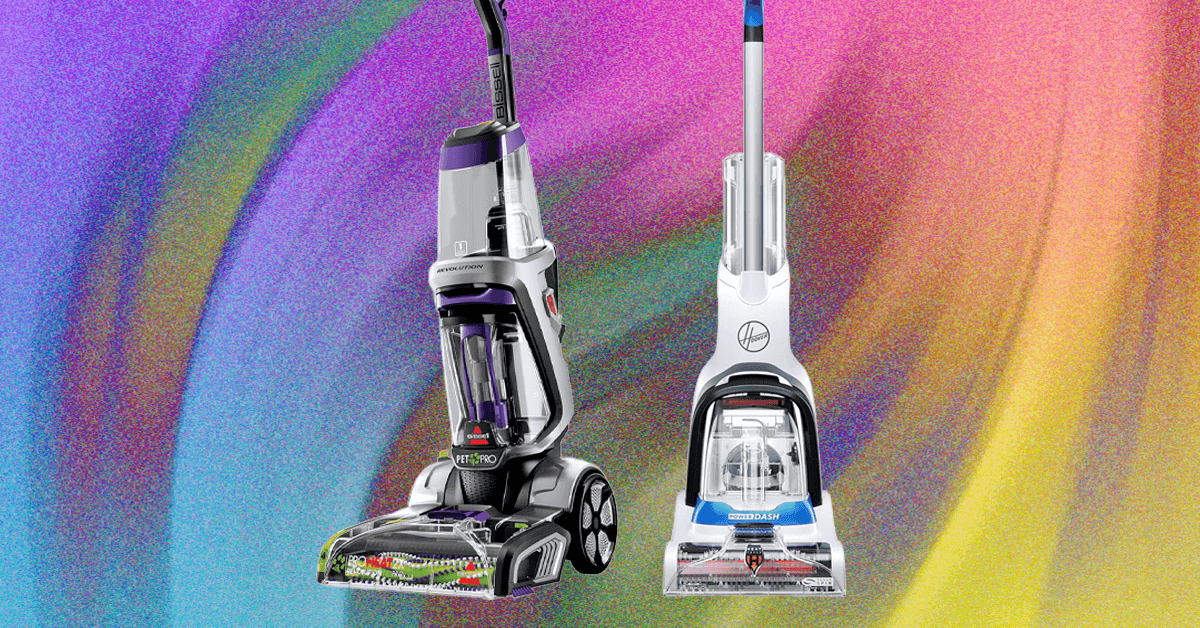
Compare Our Picks
Others Tested
Photograph: Simon Hill
Hoover HF4 Hydro for £199: For UK folks in flats or small houses with a mix of carpet and hard floor, this cordless, space-saving vacuum and mop from Hoover could be a smart pick. You get a standard cordless stick vac with around half an hour of battery life, but you can switch the head to mop. It’s excellent for cleaning hard floors, with a shape that gets right into corners and two rotating pads to lift stains. But the water tank, contained within the head, is tiny, the vacuum is only moderately powerful at lifting, and battery life drops to just 15 minutes in turbo mode.
Hoover SmartWash Automatic Carpet Cleaner for $250: It’s bulky, but it has automatic cleaning and drying cycles—pushing it forward releases the solution and pulling it back starts the drying process. After you’ve gone over the whole area, you can turn just the drying mode on for an extra pass if the carpet needs it. The handle comes out with the click of a button, and you can use its separate tank with a cleaning solution to spot-treat before vacuuming. A hose and separate antimicrobial pet tool can clean stairs or any other hard-to-reach areas that need extra elbow grease. Some customer reviews say it worked well for a few months but then shorted out. We’ll keep trying it to see if we run into that issue. —Medea Giordano
Bissell Little Green Portable Carpet Cleaner for $79: If you’ve landed on the cleaning side of TikTok, you’ve probably seen people cleaning their carpets and furniture with this Little Green machine. This opens up the world of upholstery cleaning too, not just carpets. It worked well and it’s easier to store and tote around your house than our top pick. But use the included hose-cleaning tool frequently. These hoses can get nasty. —Brenda Stolyar
Cleaners We Like for Hard Floors

Photograph: Simon Hill
Dreame H14 Pro for $380: The Dreame H14 Pro is quite large, but I found it easy to maneuver, and it can lie flat to get under furniture. A handy LED headlight helps you see what you are cleaning clearly. A full charge proved enough to do all my hard floors twice over, and the result was super shiny. What I love about this vac is that it effectively cleans up dry or wet spills, so whether you are cleaning cat litter or a spilled bowl of cereal, it performs. It’s best for cleaning recent spills but can shift stubborn stains with repeated passes on Ultra mode. When you finish, you can return it to the charging cradle and trigger the self-cleaning mode to sterilize the soft roller and dry it (though it gets loud and takes a long time). No one wants to install an app or create an account just to use a vacuum, but it enables you to choose modes and schedule the self-cleaning, which could be handy if you want it to wait until you go out. —Simon Hill
Shark S5003D Genius Steam Mop for $100: This steam mop is great for cleaning hardwood, tiles, or laminate flooring (not carpets). Simply fill the water tank, plug it in, and attach one of the mop pads. It has three heat levels, and you press down to release a jet of steam for stubborn stains. There’s no need for any detergent, it’s light and maneuverable, and it doesn’t require much space. The clever pad design enables you to flip it over when one side is soiled, and the mechanism makes it easy to attach, with a button to detach the dirty pad, which is machine washable. (You get two pads in the box.) I regularly use this mop to clean laminate, composite, and tile floors, but you must be careful using steam, especially on wood or vinyl flooring. Test it on the lowest heat setting before going over the whole floor. There are no special attachments or extras here, and it’s only suitable for use on hard floors. You also need to empty any remaining water if you don’t plan on using it for a while, or the tank can go nasty. —Simon Hill
Karcher SC 3 for $164: If your budget can stretch, this option is better if you want attachments and the option to steam-clean harder-to-reach surfaces and your hard floors. It’s good for complete kitchen or bathroom cleaning without the need for any detergent or other products. It’s effective for cleaning glass and mirrors too. It only comes with one microfiber cover, and it’s not recommended for use on fabrics or carpets. —Simon Hill
Not Recommended

Eufy E28 HydroJet Robot Vacuum with Carpet Cleaner for $1,400: I generally love Eufy’s attractive, smart, multipurpose robot vacuums, and since I have two dogs and two kids, I was expecting to love a robot vacuum that could also mop hardwood floors and has a detachable carpet cleaner. Unfortunately, the water injection system is wonky. It has to be perfectly positioned to get water from the portable carpet cleaner tank (I often had to tap it into place), and every time I mopped, it leaked constantly all over my kitchen floor. At least the carpet cleaner was effective. —Adrienne So
Things to Consider When Shopping for a Carpet Cleaner
There is a lot to think about when shopping for or using a carpet cleaner, such as how much space you’ll need for storage and whether you should rent or buy. Here are some tips to keep in mind.
Carpet cleaners are heavy and bulky, especially when filled with water. They can be harder to maneuver than regular upright vacuums. They will also need quite a bit of storage space.
Tackle stain-causing spills immediately. Most households only need to wash carpets once every six months to a year, but spot cleaners are ideal for treating immediate spills, plus they’re easier to store and use.
You likely won’t use a carpet cleaner often, so it’s OK to consider hiring professionals to do your whole home, especially if you have limited storage space. (It also can depend on how dirty and stained your carpets are.) Look at options for renting a machine from local businesses or retail stores like Home Depot. You’ll be able to get the benefits of a commercial-grade cleaner without paying a fortune.
Clean your carpet before you use a carpet cleaner. This may seem counterintuitive, but you don’t want dirt and hair to form wet clumps that block the cleaner. And if you haven’t washed your carpets in a while (or ever), be prepared for an embarrassing amount of hairy clogs to fill the dirty water tank.
The carpet shampoo or detergent you use is important. Manufacturers often insist you use their brand, and while other types may work fine, you might void your warranty (although I have no idea how they’d know). Most carpet cleaners come with some detergent.
Try, try, and try again. It can be disappointing to fire up a carpet cleaner and find that it’s incapable of removing that old red wine stain or ground-in toothpaste. Don’t lose heart. Multiple cleaning sessions can sometimes chip away at established stains, and at least reduce, if not remove, them.
Drying your carpets can take a long time. Most carpet cleaners have different settings, and they will suck up some of the water, but they all leave carpets a bit damp. The deeper cleans tend to leave carpets wet, so think about how you might speed drying time. Use fans, fire up the heating, or do your carpet cleaning in the spring and summer months when you can leave windows open.
Protect your hearing. Of all the ways you can damage your hearing, a carpet cleaner is perhaps the least fun, so protect your ears. Some of these get very loud, so wear earplugs while you work.
Power up with unlimited access to WIRED. Get best-in-class reporting and exclusive subscriber content that’s too important to ignore. Subscribe Today.











Tech
‘STAGED’: Conspiracy Theories Are Everywhere Following White House Correspondents’ Dinner Shooting

In the immediate aftermath of the attack on the White House Correspondents’ Dinner on Saturday night, influencers, pundits, and random posters lit up social media platforms like X, Bluesky, and Instagram with conspiracy theories about the attack and the alleged shooter.
Both left and right-wing accounts claimed, without evidence, that the attack was staged.
President Donald Trump, Vice President JD Vance, and dozens of other high-profile administration officials and journalists were attending the dinner at the Hilton hotel in Washington, DC, when a suspect, later identified by media reports as Cole Tomas Allen from California, allegedly ran past security towards the event. He was detained by law enforcement while the president and vice president were evacuated. Police said that they believe Cole acted alone, but did not expand on who his intended target was or what his motive may have been. “We believe the suspect was targeting administration officials,” acting attorney general Todd Blanche told NBC’s Meet the Press on Sunday morning.
On Bluesky, which has a predominantly left-leaning user base, many people simply wrote the word “STAGED” over and over again, echoing the response to the Trump assassination attempt in Butler, Pennsylvania in 2024.
On X, many claimed the shooting was staged as a way to bolster support for Trump’s plan to build a new ballroom in the White House. The president referenced the ballroom in a press conference after the incident and a Truth Social post on Sunday morning. Many prominent online Trump boosters echoed the need for the ballroom, including far-right podcaster Jack Posobiec, Libs of TikTok creator Chaya Raichik, and Tom Fitton, the right-wing activist who runs Judicial Watch.
Their quick response, conspiracy theorists claimed, was evidence of a coordinated campaign following the shooting. “Is this another staged event,” one X user asked in a post that has been viewed more than 5 million times.
Other social media users who claimed the incident was staged pointed to a Fox News clip that featured the station’s White House correspondent Aishah Hasnie speaking from the Hilton hotel. Hasnie told viewers that prior to the shooting, press secretary Karoline Leavitt’s husband allegedly told her “you need to be very safe,” before the call was cut off.
“Fox News just cut one of their reporters off as they seemed to indicate the shooting was a pre-planned false flag,” one X user wrote in a post that has been viewed more than 2 million times. Hasnie later clarified in an X post that her cell service had cut out in a location with notoriously bad service, adding: “He was telling me to be careful with my own safety because the world is crazy. He was expressing his concern for my safety.”
“I don’t want to be fomenting conspiracies,” wrote Angelo Carusone, the chair and president of Media Matters, on Bluesky about the Fox News interview. “But I mean…this was super weird. Super weird.”
Leavitt herself was also the focus of conspiracy theories after she said “shots will be fired” in an interview ahead of the dinner, referring to the jokes Trump was scheduled to deliver. Following the attack, X users claimed the comment was “strange,” “sus,” or a “curious choice of words,” while sharing memes that suggested the shooting was staged. At least one mainstream outlet appeared to amplify the conspiracy theory as well, describing Leavitt’s comment as “eerie” and “bizarre.”

Kindle Holders
Hate holding up your Kindle? Or struggle with chronic pain that makes holding it feel terrible? These holders will literally take the weight out of your hands.
A Freestanding Charger
Looking to keep your Kindle charged without adding another cord to the floor of your desk or bedside table? Same. Here’s a more stylish solution if you have one of the Signature editions.

Anker
Wireless Charging Dock for Kindle
This wireless charging dock is made by Anker for Kindles, specifically for Kindle Paperwhite and Colorsoft’s seven-inch Signature editions. Those versions have wireless charging capabilities, and this stand takes advantage of that with charging coils that line up with the back of the Kindle, where the wireless charging is. You’ll want to take off any MagSafe cases; leaving mine on made the little light on the charging dock flash until I took it off.
A Kindle Page Turner
The hottest new item to get as a Kindle lover is a page turner. They’re especially handy for holders like the ones above, where your hands aren’t already on the device, and can make for a great accessibility accessory for readers with different needs.
My biggest irritation with these devices so far is that you have to charge them both individually, and if one runs out of battery, the whole thing is useless. I also don’t love that the turner does tend to block at least one letter while I read, and you can’t place it on the lower or upper margins since it’ll activate the menus instead of turning the page. Still, it makes reading ultra comfortable, especially for my strained wrists.
Here’s my favorite one so far, that’s been solid at holding a charge, and next I’m testing this remote ($15) with a wearable ring clicker instead of a remote.

A 31-year-old engineer and computer scientist was identified by media reports and President Donald Trump as the suspected shooter at the White House Correspondents Dinner on Saturday night.
Cole Tomas Allen, of Torrance, California, was apprehended following the firing of shots at the Washington Hilton, where Trump was scheduled to deliver remarks to a ballroom full of journalists, cabinet officials, and Hilton staff. Allen’s name surfaced in media reports shortly before Trump posted two photos of a suspect following his apprehension. The person in the photos Trump posted matches photos of Allen.
In dramatic scenes, several shots were heard outside the ballroom, after which Trump and Vice President JD Vance were immediately rushed off the stage by the United States Secret Service. In the immediate aftermath of the shooting incident, it briefly appeared as if the event would proceed—Trump posted “LET THE SHOW GO ON” on Truth Social—but the event was eventually shut down.
According to the Metropolitan Police Department, the suspect “charged” a Secret Service checkpoint at the Hilton hotel, and was intercepted by agents. MPD interim chief Jeffery Carroll said the suspect was carrying a “shotgun, handgun, and multiple knives.”
At a White House press conference following the shooting, Trump said one United States Secret Service agent was shot but saved from serious injury by his bulletproof vest. Trump said the agent, who was not named, is “doing great” and in “great shape.” No other injuries were immediately reported.
The suspect was later transported to a local hospital “to be evaluated,” according to Carroll, who said he appears to be a “lone actor.”
Around the time Trump’s press conference began on Saturday night, he posted a picture on his Truth Social account appearing to show the suspected shooter on the ground, with his hands restrained behind his back, and a foil warming blanket covering the lower half of his body.
A WIRED review of public databases shows a seemingly minimal online presence associated with Allen’s name. According to his LinkedIn profile, he graduated from Caltech in 2017 with a bachelor’s in mechanical engineering and from California State University Dominguez Hills in 2025 with a master’s in computer science. An apparent photo of Allen that appears on Caltech’s website identifies him as a member of the school’s Mechanical Engineering 72 class, described by the school as a “two-term engineering design lab” for building robots and autonomous vehicles. His name is also listed in a 2025 Dominguez Hills graduation program. A search in a public facial recognition database returns only two images, both apparently of him as an undergraduate.
According to the alleged shooter’s LinkedIn profile, he has been employed part-time since March 2020 at C2 Education, a private company that helps students prepare for the SAT and ACT exams. In December 2024, C2 Education said in posts on LinkedIn and Facebook that he was the company’s “December Teacher of the Month.”
Since 2018, the suspected shooter has self-identified on his LinkedIn profile as a “self-employed” indie game developer. He appears to have released an “atomic fighting game” called Bohrdom on Steam in 2018. The game was advertised using accounts on YouTube and X that appeared to have little to no following. The caption for a trailer of the game describes it as a “non-violent, skill-based, asymmetrical fighting game loosely based on a chemistry model that is itself loosely based on reality.”
C2 Education and did not immediately respond to requests for comment. When reached for comment, the Metropolitan Police Department referred WIRED to a video of its public press conference.


Strait of Hormuz disruption ‘systemic shock’ threatening SE Asia: ERIA

Anta: The Chinese sports brand taking on Nike and Adidas

Prince Harry stirs new debate at Palace with bold move: ‘walking liability’

-

 Sports1 week ago
WWE WrestleMania 42 Night 2: Live match results and analysis
-

 Sports1 week ago
NCAA men’s gymnastics championship: All-time winners list
-

 Fashion1 week ago
UK’s Sosandar returns to profitability amid robust FY26 performance
-

 Entertainment6 days ago
Lee Anderson, Zarah Sultana kicked out of UK Parliament for calling PM ‘liar’
-

 Entertainment1 week ago
Ruby Rose old essay resurfaces detailing night of alleged Katy Perry assault
-

 Politics6 days ago
UK’s Starmer seeks to deflect blame over Mandelson appointment
-

 Entertainment1 week ago
Nathalie Baye, low-key legend of French cinema, dies aged 77
-
 Business1 week ago
No fuel shortage: Govt assures 100% domestic LPG, PNG, CNG supply amid Hormuz energy crunch – The Times of India