

Business
Video: The N.B.A. Returns to China After Six Years


new video loaded: The N.B.A. Returns to China After Six Years
transcript
transcript
The N.B.A. Returns to China After Six Years
The N.B.A, returns to China this week, after a hiatus sparked by a controversial 2019 tweet. In Macau, New York Times business reporter Tania Ganguli reveals the behind-the-scenes stakeholders who orchestrated the league’s return.
-
I’m in Macau, the gambling capital of the world. I’m here for the NBA’s return to China for the last six years, there haven’t been any NBA games here. looking at these big banners that are draped over buildings. Reminds me of being back here in 2019. the players were sitting in their hotel and they could see workers tearing those same types of banners down, peeling their faces off the building. A few days before, the Houston Rockets general manager, Daryl Morey, had sent a tweet in support of protesters in Hong Kong. Well, this made the Chinese government very upset. The NBA backed him. We are not apologizing for Daryl exercising his freedom of expression. And then chaos enveloped. That whole week. Sponsors pulled out. And a lot of the players were worried about if they would even be allowed to go home if things got worse. It was it was that surreal. they lost about $400 million. Just from that one situation The Chinese market is huge for the NBA. There are a lot of basketball fans here…. and the league has been working on cultivating them for decades. And so coming here to Macao and playing a game in China again is a very big deal for the league. when you ask anybody with the league how did these games come together? The name that they mentioned is Patrick Dumont. He’s a top executive with the Sands Casino. And owner of the Dallas Mavericks. in 2021, the Chinese government was renegotiating what’s called concessions with the casinos here in Macau. In those concession agreements, the government required that the casinos spend a certain amount on non-gaming activities like entertainment, like sports. And Sands had this arena at the Venetian, so Dumont saw bringing the NBA here as an opportunity to satisfy that requirement. One of the other main players here was Joe Sy, the owner of the Brooklyn Nets. Joe tsai is the chairman of Alibaba Group, which is a Chinese tech giant. he has a lot of deep ties to the Chinese government, the nets, and spent a lot of time over the last few years meeting with Chinese officials, having events that celebrate Chinese culture. they have spoken to Chinese media outlets and said, this market is so important to us. We care about this market more than any other NBA team. They even launched a reality show. That’s a dance team competition to choose dancers for their games here in Macao Sound up: “The brooklyn nets will find the best dancers in china” There’s a tremendous amount at stake for these teams because. The league saw what happened when something went wrong and they lost this market even briefly. there is a feeling that this has to go right, and that this is a big opportunity to get back something that they lost.
By Tania Ganguli, Christina Shaman, Kassie Bracken and Christina Thornell
October 11, 2025











The boss of insurer Aviva has cautioned that a lengthy conflict in the Middle East could send the cost of vehicle parts and repairs surging in an echo of the aftermath seen after Russia’s invasion of Ukraine.
Chief executive Amanda Blanc said the group has seen limited claims so far relating to the US-Israel war with Iran, but flagged the potential for claims costs to jump if supply chains are badly disrupted for a long time.
She said: “We have a good case study on this in terms of the Ukraine situation back in 2022 and the impact on the supply chain, which had an inflationary impact on vehicle parts and replacement vehicles.
“Obviously, if this goes on for a prolonged period of time, we would expect that this could have some impact, but to speak about this from an Aviva perspective, we are very well placed to manage that with our supply chain and our owned garage network.”
Ms Blanc added: “We will take action as necessary to make sure we look after our customers and price accordingly for any new inflationary impact.”
She said there had been “very limited” travel claims so far.
Ms Blanc added: “We have had calls from customers asking about whether they should travel and those sorts of things, and we are pointing them to the Foreign Office guidance on that.”
Full-year results from Aviva on Thursday showed annual earnings leaped 25% higher, while the firm also announced it was resuming share buybacks as it continues to benefit from its £3.7 billion takeover of Direct Line.
The group unveiled an earnings haul of £2.2 billion for 2025, up from £1.8 billion in 2024, including a £174 million contribution from Direct Line, helping the group hit its financial targets a year early.
Aviva unveiled a £350 million share buyback after putting these on hold due to the Direct Line deal, which completed last year.
Ms Blanc cheered an “outstanding performance”.
She said: “We have transformed Aviva over the last five years and whilst we have made significant progress, there is so much more to come.”
Artificial intelligence (AI) is also a big area of focus for the firm, according to Ms Blanc.
“We have clear strengths in artificial intelligence which are creating major opportunities to transform claims, underwriting and customer experience,” she said.

The firm was unable to cope during high demand, Ofwat says, leading to “immense stress” for customers.
Source link
Business
Middle East heat may ripple across India’s energy supply chain, flags Goldman Sachs – The Times of India
As tensions continue to heat up in the Middle East, concerns are raising about disruptions to one of the world’s most critical energy shipping routes, the Strait of Hormuz. Any disruption could significantly affect major oil-importing countries such as India, as the narrow Strait of Hormuz is central to global energy trade. The strait sees almost 20 million barrels of oil passing through each day, or about a fifth of the world’s consumption, pass through the route. The waterway also carries roughly 19% of global liquefied natural gas (LNG) shipments, making it a crucial corridor for energy-importing economies.A recent report by Goldman Sachs has flagged early signs of stress in the region. The report warned that tanker traffic through the Strait of Hormuz has already begun showing signs of disruption, with shipping firms, oil producers and insurers adopting a cautious approach following reports of damaged vessels in nearby waters.According to the firm, financial markets have already begun factoring in the geopolitical risk. Oil prices currently carry an estimated risk premium of $18-per-barrel, reflecting the potential market impact if energy flows through the Strait of Hormuz were disrupted for about a month.
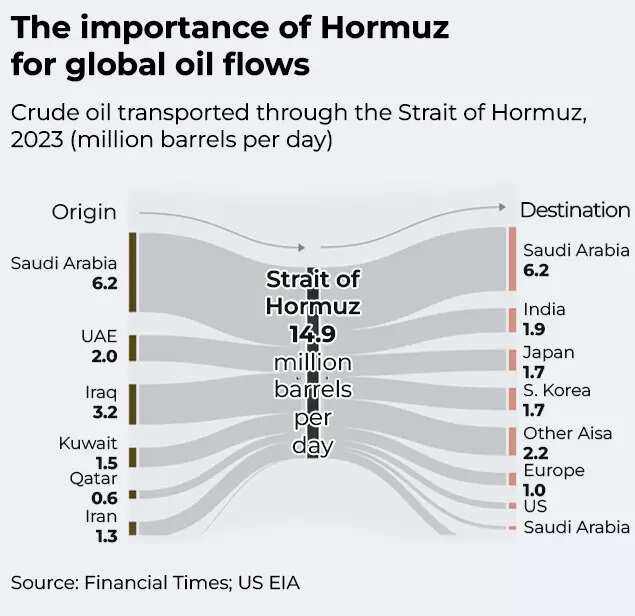
Even is the oil facilities are not directly damaged, a shutdown of the shipping route could expose a significant portion of global supply. The report estimates that in an event of full closure, about 16 million barrels per day of oil flows could be affected, despite the availability of some pipeline routes designed to bypass the strait.And the risks are not limited to crude oil shipments with almost 80 million tonnes of LNG exports annually, much of it from Qatar, moving through the passage. Any prolonged disruption could tighten gas supply globally and potentially drive European benchmark gas prices back to levels seen during the 2022 energy crisis.
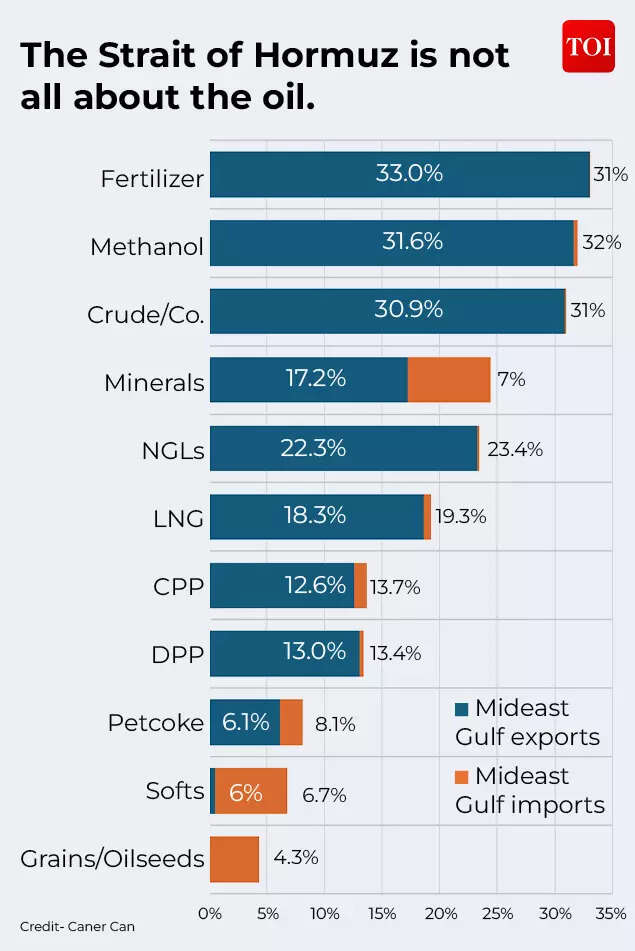
Asian economies stand among the most exposed to such disruptions. Major importers such as China, India, Japan and South Korea depend heavily on oil and LNG shipments that transit through the strategic corridor.While global oil inventories and spare production capacity could help cushion short-term shocks, the report warned that sustained disruption to Gulf shipping routes could trigger sharp volatility in global energy markets and push prices higher across oil, gas and refined fuel products.Market participants and governments are closely watching tanker traffic in the Strait of Hormuz, along with diplomatic and military developments involving the United States, Iran and Gulf nations, to assess whether the current disruptions remain temporary or escalate into a broader energy supply shock.

Aviva flags potential for Iran conflict to send claims costs rising

Queen Letizia shows presence and support during difficult day

Need One Pair for Hiking, Traveling, and Working Out? Try Gravel Running Shoes

What are Iran’s ballistic missile capabilities?

India Us Trade Deal: Fresh look at India-US trade deal? May be ‘rebalanced’ if circumstances change, says Piyush Goyal – The Times of India

Attock Cement’s acquisition approved | The Express Tribune

-
 Politics1 week ago
What are Iran’s ballistic missile capabilities?
-
Business6 days ago
India Us Trade Deal: Fresh look at India-US trade deal? May be ‘rebalanced’ if circumstances change, says Piyush Goyal – The Times of India
-
Business7 days ago
Attock Cement’s acquisition approved | The Express Tribune
-

 Politics1 week ago
US arrests ex-Air Force pilot for ‘training’ Chinese military
-
 Business1 week ago
Households set for lower energy bills amid price cap shake-up
-

 Fashion7 days ago
Policy easing drives Argentina’s garment import surge in 2025
-

 Sports6 days ago
LPGA legend shares her feelings about US women’s Olympic wins: ‘Gets me really emotional’
-

 Fashion6 days ago
Texwin Spinning showcasing premium cotton yarn range at VIATT 2026