

Sports
Brewers or Dodgers? Blue Jays or Mariners? What MLB’s final four must do to reach World Series

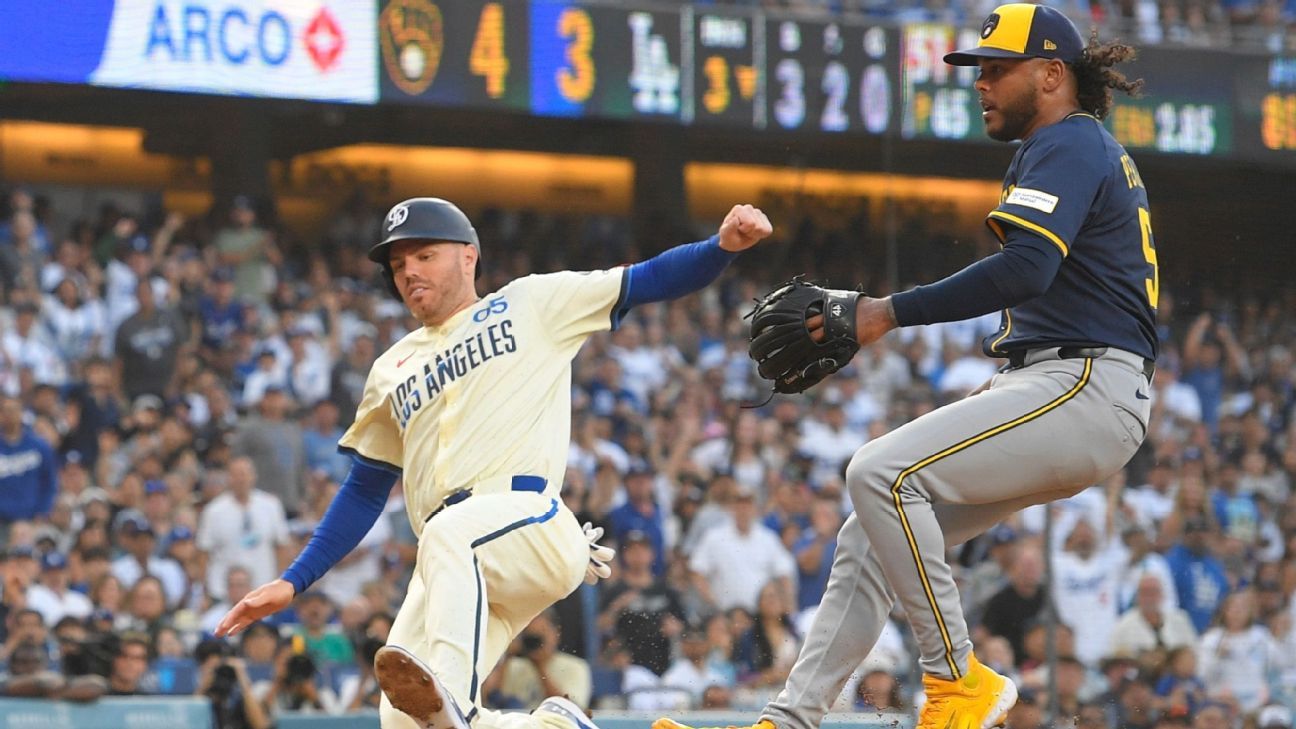
The 2025 League Championship Series matchups are set!
Starting Sunday in Toronto, the No. 2 seed Seattle Mariners and No. 1 seed Toronto Blue Jays will clash with a trip to the World Series on the line. The next day, the defending champion Los Angeles Dodgers and top-seeded Milwaukee Brewers will begin their series on the National League side of the bracket.
Seattle outlasted the Detroit Tigers in a thrilling ALDS Game 5 on Friday night, two days after Toronto dispatched the AL East rival New York Yankees to get to the ALCS. Meanwhile, in the NL, Los Angeles rolled past the Philadelphia Phillies and Milwaukee edged the division rival Chicago Cubs for the final NLCS spot.
What has stood out about all four remaining teams so far? What does each need to do to punch a ticket to the Fall Classic? And who are the X factors on each roster? Our ESPN MLB experts break it all down.
Note: Matchup odds come from Doolittle’s formula using power ratings as the basis for 10,000 simulations to determine the most likely outcomes. Team temperatures are based on Bill James’ formula for determining how “hot” or “cold” a team is at any given point; average is 72°.
Jump to:
Dodgers-Brewers | Mariners-Blue Jays
Los Angeles Dodgers vs. Milwaukee Brewers
This is the Brewers’ second showdown with the Dodgers in the NLCS, the first a seven-game loss to L.A. in 2018. Since Milwaukee started its run of contending seasons in 2017, only the Dodgers have won more regular-season games in the National League. The Brewers haven’t been able to translate that tap-tap-tapping at the championship door into a World Series crown, and twice their season has been ended by the Dodgers behemoth. L.A. entered the season with all the hype, but the Brewers exited it with a No. 1 seed. Seems easy to say now that it has come to pass, but wasn’t this always going to be how the Brewers got back to the World Series? — Bradford Doolittle
No. 1 seed Brewers’ concern level: None. Why should the Brewers be worried? Forget the seeds, the records, the run differentials — Milwaukee will enter this series perceived as a decided underdog. That’s not based just on what we’ve thought the Dodgers would be since last winter, but because of how L.A. has rolled through the beginning of its latest postseason run. But you know who else is rolling? The Brewers. And they are too young, too athletic and having too much fun to be intimidated by the Dodgers’ hype aura. Of more immediate concern, from a baseball perspective, is the fact that L.A. is awfully good. — Doolittle

Los Angeles Dodgers
Odds of advancing: 48.2%
Team temperature: 110°
What stood out most as the Dodgers rolled past the Phillies in the NLDS?
Jeff Passan: The team that the Dodgers were supposed to be has shown up in October. It’s not just the talent, which itself can be overwhelming. It’s that they are particularly comfortable in the sorts of games that would have others panicking through an expanded zone at the plate or too-fine nibbling on the mound.
Philadelphia’s starting pitching was excellent, and that still wasn’t enough to stop the Dodgers. And considering L.A. has done it without significant contributions from Ohtani or Betts over the first two games**, and with a bullpen that beyond Roki Sasaki and Alex Vesia remains in flux, the prospect of the Dodgers getting better is very real — and very scary.
David Schoenfield: Their ability to eventually get to the starting pitcher. In Game 1, Cristopher Sanchez was cruising through 5⅔ innings, having allowed just four hits. Then with two outs in the sixth, Freddie Freeman worked a walk, Tommy Edman singled and Enrique Hernandez drove both in with a double. The Dodgers then later added three runs against the bullpen.
Jesus Luzardo had been even more dominant in Game 2 with one hit allowed and 17 consecutive batters retired entering the seventh, when Teoscar Hernandez singled and Freeman doubled to chase Luzardo from the game. The bullpen entered and the Dodgers eventually scored four runs in the inning. Going back to last year’s postseason, Freeman seems to be involved in so many of these rallies while both Hernandezes become tougher outs in the postseason.
Why will (or won’t) it work against the Brewers in the NLCS?
Passan: The Brewers have a more balanced offense and a far better bullpen than the Phillies, and each is the sort of thing that could trip up Los Angeles. Now, admittedly, Milwaukee hasn’t faced the caliber of pitching the Dodgers present, so their NL-best strikeout rate this postseason will climb. And the Dodgers hit high velocity about as well as any team in MLB, so the advantage there for the Brewers — who are averaging more than 97 mph on their fastballs this postseason — isn’t quite as acute. The brand of baseball the Brewers play can work against Los Angeles. The execution simply needs to be immaculate.
Schoenfield: There are two factors in play here. The Brewers’ starting pitching isn’t as good, so manager Pat Murphy will be much quicker to his bullpen even if the starter is pitching well. The Brewers’ bullpen is much better and less likely to hemorrhage runs late like the Phillies did. So the “score late” philosophy is probably less likely of an outcome. Which puts pressure on the Dodgers’ offense to put runs on the scoreboard early in the game.
Which one player is the X factor who can make (or break) L.A.’s World Series hopes?
Passan: If Ohtani continues to disappear — he is in line to make two starts in the series and will continue to bat leadoff — the Dodgers have enough talent to overcome it, but their margin of error shrinks significantly.
He is the one player in baseball capable of single-handedly winning a series, and with his fastball sitting at career-best velocities even after his second reconstructive elbow surgery and his off-speed stuff still elite, he can control multiple games with his arm in addition to his power serving as an ever-present threat.
Poor pitching performances, on the other hand, can lose games, and lack of getting on base by a leadoff hitter hampers the ability of Mookie Betts, Teoscar Hernández and Freddie Freeman to do damage. The difference between good Ohtani and bad Ohtani is profound enough to dictate the result of the series.
Schoenfield: Emmet Sheehan. Dave Roberts has found a closer in Roki Sasaki, and Alex Vesia is the one lefty he seems to trust, but it seems unlikely the Dodgers can win a World Series with just two relief pitchers.
Tanner Scott, the closer for most of the season, has been buried on the depth chart. Roberts went to Blake Treinen in Game 2, and he nearly blew the game.
Sheehan now looks like the top right-handed setup guy. He’s going to pitch some important innings. The regular-season numbers, mostly as a starter, say he can do the job: a .185 batting average allowed and 89 strikeouts in 73⅓ innings.

Milwaukee Brewers
Odds of advancing: 51.8%
Team temperature: 74°
What stood out most as the Brewers beat the Cubs in the NLDS?
Jesse Rogers: The Brewers came out with their hair on fire in the division series, not letting getting down early in Games 1 and 2 — after a week layoff — didn’t faze them. Most interesting was their power surge in the series. Solo shots and three run homers were all the rage for the Brew Crew. Add the fact that Milwaukee deployed one arm after another throwing around 100 mph — starting with righty Jacob Misiorowski — and the Chicago Cubs were overwhelmed in the strike zone, both at the plate and on the mound.
Schoenfield: Scoring nine runs in the first game without hitting a home run and then scoring seven runs in Game 2 all via the home run was impressive, but no doubt it’s those power arms in the bullpen that offered a huge exclamation point. Misiorowski threw an incredible 31 pitches over 100 mph in his three-inning stint in Game 2, including two at 104.3 and 104.2 mph. Trevor Megill is back after missing more than a month and hit 98. Jared Koenig hit 99.8. Abner Uribe throws a 99-mph sinker with a wipeout slider. Good luck.
Why will (or won’t) it work against the Dodgers in the NLCS?
Rogers: Umm, hitting home runs and throwing 100 mph? That works against anyone. Of course, there’s a good chance the Brewers won’t hit as many long balls but that’s when they’ll rely on the other parts of their game: contact, speed and defense. And if confidence matters at all, Milwaukee swept the season series against L.A, providing further hope in the NLCS. If somehow they can continue to go deep, watch out, an upset might be, ahem, Brewing.
Schoenfield: Bullpens can get hot in the playoffs, and it looks like the Milwaukee bullpen is hot. It’s worth noting that the Dodgers had the third-highest OPS in the majors during the regular season against pitches of 97-plus mph, hitting .255/.330/.429. So the Dodgers can do some damage against premium velocity. Of course, 104 is a different beast. Still, it feels like the Dodgers will have to score some runs early in the game to win this series.
Which one player is the X factor who can make (or break) Milwaukee’s World Series hopes?
Rogers: Jacob Misiorowski. It’s clear he’s going to have an important role no matter how the Brewers elect to use him. If he can control his emotions, as well as his stuff, Misiorowski could be the bridge to the late innings in several potential Brewers wins. Or perhaps they let him start a game. Dodgers hitters are 4-for-17 with eight strikeouts this season against the rookie. More of that — along with fastballs at 103 mph or more — could help Milwaukee through a tough L.A. lineup.
Schoenfield: Jackson Chourio. There was a scare in Game 1 when Chourio left the game after tweaking his hamstring (after going 3-for-3) but he returned in Game 2 and had two more hits, including a big three-run home run in the fourth inning.
Still just 21, Chourio is already showing a propensity to shine in the October spotlight. In his first five career playoff games, he had multiple hits in four of them (including a two-homer game last year against the Mets). We’ll see if the Dodgers can exploit his tendency to chase out of the zone but if he keeps producing, the Brewers will score some runs.

At last! Super-fans of 1977 expansion have been waiting for this LCS matchup since the early days of the Carter administration. The Blue Jays and Mariners came into existence at the same time, but they have never met with stakes like these in play. The M’s beat the Jays in a wild-card round matchup in 2022, but this is different.
The two strongest division champs in the AL are vying to end long World Series droughts. Toronto hasn’t won the title in 31 years, and Seattle has never won it.
The great Willie Horton was among the first players to play for both franchises. Even though he’s best remembered as a Tiger and has a statue outside of Comerica Park, they should still let him throw out the first pitch in Seattle and Toronto. — Doolittle
No. 1 seed Blue Jays’ concern level: Appropriately alert. Toronto has the better seed and home-field edge, but Seattle has been playing slightly better in the latter stages of the season, and the run differentials are virtually the same.
What’s really exciting is the star power on both teams and that the standouts have been shining in October. Julio Rodriguez, Cal Raleigh and the scorching Vladimir Guerrero Jr. have played huge roles in the teams getting this far.
Both teams have leaned on the long ball for scoring, getting more than half their runs on homers. It’s a really close matchup that could be decided by Andres Munoz, Seattle’s edge at the back of the bullpen. — Doolittle

Toronto Blue Jays
Odds of advancing: 55.1%
Team temperature: 96°
What stood out most as the Blue Jays rolled past the Yankees in the ALDS?
Jorge Castillo: The relentlessness of their lineup. Vladimir Guerrero Jr. starred from start to finish, but Toronto received contributions from seemingly everyone manager John Schneider put in there. Four players not named Guerrero recorded two hits in Game 1. Daulton Varsho had four extra-base hits, and Ernie Clement went 3-for-4 in Game 2. Clement added another four hits in Game 3.
The Blue Jays were the toughest team to strike out during the regular season, and they registered more home runs than strikeouts in the first two games at Rogers Centre, where they’ve thrived all season. It helped that Playoff Vladdy Jr. surfaced, going 9-for-17 with three home runs, including a monumental grand slam in Game 2.
Schoenfield: Have to go with Trey Yesavage‘s absolutely dominant performance in Game 2, when he made his fourth career start and held the Yankees hitless for 5⅓ innings while striking out 11. The Yankees had no chance against him. Other than the length of the start — the Blue Jays pulled him with a big lead — it was as dominant a postseason outing as we’ve seen in a long time.
His over-the-top delivery creates an unusual look for batters, and he’s throwing 95-96 mph with a slider and wipeout splitter. Hard to believe there were 19 players selected ahead of him in the draft in 2024.
Why will (or won’t) it work against the Mariners in the ALCS?
Castillo: It’ll work at Rogers Centre because it has always worked at Rogers Centre this season. The Blue Jays scored 431 runs at home during the regular season, the third most in the majors. In the ALDS, they scored 23 in two games in Toronto. The Blue Jays dominate pitchers north of the border. The question is whether it’ll work in Seattle. T-Mobile Park is a difficult place to hit. Mariners pitchers posted a 3.28 ERA at home this season. But the Blue Jays scored 21 runs in a three-game sweep of the Mariners in May. Maybe their offense will travel.
Schoenfield: It will … if he throws strikes. He did against the Yankees, walking just one batter in his start, but in the minors, he walked 41 batters in 98 innings. The Mariners have a mix of patient hitters (Cal Raleigh, Randy Arozarena) and hitters who chase (Julio Rodriguez, Eugenio Suarez), but like the Yankees, the Mariners also whiff a lot.
Which one player is the X factor who can make (or break) Toronto’s World Series hopes?
Castillo: Trey Yesavage. Asking a rookie with four major league starts to continue dominating deep into October is a lot, but the Blue Jays lack that clear premier ace. Yesavage has the potential to supply it. Not only is his stuff good enough, he’s different enough to flummox even the most experienced hitters. His release point and arm angle are among the highest in baseball, making his fastball-splitter combination especially difficult to solve. Then, there’s his slider, which often runs arm side instead of the usual glove side. Toronto has been careful with the 22-year-old right-hander. He hasn’t thrown more than 94 pitches in a game this season, which started for him in Low-A. Now, he’s on the sport’s grandest stage and could be the difference in October.
Schoenfield: Shane Bieber. Kevin Gausman and Yesavage looked great, but given a 6-1 lead in Game 3, Bieber got knocked out in the third inning. Given how poorly Toronto’s bullpen pitched after that, maybe it was a bit of a quick hook, but it’s clear the Blue Jays will need all three of these starters to pitch well, given the bullpen didn’t post a bunch of zeroes against the Yankees. The Blue Jays’ ability to put the ball in play — they had the lowest strikeout rate in the majors — means they should continue to score some runs, so the question is whether they can keep enough runs off the scoreboard.

Seattle Mariners
Odds of advancing: 44.9%
Team temperature: 89°
What stood out most as the Mariners beat the Tigers in the ALDS?
Alden Gonzalez: The effectiveness of the starting rotation, which should come as no surprise. George Kirby, Luis Castillo, Logan Gilbert and Bryce Miller — before the fifth inning, at least — all pitched well in the ALDS. The hope is that Bryan Woo, the Mariners’ best starter this season, will return from a pectoral injury for the ALCS, taking this rotation to yet another level.
The Mariners feel really good about their back-end relievers and believe this is the deepest lineup they’ve fielded in this era. But this team still revolves around its starting pitching — a unit that dominated throughout 2024 and finally started to round into form again in the stretch run of this season. The starters need to consistently provide six and seven innings so that manager Dan Wilson doesn’t have to venture outside of Gabe Speier, Matt Brash and Andres Munoz late in games. That’s the formula.
Doolittle: Seattle’s lineup depth is really impressive, even without a standout designated hitter. It’s eye-popping to see Eugenio Suarez hitting in the six-hole and J.P. Crawford at No. 9. It’s a group that hits for power, steals bases and strikes out at a much less problematic rate than the Mariners lineups we’re used to. Raleigh and Rodriguez make for such a dynamic one-two stack in the batting order. The R&R Boys.
Why will (or won’t) it work against the Blue Jays in the ALCS?
Gonzalez: No team struck out less often than the Blue Jays this season. Only the Yankees and Dodgers finished with a higher OPS. And when the playoffs arrived, Vladimir Guerrero Jr., Ernie Clement and Daulton Varsho slugged a combined 1.000 in four ALDS games. This offense operates at a different level than the Tigers’ — and could have Bo Bichette back for this next round.
Gilbert and Woo pitched pretty well against the Blue Jays this season (five earned runs in 11 2/3 innings). Castillo and Miller (15 earned runs in 15 innings) did not. But these two teams have not seen each other since May. The Mariners’ rotation is not the same as it was then.
Doolittle: A deep lineup plays against anybody, but there’s one factor that works in Seattle’s favor. With Trey Yesavage emerging for Toronto, the Blue Jays have four key hurlers who can dominate with splitters, the breakout pitch of the 2025 postseason. (Yesavage, Kevin Gausman, Seranthony Dominguez and Jeff Hoffman are the four.)
The Mariners were in the middle of the pack in hitting splitters during the season, but they had two hitters who crushed them. And it’s the R&R Boys — Raleigh had 1.159 OPS against splitters and Rodriguez 1.091.
Which one player is the X factor who can make (or break) Seattle’s World Series hopes?
Gonzalez: Randy Arozarena. The Mariners inserted Arozarena at the top of the lineup after they acquired Eugenio Suarez and Josh Naylor at the trade deadline, and Arozarena has struggled mightily ever since. He showed some flashes in the ALDS, but the Mariners need “Playoff Randy” — the one who took over during the 2020 postseason and became a sensation while playing for Team Mexico in the 2023 World Baseball Classic. If he gets going ahead of Cal Raleigh and Julio Rodriguez, the Mariners’ offense will be scary.
Doolittle: Matt Brash. Well, that’s not fair, as Brash is good, and I picked his name as an avatar for Seattle’s middle relief crew. If the Mariners’ roster has a soft underbelly, it’s the non-closing part of the bullpen. It’s not a bad group, but with a deep, productive lineup and a star closer in Munoz, plus excellent starting pitching, it might well be Brash, Eduard Bazardo, Gabe Speier and Carlos Vargas who determine if the Mariners can finally play in a World Series.
NEWYou can now listen to Fox News articles!
Fernando Mendoza is the biggest name, but not the only big name in the 2026 NFL Draft.
Let’s check out the Over/Under odds (at DraftKings Sportsbook as of April 22) for where some of the biggest names in this year’s draft might land.
This page may contain affiliate links to legal sports betting partners. If you sign up or place a wager, FOX Sports may be compensated. Read more about Sports Betting on FOX Sports.
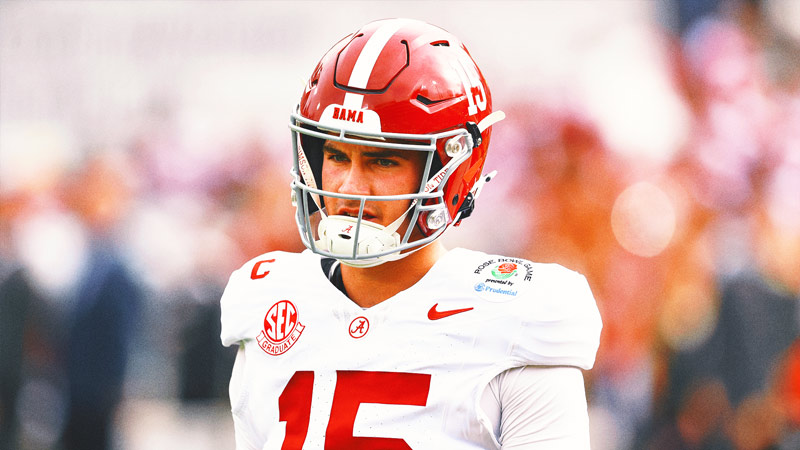
Ty Simpson
Alabama — QB
Over 24.5: -270 (bet $10 to win $13.70 total)
Under 24.5: +195 (bet $10 to win $29.50 total)
What to know: Only two quarterbacks went in the first round last season, after the first three picks of the 2024 NFL Draft were QBs. The last Alabama QB to go in the first round was Bryce Young back in 2023, when he was selected No. 1 by the Panthers. Simpson is heavily favored (-2500) to be the second quarterback off the board in 2026.
Jeremiyah Love
Notre Dame — RB
Over 5.5: +275 (bet $10 to win $37.50 total)
Under 5.5: -400 (bet $10 to win $12.50 total)
What to know: The last time a running back went in the top five was back in 2018, when the Giants selected Saquon Barkley with the second overall pick. Ashton Jeanty went sixth to the Raiders last season.
Sonny Styles
Ohio State — LB
Over 5.5: -150 (bet $10 to win $16.67 total)
Under 5.5: +115 (bet $10 to win $21.50 total)
What to know: The last linebacker to go in the top five just so happens to be the highest-paid non-quarterback in NFL history, Will Anderson Jr. He went to the Texans with the third pick in 2023. Now, Anderson mostly plays edge rusher for Houston.
Sonny Styles of Ohio State (Photo by James Black/Icon Sportswire via Getty Images)
Carnell Tate
Ohio State — WR
Over 7.5: -135 (bet $10 to win $17.41 total)
Under 7.5: +105 (bet $10 to win $20.50 total)
What to know: If you count Travis Hunter as a wide receiver, then two wide receivers went in the top 10 in 2025: Hunter to Jacksonville at No. 2, and Tetairoa McMillan to Carolina at No. 8. Three wideouts went in the top 10 in 2024: Marvin Harrison Jr. to Arizona at No. 4, Malik Nabers to the Giants at No. 6 and Rome Odunze to Chicago at No. 9. Tate is favored (-175) to be the first wide receiver to come off the board in 2026.
Jordyn Tyson
Arizona State — WR
Over 8.5: +140 (bet $10 to win $24.00 total)
Under 8.5: -185 (bet $10 to win $15.41 total)
What to know: Jordyn Tyson’s odds to be a top-10 pick in the NFL Draft opened at +400 in March. They have since surged to -500 for him to go inside the top 10.
Caleb Downs
Ohio State — S
Over 9.5: -115 (bet $10 to win $18.70 total)
Under 9.5: -115 (bet $10 to win $18.70 total)
What to know: No safety has gone top-10 in the NFL Draft since Jamal Adams went sixth to the Jets back in 2017. Minkah Fitzpatrick went 11th to the Dolphins in 2018. Malaki Starks was the first safety selected last season, going 27th to Baltimore.
Rueben Bain Jr.
Miami FL — DL
Over 8.5: -400 (bet $10 to win $12.50 total)
Under 8.5: +270 (bet $10 to win $37 total)
What to know: Defensive linemen always go in the top 10. Since 2013, only twice has the top 10 not featured a defensive lineman — back in 2021 and then again in 2024.
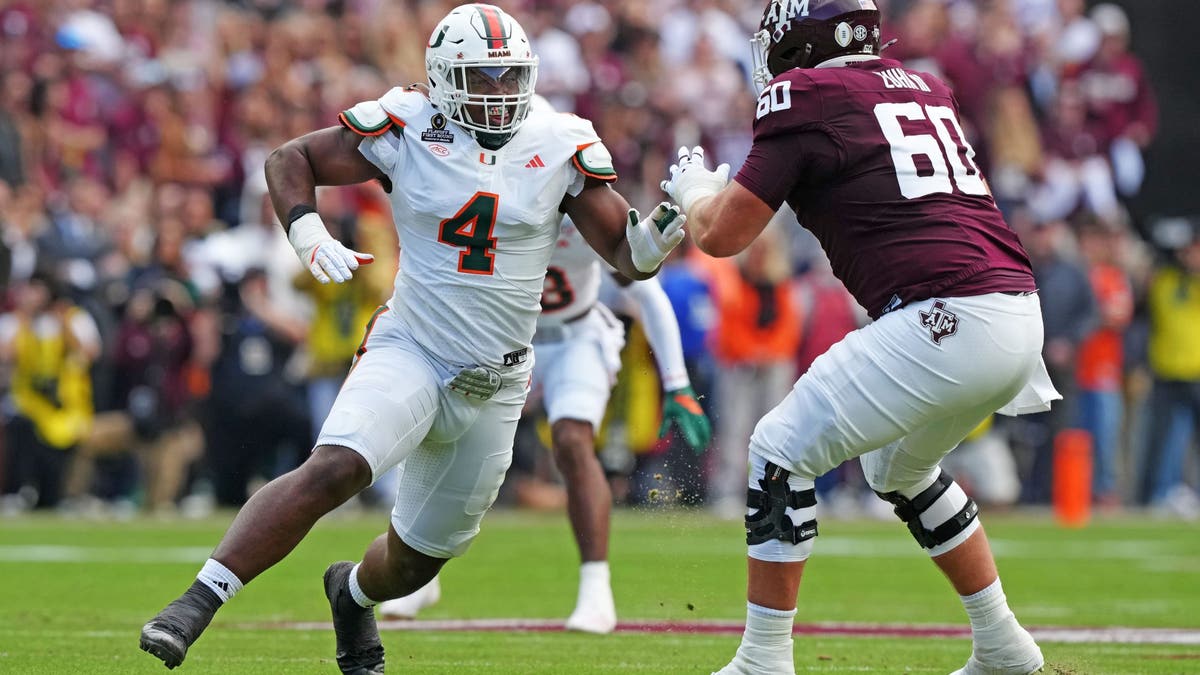
Rueben Bain Jr. of Miami (Photo by CFP/Getty Images)
Spencer Fano
Utah — OL
Over 10.5: +100 (bet $10 to win $20.00 total)
Under 10.5: -130 (bet $10 to win $17.69 total)
What to know: Fano is a close second choice to be the first offensive lineman drafted on Thursday at +110, just behind Francis Mauigoa, who leads the market at -125.
Makai Lemon
USC — WR
Over 14.5: -130 (bet $10 to win $17.69 total)
Under 14.5: +100 (bet $10 to win $20.00 total)
What to know: Lemon is expected to be the third wide receiver off the board, behind Tate and Tyson. He’ll look to follow in the footsteps of recent USC wide receivers Jordan Addison (2023) and Drake London (2022), who were both selected in the first round.
Olaivavega Ioane
Penn State — OL
Over 14.5: +225 (bet $10 to win $32.50 total)
Under 14.5: -310 (bet $10 to win $13.23 total)
What to know: Ioane has the fifth-best odds (+1800) to be the first offensive lineman selected. That said, he is still firmly expected to be a first-round pick.
Kenyon Sadiq
Oregon — TE
Over 15.5: -115 (bet $10 to win $18.70 total)
Under 15.5: -120 (bet $10 to win $18.33 total)
What to know: Colston Loveland (No. 10 to Chicago) and Tyler Warren (No. 14 to Indianapolis) both went in the top 15 last season. Brock Bowers went 13th to Las Vegas in 2024, and Kyle Pitts went fourth to Atlanta in 2021. In other words, the tight end position is on the rise when it comes to the first half of the first round. Sadiq is expected to be the first tight end off the board in 2026.
Kadyn Proctor
Alabama — OL
Over 16.5: +145 (bet $10 to win $24.50 total)
Under 16.5: -195 (bet $10 to win $15.13 total)
What to know: Proctor is the third choice (+950) to be the first offensive lineman drafted, behind Mauigoa (-125) and Fano (+110).
Dillon Thieneman
Oregon — S
Over 17.5: -215 (bet $10 to win $14.65 total)
Under 17.5: +155 (bet $10 to win $25.50 total)
What to know: Thieneman is heavily favored (-400) to be the second safety off the board, behind Downs. In 2025, only one safety was selected in the first round. That likely won’t be the case this year, with Thieneman expected to be selected in the middle of the first round.
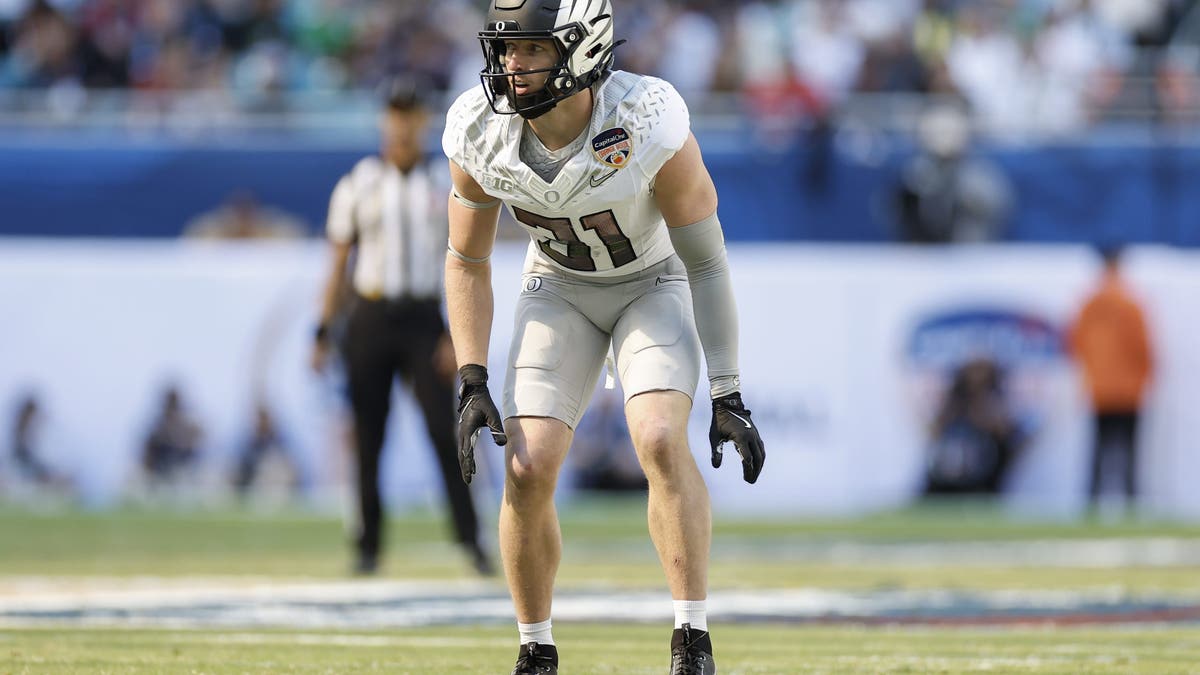
Dillon Thieneman of Oregon (Photo by David Rosenblum/Icon Sportswire via Getty Images)
Monroe Freeling
Georgia — OL
Over 19.5: +185 (bet $10 to win $28.50 total)
Under 19.5: -250 (bet $10 to win $14.00 total)
What to know: In 2025, eight offensive linemen were selected in the first round, and a similar number is expected in 2026, with Freeling projected to be among them.
Omar Cooper Jr.
Indiana — WR
Over 23.5: +120 (bet $10 to win $22.00 total)
Under: 23.5: -160 (bet to win $16.25 total)
What to know: Cooper is projected to be the fourth or fifth wide receiver selected. If he goes in the first round, he would become the first Indiana receiver drafted in the opening round since Thomas Lewis in 1994.
KC Concepcion
Texas A&M — WR
Over 24.5: +100 (bet $10 to win $20 total)
Under: 24.5: -130 (bet to win $17.69 total)
What to know: Counting Travis Hunter as a wide receiver, four total wide receivers were selected in the first round of the 2025 NFL Draft. In 2024, seven wide receivers went in the first round. This year, the line is set at 5.5 wide receivers selected in Round 1, with the over juiced to -165.
Akheem Mesidor
Miami FL — EDGE
Over 25.5: -105 (bet $10 to win $19.52 total)
Under 25.5: -125 (bet $10 to win $18.00 total)
What to know: Mesidor is expected to be the fourth or fifth edge rusher selected, behind Arvell Reese, David Bailey, and his college teammate Rueben Bain Jr. He and Auburn’s Keldric Faulk are likely next in line.
Denzel Boston
Washington — WR
Over 26.5: -125 (bet $10 to win $18.00 total)
Under 26.5: -105 (bet $10 to win $19.52 total)
What to know: Boston will look to follow in the footsteps of former Washington Huskies wide receivers Rome Odunze and John Ross, who were both selected in the first round. He is expected to be among the five or six wide receivers selected in this year’s first round.
Jermod McCoy
Tennessee — CB
Over 28.5: -150 (bet $10 to win $16.67 total)
Under: 28.5: +115 (bet to win $21.50 total)
What to know: After Mansoor Delane (-5000 to be the first cornerback selected), McCoy is tied with Colton Hood and Chris Johnson at +175 to be the second cornerback drafted. In 2025, three cornerbacks were selected in the first round.
Chris Johnson
San Diego State — CB
Over 32.5: +180 (bet $10 to win $28.00 total)
Under 32.5: -250 (bet $10 to win $14.00 total)
What to know: At the beginning of April, Chris Johnson’s odds to be selected in the first round of the NFL Draft opened at +550. He is one of the fastest rising prospects and is now -250 to go in the first.

Roster overhauls are not uncommon in today’s era of men’s college basketball.
This offseason is no different, with around a dozen power-conference schools returning zero or just one player from this past season. It has been a growing trend as the sport has become more reliant on the transfer portal, with salary caps dictating roster construction and teams adding seven to eight players in the spring becoming the new norm.
Last week, we looked at how the Final Four teams — and Duke — have been approaching the offseason. This week, we’re putting the same focus on the three winningest programs in college basketball history: Kansas, Kentucky and North Carolina. None made it out of the first weekend of the NCAA tournament, and each face massive rebuilds heading into next season.
All information as of 9 a.m. ET on April 20
Players leaving: Bill Self faces arguably the biggest rebuild of the three programs featured here.
Potential No. 1 pick Darryn Peterson was gone regardless, but All-Big 12 big man Flory Bidunga‘s decision to enter the portal and head to Louisville was a difficult loss. Starting wings Melvin Council Jr. and Tre White were seniors, and six more players joined Bidunga in the portal. The biggest loss among that group was Bryson Tiller, who started 31 games and looks poised for a breakout season in 2026-27. Making matters worse, Tiller committed to rival Missouri.
Players staying or incoming: The retention list is short. Kohl Rosario, who started the first six games of this past season before seeing his role diminish as the year progressed, is back and still has a high ceiling.
Self has the fifth-best class of incoming freshmen, led by five-star point guard Taylen Kinney. Two more SC Next 100 recruits, Davion Adkins and Trent Perry, and four-star guard Luke Barnett round out the group.
Kansas has also landed two players out of the portal thus far: Utah transfer Keanu Dawes and Toledo transfer Leroy Blyden Jr. Dawes was one of the Big 12’s best rebounders last season, ranking in the top 50 nationally at 8.8 per game. Blyden, a 6-foot-1 point guard, was the MAC Freshman of the Year.
Players in limbo: Freshman big man Paul Mbiya has been an interesting follow. He suddenly played a key role in the NCAA tournament, reports emerged that he planned to enter the portal … and yet, he’s still on the Jayhawks and hasn’t portaled yet.
Work to do: Kansas has a massive amount of work to build a roster that can compete next season. The Jayhawks’ top target is No. 1 recruit Tyran Stokes, who they appeared on track to land until a recent trip to Kentucky cast doubt on their status as the front-runners.
Kansas has hosted a long list of players from the portal, although Terrence Hill Jr. (Tennessee) and DeSean Goode (Miami) have committed elsewhere. Charlotte big man Anton Bonke was on campus last week, as was Utah transfer Terrence Brown, though UNC appears to be the favorite for Brown.
With Blyden committed, Self needs a scorer with size on the wing. Vyctorius Miller (Oklahoma State) is among the players on the Jayhawks’ list for that role. In the frontcourt, Cincinnati transfer Moustapha Thiam — one of the best bigs left in the portal — is among their targets, though he is visiting Michigan this week.
Players leaving: A roller-coaster season that started with the nation’s largest payroll and ended with a second-round loss to Iowa State in the NCAA tournament portended a roster overhaul.
The starting backcourt of Otega Oweh and Denzel Aberdeen is out of eligibility (although Florida is attempting to secure an extra year for Aberdeen), while Jayden Quaintance was expected to declare for the NBA draft. Six more players also entered the transfer portal, including starting guard Collin Chandler and frontcourt mainstays Andrija Jelavic, Mouhamed Dioubate and Brandon Garrison.
Players staying or incoming: Two key contributors are back from last season: starting center Malachi Moreno and rotation wing Kam Williams, who missed most of the second half of the campaign with a broken foot. Moreno has a chance to be one of the best centers in the country next season.
Role player Trent Noah and redshirts Braydon Hawthorne and Reece Potter are also back. And Kentucky’s lone high school commit is four-star guard Mason Williams, son of new assistant coach Mo Williams.
After missing on a few early portal targets such as BYU’s Robert Wright III and Georgia’s Jeremiah Wilkinson, Mark Pope finally landed his 2026-27 backcourt last week with Washington transfer Zoom Diallo and Furman transfer Alex Wilkins. Diallo averaged 15.7 points and 4.5 assists last season for the Huskies, while Wilkins was one of the most electric first-year point guards in the country and boosted his stock with 21 points against UConn in the NCAA tournament.
Players in limbo: Barring a surprise return from Quaintance, Pope isn’t waiting on any stay-or-go decisions.
Work to do: Kentucky still has plenty of targets left on the board, with overall No. 1 recruit Stokes at the top of the list.
Stokes is down to the Wildcats and Jayhawks, with a decision expected to come at any point. Pope could use a statement signing to help the overall vibe in Lexington, and they don’t get much bigger than Stokes. Kansas had the lead entering Stokes’ recent visit to Kentucky; did Pope flip momentum on the trip?
Kentucky needs shooting, and NC State transfer Paul McNeil Jr. is on the short list. Utah transfer Terrence Brown was also a target but visited North Carolina and Kansas and hasn’t rescheduled a visit to Kentucky. Up front, the Wildcats are prioritizing Syracuse transfer Donnie Freeman, one of the best players available. Former USC center Gabe Dynes is expected to visit this week; the 7-foot-5 Dynes would provide interior depth.

Players leaving: With Hubert Davis out and Michael Malone in, extensive roster turnover was inevitable.
Projected top-five pick Caleb Wilson was headed to the NBA regardless, while Seth Trimble is out of eligibility. Still, nine players entered the portal following the coaching change, with Derek Dixon and Luka Bogavac the most notable, although two have since opted to withdraw and return to Chapel Hill to play for Malone.
It’s also worth noting that Carolina had a commitment from top-10 incoming freshman Dylan Mingo until he reopened his recruitment last week.
Players staying or incoming: The lone starter guaranteed to return from last season is Jarin Stevenson, who helped fill Wilson’s shoes after his injury and played well, averaging 10.7 points and 6.4 rebounds over the Tar Heels’ final 10 games. Jaydon Young and Isaiah Denis are returning after initially exploring the portal. And while Mingo opted to decommit, top-25 recruit Maximo Adams kept his commitment to the Tar Heels after the coaching change.
Since the portal opened, Malone added Virginia Tech transfer Neoklis Avdalas. The 6-foot-9 guard was inconsistent for most of his freshman season but generated first-round NBA draft buzz early in the campaign and has an intriguing combination of size and playmaking ability.
Players in limbo: All-ACC big man Henri Veesaar has yet to announce his intentions.
The proven big man could return to Carolina, enter the NBA draft or head into the transfer portal. Veesaar is essentially the linchpin to Malone’s first season who would be in the preseason All-American conversation should he return to college after averaging 17.0 points and 8.7 rebounds last season.
Work to do: There are two priorities for Malone right now.
One, as we just mentioned, is keeping Veesaar. He provides an anchor on the interior and would give the new head coach a player to build around. But given the timing of Veesaar’s pending decision, the lack of legitimate replacements at his position is glaring.
The second focus is a couple of perimeter scorers and playmakers, and the Tar Heels have a few players on their shortlist. Utah transfer Terrence Brown is atop the board; he has visited UNC and Kansas. Wake Forest transfer Juke Harris met with the Carolina staff a couple weekends ago, although he’s also going through the NBA draft process. NC State’s Matt Able and Paul McNeil Jr. have also been linked to the Tar Heels.

Kentucky Gov. Andy Beshear has publicly questioned the decision-making at the University of Kentucky, including the seven-figure gig retiring athletic director Mitch Barnhart was recently given.
Beshear’s chastisement, rare for a sitting governor, comes at a turbulent juncture for Kentucky athletics, which is falling behind its peers on the gridiron and the hardwood.
Barnhart, who will step down on June 30, was recently named executive in residence for the UK Sport and Workforce Initiative by Kentucky president Eli Capilouto. The contract for the gig, which will pay Barnhart $1 million per year beginning July 1, does not provide a concrete job description. That has prompted prominent supporters to ask the school to reverse the offer.
“I am losing confidence and growing increasingly concerned with the management and decision-making at the University of Kentucky,” Beshear said in a statement Tuesday. “My concerns include the creation of a new $1 million job that has no defined duties and the announcement that the new dean of law was the only candidate not recommended by law school faculty.
“I’ve been told that despite previously saying the dean must be approved by UK’s Board of Trustees, the university has shifted and now states approval is not needed. I worry that these actions are related to certain donors pushing partisan and undue outside influence onto the university. I hope students, faculty, trustees and the community attend this week’s board meetings and ask the tough questions that should be answered.”
Beshear’s criticism also follows the recent firing of football coach Mark Stoops in December after four consecutive sub-.500 seasons. He was replaced by Will Stein, who was the offensive coordinator at Oregon.
It’s also a difficult time for Mark Pope and the men’s basketball program, which is the winningest Division I team in NCAA history but hasn’t reached the Final Four since 2015. Last year, Pope made a run to the Sweet 16 in his first season. But that success didn’t last as his second season was filled with injuries and inconsistent efforts, ending with a 19-point loss to Iowa State in the second round of the NCAA tournament in March — only 48 hours after the team needed Otega Oweh‘s half-court heave at the end of regulation to force overtime in a win over Santa Clara.
Pope will enter his third season under a powerful spotlight after missing on major targets in the portal, including BYU guard Robert Wright III and Syracuse transfer Donnie Freeman, who picked St. John’s and Rick Pitino, Pope’s mentor. While Tyran Stokes, the No. 1 recruit in the 2026 class, is still considering Kentucky, the Wildcats have not landed a top-100 prospect in the current recruiting class, according to ESPN.


‘RHOA’ alum and Kim Zolciak’s ex was 68

2026 NFL Draft Odds: Draft Positions for Ty Simpson, Jeremiyah Love, More
How a pivot to hair accessories led to business success

-

 Fashion7 days ago
France’s LVMH Q1 revenue falls 6%, shows resilience amid Iran war
-

 Entertainment1 week ago
Is Claude down? Here’s why users are seeing errors
-

 Tech1 week ago
The Deepfake Nudes Crisis in Schools Is Much Worse Than You Thought
-

 Sports1 week ago
PSL 11: Peshawar Zalmi win toss, opt to field first against Quetta Gladiators
-

 Tech1 week ago
Bremont Is Sending a Watch to the Moon’s Surface
-
 Tech1 week ago
Human-machine teaming dives underwater
-
 Business1 week ago
BP sees ‘exceptional’ oil trading result as Iran war sends crude costs soaring
-

 Fashion1 week ago
What no one is saying about the 2026 apparel slowdown