

Business
Vue cinema boss: I don’t see streaming as the competition


Will Bain,Business presenter and
Emer Moreau,Business reporter
The boss of one of the UK’s biggest cinema chains says he does not see streaming services and home entertainment as competition.
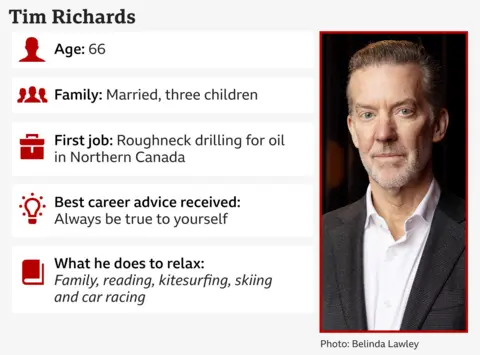
Tim Richards, the founder and chief executive of Vue International, says film studios tried to “circumvent” cinemas during the pandemic but lost “hundreds of millions of dollars” as a result.
“I think the studios certainly learned that we are in one small ecosystem, we all need each other,” he told the BBC’s Big Boss Interview podcast.
Rival cinema chains have a constructive relationship too, he says: “We are fairly open in terms of trading best practices. We want to have a message that cinemas are a great place to have a good time.”
Richards spoke of the turbulence of the last five years for the film industry.
Vue went from having its best year ever in 2019, to being “effectively closed for almost two years” during the Covid-19 pandemic, to grappling with actors’ and writers’ strikes which shut down production for nearly another year.
Vue made a pre-tax loss of £91.8m in the 12 months to 30 November 2024 compared with the year prior, and said that a decrease in revenue was “principally driven by lower admissions”.
Globally, the cinema industry has been seeing change, with big names such as Cineworld suffering. It filed for bankruptcy in the US in 2022, and in 2024, went in to administration in the UK. Since then, it has implemented restructuring of its debt, and closing some of its branches, to help it along.
While Richards was trying to figure out how to prevent Vue from going under, or from having to lay off any of its staff, streaming services like Netflix saw their subscriber numbers explode.
“I had a singular focus: save the company and save all of our 10,000 employees,” he says.
“When you have a mission like that, failure is not really an option, because the consequences are too high.”
Even as cinemas began to reopen, industry figures questioned whether the model of film release had changed for good. Films like Marvel’s Black Widow saw minimal theatrical runs as streaming platforms tried to push their original productions.
More recently, titles like K-Pop Demon Hunters and The Thursday Murder Club are playing for just a few weeks in cinemas, despite proving to be hugely popular.
But Richards is unfazed. Vue returned to pre-pandemic trading levels this year and is expecting next summer to be the company’s biggest ever.
He is emphatic that there will always be an appetite for the big screen: “During the pandemic, there was an increase with subscription services because people had no choice. But that has not continued.
“I have never looked at what happens in the home as being competition. Our biggest, most frequent customers are Netflix subscribers or Disney Plus subscribers. People who love movies love movies in all formats.”
The Hollywood strikes, too, he says, were a supply issue, not a demand one. “We’ve never had a demand issue.”
Richards clearly knows the ecosystem of films inside out. Before founding Vue (then Spean Bridge Cinemas) in 1999, he was a senior executive at Warner Brothers, operating the studio’s own cinema chain, Warner Village. Spean Bridge bought Warner Village’s 36 cinemas in 2003, and the Vue brand was born.
“The headline in the business section of the Times was: ‘Unknown Bit Player Buys Warner Brothers,'” he recalls with a laugh.
Entertainment industry squeezed
Due to cost-of-living pressures persisting, many parts of the entertainment industry are seeing revenue slow down as people cut back on discretionary spending.
Added to this are rising operational costs: an increase in the minimum wage and higher employer National Insurance contributions.
“We have done our very, very best to not pass on those costs to our customers,” Richards said. “And we haven’t. And we’ve taken a small hit as a consequence, but we’re hoping that the volume which we’ve seen as a consequence will follow it.”
Still, he says, the entertainment industry has been “squeezed… and kind of attacked in some instances”.
Government decisions have “hurt the people they’re trying to help”, in his view.
What’s the industry’s message ahead of the upcoming Budget? “Please don’t touch [us] again.”
And while Richards doesn’t believe that streamers are poaching his customers, he says he does worry about “somebody turning right and going to a theme park or a football game or something else”.
But it’s not a case of teenagers and young adults sitting at home instead of going out. “They’re a lot more social than previous generations, and that has shown in our attendance with a lot of our movies,” he says.
And what is his own favourite movie?
He responds diplomatically. “I see a lot – a lot – of movies every week.
“But I look at a movie like One Battle After Another. And when I see a movie like that, I have hope for the future because it’s such an incredible movie. Original IP, original story, incredibly well done.”
Co-op chair Debbie White said: “We thank Shirine for her leadership and for the significant contribution she has made to our Co-op, to our communities and to the co-operative movement during her tenure. The Board is grateful for her commitment and leadership, particularly during a challenging few years, and we wish her every success in the future.”

Air travel is all set to become highly expensive as the airlines are indicating at doubling the air ticket prices following a whopping increase in jet fuel rate.
The jet fuel price has rocketed to Rs417 from Rs388 per litre in Pakistan and the airlines have started to increase the airfares through enhancing fuel surcharge rates.
The airlines maintained the basic fare but added the fuel price surge into the fuel surcharge.
The one-way fare from Karachi to Islamabad and Lahore has shot up to Rs40,000 while air travel on chance seats for Islamabad and Lahore has soared by 150 percent.
Accordingly, the Pakistan International Airlines (PIA) has boosted the airfares by 10 to 100 dollars.
Domestic flights will now carry additional $10 fuel surcharge which on Canada routes extra $100 will be received as fuel charge.
Passengers on UK-bound flights to pay 75 dollars additional surcharge while 50 dollars will be received on Middle East routes.
Private airlines have gone a step ahead as they enforced charging additional 15 dollars to 150 dollars on different routes.
The airlines were under pressure after closure of many air routes with the airlines administrations are saying that extraordinary rise in airfares has become inevitable.
Earlier on Wednesday, Pakistan fuel NOTAM forced foreign airlines to tanker Jet A-1 fuel from abroad and limit uplift at Karachi and Lahore airports.
The Pakistan Airports Authority issued the order to protect local supplies amid supply disruptions.
Foreign carriers now arrive with enough fuel for their return flights while Pakistani airlines receive full requirements.
This change hit operations on March 25 when one Karachi-to-Doha flight diverted to Muscat.
The Pakistan fuel NOTAM A0147/26 took effect on March 13 and runs through March 31 2026. It targets Jinnah International Airport in Karachi and Allama Iqbal International Airport in Lahore.
Airlines follow the rule and carry maximum fuel on inbound legs. Officials confirm foreign airlines get only the minimum quantity inside Pakistan.
Pakistan fuel NOTAM creates immediate changes on the ground. Foreign airlines offload passenger baggage and cargo to stay within weight limits.
The extra fuel adds weight that reduces payload capacity on every affected flight.
According to a Notice to Airmen (NOTAM) issued by the PAA, the supply of aviation fuel at domestic airports has been significantly curtailed due to regional supply chain disruptions, advising international carriers to maximize their fuel “uplift” at foreign stations and minimize refuelling within Pakistan.
The directive has already begun to impact international flight schedules.

The government-backed bank has been accused of a series of errors, including not paying bereaved families money that was rightfully theirs.
Source link


2026 NFL draft team needs: Depth chart holes, prospect fits

China’s coal-to-chemicals: Winning the Iran war energy crisis

King Charles hopes for peace in new message as US tour hangs in balance

-

 Fashion1 week ago
Sales at US apparel, clothing accessories stores up 4% YoY in Jan 2026
-

 Tech1 week ago
Justice Department Says Anthropic Can’t Be Trusted With Warfighting Systems
-

 Entertainment1 week ago
Val Kilmer revived 1 year after death through AI
-

 Sports1 week ago
March Madness 2026 – How to watch in SA, start time, schedule, TV channel for NCAA championship basketball tournament
-
 Business1 week ago
Stocks and pound rise as US rate call approaches
-
 Business1 week ago
Brits cashing in jewellery as gold price hits record high
-

 Politics1 week ago
Iran strikes Tel Aviv with cluster-warhead missiles in retaliation of Larijani’s martyrdom
-

 Fashion5 days ago
China’s textile & apparel exports surge 17% to $50 bn in Jan-Feb 2026