

Business
Wylfa nuclear power plant plans go ahead, creating Anglesey jobs

Gareth Lewis,Wales political editor and
Steffan Messenger,Wales environment correspondent
 BBC
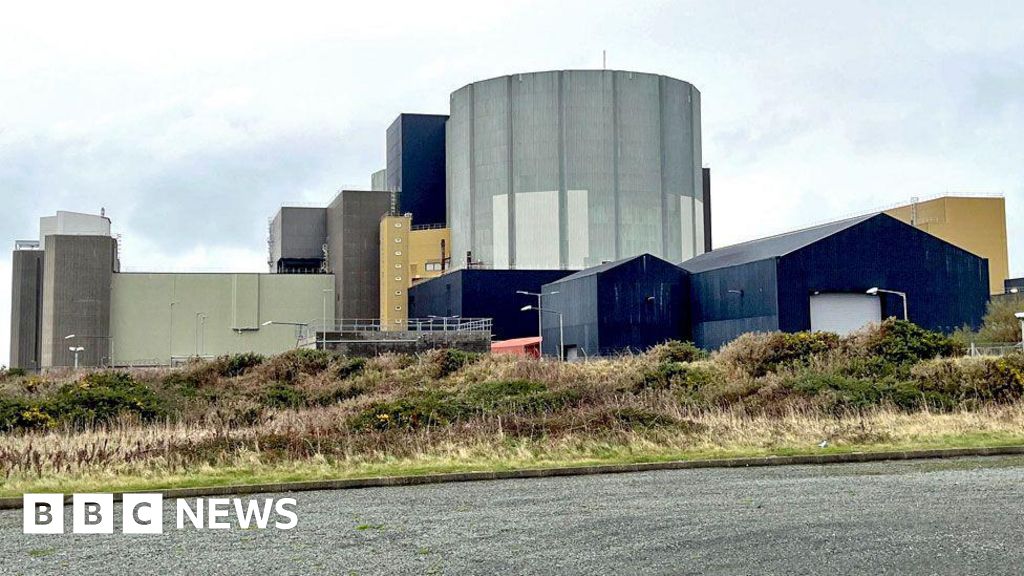
BBCA first-of-its-kind nuclear power station is to be built on Anglesey, bringing up to 3,000 jobs and billions of pounds of investment.
The plant at Wylfa will have the UK’s first three small modular reactors (SMR), although the site could potentially hold up to eight.
Work is due to start in 2026 with the aim of generating power by the mid 2030s.
Prime Minister Sir Keir Starmer said: “Britain was once a world leader in nuclear power, but years of neglect and inertia has meant places like Anglesey have been let down and left behind. Today, that changes.”
The news was also welcomed by First Minister Eluned Morgan, who said she had been “pressing the case at every opportunity for Wylfa’s incredible benefits”.
She described it as “the moment Ynys Môn and the whole of Wales has been waiting for”, using the Welsh name for Anglesey.
The project, which could power about three million homes, will be built by publicly owned Great British Energy-Nuclear and is backed by a £2.5bn investment from the UK government.
Simon Bowen, chair of Great British Energy-Nuclear, said: “This is a historic moment for the UK, and is another momentous step in realising Britain’s potential in leading the way on nuclear energy.
“These first SMRs at Wylfa will lay the groundwork for a fleet-based approach to nuclear development, strengthening the UK’s energy independence and bringing long-term investment to the local economy.”

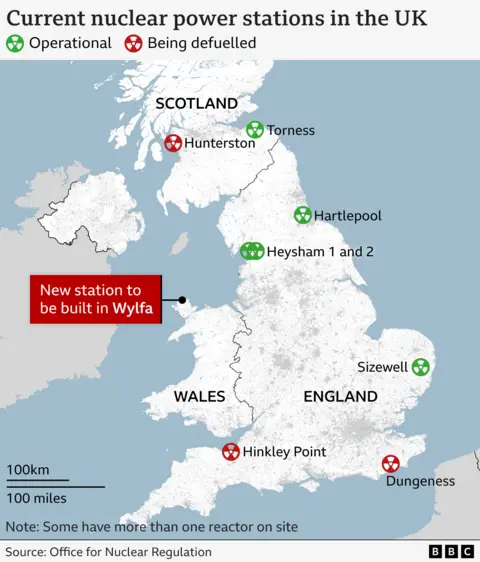
The company has also been tasked with identifying potential sites for another large-scale nuclear power plant, similar to those being built at Hinkley Point in Somerset and Sizewell in Suffolk, which have the potential to power the equivalent of six million homes.
It will report back by autumn 2026, and has been requested by Energy Secretary Ed Miliband to consider sites across the UK, including in Scotland, officials said.
It is not clear whether the SMR plans, which are smaller and more straightforward to build, rule Wylfa out from being considered after it was designated the preferred location in 2024 by the previous UK Conservative government.
The decision to opt for small modular reactors at Wylfa was criticised by the US Ambassador Warren Stephens, who said he was “extremely disappointed” by the decision.
He had been urging ministers to commit to a large-scale plant, with US firm Westinghouse having reportedly presented plans to build a new gigawatt station at the site.
“If you want to get shovels in the ground as soon as possible and take a big step in addressing energy prices and availability, there is a different path, and we look forward to decisions soon on large-scale nuclear projects,” Mr Stephens said.
‘Nuclear equivalent of an Ikea chair’
One industry expert described the announcement as “incredible”.
Prof Simon Middleburgh, director of the Nuclear Futures Institute at Bangor University, said: “They’re smaller than the average reactor, built in a modular manner in factories and shipped to the site to be put together a bit like an Ikea chair.”
The planned SMRs “fit nicely” with the existing grid capacity at the Wylfa site, offering a similar electricity output as the old power plant currently being decommissioned, he added.
There were “a few more hurdles to go through”, he cautioned – from securing regulatory approval, building the factories required to construct the SMRs and training the workforce that will run them.
Opponents of the project point to the fact that a long-term storage facility for the UK’s nuclear waste is yet to be agreed upon and say investment in renewable energy schemes – wind, wave and tidal – is what Anglesey needs.
Dylan Morgan of campaign group People Against Wylfa-B told BBC Wales the proposed SMRs were far from “small” and were in fact “an unnecessarily big development of an unproven technology”.
“Modular reactor technologies have been touted by many companies internationally but are still only plans on paper,” he said.
Wylfa beat off competition from another site at Oldbury in Gloucestershire, with the reactors designed by British engineering firm Rolls Royce, subject to final contracts, which are expected later this year.
The UK government said the plant would help provide energy independence.
The old nuclear power plant at Wylfa was switched off in 2015 and previous plans for a large-scale replacement fell through in 2021.
The company behind the scheme – the Japanese industrial giant Hitachi – cited spiralling costs and a failure to reach agreement with the UK government over funding.
Sasha Wynn Davies – now chair of the Wales Nuclear Forum – worked as a senior manager on those plans.
“I will never forget going to the secondary school in Amlwch and speaking to some of the young students and pupils there to unfortunately say that we were not progressing as a project,” she said.
“I will never forget their faces as they were so sad on behalf of their hopes for the future but also for their parents and what it meant for the area economically and socially.
“So now let’s hope our time has come again and there’s hope for our young people in particular.”
There is a huge political component to today’s announcement, with Labour at a UK level keen to show that it means business when it comes to big investment in infrastructure projects and Wylfa should demonstrate that.
In Wales, the first minister has been pushing hard for Wylfa – and the announcement comes just six months before the Senedd election.
Morgan has been trying to strike a balance: differentiating the Welsh party from UK Labour, but also pushing for extra funding, further devolution of powers and big investment announcements from her UK colleagues.
She has certainly got the latter, although plenty of other issues such as reform to the way Wales is funded and devolution of the Crown Estate – the body which owns much of the Welsh coastline and vital to future wind power – remain unresolved.

The Reserve Bank of India (RBI) on Monday decided against activating the countercyclical capital buffer (CCyB), indicating that current financial and credit conditions do not warrant an additional capital requirement for banks, PTI reported.The central bank said the decision followed a review and empirical assessment of indicators used under the CCyB framework.“Based on review and empirical analysis of CCyB indicators, it has been decided that it is not necessary to activate CCyB at this point in time,” RBI said in a statement.Under the RBI (Commercial Banks – Prudential Norms on Capital Adequacy) Directions, 2025, the CCyB framework is activated when financial conditions indicate rising systemic risks linked to excessive credit growth.The framework primarily relies on the credit-to-GDP gap as a key indicator, along with supplementary metrics.According to the RBI, the CCyB mechanism is intended to serve two broad objectives.Firstly, it requires a bank to build up a buffer of capital in good times, which may be used to maintain the flow of credit to the real sector in difficult times.Secondly, it achieves the broader macro-prudential goal of restricting the banking sector from indiscriminate lending in the periods of excess credit growth that have often been associated with the building up of system-wide risk.The framework was introduced globally after the 2008 financial crisis as part of measures proposed by the Group of Central Bank Governors and Heads of Supervision (GHOS) under the Basel framework to strengthen financial system resilience.
The company has announced plans to build seven new models in Europe including a small electric hatchback.
Source link

“Today’s policymaking is constrained by a more volatile external environment with more frequent and overlapping shocks, a rising public interest bill, in part reflecting market concerns with countries’ elevated debt, and the long-standing challenge of weak productivity growth,” he said.


Two Americans arrested at Japanese zoo

Turkiye’s current account deficit expected to widen in 2026: Minister

UK’s clothing imports fall 3% in Q1, sharply lower than Q4 2025

-

 Entertainment6 days ago
Conan O’Brien hat tricks as Oscar host
-

 Tech1 week ago
Could Contact-Tracing Apps Help With the Hantavirus? Not Really
-

 Fashion5 days ago
Italy’s Zegna Group’s Q1 growth boosted by strong organic performance
-

 Sports1 week ago
Bobby Cox, legendary Atlanta Braves manager who led 1995 World Series champions, dead at 84
-

 Entertainment1 week ago
Martin Short: Facing tragedy with joy
-

 Entertainment1 week ago
Tom Brady gets back at Kevin Hart during Netflix roast
-

 Sports1 week ago
Jacob Fatu unleashes vicious assault on Roman Reigns after World Heavyweight Championship loss at WWE Backlash
-

 Entertainment1 week ago
Martha Stewart: How to make an omelet