Connect with us

Business

37,000 crore erased in 6 days! IndiGo shares tanked over 16%; here’s what brokerages say – The Times of India


Published

on

37,000 crore erased in 6 days! IndiGo shares tanked over 16%; here’s what brokerages say – The Times of India


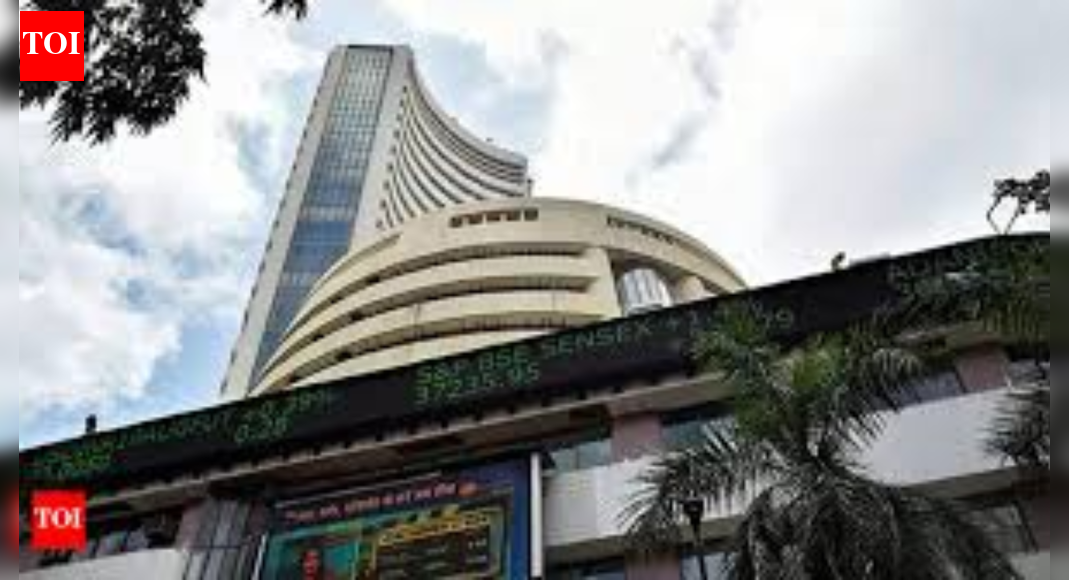
Shares of InterGlobe Aviation, the parent of IndiGo, remained under heavy pressure on Monday, extending a sharp sell-off that has wiped out more than Rs 37,000 crore in market value in less than a week, as operational turmoil rattled investor confidence.The stock slid as much as 10% to Rs 4,842 during intraday trade, marking its seventh consecutive session of losses. Over the past six trading days, InterGlobe shares have fallen 16.4%, reflecting growing concerns over the airline’s handling of revised Flight Duty Time Limitations (FDTL) and the cascading impact on costs and earnings, ET reported.The sell-off follows one of the most disruptive phases in Indian aviation, with IndiGo grappling to realign crew schedules under the new FDTL norms. A severe pilot shortage triggered widespread cancellations, culminating in more than 1,000 flights being scrapped on a single day—nearly half of the airline’s daily operations—leaving thousands of passengers stranded across major airports.IndiGo, which commands close to 66% of India’s domestic aviation market, has acknowledged planning gaps in adapting to the new regulations, which cap pilots’ night landings and mandate longer weekly rest periods.The turbulence has led brokerages to cut target prices. UBS maintained a Buy rating on InterGlobe Aviation but lowered its target to Rs 6,350, flagging insufficient preparedness for the FDTL rollout and upward revisions to cost estimates for FY26–FY28. The brokerage also factored in higher crew strength requirements and increased operating expenses due to the rupee’s depreciation.Despite near-term headwinds, UBS said the airline’s long-term growth outlook remains intact, supported by international expansion that offers margin stability and a natural hedge against currency pressures, according to ET.Investec retained its Sell rating with a target price of Rs 4,040, highlighting a sharp rise in costs. The brokerage pointed to aviation turbine fuel prices rising 6% quarter-on-quarter and the rupee weakening to 90 against the dollar. It warned that compliance with updated FDTL norms by February 10, 2026, could require around 20% more pilots per aircraft, potentially increasing costs by Rs 0.10 per ASK and cutting profit before tax by nearly 25% if fares are not raised.Jefferies, which continues to rate the stock Buy, cautioned that IndiGo’s cost curve is turning unfavourable as multiple pressures converge. It flagged higher non-fuel costs linked to operational disruptions, possible regulatory action, and rising dollar-denominated expenses such as fuel, leases and maintenance. Reduced pilot productivity under the new norms is also expected to lift employee costs.Regulatory scrutiny has intensified as well. The Directorate General of Civil Aviation has given IndiGo CEO Pieter Elbers an additional 24 hours to respond to a show-cause notice seeking an explanation for the large-scale disruptions and asking why enforcement action should not be initiated under aviation rules.Despite the steep correction, InterGlobe Aviation shares remain up about 7% on a year-to-date basis, underscoring the tension between short-term disruption risks and longer-term growth expectations.(Disclaimer: Recommendations and views on the stock market, other asset classes or personal finance management tips given by experts are their own. These opinions do not represent the views of The Times of India)





Source link

Business

Rupee At 90: How The Falling INR Is Reshaping Middle-Class Goals, Choices, And Spending Plans

Published

on

Rupee At 90: How The Falling INR Is Reshaping Middle-Class Goals, Choices, And Spending Plans


Last Updated:

How families are quietly making USD the benchmark currency for decision-making & financial planning. This shift is not driven by policy, but is happening socially and emotionally

Indian rupee crossing the 90-per-dollar mark has been analysed endlessly through charts, fiscal models, current account pressures, and global market volatility. But buried beneath macroeconomic commentary is a quieter, deeper transition happening inside the middle-class homes. It is a psychological shift that may reshape how a generation thinks about money, ambition, global mobility, and the idea of prosperity.

As the rupee weakens further to 90.43 against the US Dollar on Thursday, India seems to be witnessing a quiet dollarisation, not in the official sense of replacing currency, but in the behavioural sense. The USD has quietly become the benchmark currency for aspiration, decision-making, and financial planning. In living rooms, family WhatsApp groups, college planning discussions, start-up budgets, and even everyday consumption choices, the dollar has become the reference point.

This shift is not driven by policy. It is happening socially, emotionally, culturally, and almost invisibly.

The Aspirational Economy Was Already Dollar-Priced

A weakening rupee not only makes imports costlier, but it also rewires aspiration itself. Over the past decade, India’s middle class moved decisively into a globally linked consumption basket. The products that most symbolise upward mobility — iPhones, drones, MacBooks, branded sneakers, premium headphones — are not priced in rupees. They are priced in dollars and simply translated into rupee terms based on the day’s exchange rate.

With the rupee touching 90, the price reset has been abrupt across multiple categories. Apple’s top-end smartphone that cost Rs 80,000 a few years ago now floats near Rs 1.5 lakh. Cloud services like iCloud, Google Workspace, and premium security apps become considerably more expensive as companies adjust INR-equivalent monthly fees. Netflix and Spotify have had to recalibrate India pricing because their licensing costs are denominated in dollars. Global airline fares, which fluctuate with both fuel prices and currency swings, now create anxiety for households planning holidays.

Even seemingly small services such as AI tools, photo editing apps, cloud storage, and online courses are tied to USD billing. Each rupee slide makes the Indian buyer feel like they are falling further away from global participation. And with 90 becoming the new normal, a psychological shift is underway: earlier, the dollar felt like an external force. Now it feels like an unavoidable ruler against which progress is measured.

Why Families Are Quietly Shifting Their Reference Currency To USD

Just 10 years ago, middle-class households planned everything in rupees: a child’s college fund, the cost of a vacation, or a gadget purchase. Today, these conversations increasingly happen in USD terms.

Parents discussing foreign education now think in fixed benchmarks — “a master’s in the US costs 50-60,000 dollars per year.” Families planning a European vacation calculate budgets directly in Euros and then convert. Salaried professionals working in Indian companies compare their pay packages to US counterparts, often feeling underpaid even when adjusted for PPP. Freelancers in metro cities sometimes quote their rates in USD to Indian clients just to hedge against currency swings.

For a generation exposed to global content, remote work opportunities, and international brands, the dollar is becoming a mental unit of ambition. A man saving for his daughter’s overseas education says planning in rupees feels meaningless because the target keeps shifting. A young coder aims for her dream job ($80K) in USD. A start-up founder, who uses multiple dollar-denominated SaaS tools, keeps a tab on every currency fluctuation for his monthly expenses.

The shift is subtle but profound: Indians no longer see the rupee as the stable anchor of long-term planning. The dollar has replaced it as the more reliable reference for the future.

According to Narender Agarwal, CEO of Wealth1, the recent weakness in the rupee is driven largely by the Reserve Bank of India’s (RBI) deliberate decision to reduce active intervention and allow the currency to find its natural market level. By choosing not to defend the rupee as aggressively as in the past, the RBI is signalling confidence in India’s economic fundamentals while preserving reserves for more disruptive global shocks.

Agarwal notes that this policy shift is subtly reshaping the wealth psychology of Indian households. Instead of reacting with panic, families are becoming more aware of currency cycles, discussing long-term financial planning more openly, and reassessing how they balance domestic assets with future obligations such as education, healthcare and retirement. The weakening rupee is prompting a deeper mindset change: Indians are moving from short-term reactions to more strategic thinking about wealth preservation, risk management and global financial integration — a structural evolution in how the country saves.


Why This Number Feels Different: Understanding The Psychology

Behavioural economists say humans react strongly to round-number thresholds. Prices crossing psychologically meaningful barriers create emotional responses that amplify economic anxiety. The rupee moving from 85 to 90 is not merely a five-rupee drop — it is a symbolic event.

At 90, the dollar no longer feels “temporarily strong.” It feels dominant. It feels structural. It feels like the rupee has entered a phase from which it may not return quickly. That triggers a range of behaviours: precautionary saving, postponement of travel plans, reluctance to commit to foreign degree programmes, and increased interest in dollar-linked assets.

In interviews, several financial planners note that clients have started asking whether the rupee could slide to 100. Once that psychological trigger is activated, households begin making long-term adjustments. They may delay global consumption, reduce discretionary imports, or aggressively increase rupee savings to “keep up.” The psychological shock at 90 marks a turning point where people begin to assume depreciation is here to stay.

And that assumption, more than the number itself, shapes long-term behaviour.

How The Weak Rupee Is Changing Savings & Investment Behaviour

The dollarisation of aspiration naturally leads to the dollarisation of savings. The Liberalised Remittance Scheme (LRS) data indicate rising outward remittances for investments, foreign deposits, and international stock purchases. More Indians are parking money in USD-pegged assets, such as global ETFs, international index funds, and even crypto stablecoins, as a hedge against currency volatility.

Financial planners say the profile of clients seeking dollar-linked products has changed dramatically. It is not just high-net-worth individuals; it is software engineers, freelancers, newly married couples, and parents of school-going children. Many freelancers now insist on being paid in USD or GBP whenever possible, converting only what is needed for monthly expenses.

Parents exploring foreign education are increasingly “frontloading” tuition deposits, hoping to lock in lower exchange rates early. Even those planning for five years are shifting SIPs into funds that invest overseas or hedge currency risk.

This is a form of stealth dollarization; Indian households are not switching currencies, but they are shifting their wealth psychology towards the dollar. The rupee is becoming a spending currency; the dollar is becoming a saving currency.

Are Indians Now Shifting To Newer Alternatives?

Another underreported impact is the declining willingness to pay for global digital services. As the cost of apps, cloud platforms, and online tools rises with a weaker rupee, many Indian users are cancelling subscriptions, sharing accounts, or shifting to cheaper domestic alternatives.

Streaming platforms have already begun adjusting their India pricing to prevent subscriber loss. Global software companies are reworking local billing because India is hypersensitive to price movements. Gaming subscriptions, AI tools like ChatGPT or Midjourney, and online learning platforms see disproportionate churn in India whenever the rupee slides sharply.

Digital services inflation hits the young working population the hardest, the very group most engaged in global online ecosystems. Those who use several tools for design work say every month feels like “being taxed for wanting to stay globally connected”.

The perception that global services are “becoming too expensive in India” is feeding into a broader narrative: the rupee is no longer protecting domestic consumers from global price shifts.

Travel Decisions Are Now Currency Decisions

For middle-class families, foreign travel has long been the ultimate aspirational goal. But with the rupee at 90, vacations are being postponed not because airline tickets are costlier but because households feel the psychological burden of a weak currency.

A report from a travel aggregator shows booking interest for Europe and the US dipping, while demand for domestic tourism has risen. Travel agents note a new kind of question: “Is it worth going now or should we wait for the rupee to stabilise?” Earlier, people worried about flight prices; now they worry about currency value.

Travel budgets increasingly start with USD-INR rate checks. Every one-rupee depreciation adds thousands of rupees to a family’s holiday estimate. People are also avoiding destinations where spending is dollar-linked, such as Singapore, Dubai, or the US, and instead choosing Vietnam, Thailand or Turkey where currency swings hit less hard.

The rupee at 90 is not just reducing travel; it is reshaping how Indians choose where and when to go.

Foreign Education Has Become A Moving Target

The dream of sending children abroad, once a middle-class aspiration that felt difficult but achievable, is starting to look unstable. As tuition, living costs, and visas are all priced in dollars, families planning foreign education are suddenly staring at a steep and uncertain future.

University consultants say inquiries remain high, but conversions are dropping. The fear of future depreciation is forcing parents to file scholarship applications in more affordable destinations such as Germany, Ireland, or the Netherlands.

The biggest anxiety is unpredictability. A planned Rs 1 crore budget for a two-year programme becomes Rs 1.25 crore if the rupee weakens by 10%. Many households now feel foreign education is becoming less a question of eligibility and more a question of currency risk. This changes the calculus for an entire generation.

How Depreciation Of Rupee Is Deepening Inequality

The most invisible consequence of rupee depreciation is the widening economic gap between those who earn in dollars and those who earn in rupees. Remote tech workers, freelancers servicing global clients, IT professionals with overseas stints, and NRIs sending remittances experience rising purchasing power. For them, the rupee at 90 is a boon.

For everyone else, it is an erosion, not just of income, but of a sense of progress. Salaries denominated in rupees lose long-term value; savings lose international purchasing power; global aspirations become harder to fulfil. The gap is psychological as much as financial.

Dollar earners feel protected; rupee earners feel exposed. This divide is likely to deepen as more Indian companies adopt global hiring models and more professionals seek USD-linked income streams. A currency-led inequality — layered atop existing wealth and opportunity gaps — may shape India’s socio-economic landscape for years.

The Rupee At 90 Is Not Just An Exchange Rate But A Turning Point

India’s dollarisation is subtle, quiet, and mostly emotional. The rupee at 90 has triggered a transformation in how the middle class views itself in a global economy. Aspirations are being recalibrated. Dreams are being deferred. Plans are being repriced. And the dollar, not the rupee, is emerging as the currency on which those dreams are constructed.

If the rupee stabilises, some habits will soften. But the mental shift may be here to stay.

For a generation that came of age believing the world was opening up, the rupee at 90 feels like a door partially closing. The challenge now is whether India can keep that door open for its middle class both economically and psychologically.

Click here to add News18 as your preferred news source on Google.
Follow News18 on Google. Join the fun, play games on News18. Stay updated with all the latest business news, including market trendsstock updatestax, IPO, banking finance, real estate, savings and investments. To Get in-depth analysis, expert opinions, and real-time updates. Also Download the News18 App to stay updated.
News business Rupee At 90: How The Falling INR Is Reshaping Middle-Class Goals, Choices, And Spending Plans
Disclaimer: Comments reflect users’ views, not News18’s. Please keep discussions respectful and constructive. Abusive, defamatory, or illegal comments will be removed. News18 may disable any comment at its discretion. By posting, you agree to our Terms of Use and Privacy Policy.
img

Stay Ahead, Read Faster

Scan the QR code to download the News18 app and enjoy a seamless news experience anytime, anywhere.

QR Code


Source link

Continue Reading

Business

8th Pay Commission: Govt Lists 1.19 Crore Total Beneficiaries, Including 50 Lakh Staff And 69 Lakh Retirees

Published

on

8th Pay Commission: Govt Lists 1.19 Crore Total Beneficiaries, Including 50 Lakh Staff And 69 Lakh Retirees


New Delhi: The Finance Ministry has revealed fresh details on the scale of beneficiaries who will come under the 8th Central Pay Commission (8th CPC). According to official data shared in Parliament, the next pay revision cycle will impact 50.14 lakh serving central government employees and about 69 lakh pensioners, taking the total beneficiary pool to nearly 1.2 crore individuals.

The update was provided by Minister of State for Finance Pankaj Chaudhary in response to questions on the Commission’s progress, timeline, and financial implications. Several MPs sought clarity on whether the Terms of Reference (ToR) have been finalised, when the new pay structure might be implemented, and if funds will be earmarked for the 2026–27 Union Budget.

The government confirmed that the 8th Pay Commission has already been constituted, and its ToR were notified on November 3, 2025. The Commission is mandated to examine and recommend a revised pay matrix, allowances, pension structures and other benefits for central government employees and retirees.

Add Zee News as a Preferred Source


Once operational, the Commission is expected to submit its recommendations within 18 months of its formation. This means the final report may arrive sometime in 2027, although the implementation date will be decided later by the government.

The Ministry did not comment on speculation regarding interim relief or a merger of basic pay with dearness allowance. However, it stated that budgetary provisions will be made as required once the recommendations are finalised and approved.

For now, the update offers clarity on the sheer scale of those awaiting reforms under the 8th CPC. With over a crore individuals dependent on the outcome, expectations around salary revisions, pension adjustments and potential financial impact remain high as the Commission continues its work.


Source link

Continue Reading

Business

Elon Musk’s X bans European Commission from making ads after €120m fine

Published

on

Elon Musk’s X bans European Commission from making ads after €120m fine


Laura CressTechnology reporter

Getty Images A picture of a phone against the backdrop of the blue and yellow EU flag with yellow stars. The phone has Elon Musk's X profile on it with his face and a blue tick next to it. Getty Images

X has blocked the European Commission from making adverts on its platform – a move which comes a few days after it fined Elon Musk’s site €120m (£105m) over its blue tick badges.

Nikita Bier, who has a senior role at the social media site, accused the European Union (EU) regulator of trying to “take advantage” of “an exploit” in its advertising system to promote its post about the fine on Friday.

“It seems you believe that the rules should not apply to your account,” he said. “Your ad account has been terminated.”

A European Commission spokesperson told BBC News the Commission “always uses all social media platforms in good faith”.

X’s fine, issued on Friday, was the first under the EU’s Digital Services Act.

The EU regulator said the platform’s blue tick system was “deceptive” because the firm was not “meaningfully verifying users”.

“This deception exposes users to scams, including impersonation frauds, as well as other forms of manipulation by malicious actors,” it said.

It claimed X was also failing to provide transparency around its adverts, and was not giving researchers access to public data.

The social media platform has been given 60 days to respond to the Commission about concerns surrounding its blue checkmarks, or face extra penalties.

Following the fine, Elon Musk posted on his platform to say the EU “should be abolished”, and retweeted a response from another X user comparing it to fascism.

US Secretary of State Marco Rubio and the Federal Communications Commission (FCC) accused the EU regulator of attacking and censoring US firms, adding, “the days of censoring Americans online are over”.

‘Never been abused like this’

The dispute originated with Mr Bier, who accused the Commission of activating a rarely-used account “to take advantage of an exploit”.

He claimed it had posted a link which itself deceived users – tricking them into thinking it was a video “to artificially increase its reach”.

He said the “exploit”, which had “never been abused like this”, had now been removed.

Ad accounts on X are used by businesses to create and analyse paid advertising campaigns and run “promoted” posts on the site, separate from the users’ X profile.

In response, a European Commission spokesperson told BBC News that it was “simply using the tools that platforms themselves are making available to our corporate accounts”.

“⁠We expect these tools to be fully in line with the platforms’ own terms and conditions, as well as with our legislative framework,” it said.

And it is not the first time there has been disagreement between X and global regulators.

In 2024, Brazil’s Supreme Court lifted a ban on X after it agreed to pay 28 million reais ($5.1m; £3.8m), and blocked accounts accused of spreading misinformation.

The previous year, Australia’s internet safety watchdog fined it A$610,000 ($386,000; £317,360) for failing to cooperate with a probe into anti-child abuse practices.

A green promotional banner with black squares and rectangles forming pixels, moving in from the right. The text says: “Tech Decoded: The world’s biggest tech news in your inbox every Monday.”


Source link

Continue Reading

Trending