Business
Containers pile up over transporters’ strike | The Express Tribune
KARACHI:
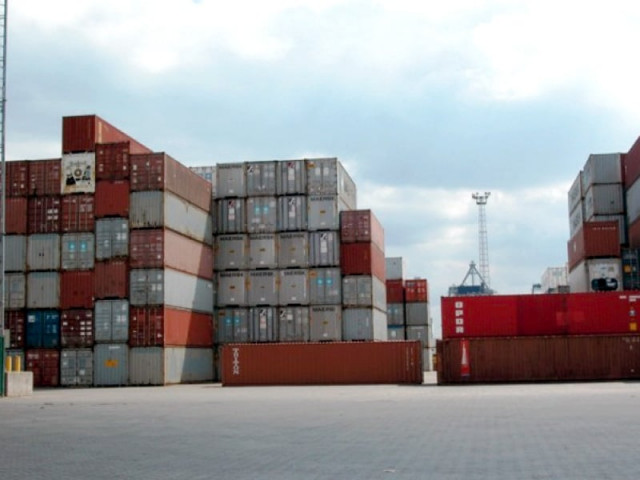
The 10-day-long strike by goods transporters has brought import and export activities to a halt, leading to a buildup of imported containers at ports.
However, spokesmen for Karachi Port and Port Qasim have stated that port operations are continuing as normal and there has been no disruption to the arrival and departure of ships.
In contrast, All Pakistan Customs Agents Association Chairman Arshad Khurshid told The Express Tribune that approximately 25,000 imported containers, including edible oil, industrial raw materials and other consumer goods, are awaiting onward transportation to their respective destinations at the two ports.
He added that due to the goods transporters’ strike, around 15,000 containers carrying export goods have failed to reach the ports.
Businessmen Group Chairman Zubair Motiwala said that the strike, now in its 10th day, has pushed the trade and industrial sectors into a distressing situation. He said that normally about 2,000 containers move in and out of the ports daily, but due to the transporters’ strike, 12,000 to 14,000 containers have remained stuck at the ports over the past 10 days.
He added that while production activities in local export industries are continuing, the transportation of finished export goods to the ports has come to a standstill. This has created the risk that if consignments fail to reach overseas buyers within the stipulated time, Pakistani exporters may suffer financial losses.
Motiwala asked the government and goods transporters to show flexibility and play their part in saving the country from an economic crisis, adding that the Karachi Chamber of Commerce and Industry has offered to facilitate dialogue between the relevant parties.

Business
American Airlines no longer lets basic economy flyers earn miles
American Airlines
Grant Baldwin | Getty Images
American Airlines customers flying on basic economy fares will no longer earn frequent flyer miles or points toward elite status, the carrier said this week.
“We routinely evaluate our fare products to remain competitive in the marketplace. Customers who purchase a Basic Economy ticket on December 17, 2025 and beyond will not earn AAdvantage miles or Loyalty Points towards AAdvantage status,” it said. “Basic Economy customers will continue to receive one free personal item and one free carry-on bag, free snacks, soft drinks and in-flight entertainment.”
Elite loyalty members will still be eligible for first-class upgrades on domestic flights if they’re on basic economy tickets, an American spokeswoman told CNBC.
Basic economy tickets are airlines’ cheapest but most restrictive fares, rolled out across the industry over the past decade. Generally, they do not allow customers to change their tickets without fees or pick their seats in advance.
The move comes as airlines across the board have been chasing customers who are willing to spend more to fly. American has fallen behind large rivals Delta Air Lines and United Airlines in the post-Covid luxury travel boom.
American’s change, posted earlier by X user JonNYC, follows a similar policy by competitor Delta Air Lines, which said travelers on its Delta Main Basic, or basic economy tickets, wouldn’t receive Delta SkyMiles.
United Airlines does allow its MileagePlus loyalty program members to earn miles on basic economy tickets, but it has a different limitation: Basic economy customers on most flights aren’t allowed to bring a carry-on bag.
American had the same restriction after it launched basic economy fares but backpedaled in 2018.
Southwest Airlines this year launched its first no-frills basic fares that stipulate those customers will board last and get a seat assignment at check-in and earn miles at a lower rate than more expensive fares.
Business
Space funding surge: India’s private space sector raises $150 million so far this fiscal, says INSPACe chief – The Times of India
India’s space industry has attracted $150 million in funding so far in the current financial year, marking the highest-ever fund mobilisation since the government opened up the sector to private participation in 2020, INSPACe Chairman Pawan Goenka said on Thursday, PTI reported.Speaking at the India Economic Forum in New Delhi, Goenka said the funding milestone had been reached earlier this week and total investments were expected to cross $200 million by the end of the financial year. “This year will see the highest funding ever for the space sector,” he said, adding that the expected inflows would be more than double what the sector raised in the previous fiscal.Goenka said investor interest in India’s space ecosystem had picked up sharply, driven by policy reforms and expanding commercial opportunities. He added that INSPACe, which acts as both promoter and regulator for private participation in the space sector, was working to sensitise investors about emerging opportunities across launch services, satellites and downstream applications.The INSPACe chairman said India’s space economy was currently valued at around $8 billion and was projected to grow to $44 billion by 2033.He noted that much of the demand for space start-ups was coming from government departments, which had earlier relied largely on ISRO for technological solutions. Goenka added that the private sector would need to play a larger role in developing space technologies for government use.He also said private companies should increasingly look at space start-ups for technology solutions relevant to their own business needs.
Business
American Airlines starts flying the longest-range narrow-body Airbus plane. Here’s what’s inside
The economy cabin of American Airlines A321XLR.
Leslie Josephs/CNBC
American Airlines is about to fly passengers to California for the first time on a skinny, long-range plane that it hopes will change air travel. The airline’s head of network planning now has to decide where else it should fly.
The first Airbus A321XLR for a U.S. airline is scheduled to take off from John F. Kennedy International Airport in New York on Thursday, bound for Los Angeles International Airport.
The XLR stands for extra long range, and with the ability to go up to 4,700 nautical miles, the plane can fly much farther than cross-country, though New York to Los Angeles is a highly lucrative route.
American will focus on routes to smaller European cities from its Philadelphia hub or from New York City that might not warrant the planes in its fleet that are larger and more expensive to operate, like a Boeing 777 or Boeing 787 Dreamliner.
American’s senior vice president of network and schedule planning, Brian Znotins, suggested in an interview with CNBC that he is considering destinations like Bordeaux and Marseille in France; Oslo, Norway; Stockholm; Copenhagen, Denmark; and Mallorca and Seville in Spain.
“It really opens up the menu for all these destinations that are just too small for a widebody,” Znotins said.
The airline will debut the planes in Europe starting in March with a nonstop flight from New York to Edinburgh, Scotland.
Airlines are increasingly turning to smaller planes for longer, nonstop flights. JetBlue Airways said it would push its Airbus A321LR — a plane that sits between a regular 321neo and an XLR, for flights to Barcelona, Spain, and Milan next year. The XLR first debuted on American’s partner, Spanish airline Iberia, in November 2024.
Premium seats
American Airlines’ Airbus A321XLR features 20 business-class suites with lie-flat seats.
Leslie Josephs/CNBC
American rolled out its new interior and configuration for the jets with the first flight Thursday.
The carrier is focusing heavily on premium seats that will take up a fifth of the plane as its executives try to catch up to more profitable rivals Delta Air Lines and United Airlines. Those two airlines in the first nine months of the year together accounted for nearly 98% of the profits of the four biggest U.S. carriers — which also include American and Southwest Airlines.
Unlike American’s Airbus 321T that has 102 seats and separate first-class and business-class cabins, the 321XLRs will have 155 seats: 20 in business class, 12 in premium economy and 123 in main cabin. That is still fewer than the standard Airbus A321s that are in American’s fleet and have 190 seats.
The new interior, with dark blue and caramel hues, is meant as an “ode to Americana,” said Rhonda Crawford, American’s senior vice president of customer experience design, who previously worked at Delta.
The privacy doors on the suites, however, won’t be able to be closed until early next year because of a certification hold up, an issue that has delayed deliveries of new planes as airlines seek more and more premium seating.
American ordered 50 of the XLR jets in 2019. The carrier said it expects to have 40 XLRs by the end of the decade. United also has the planes on order and expects to receive the first next year.
American retired its Boeing 757s and 767s, planes used often for international routes, during the pandemic and is now looking to rethink its network, while United — and Delta to a lesser degree — held onto older long-range jets.
American has also been increasing its investment in cabin refreshes and larger lounges. The airline said Wednesday that it will revamp its Admirals Club at Ronald Reagan Washington National Airport to grow seating by 50%.
American Airlines A321XLR.
Courtesy: American Airlines
As it makes those investments, the company’s executives are now trying to balance spending money — on items including new lounges and Champagne — with making money.
“You’re not going to close the margin gap by just continuing to drive only cost,” Nat Pieper, American’s newly appointed chief commercial officer and a longtime airline executive, told CNBC. “Is American going to spend more to be able to go chase premium revenue and improve our top line? Yes, we are, but let’s do it smartly.”
The American Airlines Airbus A321XLR premium economy cabin has 12 seats.
Leslie Josephs/CNBC
American was the first of the U.S. carriers to place an order for the XLRs more than six years ago. The planes have an extra fuel tank that gives them longer range, ushering in an era of leaner flying for long routes that can easily top eight hours, and testing passengers’ willingness to take a smaller jet.
The 321XLR also shows how airplane manufacturers Airbus and Boeing have continued to build upon older designs of aircraft over creating an all-new plane.

-
Business5 days agoHitting The ‘High Notes’ In Ties: Nepal Set To Lift Ban On Indian Bills Above ₹100
-
Politics1 week agoTrump launches gold card programme for expedited visas with a $1m price tag
-
Business1 week agoRivian turns to AI, autonomy to woo investors as EV sales stall
-
Tech1 week agoJennifer Lewis ScD ’91: “Can we make tissues that are made from you, for you?”
-
Sports1 week agoPolice detain Michigan head football coach Sherrone Moore after firing, salacious details emerge: report
-
Fashion1 week agoTommy Hilfiger appoints Sergio Pérez as global menswear ambassador
-
Business1 week agoCoca-Cola taps COO Henrique Braun to replace James Quincey as CEO in 2026
-
Sports1 week agoU.S. House passes bill to combat stadium drones