

Business
As WNBA labor deadline nears, players union is ‘frustrated’ by lack of progress


The WNBA Players Association executive director told CNBC she remains “frustrated” by the lack of progress toward a new collective bargaining agreement as the league’s new deadline to reach a deal approaches.
“We’re a little frustrated with where we are right now, but we are holding to our principles,” Terri Jackson, executive director of the WNBPA, told CNBC Sport in an interview. “We’re staying open to the fact that these negotiations will continue, because they must. We’ll be at the table for as long as they take, and we’re hopeful that there’s enough folks on the team side of things that will start to push these things along.”
Jackson told CNBC Sport she continues to negotiate with WNBA Commissioner Cathy Engelbert, her counterpart in the talks, on a new labor deal for the league. The CBA, or labor contract, between the WNBA and its players expired on Oct. 31, but the deadline to strike a new agreement was extended to Jan. 9 when the sides failed to reach a deal.
WNBA players are looking for significant pay increases to get a bigger cut of the league’s revenue growth. The WNBA signed a media rights deal last year that amounted to a sixfold increase in revenue. The league and its players have been actively negotiating for months over issues related to salaries, benefits, working conditions and revenue sharing.
Jackson declined to mention specifics about where the negotiations have stalled, citing her nondisclosure agreement, but added, “Everything seems to still be a sticking point.”
A’ja Wilson of the Las Vegas Aces drives to the basket against the Phoenix Mercury during Game 4 of the 2025 WNBA Finals at PHX Arena in Phoenix, Oct. 10, 2025.
Mike Lawrence | National Basketball Association | Getty Images
The WNBA’s latest proposal to the union includes increasing the maximum salary to $1 million per season, with revenue sharing that could push that number to more than $1.2 million, according to a person familiar with the matter. The current supermax contract is just under $250,000 a year.
The new proposal would also increase the average annual salary to more than $500,000, with the league minimum projected to be over $225,000, said the person. Currently, the league minimum is just over $66,000.
As part of the proposed revenue sharing agreement, players would see pay increases built in each year. The terms of the revenue sharing have been a point of contention in the talks. The WNBPA recently proposed that players receive 30% of total league and team revenue, or more than double what the league proposed, The Athletic reported.
Jackson, who is spearheading negotiations on behalf of the players, said that despite the frustrations, the union remains hopeful that it can get a deal done before the imposed deadline.
“It’s hard for us to understand why we are so far apart on the things that we should be closer to that should be so easy, but it seems as though at times, the league and the team come into the negotiating room with a mentality that pay equity is optional, and pay equity is not optional,” Jackson said.
Jackson emphasized that she’s working hard to get a deal done by Jan. 9.
“Will there be another extension? There shouldn’t be another extension,” she said. “There doesn’t need to be another extension. We understand their position and point of view. They understand our position and point of view.”
As the WNBA enjoys record growth in television ratings, attendance and sponsorship, the one thing that could stall that momentum would be a work stoppage if the sides cannot come to terms, Jackson said. Several WNBA stars have already expressed their desire to avoid any missed games. The WNBA season begins in May 2026.
Engelbert said in October that the league wants to avoid a lockout.
“Caitlin Clark, Angel Reese, Nneka Ogwumike and Napheesa Collier … have all said that and that a work stoppage would be catastrophic,” Jackson said. “Nobody wants to see that happen.”








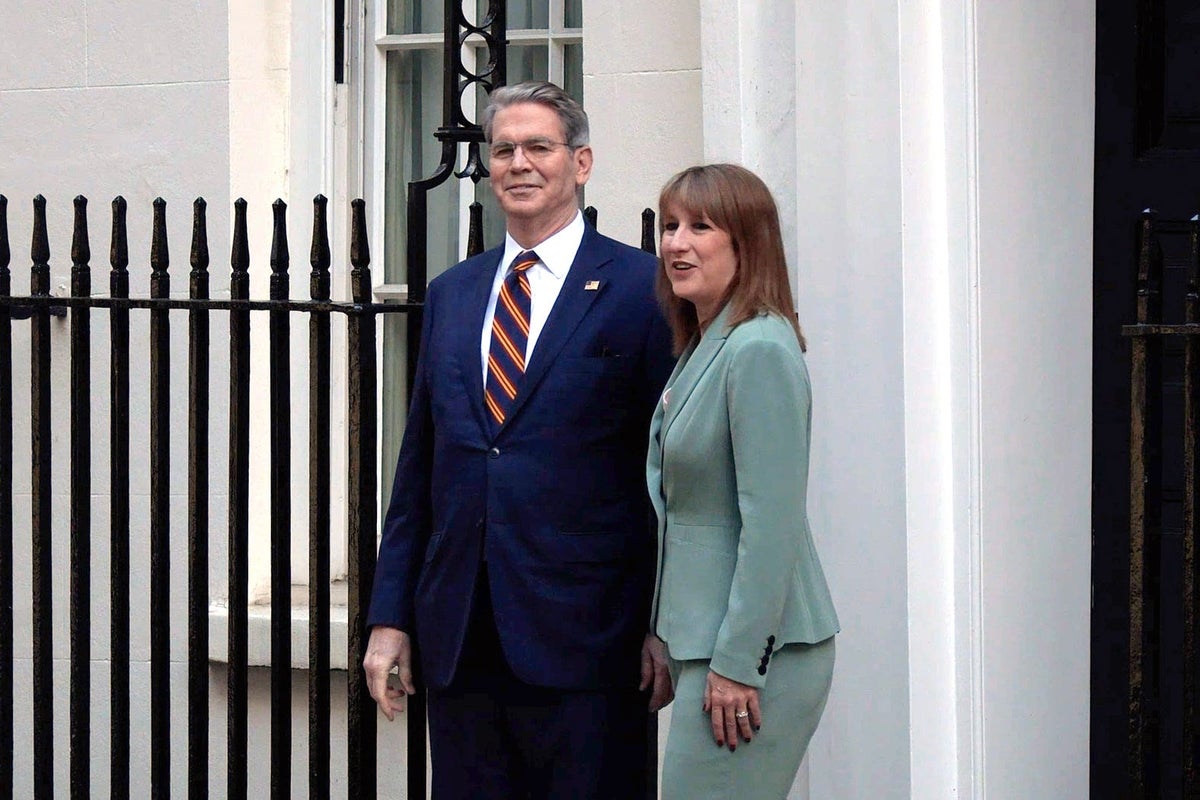
Downing Street would not deny reports that Chancellor Rachel Reeves rowed with her US counterpart during a visit to Washington DC earlier this year.
Ms Reeves had an argument with Scott Bessent when she visited the US capital for the International Monetary Fund’s spring meetings, according to the Financial Times.
The Chancellor publicly criticised the US-led war against Iran before travelling across the Atlantic, prompting Mr Bessent to berate her on the sidelines of the gathering, the newspaper reported.
Ms Reeves reportedly hit back that she did not work for the US treasury secretary, and disliked how he had spoken to her, before reiterating her argument that America lacked clear goals going into the conflict and was not making the world safer.
On Tuesday, the Prime Minister’s official spokesman was asked if he would steer away from the reports, and appeared not to.
He did however insist Ms Reeves and her US counterpart have had “constructive” engagements since the Washington DC visit.
The spokesman said: “We would not get into private conversations. The Chancellor and the US treasury secretary have a good relationship.
“They have had constructive conversations together since the Chancellor’s visits to Washington.
“I think there is a readout from the US Department of Treasury, which made clear the productive nature of their relationship.”
The Chancellor emerged as one of the most outspoken UK Government critics of the US decision to go to war in Iran before travelling to the IMF meetings in April.
At the time, she described the war as a “folly” and said: “This is a war that we did not start. It was a war that we did not want.
“I feel very frustrated and angry that the US went into this war without a clear exit plan, without a clear idea of what they were trying to achieve.”
Business
Govt lists 40 sub-sectors for faster FDI clearance from border nations-check details – The Times of India

The government has identified 40 sub-sectors, including rare earth magnets and printed circuit boards, for expedited clearance of foreign direct investment (FDI) proposals from countries sharing land borders with India, PTI reported.Under the revised framework, proposals from countries such as China, Pakistan, Bangladesh, Nepal, Bhutan, Myanmar and Afghanistan in these sectors will be processed within 60 days, as per the updated standard operating procedure (SOP).The move follows a decision taken in March to fast-track FDI approvals in specified manufacturing sectors from these countries.However, the government has clarified that majority ownership and control of the investee entity must remain with resident Indian citizens or Indian-owned entities at all times.The 40 identified sub-sectors fall under six broad categories –capital goods manufacturing, electronic capital goods and electronic components, polysilicon and ingot-wafer production, advanced battery components, rare earth permanent magnets, and rare earth processing.These include manufacturing of insulation items, castings and forgings for thermal, hydro and nuclear power plants, machine tools, display components such as LCD and LED panels, camera modules, electronic capacitors, speakers and microphones, lithium-ion batteries, wearables, and rare earth metal and magnet processing facilities.The SOP also introduces detailed reporting norms for investments involving entities with direct or indirect ownership from land-bordering countries.“The reporting under these guidelines will be governed under the Foreign Exchange Management (Mode of Payment and Reporting of Non-debt Instruments) Regulations, 2019, and the information will be accessible by the Reserve Bank of India (RBI),” the DPIIT said.The responsibility for reporting lies with the Indian investee company, which must submit required details to the DPIIT before receiving foreign capital.“The reporting is to be made prior to the inward remittance of foreign capital. In cases which do not involve foreign capital inward remittances, the reporting is to be made prior to execution of the relevant transactions, including issuance/transfer of capital instruments, as the case may be,” it added.Investors will be required to disclose details such as shareholding patterns, beneficial ownership, organisational structure, promoters, board composition, key managerial personnel and control rights.The Indian entity will also need to provide incorporation details and disclose existing or proposed shareholding linked to entities from land-bordering countries.

Ferrari technicians inspect supercars on the production line inside the company’s factory in Maranello, Italy, October 2, 2025. REUTERS/Remo Casilli/File Photo
Remo Casilli | Reuters
DETROIT — Ferrari on Tuesday beat Wall Street’s first-quarter earnings expectations and reconfirmed its guidance for the year, weeks ahead of the sports car maker revealing its first all-electric vehicle.
Here’s how the company performed in the first quarter compared with average estimates compiled by LSEG:
- Earnings per share: 2.33 euros (US $2.72) adjusted vs. 2.27 euros expected
- Revenue: 1.85 billion euros vs. 1.81 billion euros expected
Ferrari’s revenue was up more than 3% compared with 1.79 billion euros during the first quarter of 2025, while its operating profit and adjusted earnings increased 1.1% and 4.2% year-over-year, respectively.
The company’s 2026 guidance includes 7.5 billion euros in net revenues and an adjusted operating profit of at least 2.22 billion euros, or 9.45 euros adjusted EPS. Its industrial free cash flow is targeted at 1.5 billion euros or more for the year.
Those results were despite deliveries being down 4.4% year-over-year to 3,436 units, as the sports car maker said it slowed production to “ease the execution of the planned model change-over.”
The company said deliveries “were not impacted by the surge of hostilities in the Middle East, as Ferrari leveraged its geographical allocation flexibility, bringing forward certain deliveries to other regions.”
Ferrari’s results come weeks before the scheduled debut of the Luce, its first fully electric vehicle, on May 25.
“With only twenty days to the world premiere of the Ferrari Luce, the sense of anticipation has never been so high. The Ferrari Luce brings together so much extraordinary technologies and the passion of so many people. It is the evidence of how tradition and innovation can come together to create something unique,” Ferrari CEO Benedetto Vigna said in a statement Tuesday.


Climate is now in the cost sheet

Dolly Parton shares health update after canceling Las Vegas residency
[CinePlex360] Please moderate: “Hundreds in Teh

-

 Tech1 week ago
A Brain Implant for Depression Is About to Be Tested in Humans
-

 Tech1 week ago
Almost 90% of women leave tech industry within 10 years | Computer Weekly
-

 Sports1 week ago
Pro wrestling star Steph De Lander reveals how colleague’s advice helped lead her to title triumph at ACW
-
 Business1 week ago
‘I had £20,000 stolen and had to fight a 13-month fraud reporting rule to get it back’
-

 Entertainment1 week ago
Norway joins Type 26 Frigate Programme to boost NATO naval power
-
 Business6 days ago
PSX plunges over 4,800 points | The Express Tribune
-

 Entertainment1 week ago
Melania Trump says ABC should ‘take a stand’ on late-night host Kimmel
-

 Tech1 week ago
This Ambitious Laptop Doesn’t Leave Much Room for Your Hands