

Business
Why Croatia’s capital wants to hold the best Christmas market

Guy Delauney Balkans correspondent
 AFP via Getty Images
Christmas markets are not just tradition across Europe, they are big businesses that give cities a huge economic boost every December. For Zagreb, the capital of Croatia, it is an effective way of attracting tourists outside of the country’s main summer season.
The words “tourism” and “Croatia” are likely to conjure visons of sparkling Adriatic vistas during the hottest months of the year.
Tourism accounts for more than a fifth of the economy of this Balkan country, and it is keen to encourage more visitors to arrive outside of the height of summer. Yuletide frolics are a key part of that strategy.
“We’re making a transformation,” says Croatia’s Tourism Minister, Tonci Glavina.
“We are developing as a year-round tourism destination – we are not a summer destination anymore. Croatia has really made a significant development. At some point way back it was just sun and sea, but now Croatia offers many tourism products all across the country.”
Zagreb Advent, as the capital’s Christmas markets and events are collectively known, is the poster child for this approach, with billboards in neighbouring countries urging people to attend. In fact, this year the campaign has spread as far as London’s tube stations and Milan’s buses.
There are even special trains to bring visitors from Slovenia and Hungary. All of it is part of Zagreb’s push, in a very crowded field, to become one of Europe’s most popular Christmas markets.
While some cities might limit their offering to a single location, Zagreb Advent is a multi-venue spectacular that takes over large chunks of the centre.
“The entire city has become a festive ground for celebrating Christmas throughout the whole of December,” says Slavica Olujic Klapcic, who manages one of the Christmas market areas.
“What’s really special around here is that each of the locations has its own theme, and it’s a little bit different in decoration, and in the content that it offers. So for a visitor, I think it’s a good deal, because by taking a walk through Zagreb, you can see many different spots.”
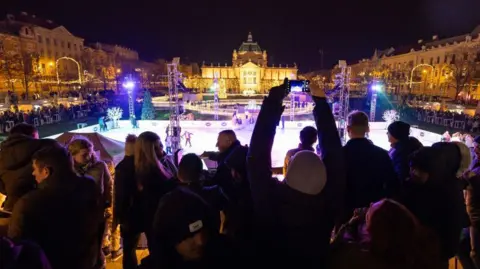
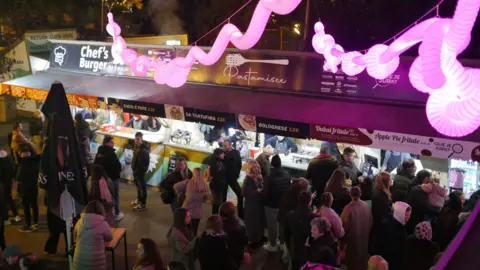
Like other Christmas markets across Europe there are no shortages of the usual seasonal staples, such as sausages and mulled wine. But there are also multiple music stages, craft stalls, vendors offering traditional Croatian food, art installations, and an enormous ice rink.


“It brings life to Zagreb,” reckons Zrinka Farina, who is involved with putting on Christmas market events outside the city’s historic Hotel Esplanade, as well as a food and music market at nearby Strossmayer Square called Fuliranje – which roughly translates as “fooling around”.
But she says that Croatians are deadly serious about trying to offer Europe’s best Christmas market. “We are such a sporty nation, we love to compete – and when we do something, we really want to be the best in the world in it.”
Such has been the effort that the city has put into Zagreb Advent since it was first held in 2014 that it was voted the best Christmas market in Europe for three years in a row, from 2015 to 2017.
The competition is organised by travel website European Best Destinations, and Zagreb’s success has helped to drive visitor numbers to the city every December.
Back in 2014, the city saw 100,198 people stay for at least one night during the last month of the year. By 2024 this had more than doubled to 245,352, which the tourist board says gave the city a €100m ($117m; £88m) economic boost.
However, Zagreb has a long way to go if it wishes to catch up with Europe’s Christmas market heavyweights.
The one held in the German city of Cologne is widely reported to be the most popular. It is expected to attract four million visitors this year, with an economic impact of €229m.
Meanwhile, Austria’s capital Vienna attracts around 2.8 million visitors to its Christmas market, and France’s Strasbourg gets two million people.
Zagreb’s event also has a limited history – it is only in its 11th year. By contrast, Dresden’s Christmas market, widely considered to be the world’s oldest, was first held in 1434. Strasbourg’s began in 1570, Vienna in 1764 and Cologne in 1820.
Despite its infancy, Zagreb Advent is said to be attracting visitors from across Europe. “They come here from Italy, Spain, Bosnia, Slovenia and even the UK,” says Lucija Vrkljan, who is working as a steward at the ice rink.
“It’s a great place to be,” says Dario Kozul, the founder of BioMania, a bistro with a stall offering vegan and gluten-free food at the Hotel Esplanade Christmas market. “We have a cross-marketing situation all the time,” he adds.
“People walk into this event and test our food – they’re really very pleased with it. Then we talk about our restaurant, and within the next couple of days, we see them there.”
 AFP via Getty Images
Marko Peric, dean of the Faculty of Tourism at Croatia’s University of Rijeka, agrees that Zagreb Advent brings “unusually high” numbers of arrivals and overnight stays in December.
But he cautions that the rest of Croatia’s heavy reliance on the summer season is a weakness that still needs to be addressed. “We need to work and develop our tourist offer in other parts of the year, including the winter,” he says.
“We don’t have snow, but we can offer a lot. We should rely on our gastronomy, which is well known, with many tourists arriving just because of that. And we could use other types of events like carnival in February, or sporting events.”
Tourism Minister Tonci Glavina insists that Croatia is making moves in the right direction. He points out that visitor numbers over July and August were actually slightly down on the same period in 2024.
But the country is still on course for a record-breaking year, thanks to significant growth either side of the summer peak, with around 5% more arrivals in June and September. This, says the minister, is “just perfect”, as is the 10% year-on-year rise over the first week of December.
“We are transforming Croatia to be a sustainable tourism destination, meaning about the same number of guests in peak season, developing the shoulder seasons, and of course developing other parts of the country to be main tourism destinations.”
Zagreb Advent has already shown the benefits. Although that may not be the first thing that springs to a visitor’s mind with all the traditional Croatian treats on offer.
After all, what could be better than a post-skate fritule doughnut, except perhaps a fritule with chocolate sauce.

The UK’s competition watchdog says it is looking at five firms in its investigation into misleading online reviews.
Source link
Business
Gold price today (March 25, 2026): How much 24K and 22K gold cost in Delhi, Mumbai & more- Check rates – The Times of India
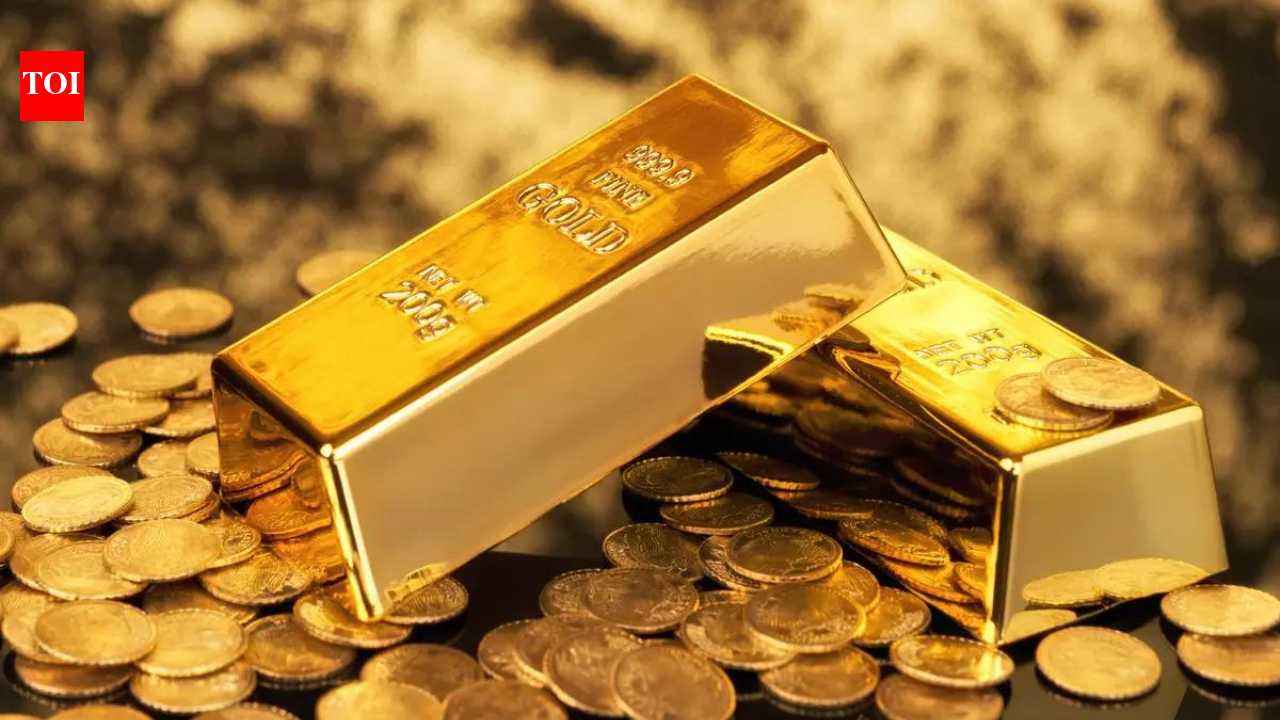
Gold futures traded higher on the Multi Commodity Exchange (MCX) on Friday with key contracts registering gains of up to 1.6 per cent amid firm buying interest and supportive global cues.The April 2026 gold contract rose by Rs 2,290, or 1.64 per cent, to trade at Rs 1,41,783 per 10 grams. The contract moved between an intraday low of Rs 1,40,287 and a high of Rs 1,42,800. The June 2026 contract, which saw higher trading activity, gained Rs 1,921, or 1.35 per cent, to Rs 1,44,435 per 10 grams. During the session, it touched a low of Rs 1,43,652 and a high of Rs 1,45,773. Meanwhile, the August 2026 contract advanced by Rs 1,480, or 1.02 per cent, to Rs 1,47,100 per 10 grams, with an intraday range of Rs 1,47,040 to Rs 1,48,600.Here is how gold prices stand across major cities today:
Gold price in Delhi today
Gold prices in the national capital declined, with 24K gold quoted at Rs 14,486 per gram, down Rs 218, while 22K gold slipped Rs 200 to Rs 13,280 per gram.
Gold price in Mumbai today
Mumbai bullion markets also saw a drop, with 24K gold priced at Rs 14,471 per gram, down Rs 218, and 22K gold at Rs 13,265 per gram, lower by Rs 200.
Gold price in Chennai today
Chennai recorded a sharper decline, with 24K gold selling at Rs 14,651 per gram, down Rs 262, while 22K gold dropped Rs 240 to Rs 13,430 per gram.
Gold price in Kolkata today
In Kolkata, 24K gold was quoted at Rs 14,471 per gram, down Rs 218, while 22K gold stood at Rs 13,265 per gram, lower by Rs 200.
Gold price in Hyderabad today
Hyderabad markets reflected a similar trend, with 24K gold priced at Rs 14,471 per gram, down Rs 218, and 22K gold at Rs 13,265 per gram, slipping Rs 200.
Gold price in Bangalore today
In Bangalore, 24K gold was quoted at Rs 14,471 per gram, down Rs 218, while 22K gold was selling at Rs 13,265 per gram, lower by Rs 200.
Gold price in Ahmedabad today
Ahmedabad bullion markets showed declines, with 24K gold at Rs 14,476 per gram, down Rs 218, while 22K gold fell Rs 200 to Rs 13,270 per gram.
Gold price in Lucknow today
In Lucknow, 24K gold was priced at Rs 14,486 per gram, down Rs 218, while 22K gold moved lower by Rs 200 to Rs 13,280 per gram.
Gold price in Patna today
Patna markets also recorded weaker rates, with 24K gold quoted at Rs 14,476 per gram, down Rs 218, and 22K gold at Rs 13,270 per gram, lower by Rs 200.
Gold price in Jaipur today
In Jaipur, 24K gold was quoted at Rs 14,486 per gram, down Rs 218, while 22K gold stood at Rs 13,280 per gram, down Rs 200.

A key survey indicates growing doubt among shoppers over prospects for the UK economy in the next year.
Source link


Prince William bold decision keeps Harry up at night: ‘No mercy’

NCAA men’s tournament: Rick Pitino’s case for best men’s college basketball coach ever
Gold price today (March 25, 2026): How much 24K and 22K gold cost in Delhi, Mumbai & more- Check rates – The Times of India

-

 Entertainment1 week ago
Val Kilmer revived 1 year after death through AI
-
 Fashion1 week ago
US’ G-III Apparel’s FY26 sales fall 7% to $2.96 bn
-

 Sports1 week ago
March Madness 2026 – How to watch in SA, start time, schedule, TV channel for NCAA championship basketball tournament
-
 Business1 week ago
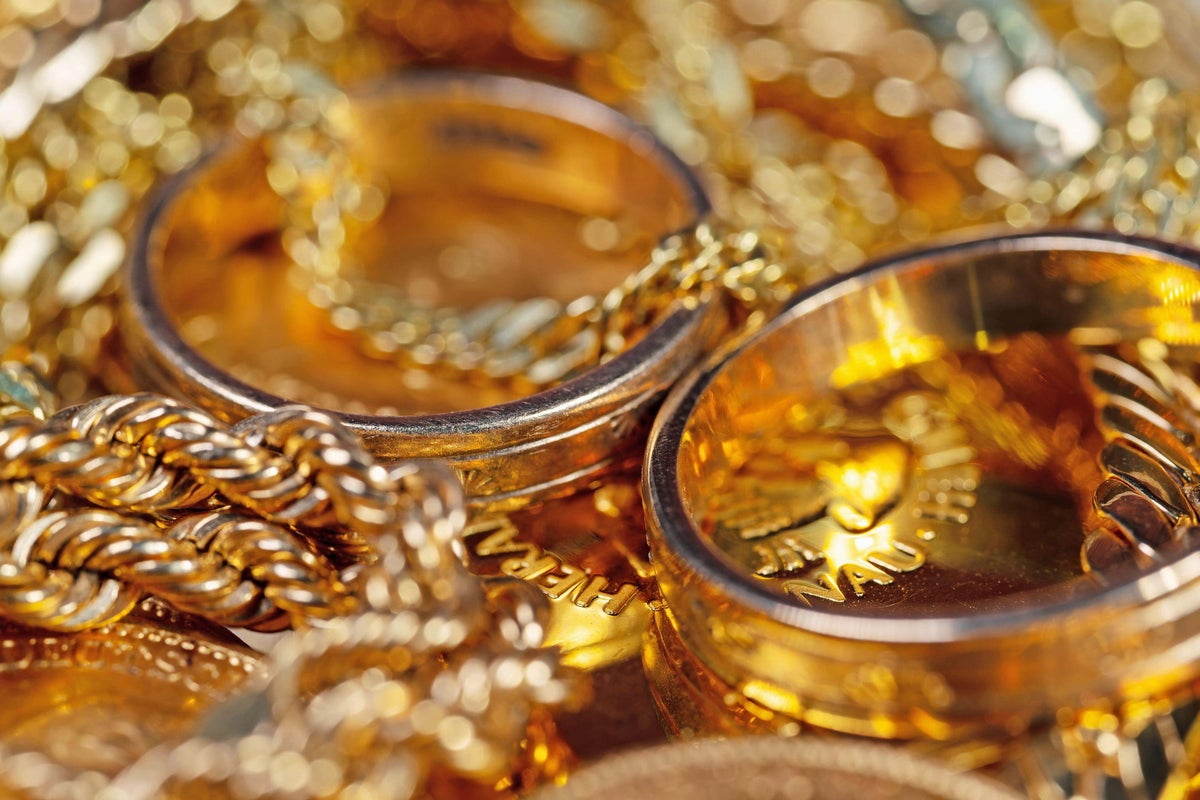
Brits cashing in jewellery as gold price hits record high
-

 Fashion6 days ago
China’s textile & apparel exports surge 17% to $50 bn in Jan-Feb 2026
-
 Business6 days ago
Flipkart group CFO to leave co amid IPO plans – The Times of India
-

 Sports7 days ago
Rating Adidas’ 2026 World Cup away shirts: Argentina, Spain, Mexico and more
-
 Business1 week ago
Video: The Effects of High Oil Prices