

Business
Why everything from your phone to your PC may get pricier in 2026

Tom GerkenTechnology reporter
 Getty Images
The cost of lots of the devices we all use could be forced up in 2026 because the price of Ram – once one of the cheapest computer components – has more than doubled since October 2025.
The tech powers everything from smartphones to smart TVs, as well as things like medical devices.
Its price has shot up because of the explosive growth in the data centres which power AI, which need Ram too.
That’s caused an imbalance between supply and demand which means everyone has to pay more.
Manufacturers often choose to swallow small cost increases, but big ones tend to get passed on to consumers.
And these increases are anything but small.
“We are being quoted costs around 500% higher than they were only a couple of months ago,” said Steve Mason, general manager of CyberPowerPC, which builds computers.
He said there “will come a point” where these increased component costs will “force” manufacturers to “make decisions about pricing”.
“If it uses memory, or storage, there is the potential for price increases,” he said.
“The manufacturers will have choices to make, as will consumers.”
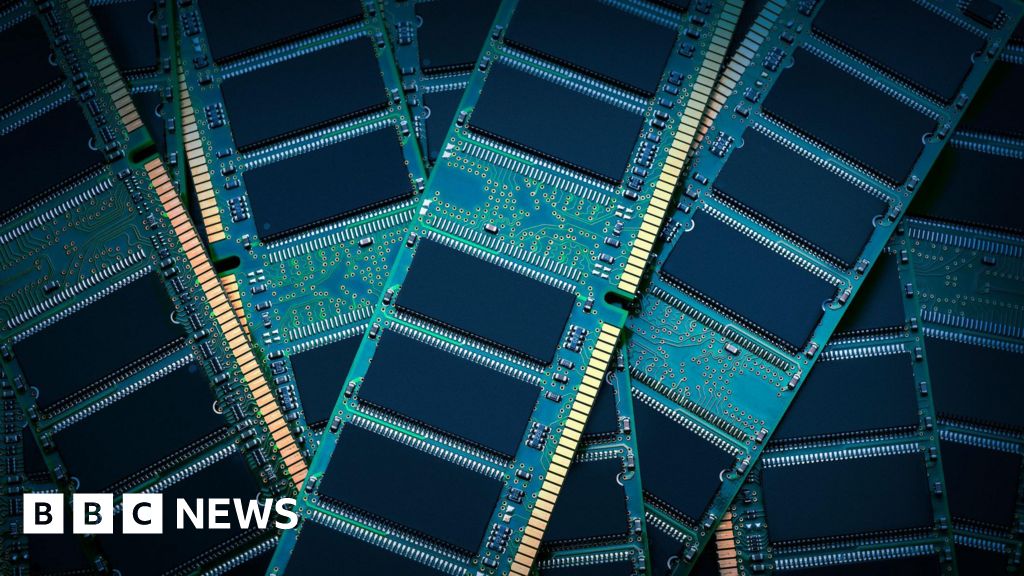
Ram – or random access memory – is used to store code while you use a device. It is a critical component of almost every kind of computer.
Without it would be impossible for you to read this article, for example.
And with the component being so ubiquitous, Danny Williams from rival computer building site PCSpecialist said he expected price increases to continue “well into 2026”.
“The market has been very buoyant in 2025 and if memory prices do not fall back a little I would expect a reduction in consumer demand in 2026,” he said.
He said he’d seen “a varied impact” across different Ram producers.
“Some vendors have larger inventories and therefore their price increases are more subtle at perhaps 1.5x to 2x,” he said.
But he said other firms did not have a large amount of stock – and they had increased prices by “up to 5x” more.
AI making prices rise
Chris Miller, author of Chip War, called AI “the main factor” driving demand for computer memory.
“There’s been a surge of demand for memory chips, driven above all by the high-end High Bandwidth Memory that AI requires,” he said.
“This has led to higher prices across different types of memory chips.”
He said prices “often fluctuate dramatically” based on “demand and supply” – and demand is significantly up right now.
And Mike Howard from Tech Insights told the BBC it came down to cloud service providers finalising their memory requirements for 2026 and 2027.
He said that gave the people who make Ram a clear picture of demand – and it was “unmistakeable” that supply “will not meet the levels that Amazon, Google, and other hyperscalers are planning for”.
“With both demand clarity and supply constraints converging, suppliers have steadily pushed prices upward, in some cases aggressively,” he said.
“Some suppliers have even paused issuing price quotes, a rare move that signals confidence that future prices will rise further.”
He said some manufacturers will have seen this coming and built up their inventory ahead of time to help mitigate the price rises – but called those firms “outliers”.
“In PCs, memory typically accounts for 15 to 20 percent of total cost, but current pricing has pushed that toward 30 to 40 percent,” he said.
“Margins in most consumer categories are not deep enough to absorb these increases.”
The bottom line for 2026
With prices trending upwards, customers will likely be left deciding whether to pay more or accept a less powerful device.
“Most of the market intelligence we have received would suggest pricing and supply will be a challenge worldwide throughout 2026 into 2027,” Mr Mason said.
And some big firms have turned their nose up at the consumer market altogether.
Micron, previously one of the biggest sellers of Ram, announced in December it would stop selling its Crucial brand to focus on AI demand.
“It removes one of the biggest players from the market,” Mr Mason said.
“On the one hand, that’s less choice for consumers – on the other hand, if their entire production ploughs into AI, it should free up capacity for the others to make more for consumers, so it may balance out.”
Mr Howard said a typical laptop, with 16GB of Ram, could see its manufacturing cost increase by $40 to $50 (£30 to £37) in 2026 – and this “will likely be passed on to consumers”.
“Smartphones will also see upwards pressure on their prices,” he said.
“A typical smartphone could see it’s cost to build increase $30 which, again, will likely get passed on directly to consumer.”
And Mr Williams said there might be another outcome of increased prices too.
“Computers are a commodity – an everyday item that people need in a modern day world,” he said.
“With the increase in memory prices, consumers will need to decide to either pay a higher price for the performance they need, or accept a compromise in a lower performing device.”
There is, of course, another option, says Mr Williams – consumers might have to “make do with old tech for a little longer.”


Business
‘Ships continuously coming even amid blockage’: Centre assures 100% energy supplies across the country – The Times of India

The Centre assured that LPG supply across the country is normal, despite rising tensions in the Middle East, with shipments sailing through the Strait of Hormuz without any disruption. Dismissing fears of any shortage in the nation, petroleum and natural gas secretary Neeraj Mittal, on Thursday, said that domestic availability remains stable. “I don’t see any problem anywhere. All domestic supplies are at 100 per cent,” he stated, adding that around 70 per cent of packed LPG has already been released into the system.While acknowledging the possibility of minor, localised supply bottlenecks, Mittal said such issues are routine and managed on a day-to-day basis.He also addressed concerns over maritime movement in the region, noting that vessel traffic has not faced delays. “Ships have been continuously coming even when there was a blockage. It takes its normal travel time. We are not talking about any delay in crossing the Strait,” he said.According to Mittal, the government is closely tracking developments and remains prepared to act if needed. “The government is reviewing this on a daily basis. If any change has to be made, it will be done,” he said.Speaking at a conference on energy security and India’s growing gas demand, Mittal further emphasised the need for preparedness in light of recent global developments. He highlighted that nearly 90% of India’s crude oil imports pass through the Strait of Hormuz, underlining its strategic importance.He further noted that India sources crude oil from 41 countries, natural gas from 30 countries, and LPG from 13 countries, stressing that such diversification plays a key role in shaping future energy policies.“The government is committed to ensuring that gas is available to all entities, and we are also focusing on diversification so that such crises do not impact supplies,” he said. Meanwhile, Green Asha, a fuel carrier with over 15,400 tonnes of LPG, also arrived in the country on Thursday after crossing Strait of Hormuz earlier this week.The conference, organised by the petroleum and natural Gas regulatory board (PNGRB) in partnership with Indraprastha Gas Limited (IGL), brought together stakeholders to discuss the expanding role of natural gas in the country’s energy mix.Discussions at the two-day event focused on infrastructure investment, regulatory support, and addressing sectoral challenges, while also encouraging innovation as India works to strengthen its energy security in the face of global uncertainties.

The cost of crude plunged on Wednesday after a deal was announced that includes the opening of the Strait of Hormuz.
Source link
Business
Strait of Hormuz open or close? Only a ‘trickle’ of oil leaving right now despite ceasefire – The Times of India

The tussle over the opening of the Strait of Hormuz continues as the Middle East crisis intensifies, with oil shipments yet to return to normal levels. According to a senior Gulf Oil adviser, any impact on fuel prices in the United States is likely to take time.Tom Kloza, the company’s chief energy adviser, told CNN that he is still “not seeing the evidence of more crude oil departing” the strait, even though reopening the route was reportedly part of the two-week ceasefire agreed on Tuesday night.Iran’s Islamic Revolutionary Guard Corps (IRGC) claimed that traffic through the strait slowed sharply and then stopped, blaming what it described as a violation of the ceasefire by Israel in Lebanon.Kloza said the situation remains uncertain and progress has been slow. “I would emphasize these are really baby steps right now. There’s no indication that the strait is going to reopen, and it seems like a flimsy ceasefire, to say what’s obvious,” he told CNN’s Jake Tapper.He added that only “a trickle” amount of oil is currently leaving the region. Because of the fragile ceasefire, companies are likely to be cautious about sending oil through the route.“It looks as though we’re weeks away from any restoration of even 50% or 70% of the Strait of Hormuz traffic that we depend on,” Kloza said.The situation could escalate further after US President Donald Trump on Thursday issued a fresh warning to Iran over the Strait of Hormuz. Posting on the social media platform Truth Social, he said American military forces and weapons would remain in place until the two sides reach a “real agreement”.“If for any reason it is not, which is highly unlikely, then the “Shootin’ Starts,” bigger, and better, and stronger than anyone has ever seen before. It was agreed, a long time ago, and despite all of the fake rhetoric to the contrary – NO NUCLEAR WEAPONS and, the Strait of Hormuz WILL BE OPEN & SAFE. In the meantime our great Military is Loading Up and Resting, looking forward, actually, to its next Conquest. AMERICA IS BACK!”Global energy supplies continue to face pressure as Iran restricts movement through the Strait of Hormuz, a vital route that carries around 20% of the world’s oil. The conflict has now stretched beyond a month, following strikes on Iran by the United States and Israel on February 28.Meanwhile, oil prices edged up on Thursday after recording their sharpest single-day drop since April 2020, as ongoing tensions in the Middle East and uncertainty over the Strait of Hormuz kept markets unsettled. Brent crude climbed back towards $97 a barrel after a 13% fall on Wednesday, while West Texas Intermediate hovered near similar levels.


India’s POY output cut to 60% as rising costs hit producers hard

This AI Button Wearable From Ex-Apple Engineers Looks Like an iPod Shuffle

Tom Holland calls Christopher Nolan ‘The Odyssey’ ‘an absolute masterpiece’

-
Uncategorized7 days ago
[CinePlex360] Please moderate: “Trump signals p
-
 Business7 days ago
Jaguar Land Rover sees sales recover after cyber attack
-

 Entertainment6 days ago
Joe Jonas shares candid glimpse into parenthood with Sophie Turner
-

 Tech6 days ago
Our Favorite iPad Is $50 Off
-

 Fashion1 week ago
China’s Anta Sports posts record $11.62 bn revenue in 2025
-

 Politics6 days ago
Iran can sustain Strait of Hormuz closure for years, will cut US military logistics: Official
-

 Sports5 days ago
UConn Final Four run could trigger a $50M furniture giveaway for Massachusetts-based Jordan’s Furniture
-
 Business6 days ago
Video: Why Is the Labor Market Stuck?