

Business
Govt Notifies Income-Tax Act 2025, Law To Come Into Effect From April 1, 2026


New Delhi: The government has officially notified the Income-tax Act, 2025, which consolidates and amends the existing income tax law, replacing the over six-decade-old Income Tax Act, 1961. The Act received the President’s assent on August 21, according to a gazette notification issued by the Ministry of Law and Justice.
The new simplified Act, which will come into effect from April 1, 2026, does not impose any new tax rate and only simplifies the language, making it easier to understand the Income Tax laws. The new Act removes redundant provisions and archaic language and reduces the number of Sections from 819 in the Income Tax Act of 1961 to 536 and the number of chapters from 47 to 23. The number of words had been reduced from 5.12 lakh to 2.6 lakh in the new Income Tax Act. (Also Read: ‘We Respect The Law’: Dream11 Confirms Shutdown Of Paid Games, Shifts To Free Play Model)
“These changes are not merely superficial; they reflect a new, simplified approach to tax administration. This leaner and more focused law is designed to make it easy to read, understand and implement,” Finance Minister Nirmala Sitharaman informed Parliament.
The new Income Tax Bill 2025 was approved by Parliament on August 12, with the Rajya Sabha returning the Bill to the Lok Sabha, which had approved it on August 11. (Also Read: India’s Forex Reserves Jump $1.49 Billion To $695.11 Billion)
“The largely dense and complex structure of the Income Tax Act, 1961, resulted in various interpretations, and several avoidable disputes kept mounting, not so much because of the rate, but because of the language. We were subjected to too many litigations. The density and complexity of the Act, along with the verbose way it was written over the decades, with different styles dominating, made the Act very, very tedious for anyone to use,” Finance Minister Nirmala Sitharaman said in the Rajya Sabha.
The Income Tax Bill, 2025, was passed in the Lok Sabha on August 11 shortly after Finance Minister Nirmala Sitharaman tabled the revised bill, incorporating most of the recommendations made by the Parliamentary Select Committee.





The firm was unable to cope during high demand, Ofwat says, leading to “immense stress” for customers.
Source link
Business
Middle East heat may ripple across India’s energy supply chain, flags Goldman Sachs – The Times of India
As tensions continue to heat up in the Middle East, concerns are raising about disruptions to one of the world’s most critical energy shipping routes, the Strait of Hormuz. Any disruption could significantly affect major oil-importing countries such as India, as the narrow Strait of Hormuz is central to global energy trade. The strait sees almost 20 million barrels of oil passing through each day, or about a fifth of the world’s consumption, pass through the route. The waterway also carries roughly 19% of global liquefied natural gas (LNG) shipments, making it a crucial corridor for energy-importing economies.A recent report by Goldman Sachs has flagged early signs of stress in the region. The report warned that tanker traffic through the Strait of Hormuz has already begun showing signs of disruption, with shipping firms, oil producers and insurers adopting a cautious approach following reports of damaged vessels in nearby waters.According to the firm, financial markets have already begun factoring in the geopolitical risk. Oil prices currently carry an estimated risk premium of $18-per-barrel, reflecting the potential market impact if energy flows through the Strait of Hormuz were disrupted for about a month.
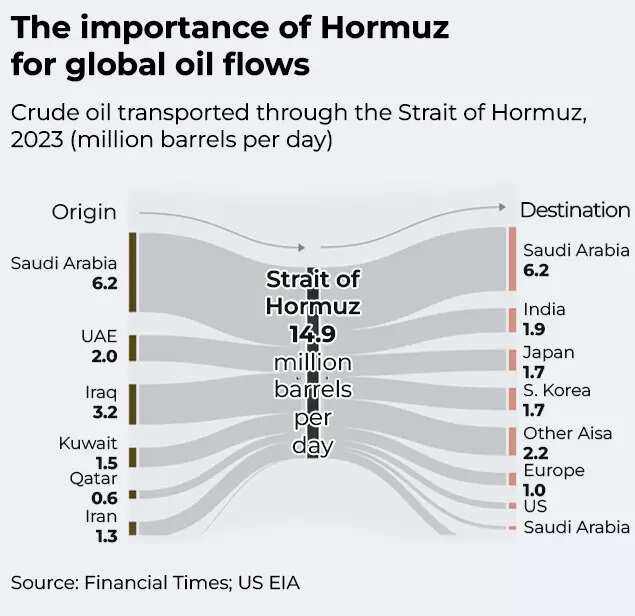
Even is the oil facilities are not directly damaged, a shutdown of the shipping route could expose a significant portion of global supply. The report estimates that in an event of full closure, about 16 million barrels per day of oil flows could be affected, despite the availability of some pipeline routes designed to bypass the strait.And the risks are not limited to crude oil shipments with almost 80 million tonnes of LNG exports annually, much of it from Qatar, moving through the passage. Any prolonged disruption could tighten gas supply globally and potentially drive European benchmark gas prices back to levels seen during the 2022 energy crisis.
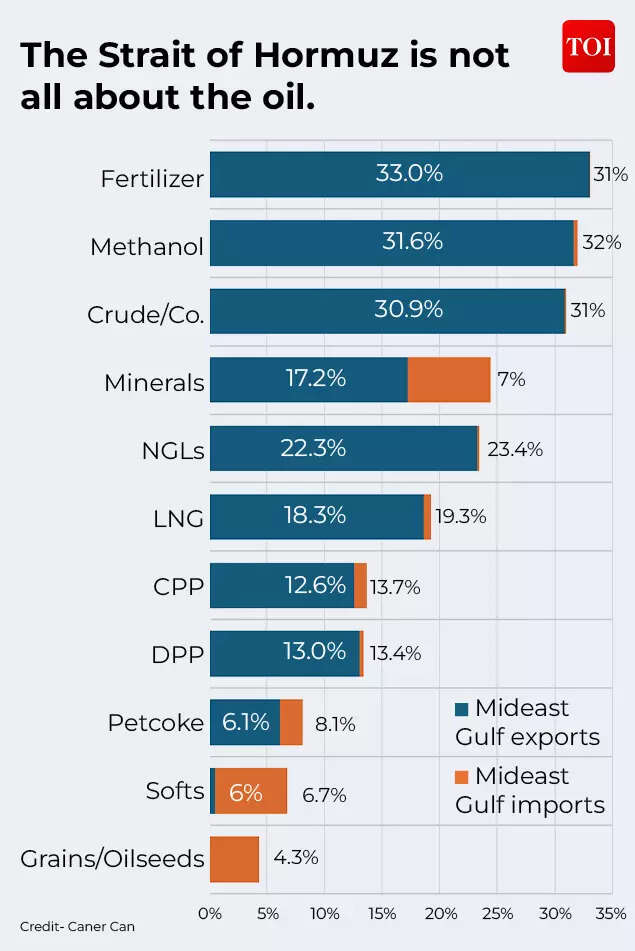
Asian economies stand among the most exposed to such disruptions. Major importers such as China, India, Japan and South Korea depend heavily on oil and LNG shipments that transit through the strategic corridor.While global oil inventories and spare production capacity could help cushion short-term shocks, the report warned that sustained disruption to Gulf shipping routes could trigger sharp volatility in global energy markets and push prices higher across oil, gas and refined fuel products.Market participants and governments are closely watching tanker traffic in the Strait of Hormuz, along with diplomatic and military developments involving the United States, Iran and Gulf nations, to assess whether the current disruptions remain temporary or escalate into a broader energy supply shock.

KARACHI: The Pakistan Stock Exchange rallied on Thursday after Saudi Arabia assured Pakistan of facilitating crude oil shipments through the Red Sea port of Yanbu Port, easing concerns over potential fuel supply disruptions.
The benchmark KSE-100 Index climbed sharply during the trading session, rising 4,439.93 points (2.85%) to reach an intraday high of 160,217.14 points.
Market Recovery
Analysts attributed the market rebound to renewed institutional buying and improving investor sentiment after Saudi assurances on oil supplies.
Market expert Ahsan Mehanti, CEO of Arif Habib Commodities, said easing fuel supply concerns played a key role in the recovery.
He added that rising global crude prices, expectations of a new International Monetary Fund loan tranche for Pakistan, and positive economic indicators also boosted investor confidence.
Alternative Oil Route
Pakistan sought an alternative supply route after Iran announced the closure of the Strait of Hormuz, a crucial global oil transit corridor.
Federal Petroleum Minister Ali Pervaiz Malik held talks with Nawaf bin Said Al-Malki, requesting Saudi support for uninterrupted energy supplies.
Saudi authorities reportedly assured Pakistan that oil shipments could be routed through Yanbu, and one crude vessel has already been prepared for dispatch.
Global Oil Market Impact
Oil prices continued to rise amid tensions in the Middle East conflict involving Iran, Israel and the United States.
Brent crude: up 3.26% to $83.99 per barrel
West Texas Intermediate (WTI): up 3.70% to $77.42 per barrel
Energy markets remain volatile as shipping disruptions threaten supply through the Strait of Hormuz, a route that handles nearly 20% of global oil trade.
Analysts say the Saudi assurance helped calm fears about Pakistan’s energy supply chain, contributing to the strong recovery at the PSX.


Aaron Rodgers tears into ex-girlfriends: ‘I got myself into crazy town’

Switzerland’s Calida narrows sales decline, lifts profit in 2025

Nancy Guthrie kidnapping mystery deepens after DNA found in glove

India Us Trade Deal: Fresh look at India-US trade deal? May be ‘rebalanced’ if circumstances change, says Piyush Goyal – The Times of India

What are Iran’s ballistic missile capabilities?

Attock Cement’s acquisition approved | The Express Tribune

-
Business6 days ago
India Us Trade Deal: Fresh look at India-US trade deal? May be ‘rebalanced’ if circumstances change, says Piyush Goyal – The Times of India
-
Business7 days ago
Attock Cement’s acquisition approved | The Express Tribune
-
 Politics1 week ago
What are Iran’s ballistic missile capabilities?
-

 Politics1 week ago
US arrests ex-Air Force pilot for ‘training’ Chinese military
-
 Business1 week ago
Households set for lower energy bills amid price cap shake-up
-

 Fashion7 days ago
Policy easing drives Argentina’s garment import surge in 2025
-

 Sports6 days ago
LPGA legend shares her feelings about US women’s Olympic wins: ‘Gets me really emotional’
-

 Fashion6 days ago
Texwin Spinning showcasing premium cotton yarn range at VIATT 2026