Connect with us

Sports

Real Madrid’s Alonso: ‘Don’t know’ when Mbappé will return

Published

on

Real Madrid’s Alonso: ‘Don’t know’ when Mbappé will return
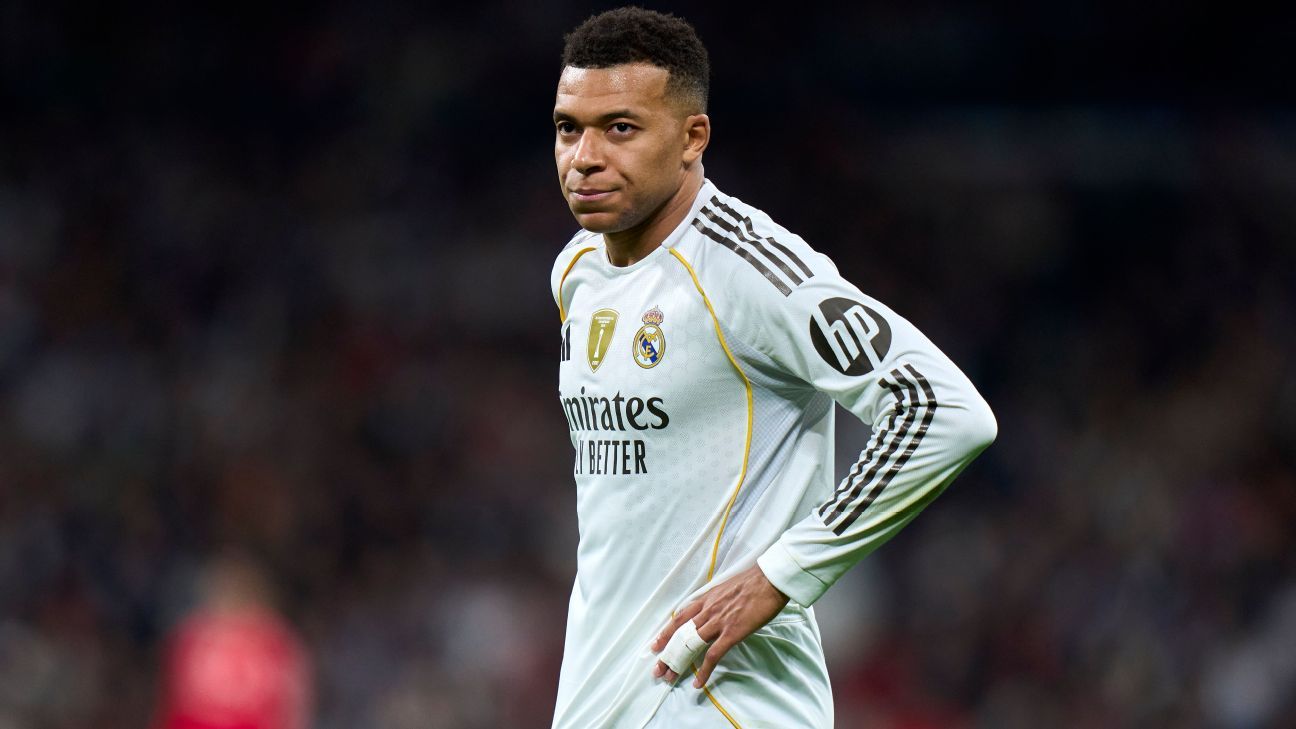

Xabi Alonso has admitted he “doesn’t know” when Kylian Mbappé will return for Real Madrid, saying the club are working to have the star forward back from injury “as soon as possible.”

Madrid confirmed on Wednesday that Mbappé had been diagnosed with a sprain in his left knee, with sources telling ESPN that the France international would miss Sunday’s LaLiga game with Real Betis, and was a major doubt to take part in next week’s Spanish Supercopa in Saudi Arabia.

Mbappé has scored 29 goals in all competitions for Madrid so far this season, but has been troubled by discomfort in recent weeks, missing the Champions League match with Manchester City in December, before returning to play the team’s last three games of 2025.

“We’re going to push to keep the time down,” Alonso said in a news conference on Saturday ahead of the Betis match.

“It’s about feelings. We’ll do everything possible to make [his absence] as short as possible, so he can be ready as soon as possible. But when is that? That’s the question, I don’t know.”

Mbappé had featured in all 18 of Madrid’s LaLiga games this season going into the Betis game, scoring 18 times. In his last match of 2025, he matched Cristiano Ronaldo‘s club record of 59 goals in a calendar year, netting in Madrid’s 2-0 win over Sevilla.

Real will play Atlético Madrid in their Supercopa semifinal in Jeddah next Thursday, before a possible final next Sunday.

“In every game we make an assessment, based on how the player feels, and we take decisions based on the necessities of the game,” Alonso said. “Now we’ll see. We’ll do everything we can to have him back as soon as possible.”

Alonso denied that it was difficult to tell a player like Mbappé that they needed to rest.

“No, managing players who always want to help the team is easy, managing players who are ambitious and always want to win is easy,” he said. “After that it’s my job to take decisions, I accept that.”

Madrid coped well without Mbappé for much of last summer’s Club World Cup, with young forward Gonzalo García, 21, filling in.

LaLiga is back! Post-winter break catch-up, predictions
Madrid great Roberto Carlos has heart surgery
Modric: Mourinho at Madrid ‘made Ronaldo cry’

“It was flexible, with the players we had,” Alonso said on Saturday. “We have to look for the best way of fitting together the pieces … We’ll miss [Mbappé] for sure, not just his goals, but the influence he has.”

Alonso said that Madrid would be “attentive” to the January transfer market, as they look to improve on an inconsistent first half of the season.

“It’s our obligation to always be attentive as to how we can improve,, if possibilities arise,” Alonso said. “But we’re happy with the squad.”


Source link

Continue Reading
Click to comment

Leave a Reply

Your email address will not be published. Required fields are marked *

Sports

Let’s play myth-busters for the NFL playoffs: 14 teams, 14 things that aren’t quite right

Published

on

Let’s play myth-busters for the NFL playoffs: 14 teams, 14 things that aren’t quite right


The NFL playoff field is set, and you know these teams. For months, you’ve been watching them, talking about them and drawing conclusions about them. But some of those conclusions are wrong.

It’s not your fault. The week-to-week nature of the NFL lends itself quite naturally to missing the forest for the trees. You see a team one week, notice something about it, watch that same team a week or so later and notice the same thing again. And then you just figure that thing to be true — that it’s part of what defines that team.

But what we’re doing here — with the 18-week regular season concluded and four months’ worth of data to sort through — is step back, look at the bigger picture and figure out which of the things we think we know about each playoff team might not, in fact, be true. For some of these teams, our conclusions might be encouraging. For some, they might be cause for concern. But hopefully this offers at least a little bit of a different way to look at all 14 playoff teams as they get ready to prove us all right or wrong (or a little of both).

So here are our annual playoff myth-busters, with a big assist from ESPN researcher Paul “Hembo” Hembekides and the ESPN Research team. Let’s start with the NFC, and teams are ordered by seeding.

Jump to a team:
BUF | CAR | CHI | DEN | GB
HOU | JAX | LAC | LAR | NE
PHI | PIT | SF | SEA

NFC

Myth: Their run game isn’t good enough.

The Seahawks finished the season ranked 27th in the NFL in offensive rush EPA, which backs up the seasonlong narrative that they weren’t running the ball consistently well and relied too much on their (admittedly outstanding) defense and wide receiver Jaxon Smith-Njigba. Seattle scored the third-most points of any team in the regular season but finished outside the top 10 in rushing yards per game despite tying for third in rush attempts. Its 4.1 yards per carry was better than only seven teams (although three of those clubs also made the playoffs).

Why it’s a myth: They’ve run the ball a lot better over the second half of the season.

From Weeks 10 through 18, Seattle’s running backs ranked fourth in the league in offensive rush EPA, behind only those of the Ravens, Rams and Patriots. Kenneth Walker III and Zach Charbonnet combined for 2,183 scrimmage yards. Yes, other teams use two-back rotations that were more productive this season. The Rams’ Kyren Williams and Blake Corum combined for 2,315 scrimmage yards. The Steelers’ Jaylen Warren and Kenneth Gainwell had 2,314. But the point is not that Seattle runs the ball better than anyone, it’s that it runs it well enough — and better as the season has gone along.

Smith-Njigba is a brilliant and vital player, but his highest target-share game of the season came in a September loss to the 49ers. The Seahawks’ offense began to ask more of its run game and less of Sam Darnold, Smith-Njigba and the pass game in the second half, and conclusions we were drawing about them in the first half might not hold up in the playoffs.


Myth: Caleb Williams‘ inaccuracy hurts the offense.

The Bears had a dominant run game this season. Their defense excelled at taking the ball away. And Williams — their brilliantly talented second-year quarterback — made some fourth-quarter magic in big wins. But his completion percentage of 58.1 is abysmal and ranked 32nd in the league among qualified starters. In this day and age, it’s tough to imagine a team winning a Super Bowl with a quarterback who isn’t completing 60% of his passes.

Why it’s a myth: Williams has improved significantly at avoiding negative plays.

Williams led the NFL with 40 throwaways, which obviously affect completion percentages but aren’t necessarily a bad thing. Five of the top seven completion percentage games of his season actually came in Bears losses, while they won nine of his 10 worst. He had the league’s second-lowest pressure-to-sack ratio (behind Brock Purdy), his pressure-to-interception ratio was third best, and he threw nine touchdowns when pressured (behind only Justin Herbert‘s 10) to just one interception. Sure, his completion percentage when pressured was 36.4 and surely drags down the overall number. But that doesn’t tell the whole story.

New coach Ben Johnson stressed to Williams when he got the job last year that, while avoiding interceptions was something he did well as a rookie, there were other negative plays he had to get better at avoiding if he and the offense wanted to have success. And Williams is doing an excellent job of staying away from interceptions and sacks, especially when he has faced pressure this season. That’s a benefit to the offense no matter what the overall completion percentage says.

play

2:20

Should the Bears be worried about the Packers matchup?

Damien Woody, Dan Orlovsky and Rex Ryan discuss why the Bears could run into trouble in their wild-card matchup with the Packers.


Myth: Saquon Barkley is the key to the offense.

This time last season, the Eagles were a juggernaut on their way to a Super Bowl title. The key to the whole thing was Barkley’s historic season. He had 2,005 rushing yards, 2,283 total yards from scrimmage and 15 total touchdowns in the 2024 regular season to lead an Eagles offense that was one of the best and most efficient in the league. This season, Barkley’s production dipped significantly, down to 1,140 rushing yards, 1,413 scrimmage yards and 9 total touchdowns. An Eagles team that was fourth in offensive efficiency in 2024 ranked 19th in that same category in 2025.

Why it’s a myth: It’s actually Jalen Hurts.

While last season’s offense seemed to center around Barkley and the Eagles’ ability to generate explosive plays in the run game, this season’s offense seems to much more closely follow the performance of the team’s Super Bowl MVP quarterback. Barkley is averaging 91.5 scrimmage yards in Eagles wins this season and 81.4 in losses. He’s averaging 3.9 yards per carry in wins and 4.7 in losses. Seven of his touchdowns have come in the Eagles’ 11 wins, whereas he has five in losses. In other words, there doesn’t seem to be evidence of a dramatic difference in Barkley’s performance in wins versus his performance in losses.

Hurts, on the other hand, sees a great deal more variance. In Eagles wins, Hurts has a 64.2 QBR, a 5.1 completion percentage over expected (NFL Next Gen Stats), 19 touchdown passes and zero interceptions. In losses, he has a 38.2 QBR, a 0.1 CPOE, 6 touchdown passes and 6 interceptions. Just a lot of evidence to suggest that Philadelphia’s success in 2025 is tied much more closely to Hurts’ performance than it is to what Barkley does.


Myth: They can’t possibly beat the Rams again.

Carolina’s Week 13 home upset of the Rams was one of the more surprising results of the entire regular season. The Rams came in as the hottest team in the league, having won six games in a row to get to 9-2. They had beaten the 49ers, Seahawks and Buccaneers in the previous three weeks and seemed poised to take control of the NFC playoff race. But on that rainy Sunday in Charlotte, Matthew Stafford threw two early interceptions and lost a crucial late-game fumble. Bryce Young threw two fourth-down touchdowns (and one third-down TD pass), and the Panthers got out with a 31-28 victory.

It felt a little fluky at the time, and with the Panthers limping to their division title with an 8-9 record, it feels unlikely to happen again in the wild-card round.

Why it’s a myth: The Panthers can kind of beat anyone.

Sure, they can also lose to anyone. They were 8-9, after all. But Carolina had eight wins as an underdog this season, by far the most in the NFL. (The Steelers, Bears, Jaguars and Falcons each had five.) The Panthers will be the seventh team with a record of .500 or worse to host a wild-card game. Of the previous six, four won the contest.

The 2008 Chargers beat the Colts. The 2010 Seahawks beat the defending Super Bowl champion Saints in the Marshawn Lynch “Beast Quake” game. The Tim Tebow Broncos of 2011 knocked off the Steelers. And the 2014 Panthers beat the Cardinals. The last two teams to host a wild-card game with a regular-season record of .500 or worse did lose — the 2020 Washington Football Team to the Buccaneers and the 2022 Buccaneers to the Cowboys. But the overall record of 4-2 certainly shows it can be done.

Carolina’s big wide receivers were a problem for the Rams’ cornerbacks in the first matchup and could be again if the Panthers can do a good enough job of keeping the Rams’ rush off Young. All I’m saying is it wouldn’t be the most stunning potential upset of the first round.


Myth: Matthew Stafford should win MVP because Drake Maye played a soft schedule.

It appears the MVP race is down to Rams veteran Stafford and Patriots second-year star Maye. The knock on Maye has been that he didn’t beat anyone especially good. The only teams in the playoff field the Patriots beat this season were the Bills (to whom they also lost) and the Panthers (who finished the season with a losing record).

Stafford led the league with 4,707 passing yards and 46 touchdown passes, threw eight interceptions and had a Total QBR of 71.0 — fourth best in the league. Maye had 4,394 passing yards, 31 touchdown passes, 8 interceptions and a league-leading Total QBR of 77.2.

Why it’s a myth: Maye has just simply been better.

Total QBR adjusts for opponent quality in its calculation, so the fact that Maye finished first in the league in that category and Stafford fourth has nothing to do with strength of schedule. It also should matter that Maye played better against the soft parts of his schedule than Stafford did against his. Just look at games against NFC South opponents. The Patriots went 4-0 in those matchups, and Maye turned the ball over a total of three times. The Rams went 2-2 against the NFC South, and Stafford turned it over six times, including the fumble that probably cost the Rams the game against Carolina.

Overall, Maye was considerably better than Stafford in common opponent games. They played six of them. Maye was 6-0 with an 81.6 QBR and a 4.3 touchdown-to-interception ratio. Stafford was 4-2 with a 57.8 QBR and a 2.3 touchdown-to-interception ratio against those teams.

The only number that shows Stafford obviously better than Maye this season is the touchdown passes. But don’t forget that a somewhat stunning 16 of Stafford’s touchdown passes were 4 yards or less (Maye had nine) and eight came from the 1-yard line (Maye had three). Maye also had four rushing touchdowns, while Stafford hasn’t had one since 2022.

Give the award to Stafford if you want, but don’t do it because of relative strength of schedule. Maye had the better year, even once we adjust for that.

play

1:25

Why Orlovsky is ‘slightly’ worried about Bo Nix in playoffs

Dan Orlovsky and Rex Ryan break down the concerns they have for Bo Nix and the Broncos heading into the playoffs.


Myth: Christian McCaffrey just had his best season as a 49er.

In a season in which it felt like every significant player on the 49ers missed time with injury, McCaffrey did not. He played in all 17 games and was second in the league in yards from scrimmage with 2,126. That included 1,202 rushing yards on 311 carries and 924 receiving yards on 102 catches. Only five players in the league caught more passes than McCaffrey; four were wide receivers and one was a tight end. The next highest reception total among running backs in 2025 was Bijan Robinson’s 79.

McCaffrey also had 17 total touchdowns (10 rushing, seven receiving), which put him third in the league behind Jonathan Taylor and Jahmyr Gibbs. Simply put, CMC was a rock when the Niners needed one. The only year in his career in which he posted more scrimmage yards was his 2019 season in Carolina, and the only two years in which he had more touchdowns were 2019 and his 2023 season in San Francisco.

Why it’s a myth: Well, 2023 happened … but his efficiency also wasn’t great this season.

McCaffrey averaged only 3.9 yards per carry this season. That figure ranked 39th in the NFL, right behind Isiah Pacheco and ahead of Chuba Hubbard. And the 49ers’ run game was very average, ranking 22nd in rush EPA. McCaffrey’s contributions as a receiver are what made his season special and helped win fantasy leagues and drag the banged-up 49ers into the playoffs. But overall, his 2025 season doesn’t hold a candle to 2023.

The starkest difference is in early-down efficiency. On first and second down in 2023, McCaffrey averaged 5.4 yards per carry, had 1,337 rushing yards and scored 14 rushing touchdowns. This season, those same numbers were 3.9 yards per carry, 1,064 rushing yards and 7 rushing touchdowns. Workmanlike, for sure, but not spectacular.

Again, McCaffrey was what the 49ers needed him to be this season — a volume eater and target mismatch in the passing game. But he’s not the explosive early-down difference-maker that he was a couple of years ago when the 49ers made it all the way to overtime in the Super Bowl.


Myth: They don’t have a true No. 1 wide receiver.

Packers coach Matt LaFleur had that famous quote a little over a year ago about how he wants “to vomit” when people ask him about his No. 1 wide receiver. LaFleur’s point was that it doesn’t matter — that he and QB Jordan Love trust whoever’s out there and that he kind of likes having an interchangeable group of WRs that he can mix and match depending on the week and the opponent.

The Packers didn’t have a single receiver with more than 55 catches, 724 yards or 6 touchdowns in 2025. Last season, their team leaders in those categories had 55 catches, 857 yards and 7 touchdowns. The year before it was 64, 793 and 8. You get the idea.

Why it’s a myth: Christian Watson.

Watson missed the first six games of this season while recovering from a knee injury, which has been his biggest problem as a pro. He returned around the same time that the Packers lost tight end Tucker Kraft to a season-ending injury and helped fill in a lot of the explosive-play element their offense lost when Kraft went down. Love’s QBR is 77.7 when Watson is on the field and 69.5 when he’s not. His completion percentage over expectation is 5.5% when Watson is on the field and 2.5% when he’s not, per Next Gen Stats. His touchdown-to-interception ratio is 5.5 with Watson and 3.0 without. And in the 10 weeks this season in which Watson has played, Love’s QBR of 76.7 is the second best in the NFL, behind only Purdy.

The 34th pick in the 2022 draft, Watson has the profile of a No. 1 WR. Injuries have kept him from consistently performing like one, but when he’s out there, the effect he has on Love and the offense makes a strong case that he is a WR1.

AFC

Myth: Their record in close games is going to catch up with them.

The Broncos were 11-2 this season in games decided by eight points or fewer. They are proud of this. They do not view it as luck, and coach Sean Payton has said as much in news conferences. Players on the team have told me when I’ve covered their games this season that this was a major point of emphasis in their offseason. They were 2-6 in one-score games last season and wanted to be the kind of team that finished close contests off. They believe they’re better equipped than their opponents to stay strong in the fourth quarter and make game-deciding plays in game-deciding moments — especially in home games at Denver’s high altitude.

All of that might be true, but decades’ worth of data says this is the kind of thing that’s prone to regression and won’t stay the case if we give it long enough. Just look at the Chiefs, who went 11-0 in one-score games last season (12-0 if you count the playoffs) and were 1-9 in one-score contests in 2025. If it can catch up to Patrick Mahomes and Andy Reid, you have to think it could catch up to anyone.

Why it’s a myth: It isn’t the 2026 season quite yet.

The natural regression to the mean when it comes to a team’s record in one-score games doesn’t have to happen in the same season. Over the past 10 seasons, 11 of the 20 teams to participate in the Super Bowl have had winning percentages better than .700 in their one-score games in that regular season. I just mentioned the Chiefs, but the Eagles — the team that beat them in the Super Bowl — were also 8-2 in one-score regular-season games in 2024. In 2022, when those same two teams met in the Super Bowl, the Chiefs had been 7-3 and the Eagles 7-1 in one-score games that regular season. The last Broncos team to win the Super Bowl, going back 10 years, was 9-3 in one-score games that regular season. The Panthers team they beat in that Super Bowl had gone 7-1 in one-score games.

Payton’s point has seemed to be that there’s some sort of art to winning close games, and that really good teams are just better at it. There’s also a mentality a team can develop over the course of a season that convinces it that it’s good at such a thing, and that could help in the critical moments in a league in which the week-to-week margins are so small. Point is, we have a lot of history that tells us teams that are great in one-score games can and do get to the Super Bowl.

play

2:04

Stephen A.: The Steelers got lucky in win over Ravens

Stephen A. Smith explains why his enthusiasm for the Steelers is tempered after they defeated the Ravens to win the AFC North.


Myth: The Patriots’ run defense is going to be a liability in the playoffs.

New England’s run defense was a big talking point early in the season. Until Tampa Bay’s Sean Tucker got 53 yards against the Pats in Week 10, no opposing running back had reached 50 rushing yards in a game. From Weeks 1 through 11, they ranked fifth in the NFL with 2.2 yards allowed before first contact per rush and 14th with a defensive rush success rate of 57.7%.

But from Weeks 12 through 17, the Patriots had one of the worst run defenses in the league. Over that six-week stretch, New England ranked 31st with 3.0 yards before first contact allowed per rush and 32nd with a 45.2% defensive rushing success rate. A team such as Buffalo, which rushed for 118 yards in its Week 5 loss to the Pats and 168 in its Week 15 victory in Foxborough, could be positioned to take advantage of a weakened Pats defense in a postseason matchup.

Why it’s a myth: Milton Williams.

The big defensive tackle signed a four-year, $104 million deal with the Patriots in March in free agency. He got injured in the team’s Week 11 game against the Jets and didn’t return until Sunday’s season finale against the Dolphins. That likely explains a lot about why the Patriots struggled so badly against the run from Weeks 12 through 17. New England spent big to sign Williams, who was drawing interest from multiple teams, and the numbers when he’s on the field vs. when he’s not indicate why that was a good idea — and why his return bodes extremely well for New England’s chances of shoring up that run defense in the playoffs. The Pats also expect to have injured linebacker Robert Spillane back in time for the postseason, which will help even more.


Myth: Trevor Lawrence is fixed and one of the best QBs in the league.

Lawrence threw 15 touchdown passes against just one interception in his final six games of the regular season. The Jaguars won their last eight games to secure a division title, and entering Sunday, they were still in position to potentially get the 1-seed in the AFC playoffs (though they did not). The first pick in the 2021 NFL draft, Lawrence appears to finally be living up to his potential under first-year coach Liam Coen and has led the Jaguars to their second 13-win season in team history — first this century.

Why it’s a myth: The stats say Lawrence is pretty much the same guy he has always been.

Lawrence’s Total QBR for the season was 58.3, 15th best in the league and just a smidge ahead of where he has always been. From 2022 to 2024, his year-by-year Total QBR numbers were 56.1, 56.9 and 56.1. His completion percentage over expectation (Next Gen Stats) last season was minus-4.0, which ranked 33rd in a 32-team league. This year? It was minus-2.7, which ranked 28th.

Now, this isn’t a criticism. Heck, the guy who’s 33rd in CPOE is Caleb Williams, and his team is the No. 2 seed in the NFC playoffs. But the idea that Lawrence is playing better than he ever has isn’t supported by the underlying numbers. Coen should be given credit for figuring out the whole picture around him and putting him in an offense that minimizes his weaknesses and maximizes his strengths. The Jaguars’ rushing differential has seen the greatest year-over-year improvement of any team in the league. They were outgained by 525 rushing yards last season, and their rush differential was plus-501 this season.

Lawrence is the same player he has always been, just with a better structure around him. It’s not necessarily that he’s fixed; it’s that maybe the Jaguars are.


Myth: This is still a classic Steelers defense.

T.J. Watt returned from a punctured lung for the regular-season finale against the Ravens. Cameron Heyward played inspired football Sunday night at age 36, looking determined to make sure this wasn’t his or Aaron Rodgers‘ final game. Nick Herbig. Alex Highsmith. Patrick Queen. Jalen Ramsey. The names, man. The names give it the feel of a vintage Steelers, big-play defense that can get after quarterbacks and get the big stops in the big moments.

Only five teams in the league had more sacks than the Steelers’ 48. Only three had more takeaways than their 27.

Why it’s a myth: This team is way too reliant on sacks and turnovers.

The Steelers ranked 14th in the league in opponent points allowed per drive at 2.1 — which is fine, kind of middle of the pack. On drives on which they didn’t record a sack, however, that average points per drive goes up to 2.5, which ranked 23rd in the league. Their defense basically doesn’t win unless it gets a sack.

The team also isn’t great at scoring when it doesn’t generate a turnover. Pittsburgh scored the 15th-most points in 2025, but it was third in scoring off turnovers behind only the Jaguars and Bears. A whopping 25.4% of Pittsburgh’s points this season came off turnovers. Only the Browns (25.8%) had a higher such percentage, and they scored only 279 points (the Steelers had 391).

There is no doubt the Pittsburgh offense needs its defense’s help. And the defense provided enough to get this team to 10 wins and a division title when Baltimore’s rookie kicker missed from 44 yards Sunday night. But it feels like another season in which the playoff competition is going to make Pittsburgh look very run-of-the-mill.


Myth: C.J. Stroud isn’t the same player he was two years ago.

In 2023 when the Texans snagged the division title, Stroud was Offensive Rookie of the Year and finished in the top 10 in MVP voting. He threw for 4,108 yards that season, along with 23 touchdown passes and only five interceptions. But his production dipped in 2024. And this season, he missed three games with a concussion and is averaging about the same number of passing yards (217.2) as he did last season (219.2). He also threw just 19 touchdowns and eight interceptions.

Why it’s a myth: He’s still great when it matters and still isn’t getting much help.

Stroud had the seventh-best QBR in the fourth quarter and the seventh best on third down in the entire league. He also had the seventh-best QBR when outside the pocket, which is of particular importance because the overhauled Houston offensive line still isn’t doing much to protect him. That unit ranked 30th in pass block win rate, ahead of only the Lions and Chargers.

The OL also ranked dead last in run block win rate, which backs up the numbers that say the Texans’ run game isn’t helping anything, either. Houston’s 108.9 rushing yards per game ranked 22nd in the league. It ranked 28th in the league at 3.9 yards per rush and 24th in the league in yards before first contact per rush.

The Texans are winning with defense, but when their offense has a good game, it tends to be because of Stroud, not in spite of him.


Myth: Their run defense will keep them from getting to the Super Bowl.

Buffalo has struggled to stop the run all season. Only the Commanders, Giants, Jets and Bengals allowed more rushing yards this season than the 136.2 per game the Bills did. No one allowed more rushing touchdowns than the 24 Buffalo allowed, either. And it was 26th in defensive rush success rate and 31st in defensive rush EPA. No matter how you slice it, the Bills’ run defense this season was terrible.

Why it’s a myth: They might not have to play a great running team in the playoffs.

With Baltimore failing to make it into the field, the Patriots are the only playoff team besides Buffalo that ranked in the top 10 in the NFL in rushing yards per game. (And they had to run for 243 in Sunday’s regular-season finale to get there.) The Chargers ranked 12th, the Broncos 16th, the Jaguars 20th, the Texans 22nd and the Steelers 26th.

Buffalo wouldn’t be the worst run defense ever to reach the Super Bowl. (The 2006 Colts allowed 173 rushing yards per game in the regular season and were worse across the board in just about every metric.) But it would be one of the worst. The good news is, there isn’t a team in the AFC that’s nearly as good at running the ball as the Bills are.


Myth: They ask too much of Justin Herbert to carry their offense.

The story of the Chargers’ season has centered on their offensive line injuries. Both starting tackles, Rashawn Slater and Joe Alt, have been out with season-ending injuries for quite some time. Even though he sat out the final game, Herbert was contacted 206 times — 34 more times than the next most contacted QB in the league (Maye). Only Geno Smith and Cam Ward were sacked more than the 54 times Herbert was dropped. He threw the most touchdowns when pressured (10) of anyone in the league, but only Joe Flacco and Sam Darnold threw more interceptions (7) when pressured than Herbert’s six.

Why it’s a myth: Their offense isn’t that pass-heavy.

The Chargers dropped back to pass on 48.8% of their offensive plays, the 20th-highest rate in the league. Heck, the Steelers had a higher percentage of pass plays than the Chargers. Just 63.6% of their offensive yardage came via the pass, which was also the 20th-highest figure in the league.

The Chargers ranked 12th in the league in rushing yards per game, even with their top two running backs having missed huge chunks of the season with injury. They’re just kind of a middle-of-the-road offense overall. Herbert does get hit too much, but it’s not because they’re putting him in an unusual number of vulnerable situations.


Source link

Continue Reading

Sports

Sources: WR Tate leaving Buckeyes for NFL draft

Published

on

Sources: WR Tate leaving Buckeyes for NFL draft


Ohio State wide receiver Carnell Tate is leaving school early and declaring for the NFL draft, sources told ESPN on Tuesday.

Tate is projected as a top-10 pick in ESPN analyst Mel Kiper’s current rankings, the latest in a gilded line of high-end Buckeye receivers. Tate caught 51 passes for 875 yards and nine touchdowns for Ohio State this year.

He did that in 11 games, as he missed three games because of injury. He flashed dominance throughout the year, as he had 183 yards receiving against Minnesota, five catches for 82 yards and a touchdown against Michigan, and 124 yards and a touchdown against Penn State.

Tate, who is 6-foot-3, 195 pounds, finishes his three-year career with 1,872 yards receiving and 14 touchdowns. In a program filled with the sport’s top wide receiver prospects, he played in 13 games as a true freshman and flashed star power as a sophomore with 52 catches for 733 yards on Ohio State’s national title winning team.

Tate’s sophomore year included seven catches against Texas for 87 yards in the College Football Playoff semifinals.

He projects as the latest OSU first-round receiver; over the past four years, there have been five first-rounders. Ohio State’s run includes both Garrett Wilson and Chris Olave in 2022, Jaxon Smith-Njigba in 2023, Marvin Harrison Jr. in 2024 and Emeka Egbuka last year.

Last year, OSU was the first team in the common draft era to have wide receivers picked in the first round in four straight years. Tate projects to extend that unprecedented run.

A veteran NFL scout summed up Tate to ESPN this way: “He’s very smooth, fast and a good athlete. He has good hands and ball skills, as he reminds me of Pro Bowl receiver Chris Chambers, but a taller version, coming out of college.”


Source link

Continue Reading

Sports

Browns in reset mode: Here’s what we know after ouster of Kevin Stefanski

Published

on

Browns in reset mode: Here’s what we know after ouster of Kevin Stefanski


Less than six months ago, coach Kevin Stefanski had a strong show of support from Cleveland Browns owners Dee and Jimmy Haslam despite the organization attempting to rebound from a 3-14 campaign during the 2024 season.

But Jimmy Haslam said another three-win season wouldn’t cut it.

“We’ve got to do better. I think we’ll know what better looks like,” Haslam said.

Ultimately, a 5-12 record in 2025 wasn’t better. The Browns on Monday announced the firing of Stefanski, who guided Cleveland the past six seasons and led the franchise to two playoff appearances while also winning two NFL Coach of the Year awards (2020 and 2023). Stefanski leaves Cleveland with a 45-56 regular-season record and a 1-2 record in the postseason.

In Monday’s statement announcing their decision to fire Stefanski, the Haslams also stated that general manager Andrew Berry would be retained and would lead the search for the team’s 11th head coach since 1999.

What’s next for the Browns as they enter an offseason stocked with two first-round picks in the 2026 NFL draft and a quarterback situation that is unsettled at best? Browns reporter Daniel Oyefusi and senior NFL insider Jeremy Fowler answer all the pressing questions in the wake of Stefanski’s firing.


What led the Browns to move on from Stefanski?

At the start of training camp in late July, the Haslams acknowledged the team would have to take its time rebuilding its foundation after a three-win finish in 2024. But in a statement announcing the firing of Stefanski, the owners said that the results over the past two seasons — a combined 8-26 record — “have not been satisfactory.”

The issues were especially prominent on offense, which has been Stefanski’s specialty. Under Stefanski, the Browns used an NFL-high 13 different starting quarterbacks, and per ESPN Research, Browns QBs under the coach have ranked bottom five in Total QBR, yards per attempt and completion percentage.

Cleveland struggled to find a consistent answer at quarterback, and its core offensive players began to age such as offensive lineman Joel Bitonio, Wyatt Teller and Jack Conklin, as well as tight end David Njoku and running back Nick Chubb. However, Stefanski wasn’t able to steer the unit to support an elite defense the past two seasons, both of which saw him give up playcalling duties.

Haslam on Monday said there is still work to do in rebuilding the roster — especially on offense — but he believed this year’s team was capable of winning more games. — Oyefusi


Why is Cleveland keeping general manager Andrew Berry?

Berry, 38, will not only remain in his current role, but he will lead the search for the franchise’s next head coach. The Haslams, in their statement, noted the “exciting young core to build upon,” which Berry has been responsible for building. He delivered a productive 2025 draft class and also netted Cleveland an extra first-round pick in 2026 by trading back from the second overall pick to No. 5 with the Jacksonville Jaguars on the opening night of the 2025 draft.

Haslam on Monday also referenced other personnel moves made by Berry, including the free agent signing of defensive tackle Maliek Collins, finding breakout kicker Andre Szmyt and the in-season trade for cornerback Tyson Campbell.

With Stefanski out, there is potentially a stronger spotlight on Berry, who arrived in Cleveland with Stefanski in 2020. He’ll need to continue to build on both sides of the ball and, of course, find a quarterback. — Oyefusi


Who are the potential candidates for the job?

One factor in determining the Browns’ direction is seasoned defensive coordinator Jim Schwartz, whose second-ranked defense should be stout once again in 2026. The Browns could push to retain Schwartz and pair him with an offensive-minded head coach. Jimmy Haslam said Monday the organization thinks highly of Schwartz and would like to keep him in the building. Remember: Maximizing a talented 2025 draft class filled with intriguing offensive options is paramount.

So, certainly the Browns could interview the likes of Seahawks offensive coordinator Klint Kubiak, Bills offensive coordinator Joe Brady, Chiefs offensive coordinator Matt Nagy and Bengals offensive coordinator Dan Pitcher, a possible sleeper for the job. Some of the hottest coaching candidates are defensive coordinators, so expect candidates such as the Rams’ Chris Shula, Packers’ Jeff Hafley, Broncos’ Vance Joseph and Chargers’ Jesse Minter.

Haslam said he doesn’t have a preference on finding a coach who specializes in either offense or defense but is looking for a good leader to build a strong culture. — Fowler and Oyefusi


How likely is Stefanski to land another head coach job this offseason?

Several sources familiar with the leaguewide hiring process expect Stefanski to become a viable head coaching candidate — quite possibly among the most viable. This year’s field is the most wide open in years, without a clear-cut top target. Having head coaching experience helps. As one high-ranking NFL executive put it, two-time coach of the year recipients don’t come available very often. Doing so in Cleveland only amplifies that feat.

The Tennessee Titans and New York Giants will likely want to speak with Stefanski. They’ve had weeks to research potential candidates and anticipated Stefanski could become available. One ding on Stefanski’s résumé is his relinquishing of offensive playcalling in back-to-back years, taking the sheen off his offensive cachet. But Stefanski lacked elite offensive weapons at his disposal the past two years, to be sure, and the burdensome Deshaun Watson contract inhibited progress for the entire operation. Teams with job openings will understand all of that. — Fowler


How will the coaching change impact the Browns’ QB situation?

This is a last-place AFC North team that needs to start over at the most important position regardless of whom it hires. Perhaps Shedeur Sanders can be a bridge option in 2026? But having two first-round picks presents a unique chance to get a premier passer if the draft falls right. Expect the Browns to explore free agent options such as Daniel Jones or Malik Willis.

Watson enters the final year of his record-breaking contract. While it feels like the relationship is over, he is an option and was once the NFL passing leader. Putting him on the field again could affect the Browns’ cap savings from the insurance policy the team took out on his $230-million contract. — Fowler


Source link

Continue Reading

Trending