

Politics
UN chief Guterres raises concerns about instability in Venezuela, legality of US operation

- UN Security Council meets before Maduro was due in court.
- Colombia calls US violation of Venezuela’s sovereignty.
- Guterres says ready to support Venezuela in finding peaceful.
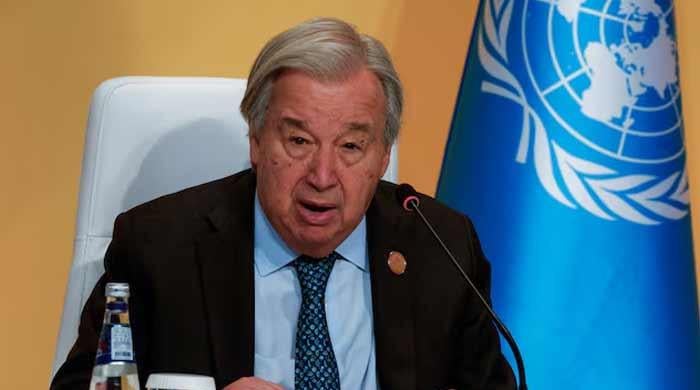
United Nations Secretary-General Antonio Guterres raised concerns on Monday about a possible intensification of instability in Venezuela after the US capture of the Latin American country’s president Nicolas Maduro.
The 15-member Security Council met at UN headquarters in New York just hours before Maduro was due to appear in a Manhattan federal court on drug charges including narco-terrorism conspiracy. Maduro has denied any criminal involvement.
“I am deeply concerned about the possible intensification of instability in the country, the potential impact on the region, and the precedent it may set for how relations between and among states are conducted,” Guterres said in a statement delivered to the council by UN political affairs chief Rosemary DiCarlo.
Guterres called on all Venezuelan actors to engage in an inclusive and democratic dialogue, adding: “I welcome and am ready to support all efforts aimed at assisting Venezuelans in finding a peaceful way forward.”
He also expressed concern that the US operation to capture Maduro in Caracas on Saturday did not respect the rules of international law.
‘Act of aggression’
Colombia, which requested Monday’s meeting, condemned the US operation as a clear violation of the sovereignty, political independence and territorial integrity of Venezuela.
“There is no justification whatsoever, under any circumstances, for the unilateral use of force to commit an act of aggression,” Colombian UN Ambassador Leonor Zalabata Torres told the council.
“Such actions constitute a serious violation of international law and the United Nations Charter.”
Legal experts have said the US operation was illegal because it lacked UN Security Council authorisation, did not have Venezuelan consent and did not constitute self-defense against an armed attack.
But the United States cannot be held accountable for any violation by the UN Security Council, which is charged with maintaining international peace and security. The United States wields a veto – along with Russia, China, Britain and France — so it can block any action.
The founding UN Charter states that members “shall refrain in their international relations from the threat or use of force against the territorial integrity or political independence of any state.” There are currently 193 members of the United Nations.
US Ambassador to the UN Mike Waltz on Sunday cited Article 51 of the UN Charter, which says that nothing “shall impair the inherent right of individual or collective self-defense if an armed attack occurs against a member of the United Nations.”
Trump has threatened another strike if Venezuela does not cooperate with opening its oil industry and stopping the flow of drugs. Trump also threatened Colombia and Mexico, and said Cuba’s communist government “looks like it’s ready to fall.”

- US refrains from commenting on alleged Russian support.
- Officials say information includes locations of US warships.
- Russia says it was in dialogue with representatives of Iran.
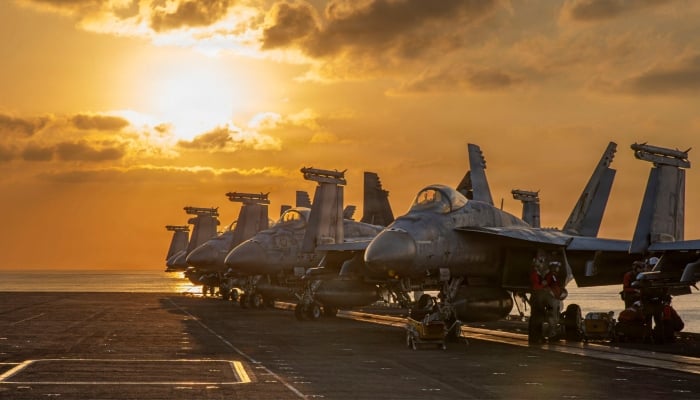
Russia is providing Iran with targeting information that includes locations of US warships and aircraft in the Middle East, the Washington Post reported on Friday, citing three officials familiar with the intelligence.
The extent of Russia’s support to Iran was not entirely clear, but the Iranian military’s own ability to locate US forces has been degraded since the US and Israel launched strikes against Tehran last week, the Washington Post reported.
The war has since escalated, triggering retaliatory strikes by Iran, and ensnared its neighbours as it seeks to impose a high cost on the US, Israel and their allies.
The US military has identified six reserve soldiers killed in Kuwait when a drone slammed into a US military facility in Port Shuaiba. Trump and other senior officials have warned the conflict will likely result in more US military deaths.
A White House spokesperson did not directly comment on the alleged Russian support to Iran.
“The Iranian regime is being absolutely crushed. Their ballistic missile retaliation is decreasing every day, their navy is being wiped out, their production capacity is being demolished, and proxies are hardly putting up a fight,” White House spokesperson Anna Kelly said in a statement, responding to questions from Reuters.
Russia was in dialogue with representatives of Iran’s leadership, the Kremlin said on Friday. It declined to provide details when asked by reporters whether Moscow was helping Tehran.
The conflict has been an unexpected shot in the arm for Russia, with a significant bump in demand for its oil and gas, boosting exports battered in recent years by sanctions linked to its war in Ukraine. The United States has given Ukraine intelligence information during its war with Russia.
The Russian Embassy in Washington and Russia’s mission to the United Nations in New York did not immediately respond to requests for comment.

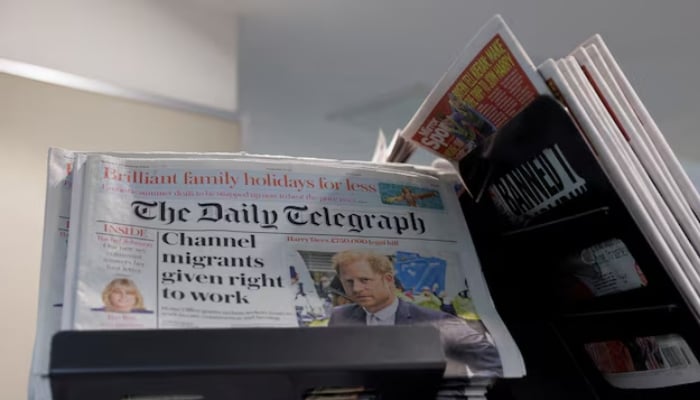
German media group Axel Springer on Friday said it had agreed to buy Britain’s Telegraph Media Group for 575 million pounds ($766.3 million) in cash, bringing to an end a prolonged period of uncertainty over the newspaper’s ownership.
The deal gatecrashed Daily Mail owner DMGT’s attempt to buy its broadsheet rival, which had been facing regulatory probes in Britain amid concerns about media plurality.
Axel Springer said it would preserve the Telegraph‘s legacy while providing a platform for expansion, including in the US, and reaffirmed its commitment to “high-quality, independent journalism” and media plurality in Britain.
After buying Politico in a deal valued at around $1 billion in 2021, the Telegraph purchase becomes Axel Springer’s second-largest investment since its founding in 1946, following an earlier failed attempt to acquire the paper in 2004.
‘Swift and efficient’ negotiations
Mathias Dopfner, Axel Springer’s CEO, said owning the Telegraph was “a privilege and a duty”.
He said the group aimed to grow the title while preserving its character and helping it become “the most read and intellectually inspiring centre-right media outlet in the English-speaking world”.
He acknowledged Telegraph staff had faced a prolonged period of uncertainty and said that the publisher intended to “bring that uncertainty to an end”.
The company credited New York Sun publisher Dovid Efune for his support in the deal.
Efune led a consortium with Axel Springer to bid for the titles last month, but Axel Springer concluded the deal alone.
RedBird IMI said it was pleased to have reached an agreement following “swift and efficient” negotiations.
“With the strength of their commercial offer and a straightforward regulatory path to ownership, we believe that Axel Springer is well placed to take the Telegraph forward into its next chapter,” RedBird said in a statement.
The companies said they were now working with the British government to obtain the necessary approvals.
Culture minister Lisa Nandy’s decision last month to issue a public-interest intervention notice sent DMGT’s deal to regulators, which were examining the implications for media plurality and competition.
Nandy’s office did not immediately respond to a request for comment.
Long-running ownership dispute
The deal brings an end to a saga that began in June 2023, when Lloyds Banking Group effectively repossessed the Telegraph after longtime owners the Barclay family fell into arrears on about 1.2 billion pounds of debts secured against the newspaper group.
RedBird IMI took control after paying off a 600 million pound loan owed to Lloyds, but the titles remained in limbo as Britain moved to block foreign state involvement in national newspapers, forcing it to reverse course.
US investment firm RedBird Capital Partners then tried to buy the group, with Abu Dhabi-backed IMI taking a minority position, but the deal collapsed in November 2025.
The bid had been restructured to comply with new rules capping foreign state ownership at 15%, but was withdrawn after a slower-than-expected regulatory process and internal opposition from senior Telegraph newsroom figures.
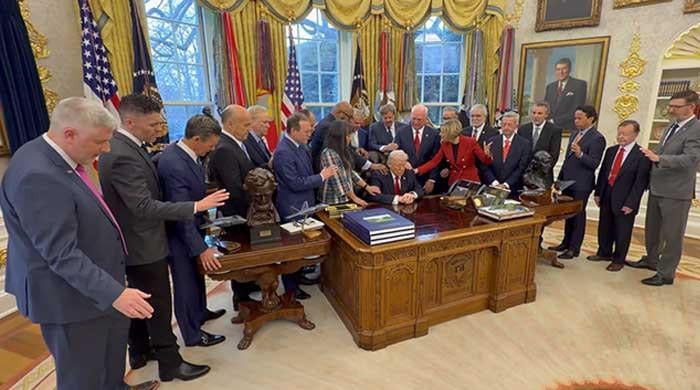
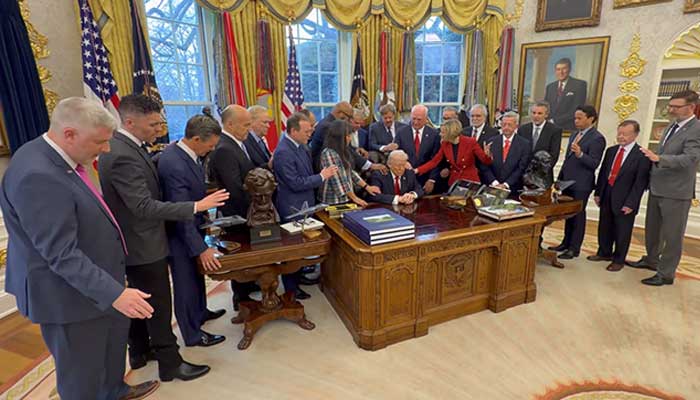
A video released by White House officials has gone viral showing US President Donald Trump surrounded by a group of pastors praying over him in the Oval Office, as US and Israeli military campaign against Iran enter its seventh day.
Critics warn that the offensive risks worsening humanitarian conditions and destabilising an already tense region.
The video, shared by White House Deputy Chief of Staff Dan Scavino, shows a prayer circle of prominent religious leaders from across the US. Trump sits behind his desk with eyes closed as Pastor Tom Mullins leads the ceremony.
Pastor Mullins said: “We are honoured to come before Your presence today, lifting up the arms of our president. We pray for Your continued blessing and favour to rest upon him. We pray for wisdom from heaven to flood his heart and mind and for Your guidance during these challenging times.”
He also prayed for the protection of US troops and for the president to lead the nation with strength and grace.
The strikes have escalated tensions across the Middle East, with analysts cautioning that continuous retaliation could prolong the cycle of conflict.
The US Department of Defence said Operation Epic Fury targets Iran’s missiles, production facilities, and naval assets.
After the death of its Supreme Leader Ayatollah Ali Khamenei in a joint US‑Israeli airstrike on Tehran, Iran has launched a series of retaliatory missile and drone attacks on Israel, Gulf states, including the United Arab Emirates and Qatar, claiming to target American facilities in response.
The US confirmed that six soldiers were killed when a drone struck a facility in Port Shuaiba, Kuwait. Critics say the human and infrastructural toll underlines the urgent need for diplomatic efforts to prevent further escalation.


Us India Oil Waiver: ‘Releases the pressure on other refineries’: US says India’s Russian oil waiver is a short-term step to stabilise global prices – The Times of India
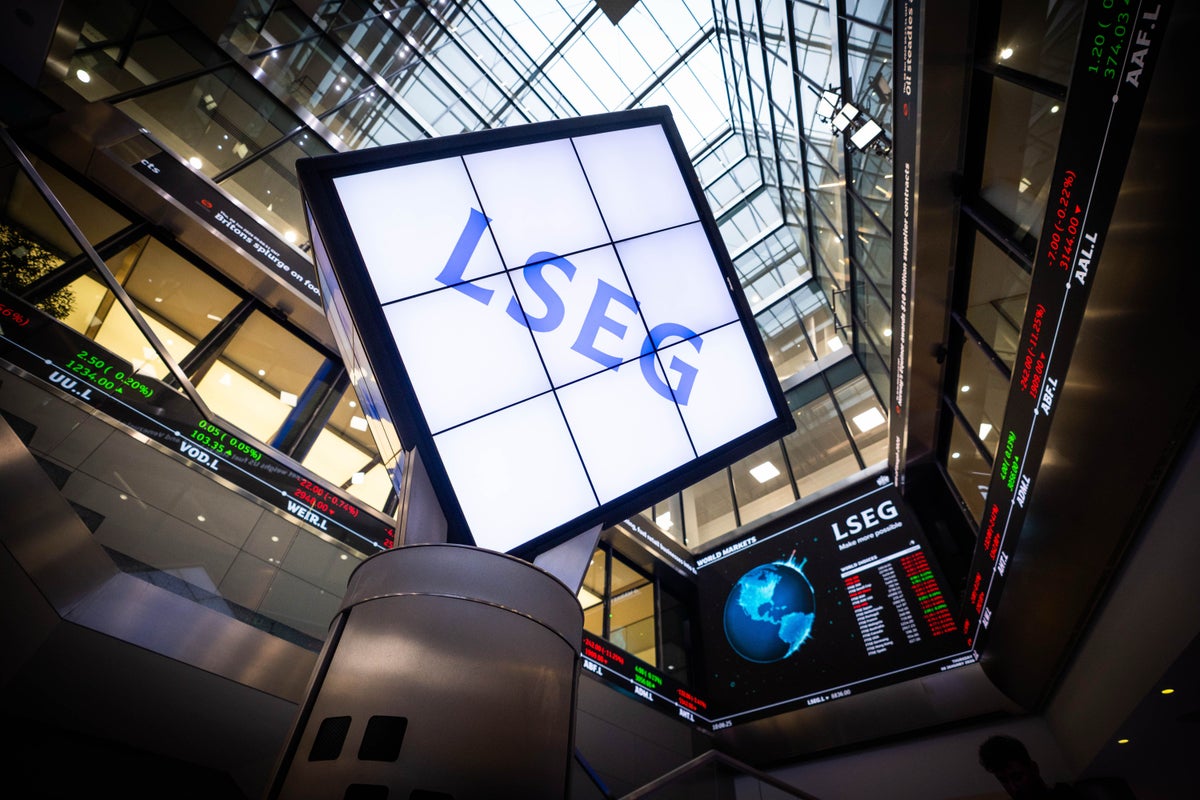
Stock markets tumble as oil prices surge in biggest weekly gain since 2020

WWE NXT star Kelani Jordan taking advice of MMA vet ahead of underground match vs Lola Vice

Attock Cement’s acquisition approved | The Express Tribune

Policy easing drives Argentina’s garment import surge in 2025

India Us Trade Deal: Fresh look at India-US trade deal? May be ‘rebalanced’ if circumstances change, says Piyush Goyal – The Times of India

-
Business1 week ago
Attock Cement’s acquisition approved | The Express Tribune
-
Business1 week ago
India Us Trade Deal: Fresh look at India-US trade deal? May be ‘rebalanced’ if circumstances change, says Piyush Goyal – The Times of India
-
 Fashion1 week ago
Policy easing drives Argentina’s garment import surge in 2025
-

 Politics1 week ago
What are Iran’s ballistic missile capabilities?
-

 Sports1 week ago
LPGA legend shares her feelings about US women’s Olympic wins: ‘Gets me really emotional’
-
 Politics1 week ago
US arrests ex-Air Force pilot for ‘training’ Chinese military
-
 Fashion7 days ago
South Korea’s Misto Holdings completes planned leadership transition
-

 Fashion1 week ago
Texwin Spinning showcasing premium cotton yarn range at VIATT 2026