

Business
Green Synergy Lincoln reunites childhood friends in warm space group


Sarah-May BuccieriLincoln
 BBC
BBCA pair of childhood friends who were reunited at a community support hub have praised the “vital charity” which runs it.
Alan Thompson, 71, first visited Green Synergy in Lincoln two years ago where he met Jane Innes, 70, and they have been “best friends” since.
“We’d gone our own ways and bumped back into each other,” Thompson said.
The charity on Roman Pavement offers offers warm space sessions as well as advice and support.
“Two years ago I wouldn’t have thought of coming to one of these places. Getting to know Jane again has been brilliant,” Thompson added.
Innes, who has attended sessions for more than five years, said she enjoyed talking to people in her community.
“You meet people, neighbours who you’ve known since you were a kid,” she said.
“You try and help people if you can.”


Green Synergy was awarded £5,000 by National Grid to support its warm spaces project which also involves handing out items such as blankets and hot water bottles.
Community engagement co-ordinator Wendy Slater said her team was made up of “real people” which gained the support of people in the city.
“They know they can come here, they trust us,” she said.
Slater said the charity offered various sessions and was “here for whatever people want”.
She said: “I remember being in a situation myself when I felt no one was there to help.
“The rough times I’ve gone through are beneficial to others.”

As well as offering a warm space, Green Synergy supports vulnerable residents living poverty, loneliness and isolation. It also runs community gardens to help improve mental health and wellbeing.
Slater said she felt a sense of pride when someone uses the support to better their life.
She said: “When you see someone walk past the door and they’ve gone from really struggling to have a job.
“I didn’t do it for them, but I gave them that step on the ladder.”
Business
From queues to QR codes: How UPI transformed India’s digital payments, now driving 49% of global real-time transactions – The Times of India
India’s financial ecosystem has undergone a major transformation in recent years, with the Unified Payments Interface (UPI) emerging as the centrepiece of the country’s digital payments revolution. Just ten years ago, financial transactions in the country were slow and largely cash-dependent but now, they are just a touch or click away, enabling instant, seamless and real-time payments across the country. The shift began with early digital infrastructure such as Real-Time Gross Settlement (RTGS) in 2004 and Immediate Payment Service (IMPS) in 2010, which enabled faster transfers but remained limited in reach. A broader transformation followed with the development of foundational systems under the JAM Trinity: Pradhan Mantri Jan-Dhan Yojana, Aadhaar and mobile connectivity, which expanded financial access and digital readiness.
UPI: India’s core digital payments achievement
Launched in 2016 by the National Payments Corporation of India, UPI has become the most significant milestone in India’s digital payments journey. It simplified transactions by linking bank accounts through a Virtual Payment Address, removing the need for account numbers and IFSC codes. Users can send or receive money instantly using only a mobile number, UPI ID and secure authentication. The system operates 24/7, processes payments in real time and works seamlessly across banks and platforms due to full interoperability. The scale of UPI has expanded rapidly. The network has grown from 216 banks in 2021 to 691 banks by January 2026, creating a unified national payments infrastructure. UPI has become the world’s largest real-time payments system by volume, processing:
- 21.70 billion transactions in January 2026 alone
- Rs 28.33 lakh crore in transaction value in January 2026
- 81% share of all retail digital transactions in India
- 49% share of global real-time payment transactions
It has achieved this scale in under 10 years, making it one of the fastest-growing financial infrastructures globally. The International Monetary Fund (IMF) has recognised UPI as the world’s largest real-time payment system by volume.Beyond scale, UPI has significantly expanded financial inclusion by reducing dependence on cash and enabling instant, low-cost transactions. It has brought millions into the digital economy, particularly small merchants, informal workers and rural users. The ecosystem has also expanded with features such as UPI Lite for small payments, UPI AutoPay for recurring transactions and Credit on UPI for access to pre-approved credit lines. Financial institutions and fintech companies have further built lending and repayment solutions on this infrastructure. Security and system strengthening UPI is supported by strong security architecture, allowing transactions without sharing sensitive banking details and providing built-in grievance redress mechanisms. Further strengthening the system, the Reserve Bank of India (RBI) has mandated two-factor authentication for digital payments from April 1, 2026. This requires multiple verification layers such as PINs, biometrics or secure tokens along with OTPs, significantly reducing fraud risks and improving trust in digital transactions. Global recognition and expansion India’s UPI model has gained international recognition from institutions such as the International Monetary Fund and the World Bank for its scale and inclusiveness. Global leaders, including French President Emmanuel Macron, have acknowledged India’s ability to process over 20 billion transactions per month through UPI, a level unmatched globally. UPI has also expanded internationally and is now operational or interoperable in countries including the United Arab Emirates, Singapore, Bhutan, Nepal, Sri Lanka, France, Mauritius and Qatar, enabling cross-border payments and supporting global remittance flows.UPI stands as India’s most significant digital financial achievement, a system that has transformed payments at scale, expanded financial inclusion and positioned India as a global leader in real-time digital transactions. Built in under a decade, it has reshaped how the country pays, saves and participates in the formal economy, emerging as a global benchmark for inclusive financial innovation.
Business
100% road tax waiver for electric cars, new rules for 2, 3 and 4 wheelers – what Delhi govt’s draft EV policy says – The Times of India
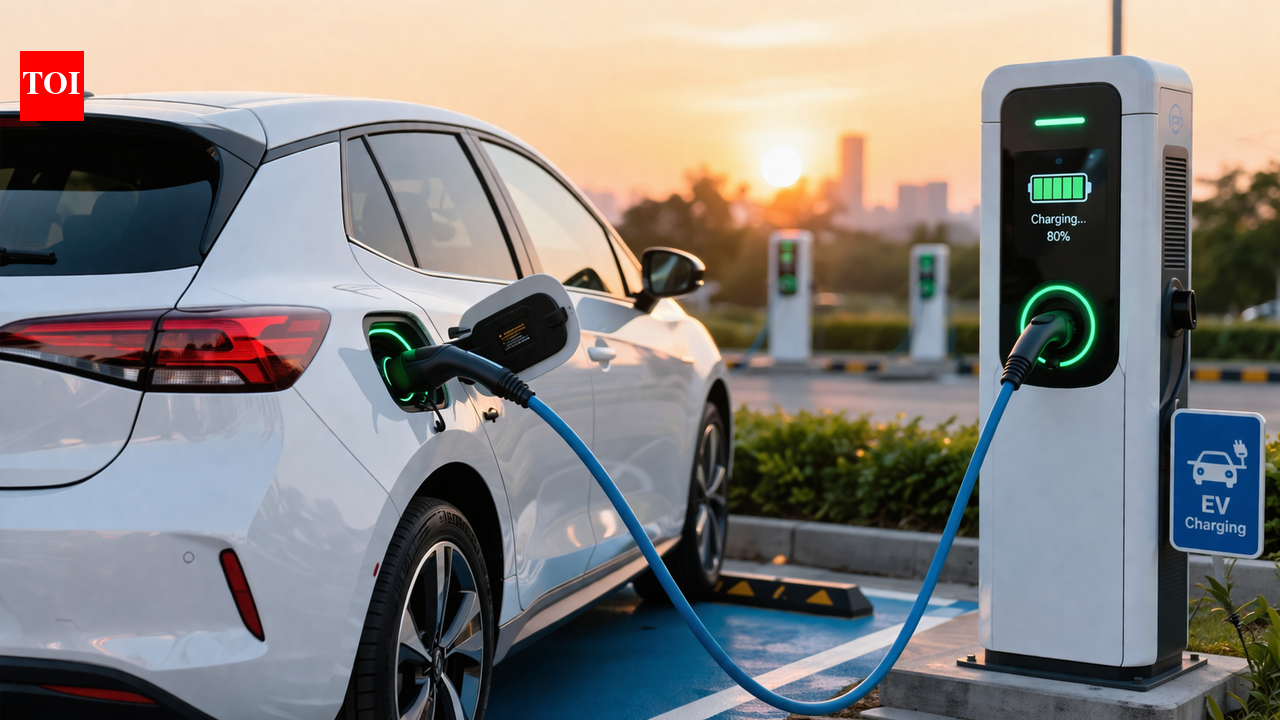
The Delhi government has unveiled the draft Electric Vehicle (EV) Policy 2026–2030, outlining a roadmap to curb air pollution and promote clean mobility in the national capital. With vehicular emissions contributing nearly 23% of the city’s pollution, the policy focuses on accelerating the shift to electric vehicles while strengthening the ecosystem needed to support their widespread adoption.The new draft builds on the earlier EV policy introduced in August 2020, which had a three-year term ending in August 2023 and has since been extended. Officials say the updated framework seeks to expand on previous efforts to curb vehicular pollution and accelerate the transition to cleaner transport. The draft offers incentives like a 100% road tax waiver for electric cars, along with benefits and updated rules for two-, three-, and four-wheelers. It also aims to expand charging infrastructure, build a stronger EV ecosystem, and encourage a gradual move away from petrol and diesel vehicles. Focused on cutting emissions, which make up about 23% of Delhi’s pollution, the policy is linked to the Right to Clean Air under Article 21, highlighting a stronger push to improve air quality in the capital.
Here’s what Delhi government’s new EV draft policy has proposed:
- Full tax exemption for affordable EV carsElectric cars priced up to Rs 30 lakh will get 100% exemption on road tax and registration fees till March 31, 2030. The policy states, “Electric cars with ex-showroom price above (Rs) 30 lakh registered in Delhi shall not be granted any exemption from road tax and registration fees.” However, vehicles priced above this threshold will not be eligible for such benefits. The draft also proposes a 50% exemption for strong hybrid vehicles.
- What’s new for 2 wheelers?
The government has also listed out intensives for two wheelers. To be eligible for incentives, the ex-factory price of an electric two-wheeler must not exceed Rs 2.25 lakh.
In the first year from the date of notification, buyers will receive Rs 10,000 per kWh, capped at Rs 30,000. This incentive reduces to Rs 6,600 per kWh (up to Rs 20,000) in the second year, and further to Rs 3,300 per kWh (up to Rs 10,000) in the third year. - Push for electric three-wheelers
From January 1, 2027, only electric three-wheelers will be allowed for new registrations in Delhi. Furthermore, the Government of National Capital Territory of Delhi (GNCTD) is also set to provide the following incentives to encourage the adoption of electric-rickshaws in the national capital:
- Slow transition to electric vehicles
The draft has proposed phased electrification of school bus fleets. This applies to all school buses, owned, leased, or hired.
10% electric within 2 years
20% within 3 years
30% by March 31, 2030Furthermore, it also mandates electrification of government fleets. All hired or leased vehicles under the Delhi government will be only electric from the date of notification, except exempted categories. New buses inducted by the
Transport Department and DTC will also be electric, with provisions for cleaner alternatives like hydrogen if introduced.Additionally, all new N1 category trucks procured by government bodies and civic agencies will be only electric. Here’s the incentive structure, based on the year of registration:
Year of Registration Incentive Year 1 (from date of notification) Rs 1,00,000 Year 2 (from date of notification) Rs 75,000 Year 3 (from date of notification) Rs 50,000 - Restrictions on conventional fleet operators
Fleet aggregators and delivery service providers will not be allowed to induct new petrol or diesel vehicles after notified timelines, with limited exceptions for certain categories till December 2026. - Expansion of EV charging and swapping infrastructure
Land-owning agencies will identify sites for public charging and battery swapping stations All new buildings and infrastructure projects must be EV charging-ready DelhiTransco Limited will handle planning, deployment, and reliability of charging networks - Battery waste management and recycling push
Strict compliance with Battery Waste Management Rules and Extended Producer Responsibility (EPR) Establishment of battery collection centres across Delhi through partnerships. - Creation of a dedicated EV Fund
A separate EV Fund will be set up under the Transport Department to finance implementation, supported by budget allocations, grants, cess, and other sources. Furthermore, a committee led by the Transport Minister will oversee implementation of the policy and management of the EV Fund. Transport Department to act as nodal agency Environment Department to track emission reductionsUrban bodies to support infrastructure rollout Education Department to ensure compliance and run awareness campaigns. - Fully digital implementation system
All processes including approvals, applications, disbursements, and grievance redressal will be conducted in a paperless digital format. - Public feedback
The government has also invited public feedback for the proposed reforms. In an official circular, the government said, “The draft Delhi Electric Vehicle (EV) Policy 2026 is hereby uploaded on the official website of Transport Department, GNCTD for the information of general public. All stakeholders including general public are invited to submit their feedback/comments within 30 days from the date of publication through the following modes: 1. By e-mail: evpolicy2026@gmail.com 2. By Post: Joint Commissioner (EV), Transport Department, Govt. of NCT of Delhi, 5/9 Underhill Road, Delhi- 110054.”
It further clarified, “All inputs/representations may kindly be submitted only through the above- mentioned modes. In this regard, the public is humbly requested to avoid visiting the office premises, as the same may cause unnecessary crowding. No objections or suggestions received after the expiry of the said period shall be considered.”Earlier this year, on March 20, CM Rekha Gupta flagged off 300 new electric buses and announced the launch of interstate bus services connecting Delhi with Ghaziabad. A foundation stone was also laid for a new Delhi Transport Corporation office near the IP depot.Meanwhile, health minister Pankaj Kumar Singh had noted the pace of adoption, stating, “After our government came to power, we registered more than 1 lakh EV vehicles. There are many reasons why EVs are not advancing further. The previous government did not provide subsidies for EVs. We are providing those subsidies, but if the previous government had given subsidies, perhaps the people of Delhi would have made more efforts to adopt EVs.“

A new government ad campaign is trying to persuade gamers to apply for air safety roles.
Source link


PM Shehbaz meets VP Vance as Islamabad talks begin

Transfer rumors, news: Arsenal eyeing Newcastle’s Gordon

PSL 11: Lahore Qalandars win toss, opt to bowl first against Peshawar Zalmi

-
 Business1 week ago
Jaguar Land Rover sees sales recover after cyber attack
-
Uncategorized1 week ago
[CinePlex360] Please moderate: “Trump signals p
-

 Entertainment1 week ago
Joe Jonas shares candid glimpse into parenthood with Sophie Turner
-

 Tech1 week ago
Our Favorite iPad Is $50 Off
-

 Fashion1 week ago
India-Bangladesh textile trade reset: 5 shocks to watch now
-

 Sports1 week ago
UConn Final Four run could trigger a $50M furniture giveaway for Massachusetts-based Jordan’s Furniture
-
 Business1 week ago
The best cash ISAs and savings accounts in April paying highest interest rates
-
 Business1 week ago
Video: Why Is the Labor Market Stuck?