Connect with us

Business

Govt raises Rs1.09tr via securities | The Express Tribune

Published

on

Govt raises Rs1.09tr via securities | The Express Tribune


KARACHI:

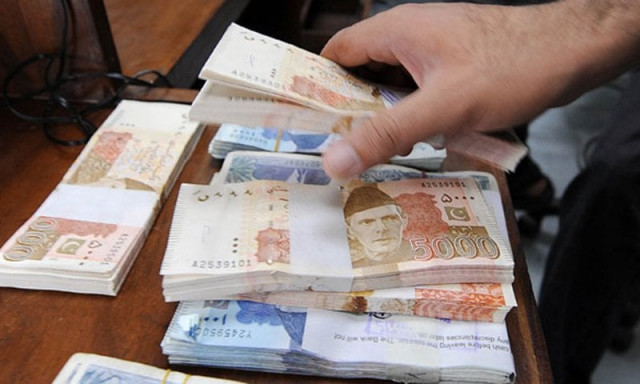
Pakistan’s latest government securities auctions attracted strong investor interest on Wednesday, with the State Bank of Pakistan (SBP) raising a total of Rs1.09 trillion through treasury bills and Pakistan Investment Bonds (PIB) Floaters, while cut-off yields declined across all T-bill tenors.

In the treasury bills auction, the government accepted Rs979 billion against a cumulative target of Rs850 billion, whereas total bids amounted to Rs2.56 trillion.

The government accepted Rs87 billion for one-month T-bills at a cut-off yield of 10.20%, marking a decline of 29 basis points from the previous auction. In the three-month tenor, Rs80 billion was accepted against bids of Rs521 billion, with the cut-off yield easing 34 basis points to 10.15%.

The six-month paper saw acceptance of Rs52 billion out of bids worth Rs404 billion as the cut-off yield fell 32 basis points to 10.16%. The bulk of the auction was concentrated in 12-month papers, where the government raised Rs761 billion against bids of Rs1.38 trillion at a cut-off yield of 10.16%, down 33 basis points from the previous auction.

Weighted average yields were largely in line with the cut-off yields, indicating consistent bidding across tenors.

Meanwhile, in the 10-year Pakistan Investment Bonds (Floating Rate – Semi-Annual) auction, the government accepted Rs108 billion against a target of Rs50 billion, while total bids stood at Rs758 billion. The cut-off price was set at 97.20, translating into a cut-off rate of 10.93%. The spread over the benchmark narrowed to 47 basis points, compared with 63 basis points in the previous auction.

Furthermore, the Pakistani rupee edged up slightly against the US dollar on Wednesday, closing at 280.06 in the inter-bank market compared to 280.07 a day earlier.

Meanwhile, gold prices in Pakistan fell, following international market losses as investors booked profits after a recent rally amid mixed global economic signals. Locally, gold per tola dropped by Rs1,200 to Rs466,762, while 10-gram rate fell by Rs1,028 to Rs400,173, according to the All-Pakistan Gems and Jewellers Sarafa Association.

A day earlier, gold had surged by Rs3,200 per tola, reflecting volatility driven by global price movements. Silver, however, remained stable at Rs8,361 per tola.

Internationally, gold slipped over 1% as profit-taking intensified, though weaker-than-expected US private payroll data bolstered expectations of potential Federal Reserve rate cuts. Spot gold touched $4,445 per ounce, up from an earlier low of $4,422. Analysts noted the market remained range bound, with $4,500 and $4,423 being high and low levels, respectively.

Adnan Agar of Interactive Commodities highlighted that Friday’s US non-farm payroll data could trigger significant price movements, while silver pulled back from recent highs near $82 to around $77.



Source link

Continue Reading
Click to comment

Leave a Reply

Your email address will not be published. Required fields are marked *

Business

How IMAX crushed other theater stocks in 2025

Published

on

How IMAX crushed other theater stocks in 2025


An Imax private screening for the movie “First Man” at an AMC theater in New York on Oct. 10, 2018.

Lars Niki | Getty Images Entertainment | Getty Images

The theatrical industry is in flux — and one stock is rising above the rest.

Imax saw its shares jump more than 44% in 2025, even before the company announced that it had generated a record $1.28 billion at the global box office for the year. Those ticket sales marked a more than 40% increase over 2024 and were 13% higher than its previous record set in 2019.

Meanwhile, shares of fellow theatrical stocks AMC, Cinemark and Marcus Theatres cratered in 2025. AMC was down more than 60%, Cinemark’s stock fell 25% and Marcus Corp., which operates theaters and hotel chains, slumped around 28%.

The sharp declines on Wall Street come as theater operators struggle to grapple with massive changes in the industry.

Domestic ticket sales have rebounded from the record lows posted during the Covid pandemic, but remain about 25% below the the record-breaking $11.8 billion collected in 2018. The 2025 box office fell short of the $9 billion analysts had projected heading into the year, signaling to industry watchdogs that post-pandemic hurdles could be more permanent than anticipated.

“In an environment where consumer spending headwinds and economic concerns forced consumers to be choiceful with their entertainment spending, streaming services continue to represent an attractive option,” Eric Wold, executive director of equity research at Texas Capital Securities, told CNBC.

At the same time that consumer habits have shifted toward the home entertainment market, Hollywood is producing fewer films.

A combination of Wall Street penny-pinching, studio mergers and lingering production shutdowns from the pandemic and dual labor strikes has led to a significant drop-off in the number of movies hitting theaters.

“I think investors are still struggling with, and frankly, what everyone within the industry is still trying to figure out is, what is the real new normal for box office?” said Robert Fishman, senior research analyst at MoffettNathanson.

The winnowing of theatrical has left Imax ahead of the pack.

Move toward premium

When the theatrical slate is thin, Imax benefits, because when moviegoers do decide to leave their couches they are opting more and more for premium large format experiences.

In 2025, more than 16% of tickets sold for domestic showtimes were for these types of theaters, according to data from EntTelligence. That’s up from 15% in 2024 and 13.8% in 2023.

Often called PLFs, premium large format auditoriums are considered an elevated viewing experience, with bigger screens and higher-quality sound systems and seating options — and they come with higher ticket prices.

In 2025, general movie tickets averaged $13.29 apiece, while PLF tickets went for around $17.65 each, EntTelligence data showed. For comparison, premium tickets in 2024 averaged around $16.88 apiece.

As Hollywood shifts toward producing more big-budget blockbuster features — while medium-to-low-budget films are more often sent to streaming — PLF screens will become increasingly important.

After all, the films that benefit the most from PLF ticket sales have been Hollywood’s biggest releases, as audiences want to see explosive action movies and dazzling spectacles in the most state-of-the-art locations.

ScreenX is the world’s first multi-projection cinema with an immersive 270 degree field of view.

CJ 4DPLEX

On the docket for 2026 is Disney’s “Star Wars: The Mandalorian and Grogu,” Universal and Christopher Nolan’s “The Odyssey,” Netflix and Greta Gerwig’s “Narnia” and Warner Bros. and Denis Villeneuve’s “Dune: Part Three.”

All of these films were shot with Imax film cameras and will have theatrical releases on Imax screens.

The company has forecast its 2026 global box office haul at a new record of $1.4 billion.

“We see no signs of slowing down given a very promising slate ahead and the consistency of our market share gains, as filmmakers, studios, and audiences worldwide continue to gravitate toward the Imax experience,” said Rich Gelfond, CEO of Imax, in a statement Wednesday.

As of the end of September, Imax had more than 1,700 locations and a backlog of 478 contracts to build Imax screens. Notably, Imax screens represent less than 1% of the total movie screens worldwide.

Putting up profits

AMC, Cinemark and Marcus all have premium large format movie screens as part of their suite of theaters as well and have invested in creating more of these spaces in their cinemas.

But the chains are playing a game of catch-up.

AMC, in addition to its existing partnership with Imax, has plans to add more Dolby Cinema theaters to its U.S.-based locations as well as Screen X and 4DX auditoriums globally. Cinemark, too, made investments in the last year to add more Screen X theaters to its portfolio.

Of course, these upgrades can be expensive. In the case of AMC, renovations prior to the pandemic saddled the company with billions in debt, which was exacerbated during Covid-related shutdowns. The company is still dealing with this debt load.

Working in Imax’s favor is the fact that the company is notably asset-light, meaning it has minimized its ownership of physical assets like buildings by leveraging its technology and partnering with other companies.

Instead of costly real estate leases, Imax makes deals with cinema chains to install its equipment into their auditoriums and then takes a share of the box office receipts for films screened in those theaters.

AMC, Cinemark, Marcus and other theater operators, on the other hand, have the financial burden of rent and utility payments, which are only partially offset by ticket sales that they split with studios. Concessions — popcorn, soda and specialty food — have become the means for these businesses to drum up enough funds to cover expenses.

But, if the production slate isn’t strong and cinemas don’t have enough content to draw in moviegoers, then profitability is at risk.

In the first quarter of 2025, all three cinema stocks posted net losses. Marcus and Cinemark rebounded to profitability in the second and third quarter, as the calendar of films improved, while AMC posted two more periods in the red.

Imax, on the other hand, was profitable in all three quarters. Through the first nine months of 2025, Imax reported net income of $43 million, up 67% from the same period in 2024.

The theater stocks will all report fourth-quarter results in the coming weeks as earnings reports roll out.


Source link

Continue Reading

Business

India outlook: Reforms put wind in its sails amid global headwinds; PMO’s Shaktikanta Das maps the road ahead – The Times of India

Published

on

India outlook: Reforms put wind in its sails amid global headwinds; PMO’s Shaktikanta Das maps the road ahead – The Times of India


India is at the cusp of a historic economic journey, with government policies and reforms giving the country “wind in its sails” even as global trade uncertainties intensify, Principal Secretary to the Prime Minister Shaktikanta Das said on Friday.Delivering the inaugural Bibek Debroy Memorial Lecture, Das said India has emerged stronger from successive global shocks and is now positioned to pursue sustained growth despite a fragmented global economic order, PTI reported.

‘India Outperforming Emerging Markets’: Economist On India’s 7.4% FY26 GDP Growth Estimates

Atmanirbharta as resilience, not isolation“At a time when the consensus that powered globalisation in past decades has frayed and multilateral cooperation has become harder to achieve, India has embraced Atmanirbharta as the overarching principle of our policies,” Das said.Clarifying the approach, he added: “Atmanirbharta is not being isolationist, but a strategy to build core competence and resilience. Economic Atmanirbharta means developing the capacity to produce critical goods and technologies at home and reducing over-reliance on foreign sources.”A self-reliant economy, backed by strong domestic capabilities and an autonomous foreign policy, provides India greater strength to sustain growth and navigate external challenges, he said. “Together, they ensure that India’s rise is resilient, sustainable and beneficial to us and to the world.”From global shocks to ‘wind in our sails’Das said India has successfully emerged from what appeared to be “perfect storms” triggered by multiple global shocks since the COVID-19 outbreak in 2020.“And now with the policies that the country has adopted, the wind is in our sails. We are indeed on our path to Viksit Bharat,” he said.India, he noted, stands at an inflection point where shifting geopolitical alignments and trade policies are reshaping the global economic landscape.“India stands today at the cusp of a historic journey — from being an incredible India to a credible India. There will be headwinds and challenges emanating from known and unknown sources,” Das said.Fragmenting world, India’s strategic responseDas flagged the strain on global institutions and multilateral frameworks, saying traditional multilateralism is increasingly being sidelined by geopolitical rivalries, protectionism and fragmentation.“Key international institutions are struggling to deliver on their mandates… Trade and supply chains, once seen as neutral conduits of globalisation, are increasingly being utilised as instrumentalities of disruption and dominance,” he said.Reshoring, friend-shoring and restricted technology flows are fragmenting global networks, reflecting broader geo-economic fragmentation, Das added.Against this backdrop, India’s approach is pragmatic. “India stands for a cooperative and rules-based global system; but at the same time, we are proactively forging partnerships and strategies to secure our national interest in a world where power is more diffused,” he said.“We, of course, acknowledge that the multilateral system must be revitalised, even as we adapt to new alignments,” Das added.


Source link

Continue Reading

Business

Bessent says Argentina peso bet was ‘homerun deal’

Published

on

Bessent says Argentina peso bet was ‘homerun deal’


US Treasury Secretary Scott Bessent said his risky US gamble on Argentina’s currency has paid off.

Bessent said American financial support had been repaid and the US no longer held any Argentine pesos in its exchange stabilisation fund.

The US had purchased the then-plunging currency last year in an effort to stave off further turmoil and boost the party of President Javier Milei, a key ally of President Donald Trump, in the run-up to national midterm elections.

The move sparked criticism from Democrats, who accused Bessent of risking taxpayer money on a country with a long history of financial turmoil.

In the end, Bessent said the manoeuvre had been a success.

“Stabilising a strong American ally – and making tens of millions in profit for Americans – is an America First homerun deal,” he wrote in an announcement on social media.

When the US moved to intervene in September, people were dumping the peso, mindful of the shocks they had experienced after previous elections and rattled by signs that Milei’s party might experience an upset in the mid-terms.

Bessent promised to do “what was needed” to stave off further drops in September. He announced a month later that the US had purchased pesos and agreed to extend a swap line to Argentina, allowing the country to exchange pesos for dollars.

The move helped to halt the falls in the currency, which saw further gains after Milei’s party clinched a landslide victory in the mid-term elections, though it has drifted lower more recently.

Argentina’s central bank said it settled the swap line in December. It ultimately traded just $2.5bn in pesos for dollars of a possible $20bn, according to a government report on deal.

The report said the US had also separately provided $872m in support involving reserves held at the IMF.

The Treasury Department did not immediately respond to a request for comment on that transaction.

“Getting your money back is a straight forward definition of a success,” said Brad Setser, senior fellow at the Council on Foreign Relations, even if he said tens of millions in profit was “small change” given the sums involved.

But he said big challenges continue to face the Argentine economy, given how much it spent last year from its reserves to prop up the currency.

“It’s been a short term success – Bessent got his money back,” he said. “I do remain worried that the Argentines are relying too heavily on the expectation that Secretary Bessent will ride to the rescue … and therefore aren’t showing enough urgency in their plans to rebuild their own reserves.”


Source link

Continue Reading

Trending