

Business
Government to water down business rate rise for pubs

Simon Jack,BBC Business Editorand
Lucy Hooker,Business reporter
 Getty Images
A climbdown on forthcoming increases to the business rates bills faced by pubs in England is set to be announced by the government in the next few days.
The government is expected to say it will make changes to how pubs’ business rates are calculated, resulting in smaller rises to bills.
Treasury officials say they have recognised the financial difficulties facing many pubs after sharp rises in the rateable value of their premises.
The move follows pressure from landlords and industry groups that included more than 1,000 pubs banning Labour MPs from their premises.
The BBC understands it will apply only to pubs and not the whole hospitality sector.
The Treasury is also thought to be ready to relax licensing rules to allow longer opening and more pavement areas for drinking.
In her November Budget, Chancellor Rachel Reeves scaled back business rate discounts that have been in force since the pandemic from 75% to 40% – and announced that there would be no discount at all from April.
That, combined with big upward adjustments to rateable values of pub premises, left landlords with the prospect of much higher rates bills.
A campaign to dilute the impact of these rises has been gaining traction in recent weeks, with pub owners and industry groups lobbying for more support.
Conversations between the government and the hospitality sector were “ongoing”, DWP minister Dame Diana Johnson said.
Speaking to Radio 4’s PM programme, she said: “We as a government want to make business rates fairer but you’ll also know we’re coming to the end of the transitional relief that was available because of Covid.”
On Wednesday Labour MPs called on the government to rethink its support for the industry.
Conservative leader Kemi Badenoch said: “What has happened is that over Christmas Labour MPs were banned from every single pub they tried to get into… so now they are pushing for a U-turn.”
She said the Conservatives had a “much better plan” which was to “slash business rates for all of the High Street, not just pubs”. She said business rates bills of less than £110,000 would be scrapped completely.
Reform also welcomed the climbdown, saying “pubs have already been lumbered with astronomical energy costs”.
The party’s deputy leader Richard Tice said: “Pubs are the backbone of our communities and a huge part of British heritage. Their closures would be a cultural catastrophe as much as an economic one.”
To calculate a pub’s business rate bill the rateable value of its premises is multiplied by a set figure: “the multiplier”.
The government had already offered some relief by reducing the multiplier for pubs, and may be about to reduce it further.
Alternatively they could boost the £4.3bn “transitional relief” fund brought in to ease the impact of withdrawing support following the pandemic.

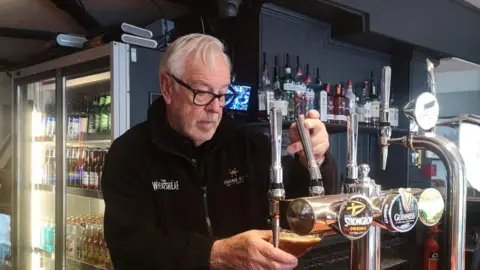 Geoff Robbins
Geoff Robbins, who owns the Wheatsheaf Pub in Faringdon, Oxfordshire with his wife Jo, said it was “a great relief” that more help was on the way.
His rates are due to rise by around 80% over the next three years. He needs a discount on most of that, he reckons, after factoring in higher gas, electricity and staffing costs.
“Rates are a tax against your business whether you make a profit or loss… you’ve got to pay, there’s no way round it,” said Geoff, who got in touch with BBC Your Voice.
Industry groups also welcomed news there would be additional help.
Emma McClarkin, chief executive of the British Beer and Pub Association, said it was “potentially a huge win” for the sector.
“This could save locals, jobs, and means publicans can breathe a huge sigh of relief,” she said.
Kate Nicholls, chair of UK Hospitality, representing the industry, said the support should apply not just to pubs, but to all hospitality businesses affected by rising rates, including cafés and restaurants.
“We need a hospitality-wide solution, which is why the government should implement the maximum possible 20p discount to the multiplier for all hospitality properties,” she said.
Other sectors are calling for the support to be even broader, to include live music venues, theatres, galleries, gyms and retailers.
Unpicking the recent Budget would be seen by many as another U-turn following climbdowns on winter fuel payments, disability benefits and inheritance tax on farms and family businesses.
Shadow business and trade secretary Andrew Griffith said the change showed Rachel Reeves’ Budget was “falling apart”.
“Labour were wrong to attack pubs and now have been forced into another screeching U-turn,” he said.
Liberal Democrat Treasury spokesperson Daisy Cooper said: “This is literally the last chance saloon for our treasured pubs and high streets – so the government must U-turn, today.
“These businesses are worried sick, making decisions now, and can’t wait a minute longer.”
The calculation of business rates is an issue that is devolved in all four UK nations.
The discount on rates during the pandemic only applied to hospitality businesses in England.
Scottish businesses are waiting for the Budget there next week to hear how the Edinburgh government will approach the issue.
Pubs there will hope the Scottish government follows the UK government in offering some relief.
Additional reporting by Kris Bramwell

Business
Top stocks to buy today: Stock recommendations for April 17, 2026 – check list – The Times of India

Stock market recommendations: Reliance Industries, and Varun Beverages are the top stock recommendations by Bajaj Broking Research for April 17, 2026.Reliance IndustriesBuy in the range of ₹ 1330.00-1350.00
Reliance Industries stock has undergone a corrective phase over the past three months and is currently consolidating near a crucial support zone of ₹1270–₹1300. This technical setup offers a favorable risk-reward profile, positioning the stock for a potential bullish reversal and the next leg of uptrend.This ₹1270–₹1300 range serves as a crucial support area, reinforced by the convergence of multiple technical factors: (a) 61.8% retracement of the previous April 2025-January 2026 up move (1115-1611) (b) 200 weeks EMA placed around 1292, which has historically acted as strong demand area for the stockThe ongoing corrective phase appears to be nearing exhaustion, with price action indicating the potential for a fresh bullish reversal. We anticipate the stock to resume its uptrend and head towards ₹ 1474 levels in the coming quarters being the high of February 2026 and the 61.8% retracement of the recent decline of the last 3 months ₹ 1611-1290.Varun BeveragesBuy in the range of 455-465
The share price of Varun Beverages has generated a breakout above the falling channel containing last 3 months decline signaling strength and offers fresh entry opportunity.The stock has also formed a higher high and higher low signaling resumption of up move after recent corrective decline.We expect the stock to head higher towards 503 levels in the coming weeks being the 80% retracement of the previous decline from 534 to 381.(Disclaimer: Recommendations and views on the stock market, other asset classes or personal finance management tips given by experts are their own. These opinions do not represent the views of The Times of India)

Experts say Mythos potentially has an unprecedented ability to identify and exploit cybersecurity weaknesses.
Source link
Business
Anthropic’s new AI model exposes fresh risks, flaws for cybersecurity, IT services – The Times of India
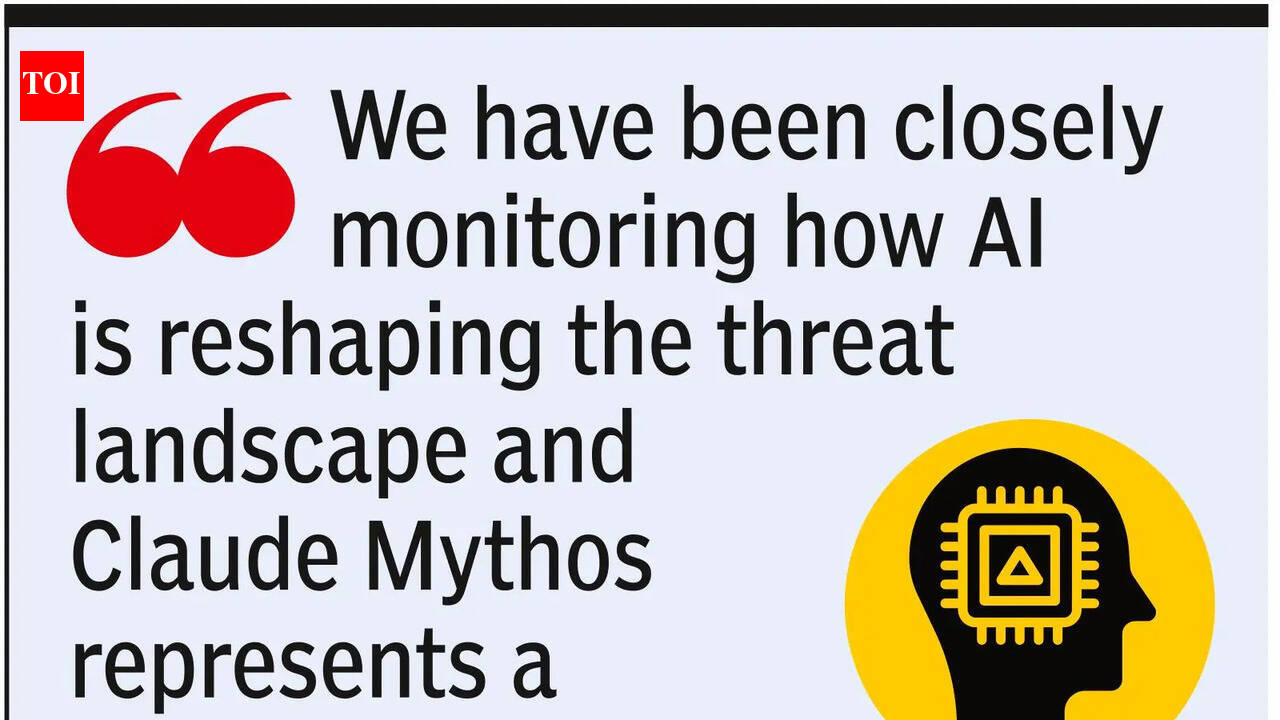
New Delhi: A powerful new AI model is forcing govts, banks, and technology firms to rethink the rules of cybersecurity – and in India, the stakes may be even higher.Claude Mythos, developed by Anthropic, has demonstrated the ability to autonomously detect and exploit software vulnerabilities, including flaws that have persisted for decades. Early tests revealed that the model could identify long-standing weaknesses and simulate complex, multi-step cyberattacks, prompting the company to restrict its wider release. Anthropic CEO Dario Amodei highlighted the shift, noting that AI systems are now capable of finding vulnerabilities “that humans have missed”, a signal of how quickly the cybersecurity landscape is changing.US Treasury Secretary Scott Bessent reportedly convened a meeting with top bank executives – including leaders from JPMorgan Chase, Goldman Sachs, Citigroup, BoA, and Morgan Stanley – to assess the risks posed by such advanced AI systems.That concern is not theoretical. According to Jaydeep Singh, GM for India at Kaspersky, the emergence of such systems represents a turning point not just for security professionals, but for everyday users. “We have been closely monitoring how AI is reshaping the threat landscape, and Claude Mythos represents a moment that every user, not just the cybersecurity industry, needs to understand,” Singh said.The dual-use nature of AI is at the heart of the concern. The same capability that strengthens defences can just as easily be weaponised. “The same capability that finds a 27-year-old vulnerability in hardened infrastructure is the capability that, in the wrong hands, turns every unpatched system into an open door,” Singh added.Cybersecurity firm Check Point Software Technologies echoed the warning. Sundar Balasubramanian, MD, India and South Asia, for Check Point, says, AI is “dramatically lowering the barrier to entry for cyber attackers,” enabling even less-skilled actors to identify and exploit vulnerabilities. He added that defensive tools can be repurposed offensively, compressing the traditional gap between attackers and defenders. Jayant Saran, partner, Deloitte India, described this as a “changed reality,” where organisations must prepare for risks that were previously invisible. He called AI a “double-edged sword…that cannot be reversed,” highlighting an accelerating race between those securing systems and those attempting to break them.In India, the risks are amplified by scale. From UPI to banking and govt platforms, millions depend on digital infrastructure – much of it built on legacy systems. These systems are often slower to patch, harder to monitor, and lack continuous threat intelligence, creating what Saran called an “asymmetric risk exposure.” Singh pointed out that this gap is especially critical in India, where legacy infrastructure serves hundreds of millions.Beyond cybersecurity, ripple effects could reach financial markets. Analysts say models like Mythos could automate parts of software development, testing, and security – core functions of IT services industry. While disruption may be gradual, labour-intensive outsourcing models could face pressure, while firms embracing AI may benefit.


Italy’s apparel export-import plunge after positive trend in 2025
Top stocks to buy today: Stock recommendations for April 17, 2026 – check list – The Times of India

Former SMU cornerback Teddy Knox faces $2.88M judgment for crash linked to Rashee Rice’s Lamborghini race

-

 Entertainment1 week ago
Queen Elizabeth II emotional message for Archie, Lilibet sparks speculation
-

 Tech1 week ago
Azure customers up in arms over ‘full’ UK South region | Computer Weekly
-

 Tech1 week ago
As the Strait of Hormuz Reopens, Global Shipping Will Take Months to Recover
-

 Fashion1 week ago
CII submits 20-pt agenda to Indian govt to back firms hit by Iran war
-

 Tech1 week ago
This AI Button Wearable From Ex-Apple Engineers Looks Like an iPod Shuffle
-

 Politics7 days ago
Indian airlines hit hardest after Dubai limits foreign flights until May 31
-
Uncategorized1 week ago
[CinePlex360] Please moderate: “Trump considers
-

 Entertainment4 days ago
Palace left in shock as Prince William cancels grand ceremony