

Politics
Tajikistan says four terrorists neutralised in latest incident on Afghan border

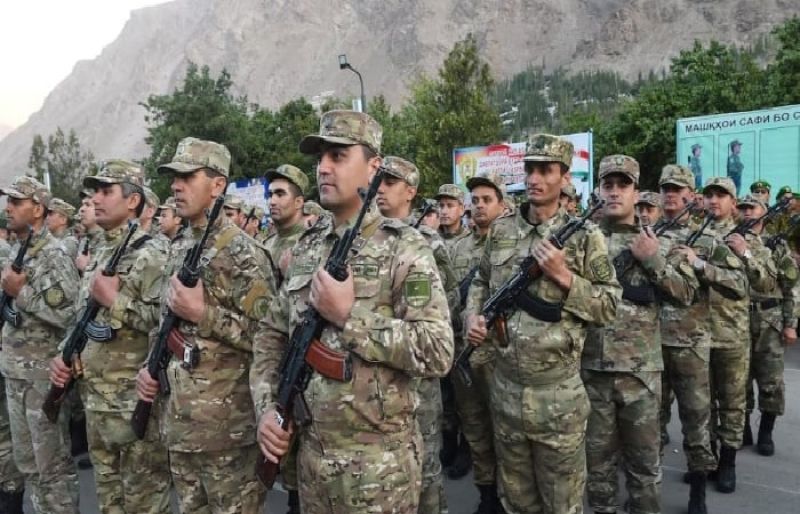

Tajikistan officials on Sunday said they “neutralised” four “terrorists” who crossed over from neighbouring Afghanistan in an area where deadly incidents have been on the rise in recent weeks, state media reported.
Tajikistan, in Central Asia, shares a mountainous border with Afghanistan and has had tense relations with the Afghan Taliban regime.
According to Tajik security services cited by the state-owned Khovar news agency, “four terrorists were neutralised” after they refused to put down arms in the southern Khatlon region.
Tajik authorities have reported at least five deadly incidents on the mountainous border, which is some 1,350 kilometres (840 miles) long, since November.
An AFP count using official data found that 16 people have been killed in total.
These include Tajik border guards, Chinese workers and what Dushanbe calls “smugglers” and “terrorists”.
After attacks on Chinese nationals in November, Tajik authorities urged the Afghan Taliban regime to take measures to prevent destabilisation of the volatile border region, where drug traffickers and militant groups are active.
Unlike other Central Asian leaders who are strengthening ties with the Taliban, Tajik President Emomali Rakhmon — in power since 1992 — openly criticises Afghanistan’s authorities.
He has urged the Taliban to respect the rights of ethnic Tajiks, estimated to represent around a quarter of Afghanistan´s population.
But Tajikistan is also taking steps towards cooperation with Kabul, through electricity supplies, the opening of border markets and meetings between Taliban and local Tajik officials.
Relations between the two nations took a hit after five Chinese nationals were killed, and several were wounded in two separate attacks along Tajikistan’s border with Afghanistan in late November and early December.
According to a UN report in December, a militant group, Jamaat Ansarullah, “has fighters spread across different regions of Afghanistan” with a primary goal “to destabilise the situation in Tajikistan.”
Dushanbe has previously voiced concerns about the presence in Afghanistan of members of Daesh in Khorasan.
- Poll follows 2025 protests that toppled government.
- Key contenders include ex-PM, rapper-turned poltician
- Initial results expected Friday; full tally may take days.
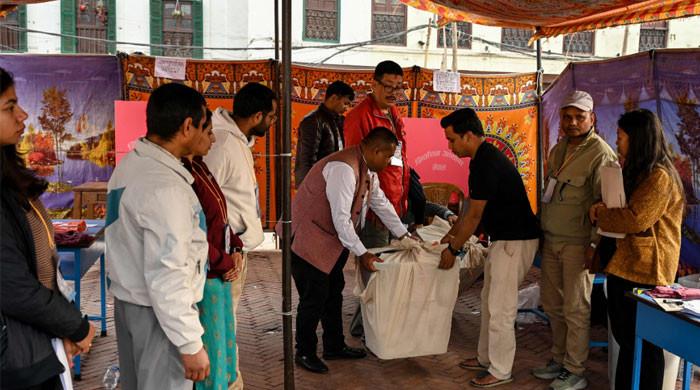
KATHMANDU: Counting was underway in Nepal on Friday, after a high-stakes parliamentary election that could reshape the country’s leadership following 2025 protests that toppled the government.
Key figures vying for power include a Marxist former prime minister seeking a return to office, a rapper-turned-mayor bidding for the youth vote, and the newly elected leader of the powerful Nepali Congress party.
“Counting has begun in most places in a peaceful manner,” Prakash Nyupane, a spokesman for the Election Commission, said Friday.
Some results are expected later Friday, but full nationwide tallies could take several days.
Even then, negotiations to form a government may drag on if — as many analysts predict — no single party secures an outright majority.
Sushila Karki, the interim prime minister, praised the peaceful conduct of a vote she has said was critical in “determining our future”.
Voters have chosen who replaces the interim government in place since the September 2025 uprising, in which at least 77 people were killed, and parliament and scores of government buildings were torched.
Youth-led protests under a loose Gen Z banner began as a demonstration against a brief social media ban, but were fed by wider grievances at corruption and a woeful economy.
“Congratulations to the Nepali people for successfully conducting a historically peaceful election… thereby providing the country with a democratic and constitutional resolution,” Karki said late Thursday after voting ended.
‘Better path’
The polls are one of the most hotly contested elections in the Himalayan republic of 30 million people since the end of a civil war in 2006.
The challenge that Karki — a 73-year-old former chief justice who reluctantly left retirement to lead the nation — now faces will be managing the reaction to the results.
Thousands of soldiers and police have been deployed.
Many are watching results in the single constituency of Jhapa-5, a usually sleepy eastern district, where two key prime ministerial hopefuls went head-to-head.
KP Sharma Oli, the 74-year-old Marxist leader ousted as prime minister last year and seeking a return to power, was challenged by former Kathmandu mayor Balendra Shah, a 35-year-old rapper-turned-politician.
Shah, from the centrist Rastriya Swatantra Party (RSP), snappily dressed in a black suit and sunglasses, has cast himself as a symbol of youth-driven political change.
Also in the race as aspiring prime minister is Gagan Thapa, 49, the new head of the country’s oldest party, Nepali Congress, who has said he wants to end the “old age” club of revolving veteran leaders.
More than 3,400 candidates ran for 165 seats in direct elections to the 275-member House of Representatives, the lower chamber of parliament, with 110 more chosen via party lists. Turnout was 59 percent.
Mira Ranjit, 49, who voted in the capital, Kathmandu, clapped as ballot boxes were collected under heavy guard and taken to counting centres late on Thursday.
“A new leader should emerge who can guide our country and show a better path for the nation, so that the Gen Z protest achieves its goal,” she said.
“We don’t need anything more than this. Many mothers lost their children, and their demands should be fulfilled.”

- Pentagon chief warns Iran miscalculating US ability to sustain the war.
- Says US campaign targets Iranian missiles, missile production and navy.
- Says Iran making ‘bad calculation’ believing US can’t sustain war.
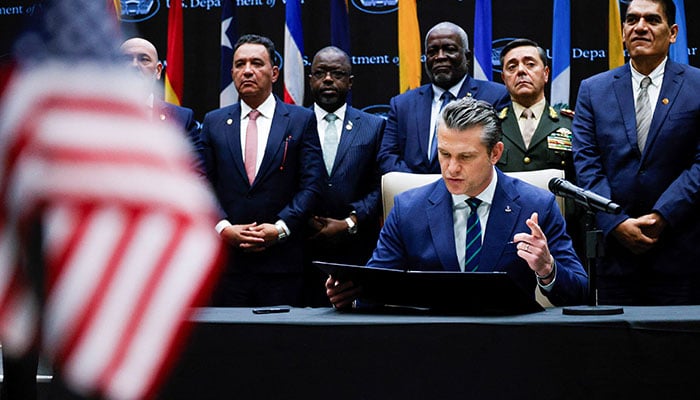
TAMPA: TAMPA: US Defence Secretary Pete Hegseth warned on Thursday that Iran was making a serious miscalculation if it believed the United States could not sustain the ongoing war, stressing that Washington had the resources and resolve to continue the military campaign for as long as necessary.
The Pentagon earlier this week said the military campaign, known as Operation Epic Fury, is focused on destroying Iran’s offensive missiles, missile production and navy, while not allowing Tehran to have a nuclear weapon.
“There’s no expansion in our objectives. We know exactly what we’re trying to achieve,” Hegseth said.
He added that Trump was “having a heck of a say in who runs Iran given the ongoing operation.”
In a telephone interview with Reuters on Thursday, Trump said the United States would have to help pick the next person to lead the country.
The US and Israeli military campaign that started on Saturday has hit targets across the country and triggered Iranian retaliatory strikes in the region as Tehran seeks to impose a high cost on the United States, Israel and their allies.
Iran has attacked countries including Israel, the United Arab Emirates and Qatar. Fire crews in Bahrain extinguished a blaze at a refinery following a missile strike.
Azerbaijan became the latest country drawn in, as it accused Iran of firing drones at its territory and ordered its southern airspace closed for 12 hours.
Hegseth said by striking countries in the region, Iran would only bring them closer to the United States.
“It’s actually firming up the unity of the resistance in order to focus exactly where we need to,” Hegseth said.
Next phase of operations
The United States has hit more than 2,000 targets in Iran, including Iranian warships.
Admiral Brad Cooper, the head of US Central Command, said US forces had destroyed 30 Iranian warships, including an Iranian drone carrier ship earlier on Thursday.
Cooper said the United States was hitting Iran’s ability to rebuild.
“As we transition to the next phase of this operation, we will systematically dismantle Iran’s missile production capability for the future, and that’s absolutely in progress,” Cooper said, adding that it would take some time.
The US military has identified the six US Army Reserve soldiers killed when a drone slammed into a US military facility in Port Shuaiba, Kuwait.
Trump and other senior officials have warned the Iran conflict will result in more US military deaths.
Hegseth, during the press conference, said Iran was making a mistake if it believed that the United States could not sustain the ongoing war, adding that Washington had just begun to fight.
“Iran is hoping that we cannot sustain this, which is a really bad miscalculation,” Hegseth said. “We set the timeline.”
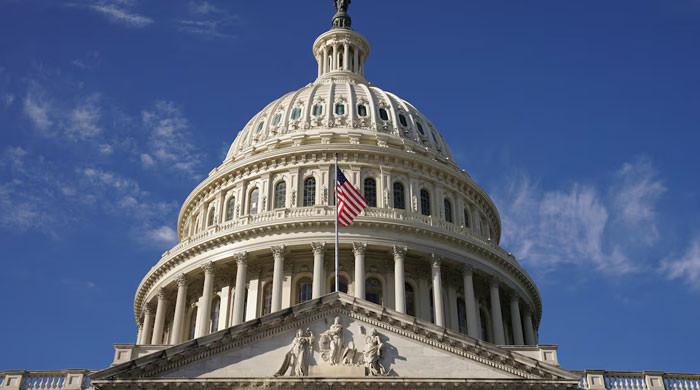
WASHINGTON: The US House of Representatives rejected an effort on Thursday to stop President Donald Trump’s air war on Iran and require that any hostilities against Iran be authorised by Congress, backing the Republican president’s military campaign on the sixth day of the expanding conflict.
The vote was 219 to 212, largely along party lines, in the House, where Trump’s fellow Republicans control a narrow majority of seats. Two Republicans voted in favour of the resolution and four Democrats voted against it.
Opponents accused Democrats of taking the issue to a vote only because they oppose Trump, putting Americans at increased risk.
“We all know that we wouldn’t be here today if the president’s name wasn’t Donald Trump,” Representative Rick Crawford of Arizona, the Republican chairman of the House Intelligence Committee, said during debate on Wednesday.
Sponsors of the resolution described it as a bid to take back Congress’ responsibility to authorise war, as spelled out in the US Constitution.
The US and Israel launched attacks on Iran on Saturday, a conflict that has killed more than 1,000 people, including at least six US service members, and caused damage and instability throughout the Middle East.
Supporters said the resolution, by requiring Trump to come to Congress for a war authorisation, would force him to explain to Americans why the US is fighting and how it might end.
“This is a war of choice, launched by this administration without authorisation, without clearly stated objectives or a defined endgame, and without explaining how they intend to keep Americans safe,” said Representative Gregory Meeks of New York, the top Democrat on the Foreign Affairs Committee.
Approval would not have stopped Iran air war
Just before the resolution vote, House members from both parties overwhelmingly passed a measure “Reaffirming Iran remains the largest state sponsor of terrorism.”
The vote would not have stopped the conflict even if the House had voted yes.
To go into effect, the resolution would also have had to pass the Senate and garner the two-thirds majorities needed to override Trump’s expected veto.
The Senate, also narrowly controlled by Trump’s party, backed his military campaign against Iran in a vote on Wednesday, voting to block a bipartisan resolution similar to the measure passed by the House. The votes this week are not the end of the matter. The War Powers Resolution of 1973, which provides for votes on the resolutions, says a president can only involve the military in an armed conflict when Congress has declared war or provided specific authority or in response to an attack.
Trump and his Republicans have argued that Iran posed an “imminent threat” so that his actions were legal under that law.
However, the War Powers measure also requires unauthorised military actions to be terminated within 60 days, giving the Trump administration a deadline at the end of April to seek Congress’ approval.


Cotton innovation to take centre stage at Bremen conference 2026

Asian stocks today: Kospi drops 1.6% as Middle East tensions weigh on markets – The Times of India

Nepal counts votes after key post-uprising election

Policy easing drives Argentina’s garment import surge in 2025

What are Iran’s ballistic missile capabilities?

India Us Trade Deal: Fresh look at India-US trade deal? May be ‘rebalanced’ if circumstances change, says Piyush Goyal – The Times of India

-
 Business1 week ago
Attock Cement’s acquisition approved | The Express Tribune
-
 Fashion1 week ago
Policy easing drives Argentina’s garment import surge in 2025
-
 Politics1 week ago
What are Iran’s ballistic missile capabilities?
-
Business7 days ago
India Us Trade Deal: Fresh look at India-US trade deal? May be ‘rebalanced’ if circumstances change, says Piyush Goyal – The Times of India
-

 Politics1 week ago
US arrests ex-Air Force pilot for ‘training’ Chinese military
-
 Business7 days ago
Greggs to reveal trading amid pressure from cost of living and weight loss drugs
-

 Sports1 week ago
Sri Lanka’s Shanaka says constant criticism has affected players’ mental health
-

 Sports7 days ago
LPGA legend shares her feelings about US women’s Olympic wins: ‘Gets me really emotional’