

Business
Water companies to face regular MOT-style checks in industry shake-up


Simon Jack,Business editorand
Jonah Fisher,Climate correspondent
 Getty Images
Inspections without notice, regular MOT-style checks and compulsory water efficiency labels on appliances are among the key measures in the government’s overhaul of the water industry.
The government is describing the measures as as the biggest overhaul of the water industry in England and Wales since privatisation.
Environment Secretary Emma Reynolds said there will be “nowhere to hide” for poor performing water companies.
The proposed changes come after widespread public anger at increasing numbers of pollution incidents, leaks and water outages that have affected thousands of customers across England and Wales in recent years.
Reynolds told the BBC: “We’ve had a system whereby water companies are marking their own homework.”
“This has been a whole system failure,” she said. “A failure of regulation, a failure of regulators, of the water companies themselves.”
The Water white paper promises to set up company-specific teams to monitor, supervise and support individual firms and their particular issues rather than rely on a “desk based, one size fits all” approach.
Smart meters and mandatory water efficiency labels on appliances including dishwashers and washing machines will also help households monitor their usage and costs, the government said.
It is also creating a chief engineer role at the regulator that will be set up to replace Ofwat.
Government officials have told the BBC that the establishment of a new regulator may take a year or more and water companies say it will take time for the benefits of new investments to be felt.
The government’s reforms come after a review by Sir John Cunliffe, who issued 88 recommendations to improve the industry.
However, he was asked not to consider whether to nationalise the sector, which was privatised in the late 1980s.
Campaigners said the proposed reforms did not go far enough.
River Action chief executive James Wallace said the measures showed the government “recognises the scale of the freshwater emergency, but lacks the urgency and bold reform to tackle it”.
The new regulator must be “truly independent” and properly funded, he warned, and said major gaps remain.
“None of these reforms will make a meaningful difference unless the failed privatised model is confronted head on. Pollution for profit is the root cause of this crisis,” Wallace said.
Surfers Against Sewage chief executive Giles Bristow said the government’s proposed changes were “frankly insulting” and fall short of much needed structural reform.
“The truth is glaringly obvious to everyone except this government. As long as the industry is structured to prioritise profit, the public will keep paying the price through soaring bills and polluted water,” he said.
Sir Dieter Helm, professor of economic policy at Oxford University, said the government had not wanted to explore that because its self-imposed spending rules have already been stretched to the limits.
“In addition to that, I think there’s a very sensible view around government that the government probably isn’t competent and capable to run these businesses,” he said.
“The government should think really quite carefully about this, because if they’re supervising the companies, and something goes wrong, Whose fault is it?”
Problems in the beleaguered sector have been thrown into focus recently after tens of thousands of South East Water customers were cut off for several days both before and after Christmas.
Mike Keil, chief executive of the Consumer Council for Water (CCW), said the “miserable disruption” underlined the importance of “meaningful change” in water regulation.
A new, powerful ombudsman service would also be welcome, Keil said, given CCW has had a 50% increase in customers asking for help with complaints relating to their water provider.
“One of our key asks of the Independent Water Commission was to make our existing voluntary ombudsman service mandatory, as this is vital to giving customers robust protection,” he said.
‘Proof in the river’


The River Pang in Berkshire is regarded by some as one of the inspirations for Kenneth Grahame’s Wind in the Willows classics. It’s environmental status has deteriorated from “good” in 2015 to “poor” now – with campaigners blaming regular sewage discharges.
On the banks of the Pang, Pete Devery from the Angling Trust told the BBC he was sceptical of the government’s plans.
“I won’t hold my breath” he said.
“The proof will be in the river. Do the rivers across the country improve? That’s the end result. Doesn’t matter what you call that regulator. It doesn’t matter how many regulators there are. If the difference isn’t made in the rivers, they will have failed.”
In 2024, water companies released raw sewage into England’s rivers and seas for a record 3.61 million hours, a slight increase on 2023.
Aging infrastructure, wetter winters and drier springs and farming runoff into rivers and lakes have all contributed to poor water service and quality.
Ofwat, is currently the water industry’s economic regulator for both England and Wales. In October 2025 the Welsh government said that when Ofwat is abolished it plans to form its own stand-alone economic regulator to replace it.
In 2025, water supply interruptions across England and Wales rose by 8% and pollution incidents by 27%, while customer satisfaction fell by 9%.
Average water bills rose by 26%, or £123 a year, from last April after years of below-inflation increases that some have blamed, along with high executive pay and shareholder dividends, on under-investment in the sector.
The sharp rise in bills is meant to address that under-investment by funding spending of £104 billion over the next five years – more than 40% of which is earmarked for new infrastructure.
Business
Sugarcane price hike: Govt raises FRP to Rs 365/quintal for 2026-27, farmers to benefit from higher returns – The Times of India
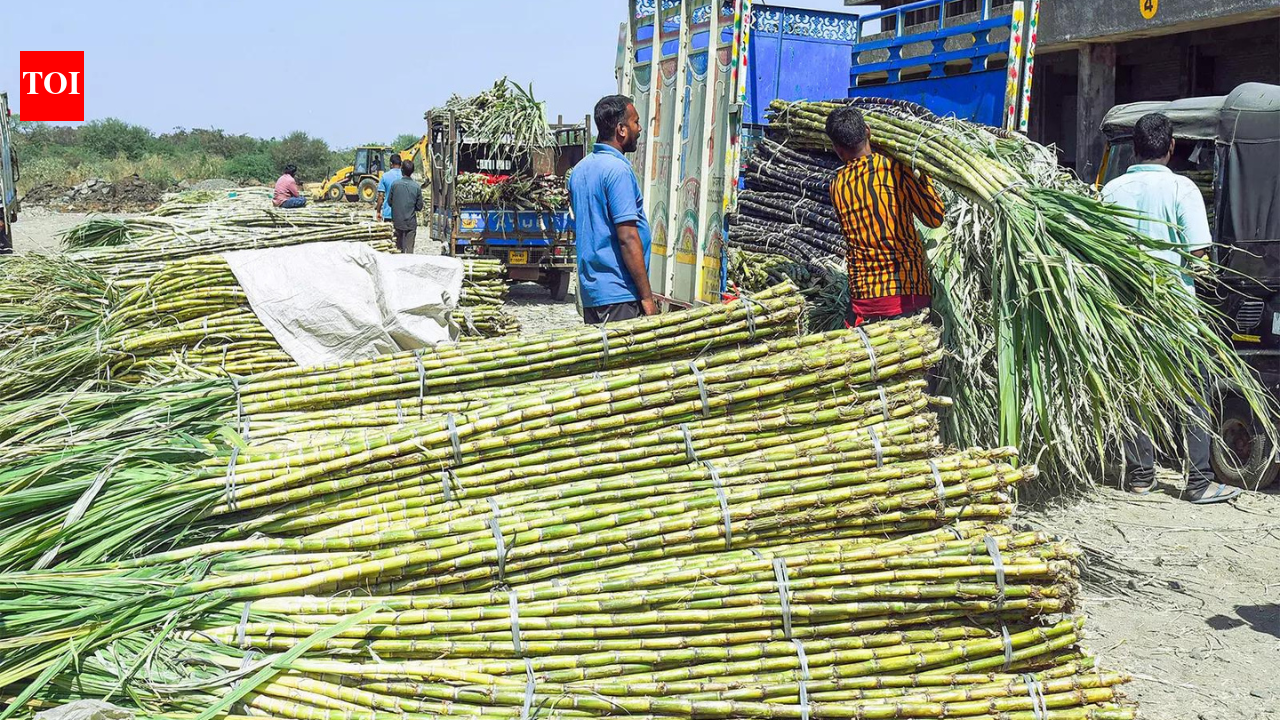
The government has increased the fair and remunerative price (FRP) of sugarcane by Rs 10 to Rs 365 per quintal for the 2026-27 season beginning October, PTI reported.The decision was approved by the Cabinet Committee on Economic Affairs (CCEA), chaired by Prime Minister Narendra Modi.“The FRP will be Rs 365/quintal for a basic recovery rate of 10.25 per cent,” Union Minister Ashwini Vaishnaw said after the meeting.The revised FRP is 2.81 per cent higher than the current rate of Rs 355 per quintal for the 2025-26 season.For every 0.1 per cent increase in sugar recovery above 10.25 per cent, the FRP will rise by Rs 3.56 per quintal, providing an incentive to mills for higher efficiency.To safeguard farmers supplying to mills with lower recovery rates, the government has decided that there will be no deduction in FRP for recovery below 9.5 per cent. In such cases, farmers will receive Rs 338.3 per quintal in the 2026-27 season.The production cost of sugarcane for 2026-27 has been estimated at Rs 182 per quintal, making the FRP 100.5 per cent higher than the cost.“Farmers are expected to get more than Rs 1 lakh crore,” Vaishnaw said.The move is expected to benefit nearly one crore sugarcane farmers, along with farm labourers and workers engaged in sugar mills.The FRP has been fixed based on recommendations of the Commission for Agricultural Costs and Prices (CACP) and consultations with state governments and stakeholders.The sugar sector supports the livelihoods of around five crore farmers and their families, and about five lakh workers directly employed in sugar mills, besides those involved in related activities such as transportation.Sugar mills are required to purchase sugarcane from farmers at the FRP or higher.Vaishnaw said the FRP has been increased every year over the past decade, and the latest revision will also support ethanol production from surplus sugarcane.On cane dues, he said that in the 2024-25 season, about Rs 1,02,209 crore, or nearly 99.5 per cent, of the total payable dues of Rs 1,02,687 crore had been cleared as of April 20, 2026.For the ongoing 2025-26 season, Rs 99,961 crore, or 88.6 per cent, has been paid out of total dues of Rs 1,12,740 crore.

Downing Street would not deny reports that Chancellor Rachel Reeves rowed with her US counterpart during a visit to Washington DC earlier this year.
Ms Reeves had an argument with Scott Bessent when she visited the US capital for the International Monetary Fund’s spring meetings, according to the Financial Times.
The Chancellor publicly criticised the US-led war against Iran before travelling across the Atlantic, prompting Mr Bessent to berate her on the sidelines of the gathering, the newspaper reported.
Ms Reeves reportedly hit back that she did not work for the US treasury secretary, and disliked how he had spoken to her, before reiterating her argument that America lacked clear goals going into the conflict and was not making the world safer.
On Tuesday, the Prime Minister’s official spokesman was asked if he would steer away from the reports, and appeared not to.
He did however insist Ms Reeves and her US counterpart have had “constructive” engagements since the Washington DC visit.
The spokesman said: “We would not get into private conversations. The Chancellor and the US treasury secretary have a good relationship.
“They have had constructive conversations together since the Chancellor’s visits to Washington.
“I think there is a readout from the US Department of Treasury, which made clear the productive nature of their relationship.”
The Chancellor emerged as one of the most outspoken UK Government critics of the US decision to go to war in Iran before travelling to the IMF meetings in April.
At the time, she described the war as a “folly” and said: “This is a war that we did not start. It was a war that we did not want.
“I feel very frustrated and angry that the US went into this war without a clear exit plan, without a clear idea of what they were trying to achieve.”
Business
Govt lists 40 sub-sectors for faster FDI clearance from border nations-check details – The Times of India

The government has identified 40 sub-sectors, including rare earth magnets and printed circuit boards, for expedited clearance of foreign direct investment (FDI) proposals from countries sharing land borders with India, PTI reported.Under the revised framework, proposals from countries such as China, Pakistan, Bangladesh, Nepal, Bhutan, Myanmar and Afghanistan in these sectors will be processed within 60 days, as per the updated standard operating procedure (SOP).The move follows a decision taken in March to fast-track FDI approvals in specified manufacturing sectors from these countries.However, the government has clarified that majority ownership and control of the investee entity must remain with resident Indian citizens or Indian-owned entities at all times.The 40 identified sub-sectors fall under six broad categories –capital goods manufacturing, electronic capital goods and electronic components, polysilicon and ingot-wafer production, advanced battery components, rare earth permanent magnets, and rare earth processing.These include manufacturing of insulation items, castings and forgings for thermal, hydro and nuclear power plants, machine tools, display components such as LCD and LED panels, camera modules, electronic capacitors, speakers and microphones, lithium-ion batteries, wearables, and rare earth metal and magnet processing facilities.The SOP also introduces detailed reporting norms for investments involving entities with direct or indirect ownership from land-bordering countries.“The reporting under these guidelines will be governed under the Foreign Exchange Management (Mode of Payment and Reporting of Non-debt Instruments) Regulations, 2019, and the information will be accessible by the Reserve Bank of India (RBI),” the DPIIT said.The responsibility for reporting lies with the Indian investee company, which must submit required details to the DPIIT before receiving foreign capital.“The reporting is to be made prior to the inward remittance of foreign capital. In cases which do not involve foreign capital inward remittances, the reporting is to be made prior to execution of the relevant transactions, including issuance/transfer of capital instruments, as the case may be,” it added.Investors will be required to disclose details such as shareholding patterns, beneficial ownership, organisational structure, promoters, board composition, key managerial personnel and control rights.The Indian entity will also need to provide incorporation details and disclose existing or proposed shareholding linked to entities from land-bordering countries.


Pakistan ‘hopeful’ efforts will lead to early resolution of US-Iran conflict: DPM Dar
Sugarcane price hike: Govt raises FRP to Rs 365/quintal for 2026-27, farmers to benefit from higher returns – The Times of India

Climate is now in the cost sheet

-

 Tech1 week ago
A Brain Implant for Depression Is About to Be Tested in Humans
-

 Sports1 week ago
Pro wrestling star Steph De Lander reveals how colleague’s advice helped lead her to title triumph at ACW
-

 Tech1 week ago
Almost 90% of women leave tech industry within 10 years | Computer Weekly
-
 Business1 week ago
‘I had £20,000 stolen and had to fight a 13-month fraud reporting rule to get it back’
-

 Entertainment1 week ago
Norway joins Type 26 Frigate Programme to boost NATO naval power
-

 Entertainment1 week ago
Melania Trump says ABC should ‘take a stand’ on late-night host Kimmel
-

 Tech1 week ago
This Ambitious Laptop Doesn’t Leave Much Room for Your Hands
-
 Business6 days ago
PSX plunges over 4,800 points | The Express Tribune