

Business
Caribbean cannabis growers eye budding domestic sales and exports

Gemma HandyBusiness reporter, St John’s, Antigua
 Gemma Handy
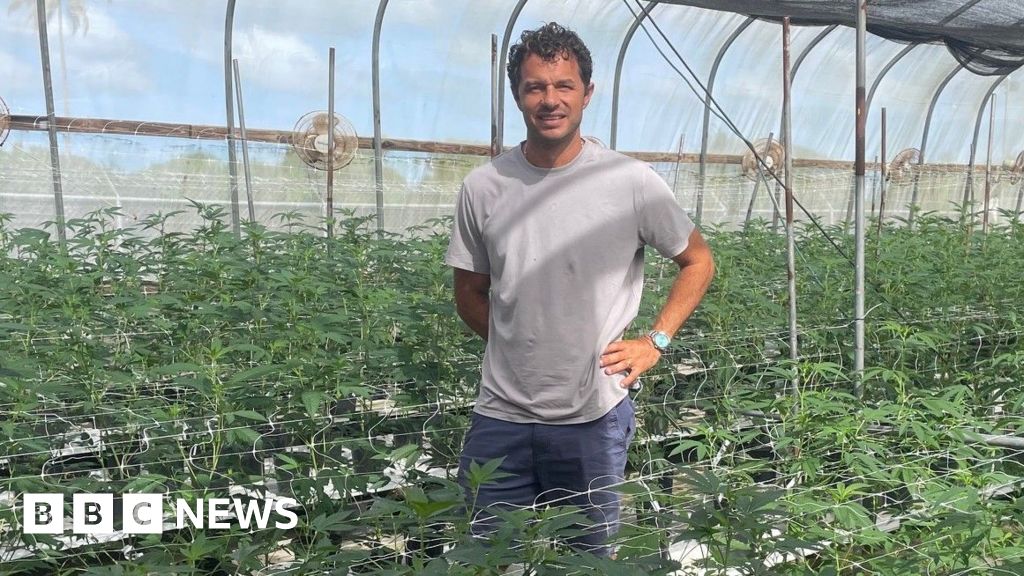
Rub the leaf and inhale the fragrance, Michaelus Tracey is saying.
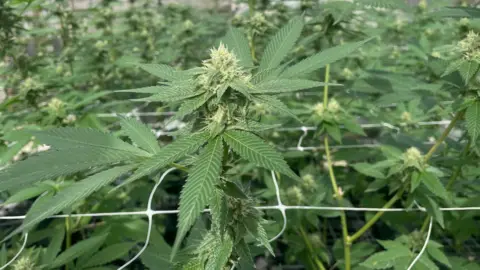
The musky scent of this cannabis plant is distinctly different from the citrusy aroma of another that he is also holding.
To the untrained eye, the neat rows of flowering cannabis crops in front of us are indistinguishable from each other.
Yet master cultivator Tracey can identify the separate varieties by their smell and the shape of their leaves.
Nine strains are being grown here at Pineapple Road, a farm deep in the countryside on the Caribbean island of Antigua. The warm temperatures, abundant sunshine, and high humidity make this prime territory for growing the plants.
Intense trials were conducted to produce the various strains, Tracey explains. “We wanted different flavour profiles as well as different effects, but all with a medicinal value – something to help you relax, something to give you more energy, more pain relief, less anxiety.”

 Gemma Handy
Last year marked a decade since Jamaica decriminalised the recreational use of cannabis and legalised its production and sale for medical reasons. Several other Caribbean nations, including the twin island country Antigua and Barbuda in 2018, have since followed suit.
Smoking cannabis is emblematic of Caribbean culture, to the extent it has become a cliché. But while the region’s affection for the plant is well documented, its status as a leader in the field is less so.
Today the region is home to a plethora of legally registered cannabis farms and medicinal dispensaries, where both locals and tourists can purchase the drug if they have a valid medical authorisation card.
Yet Prof Rose-Marie Belle Antoine, an expert on the cannabis industry in the Caribbean, believes there needs to be further liberalisation.
“Decriminalisation isn’t good enough,” says Antoine, a former chair of the Caribbean Community’s Regional Commission on Marijuana. “We should just make it legal but regulated.”
Antoine is campus principal at the University of the West Indies in Trinidad, where researchers are due to start studying various potential benefits of cannabis.
Areas tipped for study range from alleviating the side effects of cancer treatment, to how the plant can boost agriculture by improving soil health. The research will take place in Antigua, where legislation is more progressive.
The work offers “a lot of potential”, she says, but adds that legalisation would make life easier.
“The Caribbean is a leader in cannabis, in terms of strains and knowledge, and it has a long tradition of this. But legalities, the ‘war on drugs’ and all that nonsense, stifled not just the industry, but research and development,” says Antoine.
Some in the region hope that US President Donald Trump’s executive order in December to reclassify cannabis as a lower-level drug will benefit the Caribbean.
“It’s a significant milestone,” says Alexandra Chong, chief executive of Jamaica-based business Jacana, which sells a range of products derived from cannabis, from extract oil drops to skin cream.
“So much US public policy gets filtered down to the Caribbean,” she says. “Because cannabis was classified as a schedule one drug alongside heroin in the US, regulatory bodies across the Caribbean have not been as bullish with [reducing] regulation.”
Chong adds that the US reducing cannabis to the lower schedule three level, which also includes combined paracetamol-codeine tablets, was “far more appropriate”.
The White House lowering the classification of cannabis may mean that in the future Caribbean nations can export the drug to the US for recreational use.
However, the importation of such cannabis into the US is currently still illegal under federal law. This is despite 24 US states having now legalised the use of the drug recreationally.
Producers in both Jamaica and Antigua are keen to start legally exporting the drug. Jamaica’s Cannabis Licensing Authority says it “has put in place interim administrative procedures to facilitate the export of ganja by licensees that hold a valid import permit from the country that the product will be exported to”.
Meanwhile, Antigua and Barbuda’s Medicinal Cannabis Authority is working hard to develop a cannabis export industry. “We already have the legal framework in place, a prime geographical location and an international airport,” the body’s chief executive Regis Burton tells the BBC.
He says it’s “highly likely” that Antigua will eventually be able to export its products, not least for the novelty value. “Very few people can say they’ve tried Antiguan cannabis,” he adds.
 Jacana
Domestically, high overheads in both Jamaica and Antigua and Barbuda – and rules that limit the sale of cannabis to people with medical approval – are said to be leaving most of the market to illegal producers.
Jacana estimates that more than 800,000 people a year in Jamaica use cannabis, of whom half are tourists. But that 90% of the 87 tonnes of the drug consumed per annum comes through illicit channels.
Chong adds that “over-regulation has strangled the industry. Over time it’s got easier, but it’s by no means perfect”.
She says that due to these problems, she estimates that of the 160-plus licences of various categories granted by Jamaica’s Cannabis Licensing Authority between 2017 and 2024, “very few” are still in operation.
In Antigua, Robert Hill, a consultant to the industry, says: “It’s still more profitable to import cannabis illegally. Unlike dealers, private companies have staff and bills to pay.”
Currently the island has just six cannabis farms, four dispensaries and a cannabis lounge, where people can smoke on the premises. At the same time, Antiguan authorities intercepted 45kg of illegally imported cannabis in just 24 hours back in September.
Meanwhile, Antigua has been innovative in its approach to domestic illegal growers. Instead of prosecutions, violators were invited to take part in a free six-week course to teach them how to enter the market legally.
“Twenty-two have already graduated, with two soon to transition to a medicinal business,” Burton tells the BBC. “The industry won’t be successful if the illicit market does as it pleases.”
The continuing liberalisation of cannabis across the Caribbean is also said to be having a positive impact on social justice for one community in particular.
In 2018, Antigua’s Prime Minister Gaston Browne issued a formal apology to the country’s Rastafarians, for decades of historic persecution, stigma and abuse over their cannabis use. Six years later, the government granted Rastafarians official sacramental authorisation to grow the plants.
And last summer, it announced plans to expunge the criminal records of people previously prosecuted for possession of small amounts of marijuana.
 Gemma Handy
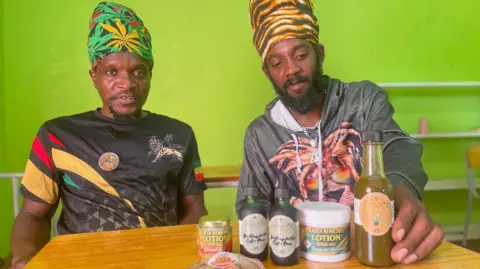
But for High Priest Selah, of Antigua’s Nyabinghi denomination of Rastafarians, memories of the harassment he and others once suffered still linger.
“The police were always coming and locking us up, destroying our plants, tarnishing our name and embarrassing us in public,” he recalls. Campaigners from his community played a major role in getting the plant decriminalised.
Back at Pineapple Road, two employees are carefully hand-rolling joints, each one containing a gram of pure marijuana, for sale in the company’s dispensary.
Burton hopes more local growers will get on board and keep the industry’s proceeds in Caribbean hands.
Hill agrees. “We have the ability to compete with much bigger countries thanks to our climate which reduces costs,” he says, adding: “We’re not trying to create an Amsterdam, this is about wellness.”

Two ads promoting British beef and milk have been banned after television presenter and environmental campaigner Chris Packham complained that they misled consumers about the products’ carbon footprints.
Both ads for the Agriculture and Horticulture Development Board’s (AHDB) Let’s Eat Balanced campaign used the carbon footprint of British beef and milk to promote the products, firstly stating: “British beef not only tastes great, but has a carbon footprint that’s half the global average*.”
The asterisk linked to text that stated: “Full lifecycle emissions of CO2 eq (carbon dioxide equivalent) per kg of beef.”
The ad for milk stated: “British milk not only tastes good, but is also produced to world-class standards, and has a carbon footprint a third lower than the global average.”
Packham complained to the Advertising Standards Authority (ASA) that the ads, and specifically the carbon footprint claims, were misleading as they did not reflect the full environmental impact of British meat and dairy.
The AHDB said the ads’ mention of carbon emissions would be understood in relation to the environmental impact of beef and milk that occurred between the “cradle-to-retail” stages.
But the ASA said the average consumer “being reasonably well-informed, observant and circumspect” would understand the claims to apply beyond the retail stage and include actions such as cooking and wastage.
The ASA said: “While we acknowledged the potential difficulties in producing post-retail emissions data, the claims in the ads suggested those emissions were included and we therefore expected the evidence provided to also include them.
“We therefore concluded that the evidence presented was insufficient to support the full life-cycle claims in the ads, which was how the average consumer was likely to interpret them.
“We reminded AHDB that environmental claims should be based on the full life cycle unless the ad stated otherwise.”
AHDB’s director of communications and market development, Will Jackson, said: “Let’s Eat Balanced is doing what it was designed to do, providing clear, factual, evidence-led information about British food, nutrition and farming standards.
“Since the investigation began, we have conducted independent consumer research which found that the majority of respondents interpreted these adverts as relating to the production phase only, from farm to retail.
“This research provides important insight into consumer understanding and supports our belief that consumers were not misled by the information we shared in these two specific adverts.”

BENGALURU: India’s Gen Z workforce is embracing what experts describe as “portfolio careers” – balancing multiple professional identities and income streams simultaneously. New research from LinkedIn shows that 75% of Gen Z entrepreneurs in India now manage multiple income streams, significantly higher than the 62% among Gen X entrepreneurs. The findings point to a growing preference among younger professionals for flexibility, autonomy and diversified sources of income. “We’re also seeing the rise of the ‘portfolio era’, with more professionals creating multiple income streams and redefining what a career can look like. This shift is making entrepreneurship more accessible than ever before,” said LinkedIn India country manager Kumaresh Pattabiraman.Rather than depending on a single full-time role, many professionals are simultaneously building businesses, freelancing, consulting, creating online content and monetising specialised skills through digital platforms. The trend comes amid a broader rise in entrepreneurial activity in India. LinkedIn recorded a 104% year-on-year increase in members adding “Founder” to their profiles – the highest growth among all global markets.AI is also emerging as a major enabler of this shift. The report found that 85% of Gen Z entrepreneurs consider AI and digital tools important to their business operations.

Sam Altman said Elon Musk tried many times for total control of OpenAI, which he’s now suing.
Source link


India’s apparel sourcing window reopens—for now

Will LeBron James retire after current season?

South Korea reviews phased support for Strait of Hormuz security efforts

-

 Tech1 week ago
DHS Demanded Google Surrender Data on Canadian’s Activity, Location Over Anti-ICE Posts
-
 Business1 week ago
Heineken plans huge investment in hundreds of UK pubs ahead of World Cup
-

 Tech5 days ago
A new frontier: Identity stack evolves for agentic systems | Computer Weekly
-

 Tech4 days ago
‘Orbs,’ ‘Saucers,’ and ‘Flashes’ on the Moon: Pentagon Drops New UFO Files
-
 Business1 week ago
India among most resilient large EMs, better placed for future global shocks; policy reforms & strong buffers help: Moody’s – The Times of India
-

 Sports5 days ago
Shaheen Afridi achieves landmark feat during opening Test against Bangladesh
-

 Tech5 days ago
What Microsoft Executives Really Thought About OpenAI in 2018
-

 Fashion5 days ago
New orders in German manufacturing up 5% MoM in Mar 2026: Destatis