

Business
Boeing’s quarterly sales jump 57% as CEO says there’s ‘a lot to be optimistic about’


A Boeing Co. 737 Max airplane at the company’s manufacturing facility in Renton, Washington, US, on Thursday, Nov. 20, 2025.
David Ryder | Bloomberg | Getty Images
Boeing reported revenue ahead of Wall Street expectations for the fourth quarter as the company’s turnaround picked up steam following years of crises.
The company’s airplane deliveries last year were the highest since 2018, helping drive revenue. Boeing brought in $23.9 billion in the last three months of 2025, a 57% increase over the same period in 2024 and topping analysts’ expectations. Cash flow of $400 million was roughly double what Wall Street was expecting.
CEO Kelly Ortberg told staff that the company is making progress and that there’s “a lot to be optimistic about” in 2026.
“At the same time, with progress comes expectations, and our customers and stakeholders are going to expect more from us this year,” he said.
Here’s how Wall Street expects Boeing performed in the fourth quarter, according to analysts’ estimates compiled by LSEG:
- Earnings per share: $9.92 adjusted. That may not compare to an expected loss of 39 cents.
- Revenue: $23.95 billion vs. $22.6 billion expected
The company’s adjusted earnings per share of $9.92 included the impact of the sale of its Jeppesen aircraft navigation unit.
The company beat Wall Street estimates on its commercial airplane revenue, reporting $11.38 billion versus $10.72 billion expected, according to Street Account. That marked a nearly 140% increase from the year prior. Its defense unit revenue rose 37% from the fourth quarter of 2024 to $7.42 billion
Boeing still has a long road ahead to deliver delayed aircraft — some of which haven’t yet won regulator approval — to customers around the world.
Boeing delivered 600 airplanes to customers last year, nearly double the number from 2024 and the most since 2018. Ortberg, who came out of retirement to run the manufacturer in 2024, and other executives have said more production increases are on the horizon in the coming months.
Deliveries are key for aircraft manufacturers because customers pay the bulk of an aircraft’s price when they receive it.
For Boeing, it’s a crucial ramp up after the company has burned through roughly $40 billion since the first quarter of 2019 — when the second of two fatal crashes of the best-selling 737 Max plunged it into crisis for years — through the third quarter of 2025. The Covid-19 pandemic, residual supply chain and labor shortages and a host of production problems have continued to hamstring the company, the largest U.S. exporter by value.
Boeing handed over 63 jetliners to customers last month, and 44 of those deliveries were 737 Maxes, the manufacturer said earlier this month.
Airbus still delivered more aircraft last year than Boeing, with 793, though that total is below the record 863 airplanes the European manufacturer handed over in 2019.
But Boeing outsold Airbus with 1,173 net orders in 2025 over its European competitor’s 889 net orders for the year. Airlines are starting to look out to the 2030s, securing delivery slots as they chart growth and replace older, more fuel-thirsty planes. Boeing counts Alaska Airlines and Delta Air Lines as customers in recent weeks for deliveries into the next decade.
Boeing is far from out of the woods, though. Investors will be eager to hear from the company’s leadership about what delivery pace is most realistic this year. The manufacturer still needs the Federal Aviation Administration’s approval for further Max increases beyond 42 per month, a requirement the regulator instated after a near-catastrophic midair blowout of a panel in January 2024.
Investors are likely to seek a firmer timeline for long-delayed 737 Max 7 and Max 10 certification as well as the twin-engine 777X, which will become the largest wide-body in its lineup. They are also looking for an update on Boeing’s defense business, where delays have included the two 747s that will serve as the next Air Force One aircraft.
Boeing executives will host an earnings conference call at 10:30 a.m. ET.
— CNBC’s Laya Neelakandan contributed to this report.
This is developing news. Please check back for additional updates.






Virgin Media O2 recorded its highest-ever broadband traffic spike as millions across the UK tuned in to watch Arsenal‘s Uefa Champions League semi-final victory over Atletico Madrid.
Peak downstream traffic on the network surged by 17 per cent compared to an average Tuesday evening, marking an unprecedented event in Virgin Media’s broadband history.
This figure was 4.2 per cent higher than the previous record, established during Liverpool’s Champions League match against Real Madrid last November.
Jeanie York, chief technology officer at Virgin Media O2, commented on the phenomenon: “Live sport is one of the biggest drivers of broadband traffic in the UK and last night’s Champions League semi-final set a record on our network.
“As more people stream the biggest sporting moments from home, reliable, high-capacity connectivity has never been more important.”
Bukayo Saka delivered the decisive goal at the Emirates Stadium on Tuesday night as Arsenal secured a 2-1 aggregate triumph over Atletico Madrid to reach the Champions League final in Budapest on May 30 – their first on Europe’s grandest stage for 20 years.
And although Arsenal have received an official allocation of just 16,824 tickets from UEFA for the final at the 67,000-capacity Puskas Arena, Declan Rice wants the Hungarian capital to be a sea of red for the fixture against either Bayern Munich or Paris St Germain.
He said: “Bring it on, bring it on, I’ll be ready. I want every Arsenal fan out there, 200,000 of you, come out. Let’s try and do it because we’re going to need all the support, all the energy and let’s make it special.”
Mikel Arteta, meanwhile, hailed his “incredible” players for “making history” after securing the win.
Arteta said: “It was an incredible night. We made history again together and I cannot be happier and prouder for everybody that’s involved in this football club.
“The supporters were with us for every ball. They made it special and unique, and I have never felt it like that in this stadium.
“We knew how much it meant to everybody, we put everything on the line, the boys did an incredible job and after 20 years, and the second time in our history, we are back in the Champions League final.”
Business
Airlines spent 56.4% more on jet fuel in month after Iran war started, U.S. government says

A technician prepares to refuel a Delta Airlines aircraft at the Austin-Bergrstrom International Airport on April 10, 2026 in Austin, Texas.
Brandon Bell | Getty Images
U.S. airlines spent 56.4% more on jet fuel in March, the month after the U.S.-Israel strikes on Iran began, than they did in February, U.S. government data released Wednesday shows.
U.S. carriers spent $5.06 billion on fuel in March, up from $3.23 billion in February. It was 30% more than what they paid in March 2025, according to the Department of Transportation.
Airlines have lowered or scrapped their 2026 forecasts altogether because of the spike in fuel, their biggest expense after labor. Some carriers have scaled back growth plans to cut costs and avoid having too much expensive capacity in the markets.
The spike in jet fuel was even sharper and topped $4 a gallon in some markets in April as the war continued and the Strait of Hormuz was effectively closed.
Spirit Airlines collapsed over the weekend, and the carrier said the surge in jet fuel costs foiled its plans to emerge from bankruptcy midyear.
Other major carriers told Wall Street as they reported earnings last month that they expect customers to cover the higher jet fuel costs by early 2027, if not the end of this year.
So far, booking trends show consumers are still traveling, In March, travel agency ticket sales rose 12% from a year ago to $10.4 billion, with the number of domestic trips up 5% and international up 1%, according to the Airlines Reporting Corp.
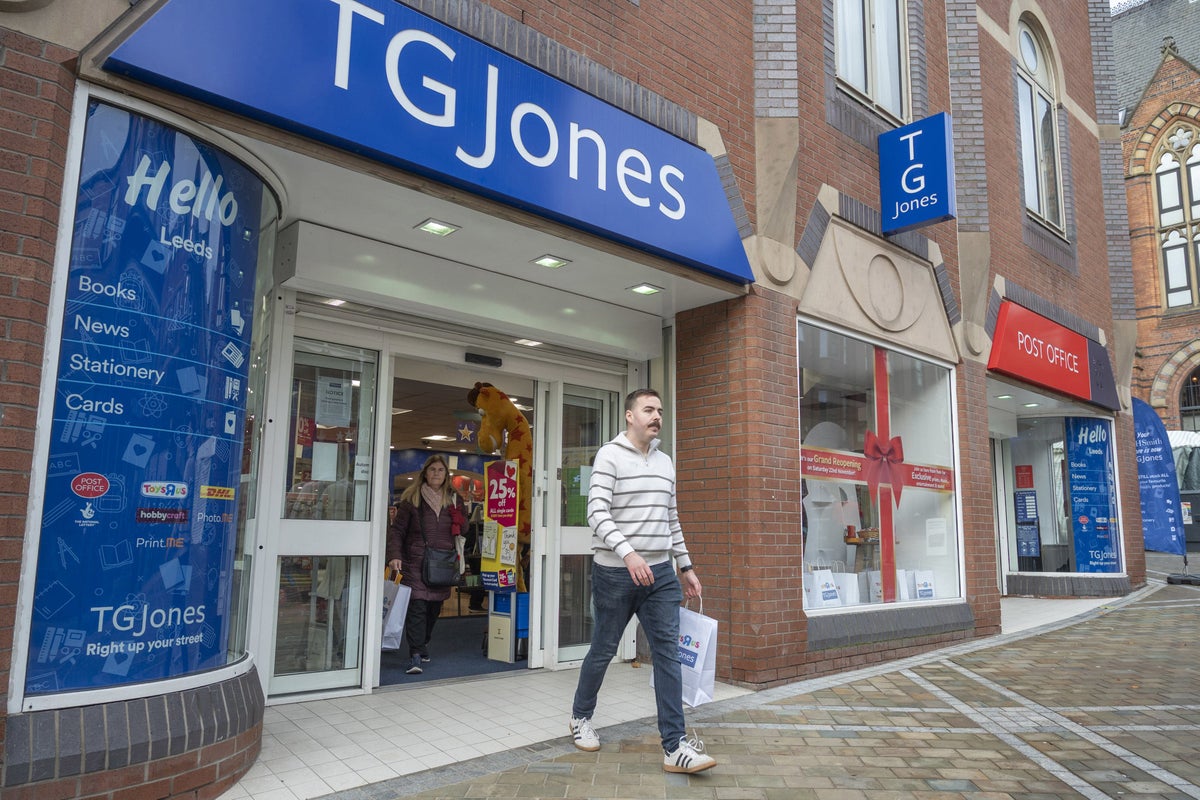
Up to 150 high street stores previously part of the WH Smith business face closure, with hundreds of jobs understood to be at risk.
TGJones attributed the significant restructuring to the “direct result of government policy and recent geopolitical events”.
The firm stated that the planned closures are a necessary measure after 12 months of “highly challenging trading conditions”.
These outlets were rebranded as TGJones following Modella Capital’s acquisition of 480 WH Smith stores last year.
In a statement provided to the Press Association on Wednesday, a spokesperson for the business emphasised that the decision to restructure “had not been taken lightly”.
In a statement provided to the Press Association on Wednesday, a spokesperson for the business said the decision to restructure the company “had not been taken lightly”.
The statement said: “While we continue to believe in the strength of the core business, TGJones has experienced highly challenging trading conditions over the past year, along with many other brick-and-mortar retailers.
“Weak consumer spending and cost-of-living pressures, combined with rising operating costs as a direct result of government policy and recent geopolitical events, have meant that the company as a whole has remained loss-making.
“The forced name change from WH Smith has also negatively impacted consumer awareness, despite the fact that the proposition has improved.”
The statement continued: “The survival of this iconic 234-year-old business is our imperative. No decisions have yet been taken on how this will impact roles, but we will aim to preserve as many jobs as possible.
“Any potential store closures or role reductions will be subject to appropriate consultation, and we are committed to engaging openly and constructively with colleagues and their representatives.
“We want to be clear, however, that the plan may result in the closure of some stores and the loss of some roles.
“We recognise the impact this uncertainty will have on colleagues, their families and the communities we serve.”


Gary Player, 90, takes on Bryson DeChambeau in White House push-up contest as Trump watches

Pentagon to release first batch of UFO, alien files ‘very soon’

Trump’s Team Wants Him to Accept an Iran Deal He’s Already Rejected

-

 Sports1 week ago
Pro wrestling star Steph De Lander reveals how colleague’s advice helped lead her to title triumph at ACW
-
 Business1 week ago
‘I had £20,000 stolen and had to fight a 13-month fraud reporting rule to get it back’
-
 Business7 days ago
PSX plunges over 4,800 points | The Express Tribune
-

 Tech1 week ago
This Ambitious Laptop Doesn’t Leave Much Room for Your Hands
-

 Tech6 days ago
Almost half of UK businesses hit by cyber attacks | Computer Weekly
-
 Business1 week ago
BP profits more than double as oil trading booms amid Iran war
-
Uncategorized1 week ago
[CinePlex360] Some plugins have failed to updat
-

 Sports1 week ago
Match officials announced for HBL PSL 11 qualifier – SUCH TV