

Business
Cost of commuting rises as govt hikes fuel prices | The Express Tribune

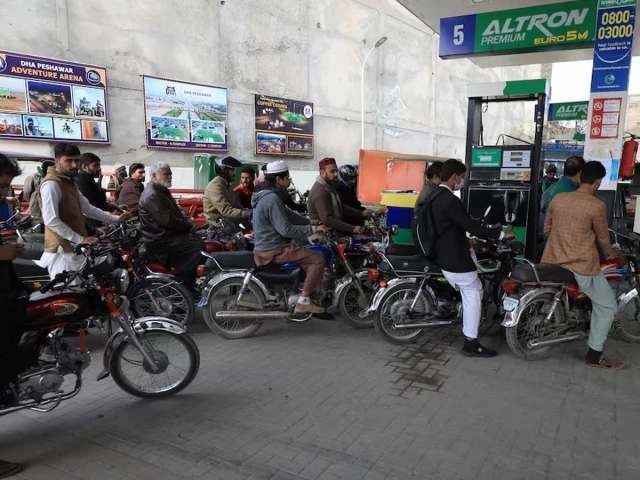
People wait for their turn to get fuel at a petrol station in Peshawar. Photo: Reuters/ File
The federal government has increased the price of petrol by Rs5 per litre and high-speed diesel by Rs7.32 per litre for the next fortnight, according to a notification issued by the Petroleum Division late on Sunday night.
Petrol has been raised by Rs5 per litre, taking the price from Rs253.17 to Rs258.17 per litre.
High-speed diesel (HSD) has been increased by Rs7.32 per litre and now costs Rs275.70 per litre, up from the previous Rs268.38.
The notification further stated that the revised prices take effect immediately from February 16 and will remain in force for the next fortnight.
Fuel prices in Pakistan are reviewed fortnightly and are influenced by changes in international oil prices, exchange rate fluctuations, and domestic tax adjustments. Diesel prices are of particular concern as HSD is widely used in transport, agriculture, and power generation, meaning increases often have a direct impact on inflation and the cost of essential goods.
On February 1, in its fortnightly review, the federal government had reduced the price of high-speed diesel by Rs14 per litre from Rs282.38 to Rs268.38 per litre for the next 15 days, while keeping petrol prices unchanged at Rs253.17 per litre.
Earlier, sources had said the price of petrol might rise by Rs4.39 per litre, while high-speed diesel was likely to see an increase of Rs5.40 per litre.








Business
New norms for NH & bridge works: Longer timelines, realistic deadlines – The Times of India

New Delhi: In a major change in policy, govt has increased the time allowed for construction of 6-10 km-long bridges across rivers such as Ganga and Brahmaputra to six years and for 2.5-6 km-long bridges on Mahanadi and Godavari to five years. The timelines have been revised from the current 24-30 months.Similarly, the construction period has been fixed at two years for national highway projects costing up to Rs 500 crore, 30 months for Rs 500-1,500 crore projects, and three years for works costing over Rs 1,500 crore.The change in the ‘normative construction period’ has been made after a gap of 13 years, learning from past experience of how the average time taken for completion of NH projects has been over four years against the standard timeline of 2.5-3 years. The revised timeline for construction will be applicable for all NH projects to be bid out from May 6.In a circular, the road transport ministry said present guidelines — issued in 2013 — are derived from a legacy linear model that does not explicitly account for voluminous earthwork, leading to unrealistic construction period and resulting in additional cost and risk.“Therefore, a need was felt to revise the existing guidelines based on scientific analysis, understanding of completed projects, and prescribe a realistic construction period for civil works at DPR and bid invitation stage,” the ministry said. It added that the new norm will improve predictability in completion of projects, reduce disputes, enhance value and quality of NHs, for realistic and bankable bids, better quality outcomes and improved investor confidence.An additional six months time has been provisioned in the new norms for critical projects which involve multiple flyovers, tunnels or elevated structures. Similarly, an addition of 12 months has been provisioned for projects that involve cutting and slope stabilisation in hilly states.
Business
JPMorgan CEO Jamie Dimon in annual letter cites risks in geopolitics, AI and private markets

JPMorgan Chase CEO Jamie Dimon is calling for a broad recommitment to American ideals as his bank navigates geopolitical uncertainty, a teetering economy and the revolutionary impact of artificial intelligence.
Dimon in his annual letter to shareholders, published Monday, noted the country’s 250th anniversary as “the perfect time to rededicate ourselves to the values that made this great nation of ours — freedom, liberty and opportunity.”
“The challenges we all face are significant. The list is long but at the top are the terrible ongoing war and violence in Ukraine, the current war in Iran and the broader hostilities in the Middle East, terrorist activity and growing geopolitical tensions, importantly with China,” Dimon said. “Even in troubled times, we have confidence that America will do what it has always done — look to the values that have defined our singular nation and sustained our leadership of the free world.”
Dimon, the longtime leader of the world’s largest bank by market cap, is among the most outspoken of U.S. corporate leaders. His annual letter offers not only a matter of record for his firm’s performance, but also sweeping perspectives on the global state of affairs.
In Monday’s letter, Dimon noted headwinds including global conflicts, persistent inflation, private market upheaval and what he called “poor bank regulations.”
Dimon said that while regulations like those put in place after the 2008 financial crisis “accomplished some good things … they also created a fragmented, slow-moving system with expensive, overlapping and excessive rules and regulations — some of which made the financial system weaker and reduced productive lending.”
He specifically cited negative consequences of capital and liquidity requirements, the current construction of the Federal Reserve’s stress test and a “badly handled” process at the Federal Deposit Insurance Corp.
Dimon also said JPMorgan’s reaction to revised proposals for Basel 3 Endgame and a global systemically important bank, or GSIB, surcharge — issued by U.S. regulators last month — were “mixed.”
“While it was good to see that the recent proposals for the Basel 3 Endgame (B3E) and GSIB attempted to reduce the increase in required capital from the 2023 proposals, there are still some aspects that are frankly nonsensical,” Dimon said.
The CEO said with the aggregate proposed surcharges of about 5%, the bank would need to hold “as much as 50% more capital across the vast majority of loans to U.S. consumers and businesses when compared with a large non-GSIB bank for the same set of loans.”
“Frankly, it’s not right, and it’s un-American,” he said.
On trade and geopolitics
Dimon identified geopolitical tensions as the primary risk facing his bank, namely the wars in Ukraine and Iran and their impacts on commodities and global markets — deeming war “the realm of uncertainty.”
“The outcome of current geopolitical events may very well be the defining factor in how the future global economic order unfolds,” he said. “Then again, it may not.”
He also cited a “realignment of economic relations in the world” brought on by U.S. trade policy. U.S. President Donald Trump has made tariffs a signature policy of his second term in office, introducing higher duties on dozens of trade partners and import categories.
“The trade battles are clearly not over, and it should be expected that many nations are analyzing how and with whom they should create trade arrangements,” Dimon said. “While some of this is necessary for national security and resiliency, which are paramount, it is hard to figure out what the long-term effects will be.”
On private markets
Dimon also spoke to recent upheaval in the private markets, as fears around loans made to software firms spur massive redemption requests at private credit funds.
“By and large, private credit does not tend to have great transparency or rigorous valuation ‘marks’ of their loans — this increases the chance that people will sell if they think the environment will get worse — even if actual realized losses barely change,” Dimon said.
The executive added that actual losses are already higher than they should be relative to the environment.
“However this plays out, it should be expected that at some point insurance regulators will insist on more rigorous ratings or markdowns, which will likely lead to demands for more capital,” he said.
On AI
Dimon reiterated Monday that the pace of AI adoption is unlike any technology that came before it. He said while its implementation will be “transformational,” it remains to be seen how the AI revolution will unfold.
“Overall, the investment in AI is not a speculative bubble; rather, it will deliver significant benefits. However, at this time, we cannot predict the ultimate winners and losers in AI- related industries,” Dimon said.
“We will not put our heads in the sand. We will deploy AI, as we deploy all technology, to do a better job for our customers (and employees),” he wrote.
JPMorgan has been at the forefront of Wall Street firms introducing AI at every level of its business. Last year, JPMorgan Chief Analytics Officer Derek Waldron gave CNBC an early demonstration into how it’s using agentic AI to speed up work and improve results for customers and shareholders.
In February, Dimon said AI was reshaping JPMorgan’s workforce and that the bank had “huge redeployment plans” for employees.
“We have focused on some of the ‘known and predictable’ and some of the ‘known unknown’ events,” he said. “But huge technological shifts like AI always have second- and third-order effects as well that can deeply impact society. … We should be monitoring for this kind of transformation, too.”
— CNBC’s Leslie Picker and Ritika Shah contributed to this report.

The prices of gold increased in the local market on Monday, with 24-karat gold per tola rising by Rs1,100 to settle at Rs491,462 compared to Rs490,362 on the previous trading day, according to rates issued by the All Pakistan Sarafa Gems and Jewellers Association.
Similarly, the price of 10 grams of 24-karat gold increased by Rs943 to Rs421,349 from Rs420,406, whereas 10 grams of 22-karat gold went up by Rs864 to Rs386,250 against Rs385,386.
In the international market, the price of gold increased by $11 to $4,687 per ounce from $4,676.
Meanwhile, the price of silver per tola decreased by Rs 50 to Rs 7,744 from Rs 7,794, while the price of 10 grams of silver declined by Rs 43 to Rs 6,639 from Rs 6,682.
The price of silver in the international market also decreased by $0.50 to $72.60 per ounce from $73.10.


Border Patrol Agents Sold Challenge Coins With ‘Charlotte’s Web’ Characters in Riot Gear
New norms for NH & bridge works: Longer timelines, realistic deadlines – The Times of India

‘Sprit of resistance will continue’: Iran officials condemn Israeli assassination of IRGC intel. chief

-

 Sports1 week ago
USMNT handed reality check by Doku, Belgium ahead of World Cup
-

 Sports1 week ago
2026 NCAA men’s hockey tournament: Schedule, results
-
Uncategorized4 days ago
[CinePlex360] Please moderate: “Trump signals p
-
Uncategorized1 week ago
[CinePlex360] Please moderate: “Further tariff
-

 Tech3 days ago
Our Favorite iPad Is $50 Off
-

 Entertainment3 days ago
Joe Jonas shares candid glimpse into parenthood with Sophie Turner
-
 Sports7 days ago
Fakhar Zaman denies ball-tampering charge in PSL match | The Express Tribune
-

 Sports1 week ago
Man City show why they are worthy WSL title winners as tired United wilt