

Business
Airlines must offer 60% seats free from April 20, DGCA says amid row over seat selection charges – The Times of India


Passengers flying within India will be able to choose a larger share of seats without paying extra from April 20, after aviation regulator DGCA directed airlines to offer at least 60 per cent of seats on every flight free of charge.The move follows concerns over airlines charging steep fees for seat selection, with the civil aviation ministry announcing on March 18 that it had asked the regulator to ensure fairer access for passengers.
New rule raises free seat quota from 20% to 60%
Acting on the ministry’s direction, the Directorate General of Civil Aviation (DGCA) issued an amended Air Transport Circular on March 20, which will come into force 30 days later, effectively from April 20.Under the revised rules, airlines must ensure that at least 60 per cent of seats on any flight are available for selection without any additional charge. At present, only around 20 per cent of seats are generally offered free, while the rest attract a fee.The DGCA has also told airlines to keep their seat allocation policies transparent and clearly show the availability of free seats, along with any applicable conditions, on their booking platforms.“Airlines should maintain transparent seat allocation policies and clearly communicate the availability of free seats and applicable conditions on their booking interfaces,” the regulator said in the revised circular dated March 20.
Families on same booking should be seated together where possible
The regulator has further said that passengers travelling on the same PNR (Passenger Name Record) should, as far as practicable, be seated close to one another, which would ordinarily mean adjacent seats in the same row.An official cited by news agency PTI said that airlines are now preparing to implement the new directive.Seat selection charges currently range from Rs 200 to Rs 2,100, depending on factors such as front-row placement and extra legroom.
Airlines object, warn of possible fare hikes
The new rule comes against the backdrop of growing criticism over airlines levying hefty charges for add-on services, especially seat selection.However, the move has faced strong resistance from carriers. As per PTI, IndiGo, Air India and SpiceJet objected to the decision last week, arguing that forcing airlines to make at least 60 per cent of seats free would hurt revenues and could eventually push up airfares.In a letter sent to the civil aviation ministry on March 20, the Federation of Indian Airlines (FIA), which represents the three carriers, urged the government to withdraw the decision.
Other optional service charges must also be clearly shown
Apart from seat selection, the DGCA has also directed airlines to display all charges for optional services such as carrying sports equipment or musical instruments in a clear and unambiguous manner on websites and booking portals.The regulator said airlines must also disclose any liability conditions in case of damage linked to such items.The change comes at a time when Indian airports are handling more than five lakh passengers daily, underlining the wide impact the new rule could have across the country’s fast-growing aviation market.DGCA chief Faiz Ahmed Kidwai recently said the regulator is trying to simplify rules for airlines while also protecting passenger rights. Speaking at the Indian Chamber of Commerce Aviation and Tourism Summit, he said the aim is to strike a balance between supporting airline growth and safeguarding travellers.“India’s aviation market is one of the fastest-growing in the world, but airlines are currently dealing with several operational hurdles,” Kidwai said, as quoted by news agency IANS.
Business
Big drop! Why bench strength of TCS, Infosys, Wipro & other IT companies has fallen by around 75,000 people – The Times of India

Indian IT sector majors – Tata Consultancy Services (TCS), Wipro, Infosys, HCL Tech, and Tech Mahindra – have seen their bench strength drop by 25% in the last two years. Bench strength acts as a traditional reserve workforce with an aim to be a cushion during demand fluctuations. This buffer has contracted sharply, declining by roughly one-fourth over the past two years, and industry observers believe it may not return to earlier levels even if growth revives.Across major firms such as TCS, Infosys, Wipro, HCLTech and Tech Mahindra, the number of employees on the bench has dropped by around 75,000, falling from nearly three lakh to about 2.25 lakh, according to industry estimates cited by experts in an ET report.The proportion of unassigned employees has also narrowed considerably. “The bench across IT services is currently between 8-15% of the workforce compared to over 20% earlier,” said Pareekh Jain, CEO of EIIRTrend. Similarly, TeamLease Digital estimates the current range at 8-12%, down from 20-30% in previous years.
Deeper Shift In IT Sector Bench Strength Trends
Historically, companies maintained a sizeable bench by hiring in anticipation of future projects, ensuring that skilled personnel were readily available when demand materialised. This approach was viable during periods of rapid expansion. However, firms are now moving away from that model and tightening workforce utilisation.Companies that once operated with 4-5% of employees on the bench are now targeting significantly lower levels, often between 1% and 1.5%. In some cases, stricter policies have been introduced. For instance, in TCS bench duration has been capped at around 35 days annually, after which performance evaluations are initiated, and employees who remain unallocated may be asked to exit.Experts indicate that this shift is not merely cyclical but reflects a deeper structural change. “The concept of bench does not make sense unless an IT services firm can predict skill or role-based demand with 90% accuracy three months in advance,” said Gaurav Vasu, founder of UnearthInsight.Slower industry growth has been identified as the primary driver behind this contraction, rather than technological disruption. “Low growth is the bigger factor in bench reduction today. When growth returns, firms may not need to rebuild their bench because local hiring in different countries has increased significantly over the last five to six years,” Jain said.Over the past two years, hiring patterns have undergone a clear shift. Demand for traditional mid-level delivery roles has declined by roughly 20–30 per cent, while requirements for skills in artificial intelligence, generative AI, data, and cloud technologies have increased by about 30–40 per cent across the same firms, according to Neeti Sharma, CEO of TeamLease Digital.Global capability centres, however, present a more varied trend, with mid-level recruitment showing relatively greater resilience. “Leadership hiring has grown in line with overall demand, with the share of such roles increasing from around 15% in 2024 to around 20% in 2025. What has changed is the nature of these roles. Today, more than 50% of job demand is driven by emerging skills, especially in AI, cloud, and platform engineering,” said Kapil Joshi, CEO of IT staffing at Quess Corp. In contrast, hiring at the entry level has declined by around 30–35 per cent during the same period, he added.The changes are also affecting how quickly professionals are placed. The average time required to assign a benched engineer with 8–12 years of experience has lengthened to 60–90 days, compared with 30–45 days earlier, Sharma told ET.
Salary Trends
Compensation trends are diverging as well. Premiums for lateral hiring in non-AI roles have reduced to 10–20 per cent, down from 25–35 per cent in FY 2022–23. In contrast, professionals with AI capabilities continue to command premiums of 20–30 per cent and tend to secure offers more quickly, Sharma said. According to Quess data, premiums for generative AI roles range between 15–40 per cent depending on the position.The broader career structure within IT services firms is also evolving. “The people manager role is not disappearing, but its responsibilities are narrowing, shifting toward revenue expansion and profitability management away from headcount oversight,” Vasu said.
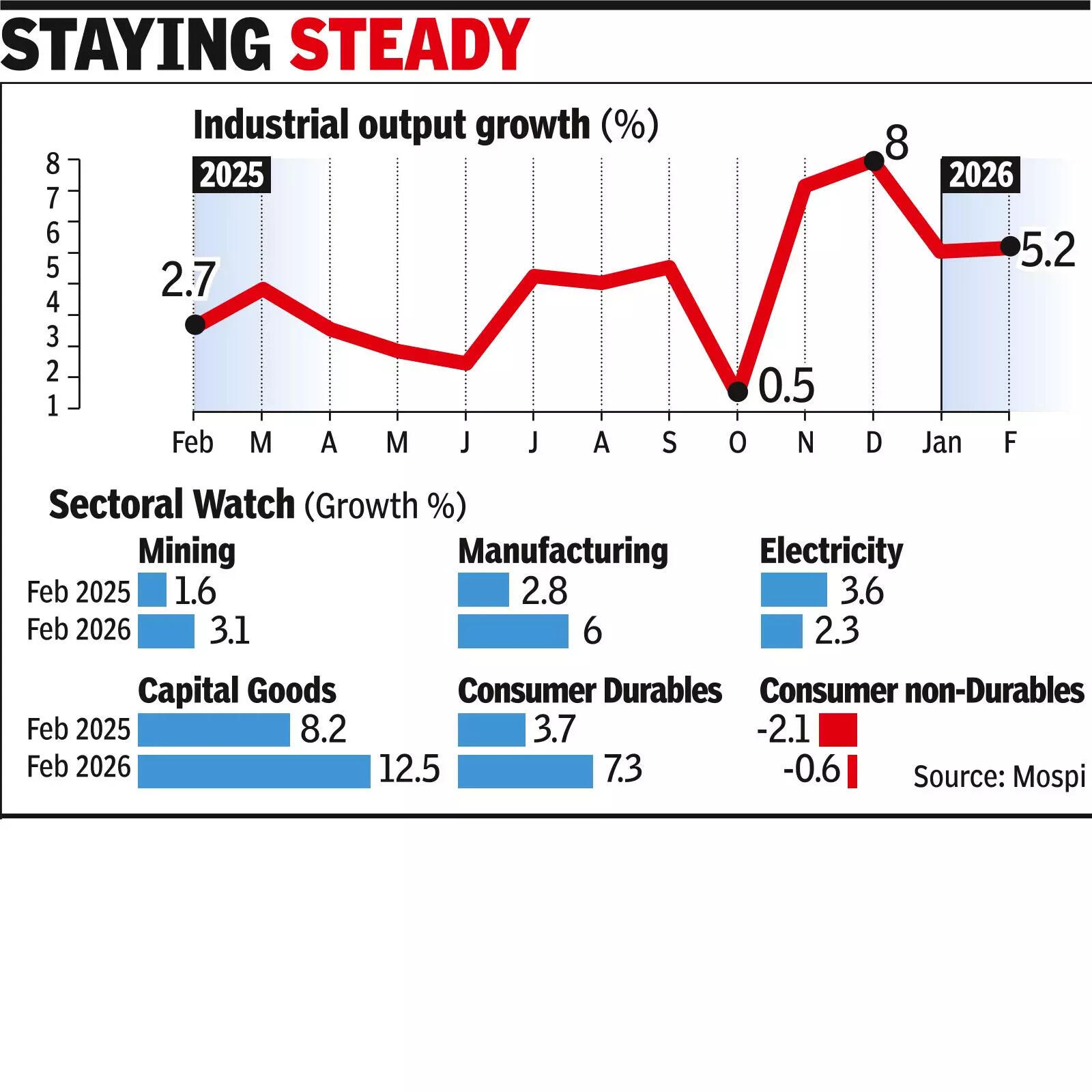
NEW DELHI : The country’s industrial output growth accelerated in Feb, led by a recovery in the manufacturing sector, but the West Asia conflict is expected to weigh heavily on the crucial sector in the months ahead.Data released by the National Statistics Office (NSO) on Monday showed the index of industrial production rose 5.2 per cent in Feb, a tad higher than the upwardly revised 5.1% in Jan. The manufacturing sector rose 6 per cent in Feb, higher than 2.8 per cent in Feb last year and above the 5.3 per cent in Jan.Within the manufacturing sector, 14 out of 23 industry groups grew in Feb compared to the same month a year earlier. The top three positive contributors in Feb were — manufacture of basic metals (13.2 per cent), manufacture of motor vehicles, trailers and semitrailers (14.9 per cent) and manufacture of machinery and equipment (10.2 per cent), according to the statistics office. The electricity and mining sectors remained sluggish, rising 2.3 per cent and 3.1 per cent respectively.Experts expect the West Asia conflict to hurt factory sector expansion. Aditi Nayar, chief economist, ICRA, said the agency expects IIP growth to decelerate to 3 per cent-4 per cent in March, amid the unfolding adverse impact of the West Asia crisis on some manufacturing segments, both through the price and availability channels, and weaker electricity performance in the month.

Oil markets have been sensitive to Donald Trump’s comments on the war. But are traders growing less responsive?
Source link


2026 World Cup playoffs: Who will claim the final six spots?

Rain, strong winds likely in Karachi from April 1

Netherlands manufacturing output prices fall 2.3% YoY in February

-

 Politics7 days ago
Afghanistan announces release of detained US citizen
-

 Sports7 days ago
Broadcast industry CEO says consolidation is ‘essential’ to compete for NFL soaring media rights prices
-

 Entertainment7 days ago
UN warns migratory freshwater fish numbers are spiralling
-
 Business7 days ago
Property Play: Home flippers see smallest profits since the Great Recession, real estate data firm says
-

 Tech7 days ago
Can a Home Appliance Fix the Problem of Soft-Plastic Waste?
-
 Business7 days ago
Gold prices soar in Pakistan – SUCH TV
-

 Fashion7 days ago
ICE cotton slips on weaker crude, profit booking
-
 Business7 days ago
More women are entering wealth management, but few are in advisory roles, study finds