

Business
What does a US naval blockade of Iran mean for oil flows? | The Express Tribune

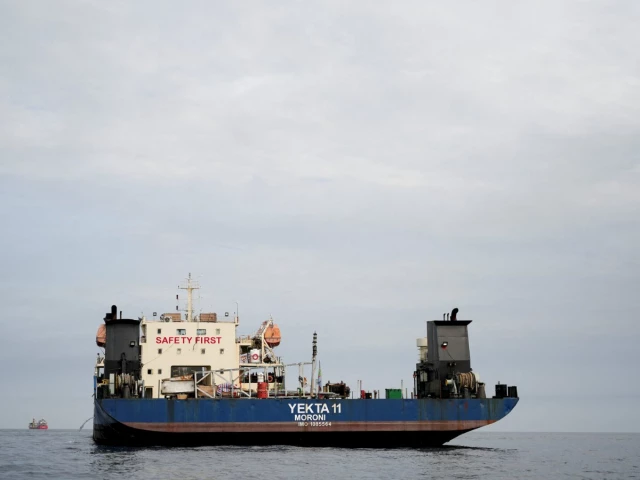
Blocking Iranian shipments would disconnect a significant source of oil from the world’s markets
A vessel at the Strait of Hormuz, off the coast of Oman’s Musandam province, April 12, 2026. PHOTO: REUTERS
The US military said it would block shipping traffic in and out of Iran’s ports starting at 10am ET (7pm PKT) on Monday, a move that would prevent roughly two million barrels of Iranian oil a day from entering the world’s markets, further tightening global supply.
Here are details on the planned blockade and its implications for oil markets.
What was announced?
After weekend peace talks in Islamabad between negotiators from the US and Iran ended without a deal, President Donald Trump said the US Navy “will begin the process of BLOCKADING any and all ships trying to enter, or leave, the Strait of Hormuz.”
The US military’s Central Command later said the blockade would only apply to ships going to or from Iran, including all Iranian ports on the Gulf and Gulf of Oman.
US forces would not impede freedom of navigation for vessels transiting the Strait of Hormuz to and from non-Iranian ports and additional information would be provided, it said.
Also Read: Iran says Gulf ports are ‘either for everyone or for no one’
Iran’s Revolutionary Guards responded to Trump by warning that military vessels approaching the strait would be considered a ceasefire breach and dealt with harshly and decisively.
Retired Admiral Gary Roughead, a former chief of US naval operations, cautioned that Iran could fire on ships in the Gulf or attack the infrastructure of Gulf states that host US forces.
What is the implication for oil flows?
Blocking Iranian shipments would disconnect a significant source of oil from the world’s markets. Iran exported 1.84 million barrels per day (bpd) of crude in March and has shipped 1.71 million bpd thus far in April, compared with a full-year average of 1.68 million bpd in 2025, according to Kpler data.
However, a surge in Iranian output before the war started on February 28 has led to near-record levels of Iranian oil loaded on ships, with more than 180 million barrels floating as of earlier this month, according to Kpler data.
What about oil flows from other Gulf producers?
Shipping traffic through the Strait of Hormuz, which has been severely curtailed by an Iranian blockade since the start of the war, remains nearly halted despite last week’s two-week ceasefire agreement between Washington and Tehran.
Oil tankers were steering clear of the strait on Monday.
Read More: US blockade of Iran will be major military endeavor, experts say
On Sunday, two Pakistan-flagged tankers, Shalamar and Khairpur, entered the Gulf to load cargoes from the United Arab Emirates and Kuwait; a third ship, the Liberia-flagged very large crude carrier (VLCC) Mombasa B, also transited the strait earlier on Sunday and was ballasting in the Gulf.
Another VLCC, the Malta-flagged Agios Fanourios I, which tried to pass through the strait on Sunday to load Iraqi crude destined for Vietnam, turned back and was anchored near the Gulf of Oman.
On Saturday, three fully loaded supertankers passed through the Strait of Hormuz in what appeared to be the first vessels to exit the Gulf since the US-Iran ceasefire deal.
Some 187 laden tankers carrying 172 million barrels of crude oil and refined products were inside the Gulf as of last Tuesday, according to Kpler.
Which importers are most affected
Before the war, most Iranian oil exports were shipped to China, the top global crude importer. Last month, the US unveiled a sanctions waiver that has enabled other buyers, including India, to import Iranian oil.
India is set to receive its first crude shipment from Iran in seven years this week, ship tracking data from LSEG and Kpler showed on Wednesday.
Before the war, roughly 20% of global oil and natural gas exports were shipped through the Strait of Hormuz, with most cargoes headed to Asia, the largest importing region.






The FTSE 100 posted modest falls on Monday as the oil price topped 100 dollars per barrel once more as the US pressed ahead with a naval blockade of the Strait of Hormuz.
US President Donald Trump announced he would blockade the key shipping route after vice president JD Vance left weekend negotiations with an Iranian delegation in Pakistan without a deal.
The FTSE 100 closed down 17.57 points, 0.2%, at 10,582.96. The FTSE 250 ended down 74.13 points, 0.3%, at 22,276.89, but the AIM All-Share rose 4.83 points, 0.6%, to 782.31.
News of the breakdown in talks between the US and Iran dealt a blow to those hoping for an end to the conflict, sending oil prices higher once more.
The US set a deadline of 2pm on Monday to begin a partial blockade of the Strait of Hormuz, through which a fifth of the world’s oil and gas passes.
“The blockade will be enforced impartially against vessels of all nations entering or departing Iranian ports and coastal areas, including all Iranian ports on the Arabian Gulf and Gulf of Oman,” the US Central Command posted on X.
The threat comes as Tehran has already effectively closed the Strait of Hormuz to oil and other traffic since the start of US-Israel strikes on Iran in late February.
“Reopening the Strait of Hormuz remains the key requirement for reigniting a sustainable rally across risk assets,” said David Morrison, an analyst at Trade Nation.
“Yet there’s also a conviction, rightly or wrongly, that the war will end relatively soon,” he said, noting that oil futures contracts for deliveries later this year are currently priced well below current market prices.
“As far as oil traders are concerned, this war may be in its seventh week, but it should be resolved by summer,” Mr Morrison said.
Brent oil traded higher at 101.95 dollars a barrel on Monday afternoon, up from 96.14 dollars at the time of the equities close in London on Friday.
“Although oil prices have jumped back above the 100 dollars level, the fact that they have not returned to pre-ceasefire highs above 111 dollars per barrel for Brent has tempered the sell-off in risky assets at the start of this week. The peace talks between Iran and the US at the weekend was not a single event, but should be viewed as a process, and there are hopes that more talks will continue,” observed Kathleen Brooks, research director at XTB.
In European equities on Monday, the CAC 40 in Paris closed down 0.3%, as did the DAX 40 in Frankfurt.
In New York, markets were mixed. The Dow Jones Industrial Average was down 0.6%, the S&P 500 was little changed, and the Nasdaq Composite was up 0.3%.
Shares in Goldman Sachs fell 3.6% despite better-than-expected first quarter earnings.
Kicking off a busy week of US banking results, Goldman reported 17.23 billion dollars in total net revenue, up 14% from 15.06 billion dollars the year prior.
But Citigroup analyst Keith Horowitz said an impressive equities performance was offset by a large CET1 capital ratio decline and a weak contribution from its Fixed Income, Currencies & Commodities division.
The yield on the US 10-year Treasury was at 4.33% on Monday, widened from 4.30% on Friday. The yield on the US 30-year Treasury stretched to 4.93% on Monday from 4.90%.
The pound fell to 1.3451 dollars on Monday afternoon from 1.3472 dollars on Friday. Against the euro, sterling rose to 1.1492 euros from 1.1482 euros.
In London, Associated British Foods fell 2.0% as RBC Capital Markets downgraded to ‘underperform’ from ‘sector perform’ seeing further downside risk to consensus earnings forecasts, mainly due to pressure on its largest business, retailer Primark.
On the FTSE 250, Wickes was knocked back 5.1% after a downgrade to ‘hold’ from ‘buy’ by Panmure Liberum which thinks consensus forecasts are too ambitious.
While recruiter Hays fell 2.1% amid the uncertain economic outlook amid the Middle East crisis, and ahead of a trading statement this week.
The US-Iran war weighed on travel operators with budget airlines easyJet and Wizz Air down 2.4% and 5.4%, while cruise operator Carnival lost 2.6% and travel retailer WH Smith declined 3.2%.
Meanwhile, Essentra tumbled 11% as Deutsche Bank downgraded to ‘hold’ from ‘buy’ believing there is a “meaningful risk” that input cost inflation hits demand, particularly in the Europe, Middle East & Africa region.
This would “once again” defer Essentra’s recovery, the bank said.
Elsewhere, Mothercare plunged 21% after reporting lower earnings and sales in financial 2026 amid ongoing Middle East uncertainty.
The Watford-based retailer, which specialises in products for newborn babies and children, said adjusted Ebitda fell to £1.3 million from £3.5 million, while worldwide retail sales by franchise partners declined 22% to £180 million.
Mothercare said the Middle East conflict had an impact of £100,000, citing continued uncertainty for franchise partners in the region. However, it described the recent performance as “usefully resilient” ahead of financial 2027.
Gold traded at 4,714.40 dollars an ounce on Monday, down from 4,775.63 dollars at the same time on Friday.
The biggest risers on the FTSE 100 were Metlen Energy & Metals, up 1.04p at 33.32p, Sage Group, up 23.40p at 841.00p, 3i Group, up 68.50p at 2,759.00p, London Stock Exchange, up 222.00p at 9,190.00p and BAE Systems, up 51.50p at 2,245.50p.
The biggest fallers on the FTSE 100 were United Utilities, down 32.00p at 1,362.00p, Severn Trent, down 71.00p at 3,184.00p, National Grid, down 27.80p at 1,319.80p, Marks & Spencer, down 7.50p at 357.40p and Fresnillo, down 72.00p at 3,524.00p.
Tuesday’s global economic calendar has China trade figures overnight and US producer price inflation data.
Contributed by Alliance News

The incident marks the second time the games giant has been hacked by young, English-speaking hackers.
Source link
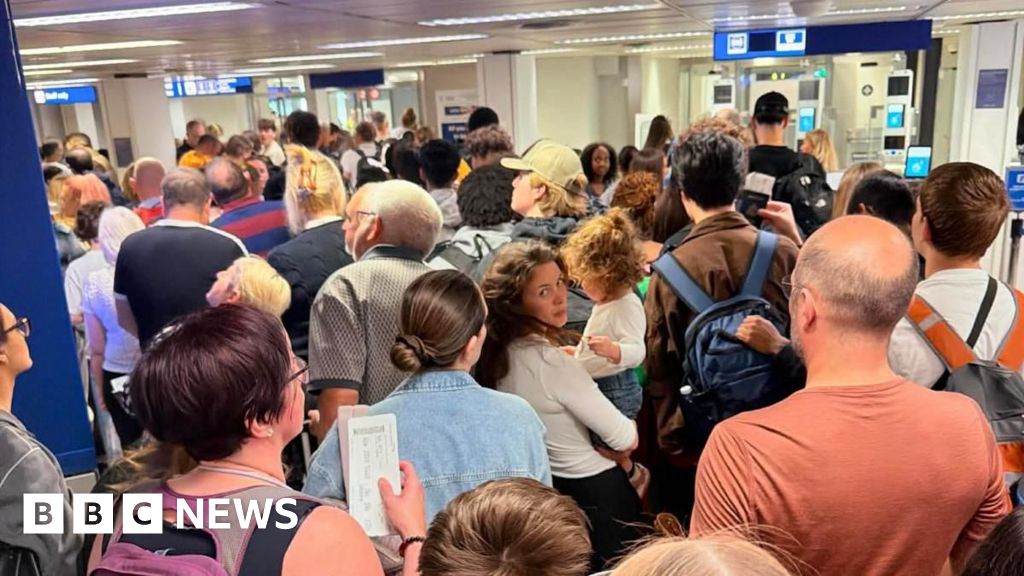
Airlines warn of further disruption due to the introduction of a new EU digital border control system.
Source link

FTSE 100 edges lower amid new US-Iran uncertainty

Prince Edward, Anne stand by Andrew after King Charles’ blow: ‘Threat’ to monarchy

Meta Is Warned That Facial Recognition Glasses Will Arm Sexual Predators

-

 Fashion6 days ago
India’s exports face reset as EU links trade to carbon metrics: EY
-
 Politics1 week ago
Trump confirms rescue of airman whose F-15 was downed in Iran
-

 Entertainment5 days ago
Queen Elizabeth II emotional message for Archie, Lilibet sparks speculation
-
 Tech5 days ago
As the Strait of Hormuz Reopens, Global Shipping Will Take Months to Recover
-

 Tech5 days ago
Azure customers up in arms over ‘full’ UK South region | Computer Weekly
-

 Entertainment6 days ago
Lamar Odom shocking response to Khloé Kardashian account of his overdose
-

 Tech4 days ago
This AI Button Wearable From Ex-Apple Engineers Looks Like an iPod Shuffle
-

 Sports1 week ago
With Messi goal, Inter Miami open new stadium with dream moment