

Business
Iran war: Trump sanctions waiver or not – why India continues to buy Russian oil – The Times of India

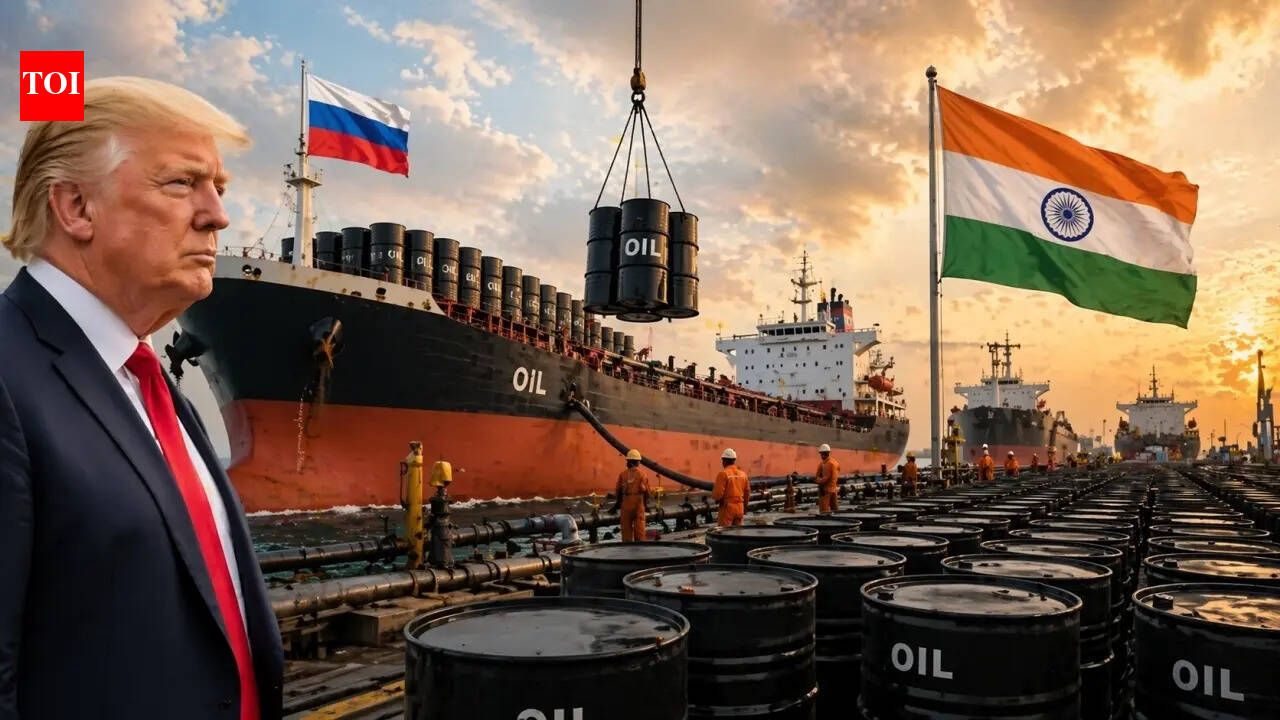
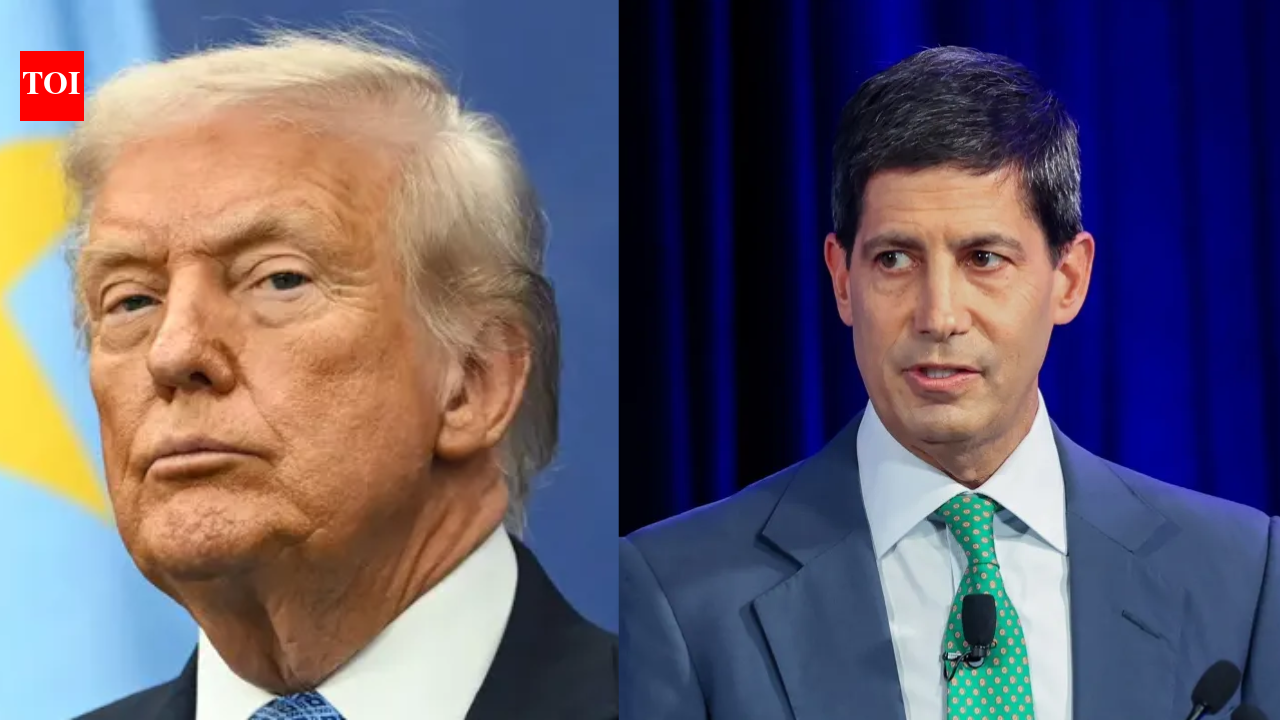
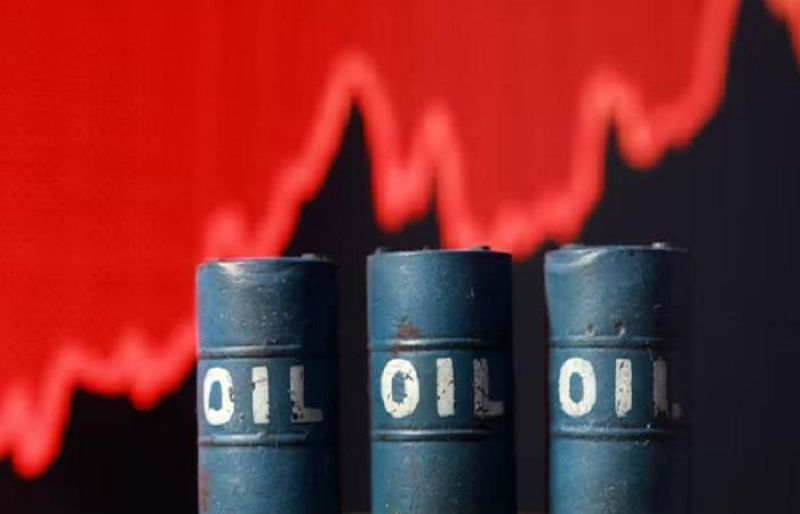
In early March, India was staring at a possible crude oil supply problem – the US-Iran war caused the Strait of Hormuz through which 20% of global crude transits to be effectively closed. To rescue came Russian crude oil! In fact, Russian crude has become a crucial support for India’s oil imports both in April and March. The import volumes are actually touching highs seen when India was bagging Russian crude at a huge discount.US President Donald Trump sanctioned two Russian oil majors towards the end of last year. This made it financially unviable for Indian refiners to continue to buy Russian crude at the same level as before, though flows of unsanctioned oil continued.However, in March, with the US sanctions waiver in effect, India has aggressively procured Russian crude, picking up millions of barrels. After the Russia-Ukraine war, Russian crude has maintained its position as the largest supplier of crude oil to India. Through Western sanctions, US President Donald Trump’s pressure and sanctions on Russian oil majors, crude from Russia has continued to flow to India, though the levels have varied.
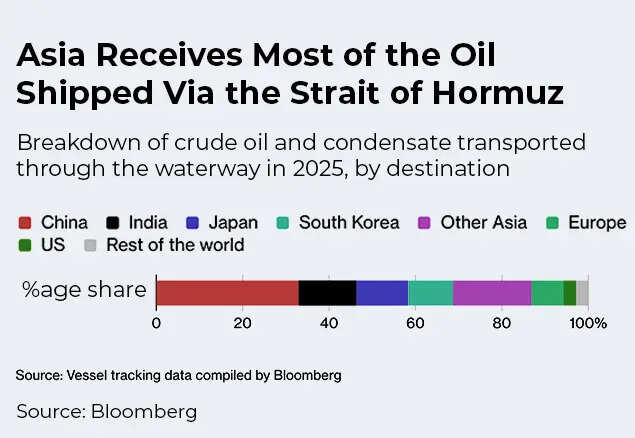
However, experts believe that once the situation in the Middle East normalizes, India will go back to buying crude from Gulf countries, and Russia’s percentage in India’s oil imports will come down.
US sanctions waiver & India’s aggressive buying
India has never officially said that it will stop buying Russian crude, and even when levels dropped after sanctions, Russia was still the biggest contributor. However, the Donald Trump administration’s decision to waive sanctions on Russian crude, and extend that waiver to May has allowed Indian refiners to step up procurement without any worries.According to the latest report from Centre for Research on Energy and Clean Air (CREA)’s analysis, while India’s total crude imports recorded a 4% reduction in March, Russian imports doubled.
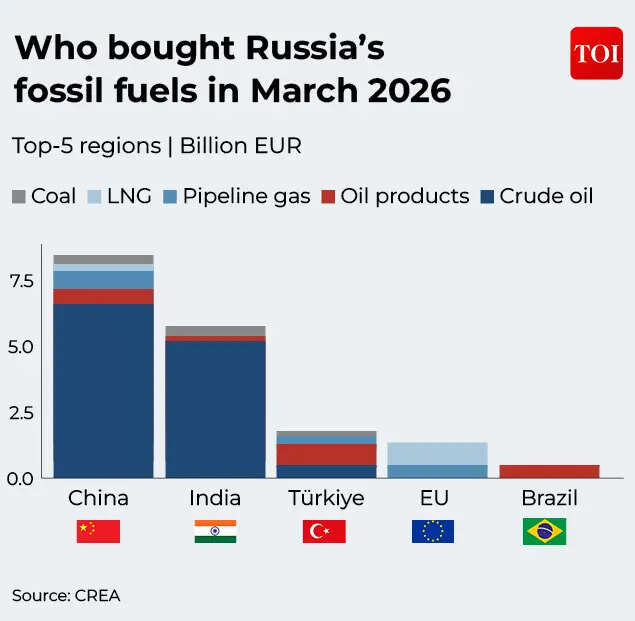
“The biggest shift was in state-owned refineries’ imports from Russia, which saw a massive 148% month-on-month increase. Their imports were in fact 72% higher than March 2025, presumably due to Russian barrels being more available in the spot market, which serves as the primary source of imports for them,” says CREA.Russia’s share of India’s crude oil imports in March 2026 placed the month at the upper end of historical highs, closely mirroring peak levels seen in 2023, when Western sanctions redirected Russian oil flows toward Asia and made Moscow India’s single largest supplier.Sourav Mitra, Partner – Oil and Gas, Grant Thornton Bharat explains the emergence of Russia as a dominant supplier of crude for India.Russia’s share surged sharply in the months following the Ukraine war, peaking during several months in mid‑2023, particularly around May–June, when imports rose to about 1.9-2.0 million barrels per day and accounted for nearly 42-45% of India’s crude basket, displacing Iraq and Saudi Arabia. That dominance persisted through much of 2023, with average shares close to 40% between April and September, before easing in 2024 and early 2025 as price discounts narrowed, compliance costs increased and refiners partially rebalanced toward Middle Eastern grades.“Against this backdrop, the rebound seen in March 2026 effectively matches the 2023 peak, although the underlying drivers differed, with the latest spike largely reflecting supply disruptions in West Asia that curtailed Gulf inflows and compelled refiners to rely more heavily on available Russian cargoes. We expect that while March marks a return to near‑record dependence on Russian crude, such elevated levels are unlikely to persist once Middle Eastern supply chains stabilize,” Mitra tells TOI.
No more discounts! India paying a premium for Russian crude
What stands out is the fact that when India stepped up its procurement of Russian crude after the Ukraine war began, the oil was available at very steep discounts. This was due to European sanctions that made Russian crude available at a much lower rate than Brent. Come 2026, with oil supplies via Hormuz disrupted and global crude oil prices rising, Russia is now selling at a premium!According to Sourav Mitra of Grant Thornton Bharat, Indian refiners are currently paying a premium of about $4-6 per barrel over the Brent benchmark for Russian crude. These are some of the highest delivered premiums on Russian crude since Russia began diverting large volumes of crude to Asia after the Ukraine war, he tells TOI. “This shift is attributed to intense competition for prompt Russian cargoes as disruptions to Middle Eastern supply routes pushed refiners to prioritise assured deliveries over price. The premium contrasts starkly with February 2026, when Indian buyers were still securing Russian crude at discounts of roughly $12–$15 per barrel, shortly before conditions deteriorated in the Strait of Hormuz,” he elaborates.In fact, the turnaround is even more pronounced compared with 2022-23, when Russian crude frequently traded $20-$30 below Brent. The price inversion was reinforced by the US sanctions waiver issued in early March 2026 and effectively released millions of barrels into the market, strengthening sellers’ leverage. “As a result, India has shifted from discount‑driven buying to security‑led procurement, paying a premium to ensure supply continuity while Gulf flows remain disrupted,” he adds.
Why India continues to buy Russian crude
Russian oil is not going out of India’s crude imports anytime soon, experts say.However, Ivan Mathews, Head of APAC Analysis at Vortexa expects Russian crude imports to decline month-on-month in April. “Discounts on Russian crude were less competitive due to increased demand during the sanctions waiver period, which has since been extended to 16 May. This will lead to lower marginal imports for economics-driven refineries in India. Additionally, reduced crude loadings from Russia will decrease the availability of Russian barrels for imports in the coming weeks,” Mathews tells TOI.
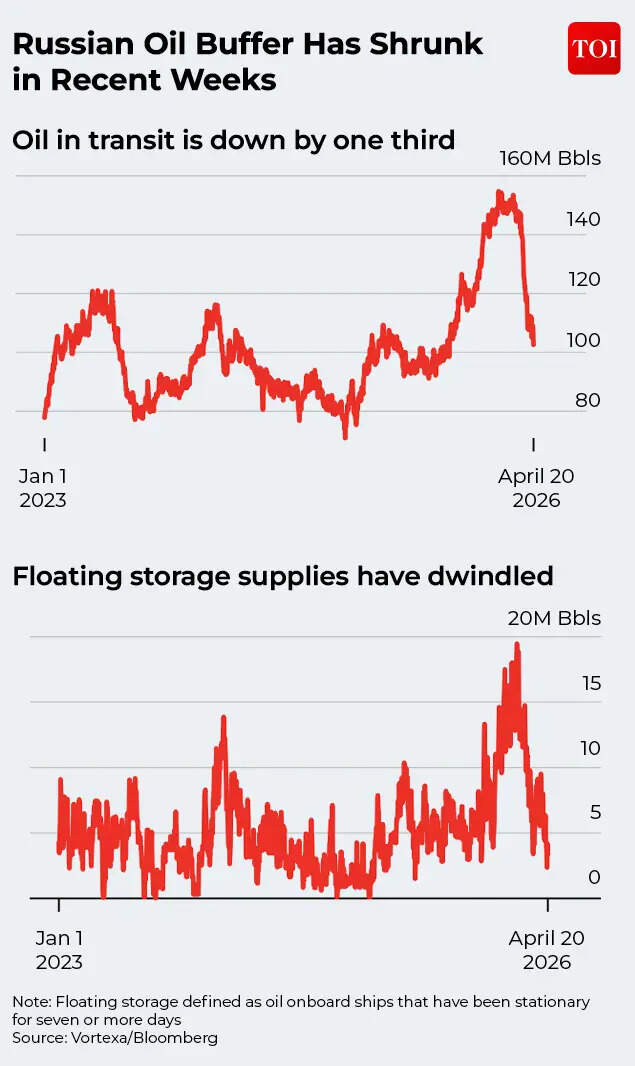
Mitra of Grant Thornton Bharat says that Russian crude is now well integrated into India’s refining system and serves as a reliable fallback when alternative supplies tighten. Russia is likely to remain an important supplier through 2026 even as its share moderates from March’s highs and Middle Eastern flows stabilize.Sumit Ritolia, Manager Modelling and Refining at Kpler believes that Russian oil will continue to be a major part of India’s crude oil imports in the coming months as well. Currently, India’s Russian crude imports are tracking at around 1.6mbd, which is approximately 375 kbd lower than March levels.However, as Ritolia points out, this dip needs context as Nayara (≈400 kbd, fully reliant on Russian crude) has been under maintenance since the second week of April. Adjusting for this, the underlying demand signal for Russian barrels remains intact.“The flows are expected to range between 1.5-2 mbd with a slight dip possible due to ongoing infrastructure issues in Russia due to the conflict with Ukraine,” Ritolia tells TOI.Interestingly, Kpler data shows that even after US sanctions on Russian majors Lukoil and Rosneft came into effect late last year, Russia continued to be the largest supplier of crude oil to India. However, admittedly the volumes saw a sharp drop, with February levels being much lower. While the Donald Trump administration claimed finalising a trade deal contingent on India stopping crude imports from Russia, New Delhi has never said it will not buy oil from Moscow.The US first waived the sanctions in early March and then extended the waiver recently. Experts are of the view that even when the sanctions waiver lapses, Russian oil will continue to be imported, though the quantities may dip.“A key point that is often missed is that Russian oil itself is not sanctioned but certain entities, vessels, and financial channels are,” says Sumit Ritolia.According to Ritolia, Russia continues to be a core supplier for India, but in the absence of sanctions waiver procurement must strictly ensure:• No involvement of sanctioned sellers or intermediaries• Use of non-sanctioned vessels• Fully compliant financial, insurance, and trading channelsIndia is unlikely to move away from Russian crude in the near term. Instead, we should expect more documentation, tighter screening rather than a structural shift in sourcing as and when sanctions lapse, Ritolia added.
India’s Diversified Crude Supplies
But even as Russia is expected to continue being an important player in India’s crude imports, it is equally important to note that New Delhi has diversified its basket to include over 40 countries.As Sushil Mishra, Director, Crisil Intelligence points out: Historically, Russia’s share in India’s crude imports peaked at over 40%, however, it has varied in the last few years amid diversification efforts and evolving geopolitical dynamics. Improved refinery flexibilities have enabled Indian refiners to process a wider range of crude grades including those from the American, Russian, and Middle Eastern.“India continues to strengthen its energy resilience by diversifying crude sourcing and maintaining a pragmatic sourcing strategy driven by price, availability, and energy security considerations. This approach allows flexibility to adjust sourcing patterns in response to changing global market conditions and geopolitical developments,” he tells TOI.






Jenny Lennick’s colourful hair clips are sold across the US and around the world.
Source link

Lululemon store sign in London, March 2, 2026.
Peter Dazeley | Getty Images
Lululemon on Wednesday named Heidi O’Neill as the athleisure company’s new CEO, effective Sept. 8.
The news comes after the company has seen more than a year of disappointing performance and is embroiled in a dramatic proxy battle, with founder Chip Wilson criticizing the business.
Shares of the company sank more than 5% in extended trading.
O’Neill has held multiple roles at Nike, contributing to the sportswear behemoth’s growth. She also held positions at Levi Strauss, Hyatt Hotels and Spotify.
“Heidi is an inspiring leader and proven, consumer-driven brand strategist, with a rare ability to both imagine a new future for a brand and to create the structure and processes to deliver on that vision,” said Marti Morfitt, Lululemon’s executive chair of the board of directors, in a statement. “We selected Heidi because of the breadth of her experience, her demonstrated success delivering breakthrough ideas and initiatives at scale, and her ability to be a knowledgeable change and growth agent.”
O’Neill said in a statement that she plans to focus on building off of the company’s core foundation and unlock growth in global markets. O’Neill will start with a base salary of $1.4 million, according to an 8-K filing.
“I am humbled by the opportunity and energized by what the team is already building,” she said in her statement. “I look forward to joining the company and helping to define and deliver the organization’s next chapter of success.”
Lululemon has been struggling with weak sales and increased competition, as well as mounting costs from tariffs. In its last earnings report, the retailer said it expects tariffs to cost the company $380 million this year.
Wilson, Lululemon’s largest shareholder, has also been placing increased public pressure on the company to make changes to its board of directors. He did not immediately respond to a request to comment on the appointment.
In a statement, GlobalData managing director Neil Saunders said O’Neill has “a very strong pedigree in the activewear and sporting space” and “has an intimate knowledge of how the industry works.”
“There will be some, mostly activist investors, who see O’Neill as something of a safe and traditional choice,” Saunders said. “This argument is partly valid as a lot of cultural change is needed at Lululemon in order to improve performance. However, in our view, O’Neill is her own person who will come with an agenda of change.”
While at Nike, O’Neill played a key role in the company’s doomed direct-to-consumer sales strategy, where the brand pivoted away from wholesale partners in favor of its own website and stores under former CEO John Donahoe. When current CEO Elliott Hill took over as Nike’s next chief executive, he made it a priority to walk back the direct-selling plan.
Prior to leaving Nike, O’Neill also oversaw product and innovation at a time when the brand faced criticism for falling behind on new products and focusing too heavily on the same legacy lifestyle franchises, Dunks, Air Force Ones and Air Jordans. While the franchises briefly led to a surge in sales, fueling Nike’s growth to a $50 billion-plus brand, they ultimately became ubiquitous in the market and viewed as uncool by some consumers.
Now, Hill is still working on unwinding that strategy and clearing inventory from those franchises from the marketplace, which has hit Nike’s margins and led to a decline in sales online.

A Southwest Airlines Boeing 737 airplane lands at Los Angeles International Airport after arriving from Chicago on March 7, 2026 in Los Angeles, California.
Kevin Carter | Getty Images
Southwest Airlines forecast second-quarter earnings below analyst estimates, citing higher fuel prices, while holding off on updating its full-year 2026 forecast.
Southwest expects to earn between 35 cents and 65 cents a share in the current quarter, while analysts polled by LSEG expected 55 cents a share.
The airline in January forecast earnings per share of $4 this year, saying that it expected its new initiatives would pay off. Southwest has sought to increase revenue with checked bag fees and seat assignment fees.
“Achieving this outcome would require lower fuel prices and/or stronger revenue performance to offset higher fuel expense. The Company expects to provide updates to this guidance as appropriate,” Southwest said in an earnings release Wednesday.
Airlines have been either cutting their full-year forecasts or holding off on further forecasts because of volatile prices for jet fuel, generally their biggest expense after labor. They are also pulling back on their capacity growth plans to cut costs, which can drive up airfare when fewer seats are for sale.
Southwest said it expects its capacity to be flat to up no more than 1% in the second quarter, and unit revenues to rise by 16.5% to as much as 18.5% over last year.
“Demand continues to be strong, and we remain focused on controlling what we can control by managing costs, optimizing revenue initiatives, and directing capacity toward higher‑return opportunities,” CEO Bob Jordan said in the earnings release.
Here’s what the company reported for first quarter compared with Wall Street expectations, according to consensus estimates from LSEG:
- Earnings per share: 45 cents vs. 47 cents cents expected
- Revenue: $7.25 billion vs. $7.27 billion expected
Southwest swung to a profit of $227 million, or 45 cents a share in the first quarter, compared with a $149 million loss, or a loss of 26 cents per share, a year earlier.
Revenue rose nearly 13% to $7.25 billion compared with $6.43 billion in the year-earlier period.


‘RHOA’ alum and Kim Zolciak’s ex was 68

2026 NFL Draft Odds: Draft Positions for Ty Simpson, Jeremiyah Love, More
How a pivot to hair accessories led to business success

-

 Fashion7 days ago
France’s LVMH Q1 revenue falls 6%, shows resilience amid Iran war
-

 Entertainment1 week ago
Is Claude down? Here’s why users are seeing errors
-

 Tech1 week ago
The Deepfake Nudes Crisis in Schools Is Much Worse Than You Thought
-

 Tech1 week ago
Bremont Is Sending a Watch to the Moon’s Surface
-

 Sports1 week ago
PSL 11: Peshawar Zalmi win toss, opt to field first against Quetta Gladiators
-

 Tech1 week ago
Human-machine teaming dives underwater
-
 Business1 week ago
Standard Life buys rival in £2b deal to create savings giant
-
 Business1 week ago
BP sees ‘exceptional’ oil trading result as Iran war sends crude costs soaring