

Business
Asian stocks today: Markets trade mixed ahead of US economic data; HSI nears 1% loss; Nikkei adds over 800 points – The Times of India

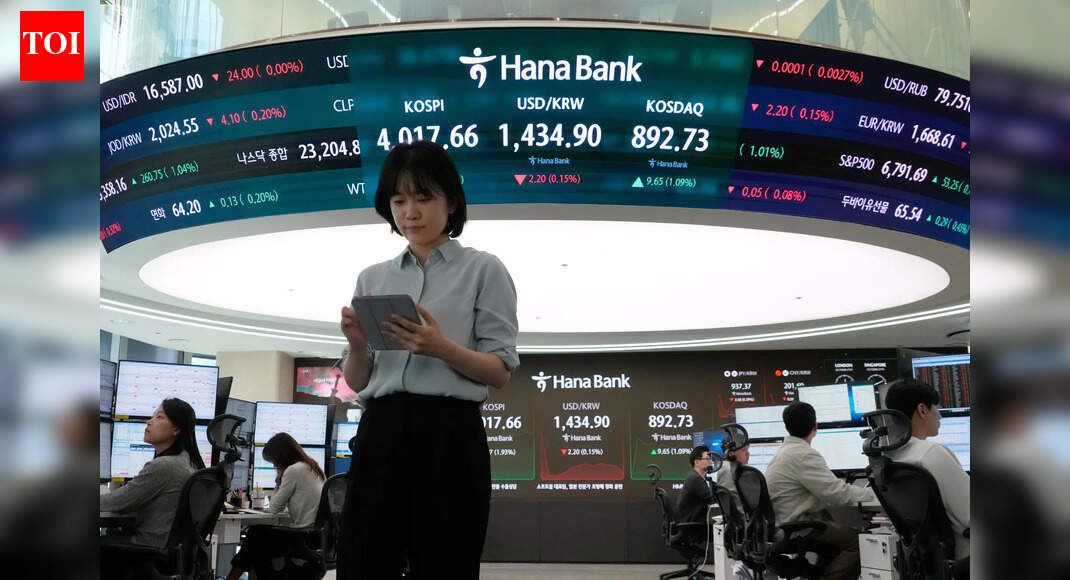
Asian equities traded mixed on Wednesday as global traders took their cue from another rally on Wall Street, although the enthusiasm remained limited ahead of crucial US economic data and next week’s Federal Reserve meeting.Hong Kong’s HSI was down 252 points or 0.97% to reach 25,842. Shenzhen and Shanghai also traded in red, down 0.09% and 0.05% respectively. Nikkei, meanwhile, jumped 817 points to trade at 50,120 at 11:05 AM IST. The prospect of a third straight US interest rate cut has been absorbed into pricing for days, leaving investors reluctant to place fresh bets until the final economic updates arrive. The two figures now commanding the most attention are the private-sector jobs reading from payrolls group ADP, scheduled for release later on Wednesday, and the personal consumption expenditure (PCE) index coming on Friday, the inflation measure the Fed relies on most heavily. Money markets currently assign around a 90% likelihood to a December 10 rate cut and anticipate three more reductions during the course of the next year. Adding to the broader market mood are reports that President Donald Trump’s senior economic adviser Kevin Hassett, known for advocating deeper rate cuts, is now the frontrunner to succeed Jerome Powell when the Fed chair’s term expires in May. Still, analysts pointed out that the policy board does not appear aligned on whether monetary decisions should be driven more by persistent inflation pressures or weakening employment conditions. One area offering relief came from the American retail sector, where the National Retail Federation reported a record turnout for the “Black Friday” shopping period. According to the industry group, 202.9 million consumers made purchases across the five-day stretch, beating projections and reflecting what the NRF described as a “highly engaged consumer”. Following the latest gains on Wall Street, most Asian markets also registered advances. Tokyo climbed by more than one per cent, while Seoul, Sydney, Singapore, Wellington, Taipei and Jakarta all traded higher. Losses were recorded in Hong Kong, Shanghai and Manila. Meanwhile, Bitcoin pushed back above the $90,000 mark after almost 10% was wiped from its value earlier in the week during a broad shift away from risk assets. Even with the rebound, sentiment within the crypto space remains cautious after the token fell as low as $80,550 last month, having previously touched an all-time high above $126,250 in October.



Last Updated:
Every $10 rise in global crude oil prices could shave around 0.5 percentage points off India’s GDP growth, say experts




India imports nearly 50 percent of crude oil from the Middle East
Every $10 rise in global crude oil prices could shave around 0.5 percentage points off India’s GDP growth, underscoring the country’s heavy reliance on imported oil and vulnerability to global energy volatility, Vandana Bharti, Research Head–Commodity at SMC Global Securities, told ANI.
In an interview with ANI, Bharti said escalating geopolitical tensions in West Asia pose a significant economic risk for India as crude prices climb and supply chains face potential disruptions.
“Every $10 increase in crude oil prices impacts India’s GDP by roughly 0.5%. We have already seen prices rise by about $10–$15 recently, and the economic impact will eventually reflect in growth numbers,” she said.
West Asia tensions driving oil prices higher
The surge in oil prices follows intensifying tensions involving the United States, Israel and Iran, particularly around the Strait of Hormuz — a critical maritime corridor through which roughly 20–25% of global oil shipments pass.
Bharti said the conflict has injected additional uncertainty into global energy markets and added what she described as a “war premium” to crude prices.
“It’s not just about the possibility of the Strait of Hormuz closing. Insurance costs and freight charges are rising, and shipments are being rerouted. All these factors add a war premium to crude oil prices and increase market uncertainty,” she said.
Risks extend beyond shipping
According to Bharti, the risks go beyond maritime routes and extend to energy infrastructure itself.
“Energy sites such as crude oil facilities and LNG plants are potential targets. There are also concerns about seabed cables and other critical infrastructure. So the threat is not only to energy supply but also to broader global trade and connectivity,” she noted.
Crude prices rise sharply
Oil prices have already surged as tensions intensified in the region.
Bharti said crude climbed from around $69 per barrel to nearly $78 per barrel within a week.
“In just one week we have seen prices move from about $69 to $78 per barrel. If tensions persist, crude could rise further to around $85–$87 per barrel in the coming days,” she said.
India’s reliance on Middle Eastern crude
India remains particularly vulnerable to such price shocks due to its heavy dependence on imported oil.
Bharti noted that roughly half of India’s crude imports come from the Middle East, and many domestic refineries are specifically configured to process Middle Eastern crude grades.
“India imports nearly 50% of its crude from the Middle East, so any disruption in the region directly impacts supply availability and pricing,” she said.
India maintains strategic petroleum reserves that can help cushion short-term disruptions, but Bharti emphasised that these are primarily meant for emergencies.
“We have reserves that can last about 25–30 days in emergency situations, but the structural dependence on Middle Eastern supply remains,” she said.
She added that even brief supply disruptions could trigger volatility across Asian financial markets.
“Even a two-week disruption could create significant volatility in Asia. We are already seeing pressure on currencies, equity outflows and rising economic uncertainty,” Bharti said.
Diversification may cushion the impact
Bharti said India could mitigate some risks by diversifying crude supply sources.
“Russia has been offering crude at discounted prices, so India may increase purchases from Russia or other suppliers if required. Adjusting supply chains and renegotiating trade arrangements can provide some relief,” she said.
She also pointed out that members of the Organization of the Petroleum Exporting Countries (OPEC) may attempt to stabilise prices, although security concerns could limit immediate production increases.
Impact on fertilisers and agriculture
Higher crude prices could also ripple into other sectors of the economy.
Bharti warned that rising energy costs may push up fertiliser prices and agricultural input costs, potentially affecting the upcoming kharif crop season.
“Higher energy costs could make fertilisers and farm inputs more expensive, which may increase the cost of cultivation for farmers,” she said.
Renewables gain strategic importance
Bharti added that the ongoing geopolitical tensions highlight the need for countries to accelerate the transition to renewable energy.
“Events like this are a wake-up call. Governments may increasingly prioritise renewable energy such as solar to reduce dependence on volatile fossil-fuel supply routes,” she said.
 Click here to add News18 as your preferred news source on Google.
Follow News18 on Google. Join the fun, play games on News18. Stay updated with all the latest business news, including market trends, stock updates, tax, IPO, banking finance, real estate, savings and investments. To Get in-depth analysis, expert opinions, and real-time updates. Also Download the News18 App to stay updated.
March 06, 2026, 08:16 IST
Read More

The supply chain risk designation of the artificial intelligence firm is a first for a US company.
Source link
Business
Historic winter storms weigh on Gap, Old Navy performance after 800 temporary store closures

Pedestrians in the snow at Times Square during a winter storm in New York, US, on Sunday, Feb. 22, 2026.
Bloomberg | Bloomberg | Getty Images
Historic winter storms and subsequent store closures weighed on Gap’s performance during its holiday quarter and contributed to worse-than-expected results at its portfolio of brands, the retailer said Thursday.
Cold weather, snow and ice throughout much of the U.S. in January led to about 800 temporary store closures at the storms’ peak, contributing to a miss on comparable sales for Old Navy and mixed companywide results, the retailer said.
“Old Navy and all the brands were actually trending better heading into that weather disruption,” said finance chief Katrina O’Connell. “The good news is the trends recovered immediately after those storms passed.”
Across the business, which includes Old Navy, Banana Republic, Athleta and Gap’s namesake banner, the retailer reported mixed fiscal fourth quarter results – missing expectations on the bottom line and meeting consensus on revenue.
Here’s how the retailer did compared with what Wall Street was anticipating, based on a survey of analysts by LSEG:
- Earnings per share: 45 cents vs. 46 cents expected
- Revenue: $4.24 billion vs. $4.24 billion expected
Gap’s stock fell as much as 9% in extended trading Thursday.
The company’s reported net income for the three-month period that ended Jan. 31 was $171 million, or 45 cents per share, compared with $206 million, or 54 cents per share, a year earlier. During the quarter, Gap’s gross margin was weighed down by tariffs and fell to 38.1%, slightly worse than analysts expected, according to StreetAccount.
Sales rose to $4.24 billion, up about 2% compared to $4.15 billion a year earlier.
Gap’s guidance was largely in line with expectations, but failed to exceed consensus. For the current quarter, it’s expecting revenue to rise between 1% and 2%, compared to expectations of 2%, according to LSEG.
For the full year, the company is expecting sales to grow between 2% and 3%, in line with expectations of 2.5% growth, according to LSEG. Given a $313 million positive legal settlement Gap saw during the current quarter, it issued an adjusted full-year earnings per share outlook. The company said its expecting adjusted earnings per share to be between $2.20 and $2.35, compared to expectations of $2.32, according to LSEG.
Gap did not factor recent changes to tariffs into its outlook because the company believes it’s “premature to plan for a change” as the situation continues to evolve, said O’Connell. Given how much of a hit Gap took from President Donald Trump’s global tariffs, which were struck down by the U.S. Supreme Court last month, Gap could issue stronger guidance in the coming quarter because the newly enacted 15% tariff is slightly below the previous rates for many countries.
“If the [current] Section 122 tariffs were to stay in place for the year or expire in July, it should lead to a more favorable outcome versus the outlook we provided today,” said O’Connell. “If 15% were the rate that would stay in place for the balance of the year, that rate is slightly below the current IEEPA rates that are contemplated in our plans, so that could give us a modest benefit to operating income if that scenario were to play out.”
Gap’s choppy results come just over two years into CEO Richard Dickson’s turnaround plan and analysts begin to expect more from the apparel giant. Now that the company has improved profitability, returned to growth and amassed a staggering $3 billion cash pile, Dickson said he’s ready to turn to the next phase of the plan, which is about “building momentum.”
“Our primary focus is going to be on growing our core apparel business, and we’re going to do this through continuous improvement,” said Dickson. “This has all been driven by disciplined execution, which we need to continue to do with better product, better marketing and better storytelling and that’s not easy, but we’re proving that that muscle is getting stronger and stronger now.”
In the meantime, Gap is also turning its sights on growth opportunities for the company, including its expansion into beauty and accessories and its fashion and entertainment platform through the recent appointment of a chief entertainment officer. He said the ventures will begin to really scale next year.
Here’s a closer look at how each brand performed:
Old Navy
Gap’s largest and most important brand saw sales rise 3% to $2.3 billion, with comparable sales also up 3%, well below analyst consensus of 4.3%, according to StreetAccount. Despite the miss, Gap said Old Navy’s “price value equation is resonating with consumers” and it’s continuing to win over shoppers across a wide range of income levels.
Gap
The brightest spot of Gap’s quarter came from its namesake banner, which saw sales rise 8% to $1.1 billion with comparable sales up 7%, far ahead of expectations of 4.6%, according to StreetAccount. Under Dickson, the brand has worked to regain its cultural relevance and is winning over a wide range of generations, including younger, Gen Z shoppers.
Banana Republic
The safari-chic workwear brand posted its third straight quarter of positive comparable sales, which were up 4%, beating expectations of 2.5%. Sales rose 1% to $549 million, reflecting progress in both marketing and product assortment. “Men’s just continues to build momentum. Key items like the traveler pant, our cashmere program, really fantastic outerwear that’s been driving the performance, particularly in the quarter,” said Dickson. “Women’s performance is becoming much more consistent. We’ve had strength in denim skirts and sweaters and as we enter 2026, Banana is really starting to find its momentum.”
Athleta
The athleisure brand saw another quarter of sagging sales, with revenue down 11% to $354 million and comparable sales down 10%. In some ways, the drop reflects an overall sluggish athletic apparel market, but the company has also had a number of strategic missteps, including targeting the wrong customer and offering products that failed to land. Under the brand’s new CEO, Dickson said Athleta has been working on revamping the assortment, bringing back customer favorites and dialing up innovation.


Turkiye’s apparel exports drop 6% to $16.3 bn in 2025
How Costly Is A $10 Oil Spike For India’s Economy?

Jayson Tatum, 10 months after Achilles injury, expected to return to Celtics Friday vs Mavericks: report

Policy easing drives Argentina’s garment import surge in 2025

What are Iran’s ballistic missile capabilities?

India Us Trade Deal: Fresh look at India-US trade deal? May be ‘rebalanced’ if circumstances change, says Piyush Goyal – The Times of India

-
 Fashion1 week ago
Policy easing drives Argentina’s garment import surge in 2025
-
 Politics1 week ago
What are Iran’s ballistic missile capabilities?
-
Business7 days ago
India Us Trade Deal: Fresh look at India-US trade deal? May be ‘rebalanced’ if circumstances change, says Piyush Goyal – The Times of India
-
 Business1 week ago
Attock Cement’s acquisition approved | The Express Tribune
-

 Politics1 week ago
US arrests ex-Air Force pilot for ‘training’ Chinese military
-
 Business6 days ago
Greggs to reveal trading amid pressure from cost of living and weight loss drugs
-

 Sports7 days ago
LPGA legend shares her feelings about US women’s Olympic wins: ‘Gets me really emotional’
-

 Fashion7 days ago
Texwin Spinning showcasing premium cotton yarn range at VIATT 2026