

Tech
Attacks on GPS Spike Amid US and Israeli War on Iran

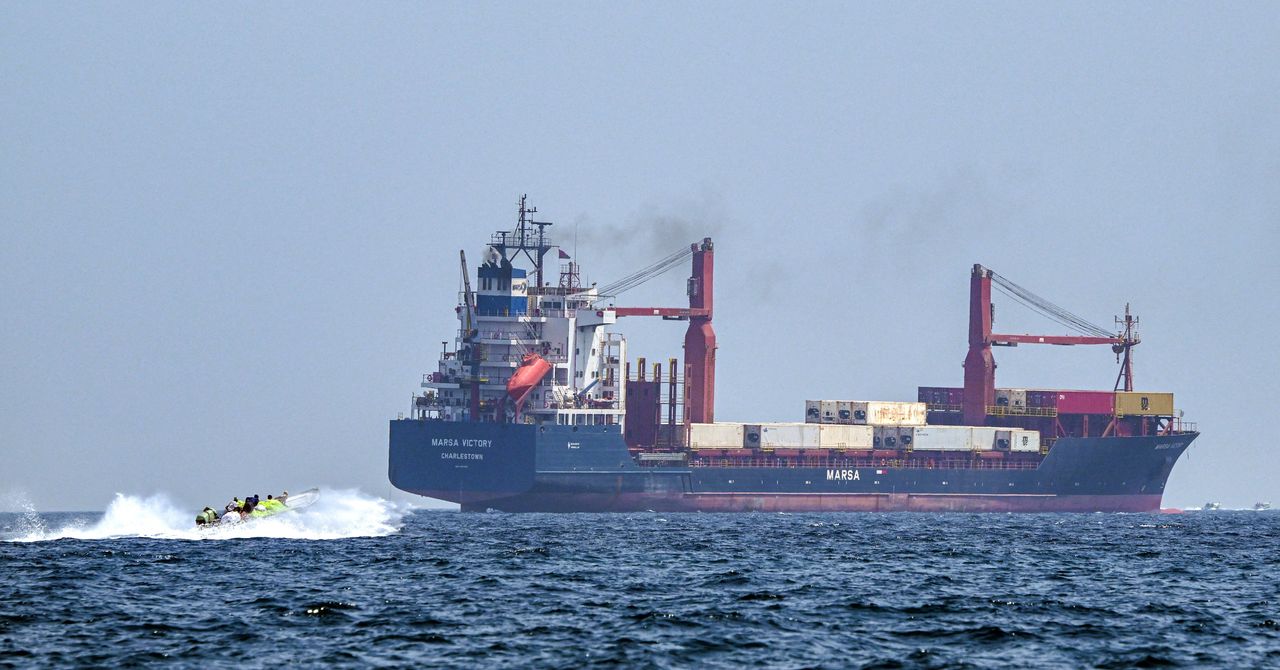
Shipping through the Strait of Hormuz—the narrow but vital oil trade route in the Middle East—has almost ground to a halt since the start of the United States and Israel’s war against Iran. Tankers in the region have faced military strikes and a spike in GPS jamming attacks, a new analysis says.
Since the first US-Israeli strikes against Iran on February 28, more than 1,100 ships operating across the Gulf region have had their GPS or automatic identification system (AIS) communications technology disrupted, says Ami Daniel, the CEO of maritime intelligence firm Windward. Ships have been made to appear as if they were inland on maps, including at a nuclear power plant, the firm says.
The analysis comes as maritime officials have warned of a “critical” risk to ships operating in the region and as the initial conflict has quickly expanded to involve countries across the Middle East. At least three tankers in the region have been damaged in the conflict.
“We’re seeing a lot of GPS jamming,” Daniel says of shipping in the Strait of Hormuz and surrounding areas. The levels of electronic interference are “way above the baseline” of usual interference, he says. “It’s becoming very dangerous to go in and out.”
Over the last few years, attacks against GPS and navigation systems have been on the rise—largely driven by the wars in Ukraine and Gaza. They can impact people’s phones or devices, but also disrupt the safety and navigation systems in planes and ships. The electronic interference largely comes in two forms: jamming and spoofing. During jamming attacks, satellite signals are overwhelmed so that positioning data isn’t available. Whereas spoofing can create false signals that make an object appear incorrectly on a map—for instance, making ships appear as if they are inland at airports.
Inaccurate location data can lead to ships running off course, potentially increasing the chances of them crashing into other tankers, running aground, or causing damaging oil spills. In warzones, electronic interference is often used to try and disrupt the navigation systems of drones or missiles, which can rely on location data to find and hit their targets.
Analysis of shipping data by Windward found that there has been an “escalating” level of electronic interference across Iranian, United Arab Emirates, Qatari, and Omani waters since the initial strikes on February 28. Daniel says that the majority of the activity the company has identified so far has been jamming rather than spoofing. The company’s analysis says it has identified around 21 “new clusters” where ships have had their AIS data jammed in recent days.
“Ships were falsely positioned at airports, a nuclear power plant, and on Iranian land, creating navigation and compliance risks,” a report from the firm says. “AIS signals have also been diverted to the Barakah Nuclear Power Plant and nearby waters, while hundreds of other vessels are creating circle-like patterns off UAE, Qatari, and Omani waters.”
GPS and AIS interference within the Strait of Hormuz and the surrounding area is not new. In June 2025, as Israel and Iran exchanged missile fire, significant jamming in the region was reported.
While almost all commercial air travel has been grounded around the Middle East, there have been signs of electronic interference on aircraft flying ahead of and around the strikes. “There are at least six new spoofing signatures in the Middle East,” says Jeremy Bennington, vice president of positioning, navigation, and timing strategy and innovation at technology firm Spirent Communications. “Hundreds of flights have been impacted. However, that decreased significantly over the weekend as flights have been canceled.”









Tech
A Possible US Government iPhone-Hacking Toolkit Is Now in the Hands of Foreign Spies and Criminals

Google notes that Apple patched vulnerabilities used by Coruna in the latest versions of its mobile operating system, iOS 26, so its exploitation techniques are only confirmed to work against iOS 13 through 17.2.1. It targets vulnerabilities in Apple’s Webkit framework for browsers, so Safari users on those older versions of iOS would be vulnerable, but there’s no confirmed techniques in the toolkit for targeting Chrome users. Google also notes that Coruna checks if an iOS devices has Apple’s most stringent security setting, known as Lockdown Mode, enabled, and doesn’t attempt to hack it if so.
Despite those limitations, iVerify says Coruna likely infected tens of thousands of phones. The company consulted with a partner that has access to network traffic and counted visits to a command-and-control server for the cybercriminal version of Coruna infecting Chinese-language websites. The volume of those connections suggest, iVerify says, that roughly 42,000devices may have already been hacked with the toolkit in the for-profit campaign alone.
Just how many other victims Coruna may have hit, including Ukrainians who visited websites infected with the code by the suspected Russian espionage operation, remains unclear. Google declined to comment beyond its published report. Apple did not immediately provide comment on Google or iVerify’s findings.
In iVerify’s analysis of the cybercriminal version of Coruna—it didn’t have access to any of the earlier versions—the company found that the code appeared to have been altered to plant malware on target devices designed to drain cryptocurrency from crypto wallets as well as steal photos and, in some cases, emails. Those additions, however, were “poorly written” compared to the underlying Coruna toolkit, according to iVerify chief product officer Spencer Parker, which he found to be impressively polished and modular.
“My god, these things are very professionally written,” Parker says of the exploits included in Coruna, suggesting that the cruder malware was added by the cybercriminals who later obtained that code.
As for the clues that suggest Coruna’s origins as a US government toolkit, iVerify’s Cole notes that it’s possible that Coruna’s code overlap with the Operation Triangulation code that Russia pinned on US hackers could be based on Triangulation’s components being picked up and repurposed after they were discovered. But Cole argues that’s unlikely. Many components of Coruna have never been seen before, he points out, and the whole toolkit appears to have been created by a “single author,” as he puts it.
“The framework holds together very well,” says Cole, who previously worked at the NSA, but notes that he’s been out of the government for more than a decade and isn’t basing any findings on his own outdated knowledge of US hacking tools. “It looks like it was written as a whole. It doesn’t look like it was pieced together.”
If Coruna is, in fact, a US hacking toolkit gone rogue, just how it got into foreign and criminal hands remains a mystery. But Cole points to the industry of brokers that may pay tens of millions of dollars for zero-day hacking techniques that they can resell for espionage, cybercrime, or cyberwar. Notably, Peter Williams, an executive of US government contractor Trenchant, was sentenced this month to seven years in prison for selling hacking tools to the Russian zero-day broker Operation Zero from 2022 to 2025. Williams’ sentencing memo notes that Trenchant sold hacking tools to the US intelligence community as well as others in the “Five Eyes” group of English-speaking governments—the US, UK, Australia, Canada and New Zealand—though it’s not clear what specific tools he sold or what devices they targeted.
“These zero-day and exploit brokers tend to be unscrupulous,” says Cole. “They sell to the highest bidder and they double dip. Many don’t have exclusivity arrangements. That’s very likely what happened here.”
“One of these tools ended up in the hands of a non-Western exploit broker, and they sold it to whoever was willing to pay,” Cole concludes. “The genie is out of the bottle.”

Alongside its price-friendly iPhone 17e and M4 iPad Air yesterday, Apple just announced a few updates to the MacBook Pro, MacBook Air, and its rarely-refreshed desktop display line.
The MacBook Air has now been updated to the latest M5 chip. It’s a fairly modest upgrade, but it brings it up to speed with Apple’s latest processor that debuted in the MacBook Pro last fall. There are no other major hardware changes—it now comes with 512 GB of starting storage with “faster SSD technology”—but you can still get the Air in either a 13- or 15-inch screen size.
This laptop also features Apple’s N1 wireless chip, which includes Wi-Fi 7 and Bluetooth 6 for the latest connectivity standards. It still comes with the standard 16 GB of RAM, and sadly, there’s a $100 price bump to account for the extra storage. It now starts at $1,099 for the 13-inch model and $1,299 for the 15-inch model. Apple says you can preorder it tomorrow, with sales kicking off on March 11.
More interestingly, Apple is expanding the M5 chip series with the M5 Pro and M5 Max, now available in the 14-inch and 16-inch MacBook Pro. Like previous generations of Apple silicon, the “Pro” and “Max” configurations add significantly improved multi-core CPU and graphics performance.
The M5 Pro and M5 Max can be configured with up to 18 CPU cores (12 performance cores and 6 “super” cores), up from 16 on the M4 Max. The M5 Pro can scale up to 20 GPU cores, while the M5 Max extends up to 40 GPU cores. Thanks to higher memory bandwidth, more efficient Neural Engine, and improved GPU architecture, Apple says the M5 Pro and M5 Max have “over 4X the peak CPU compute for AI” compared to the last generation and offer 20 percent better GPU performance.
The new MacBook Pros don’t include any other hardware changes; things have stayed largely the same since 2021—same port selection, Mini-LED display, speakers, and webcam. Even the claimed 24-hour battery life hasn’t changed from the M4 models, which came out in late 2024. Interestingly, as recently as last week, Bloomberg reported that Apple plans to launch a more significant update to the MacBook Pro later this fall, which will reportedly debut the M6 chip, an OLED touchscreen, and a thinner chassis.
Like the MacBook Air, all versions of the M5 Pro or M5 Max MacBook Pros come with twice the storage and a slightly higher starting price. Coming with 1 TB, the 14-inch M5 Pro now starts at $2,199, and the 16-inch model at $2,699. That’s $200 more than last year’s machines. Meanwhile, M5 Max prices start at $3,599.
National Grid has carried out the first trial of flexible electricity usage by a UK datacentre, in conjunction with operator Nebius. The trial used artificial intelligence (AI)-powered datacentre management software from Emerald AI’s software on a bank of 96 Nvidia Blackwell Ultra high-performance graphics processing units (GPUs) at a Nebius datacentre near London.
Over five days in December 2025, more than 200 real-time simulated “grid events” were sent to the site to test the Emerald software’s ability to dynamically adjust the datacentre’s power consumption.
Emerald AI’s platform was able to adjust power use to the requested level and cut demand by up to 40% while critical workloads ran as normal.
Key results included successfully reacting to spikes in demand during half time at football matches, followed by load-reduction requests for up to 10 hours that demonstrated an ability to help the grid navigate periods of low wind or extreme heat, and simulated a system stress event that saw it shed 30% of load in 30 seconds to help maintain grid resilience.
According to the partners involved in the trial, such capabilities could enable AI datacentres to add more than 2GW of capacity back to the grid when needed.
The aim is that AI datacentres can avoid being simply a source of electricity constraint to being more controllable in relation to the electricity grid, by managing peaks, making better use of existing infrastructure, and supporting the connection of different sources of energy to the grid.
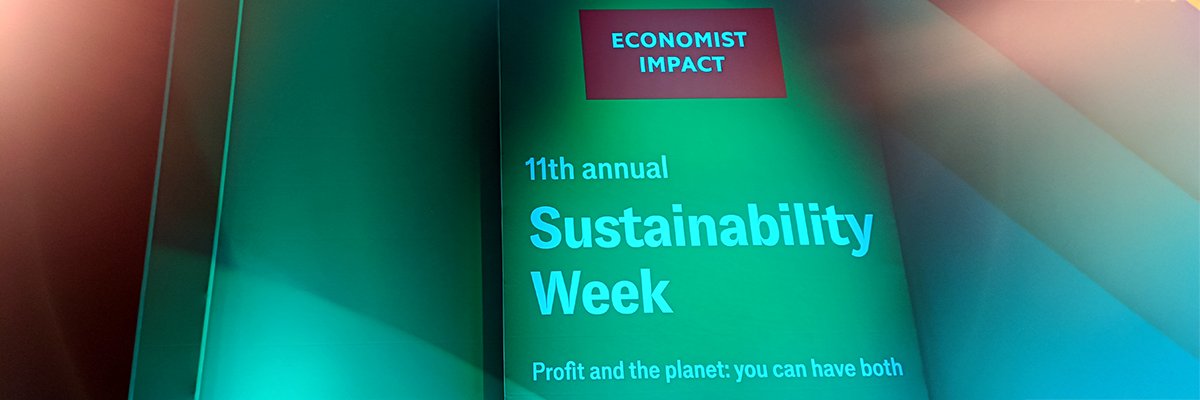
“Most electric networks, most electric power systems, operate with probably 30% of capacity in place a year; there’s lots of capacity in the system, it’s a small number of hours a year when we’re at peak,” said Steve Smith, president of National Grid Partners, speaking at the Economist Impact Sustainability Week event in London.
“So, the trick is how you do it,” said Smith. “Because if you can throw more electrons at a fixed-cost system, you don’t need to put more infrastructure in, and the rates come down for everyone else.
“If you’re doing a small number of hours and you’re stretched, if we say, can you actually moderate your load when we need you to, then we don’t need to build lots more capacity.”
Also speaking at the Sustainability Week event, Varun Sivaram, chief executive of Emerald AI, said the trial showed that AI hardware at the Nebius datacentre could consume energy flexibly at a moment’s notice.
“When we got the signal in the middle of the night, we were able to reduce power within 30 seconds by over a third,” said Sivaram. “That’s also going to be the case with renewable energy, when there’s low wind, for eight hours, and the AI factory can reduce its consumption in such a way that we protect the critical workloads that run at 100% throughput.”
Sivaram explained that there are three ways to achieve flexibility of power consumption for AI workloads. The first is to slow some down or pause them. “Maybe a fine-tuning model run that doesn’t need to finish right this second, but it can be delayed by an hour,” he suggested.
The second way, he said, is by moving AI workloads. “You expect your answer from AI pretty soon, but we may be able to move it, as we did with a move between two different Oracle datacentres at the rate of 10 milliseconds of latency. There is a little bit of a latency penalty, but not relevant for that workload,” said Sivaram.
The third way, he said, is to monitor the datacentre to achieve flexibility. Here, Emerald operates as software intelligence to operate AI workloads – that can include by tagging them as different priorities – in an optimal way to give the grid what it needs while protecting the integrity of the workloads for the user.


Demi Lovato, Keke Palmer question relationship with older men

Iran Conflict: Middle East tensions: Global insurers exit Iranian waters as conflict deepens – The Times of India

Barcelona gets bigger spending cap, opens door on new signings

-

 Politics6 days ago
What are Iran’s ballistic missile capabilities?
-

 Politics6 days ago
US arrests ex-Air Force pilot for ‘training’ Chinese military
-
 Business7 days ago
Households set for lower energy bills amid price cap shake-up
-

 Sports1 week ago
Top 50 USMNT players of 2026, ranked by club form: USMNT Player Performance Index returns
-
 Business7 days ago
Lucid widely misses earnings expectations, forecasts continued EV growth in 2026
-

 Fashion5 days ago
Policy easing drives Argentina’s garment import surge in 2025
-

 Sports6 days ago
Sri Lanka’s Shanaka says constant criticism has affected players’ mental health
-

 Fashion5 days ago
Texwin Spinning showcasing premium cotton yarn range at VIATT 2026