

Business
Bewakoof Co-Founder Prabhkiran Singh Announces Exit After 14 Years At The Helm

Last Updated:
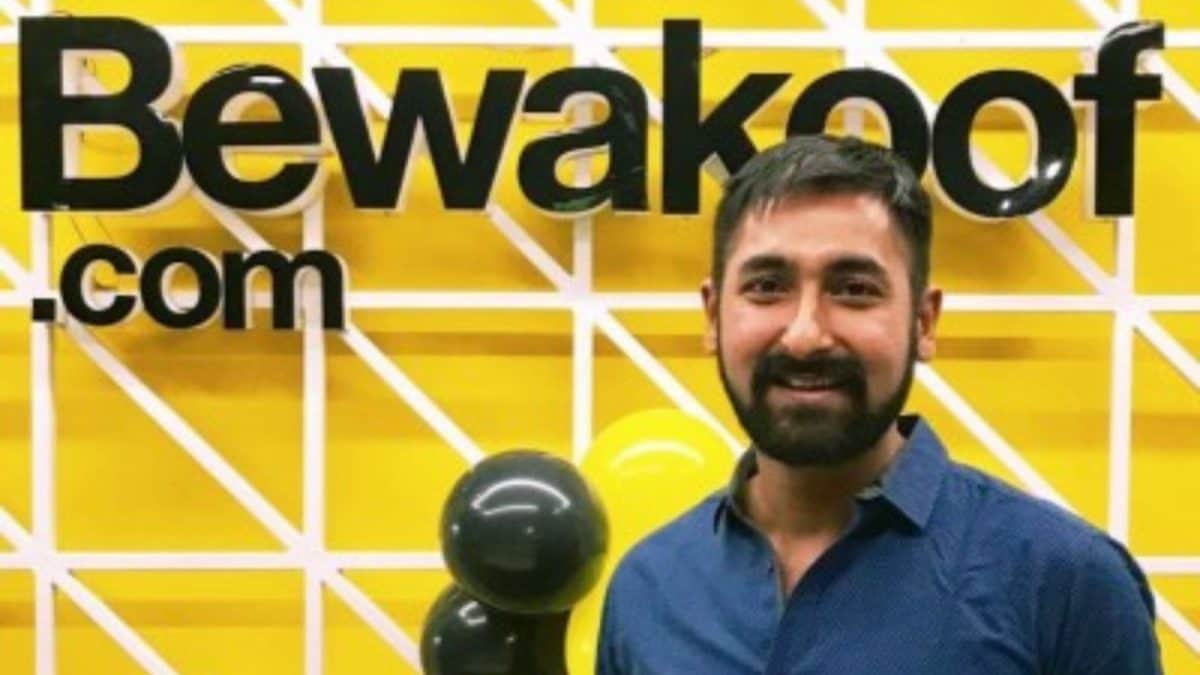
Prabhkiran Singh, Co-Founder and CEO of Bewakoof, steps down after 14 years, leaving a Mumbai slum startup turned national youth brand.




Prabhkiran Singh announces his decision to step down as CEO of Bewakoof after 14 years.
Prabhkiran Singh, Co-Founder and CEO of Bewakoof, has announced that he will be stepping away from the company he built over the past 14 years, marking the end of a long entrepreneurial chapter that began in 2011.
Bewakoof is a D2C fashion brand, which is popular among GenZ.
From Mumbai Slum Startup To National Youth Brand
In a LinkedIn post shared on Tuesday, Singh reflected on starting Bewakoof at the age of 21 with a fellow engineering graduate. The company was launched from a small room in a Mumbai slum at a time when direct-to-consumer (D2C) fashion brands were still a nascent concept in India and equity funding was limited.
He recalled personally handling early operations, including making T-shirt deliveries via local trains and responding to customer queries. Over time, the brand scaled significantly, growing from campus T-shirt sales to shipping over 20,000 products daily.
Bewakoof went on to become one of India’s prominent youth-focused fashion brands and, according to Singh, was the first D2C fashion startup in the country to cross ₹100 crore in revenue. The company also built a social media community of more than 6 million followers.
Backed By TMRW And Aditya Birla Group
Singh stated that the company is now “structurally ready” for its next phase, supported by a strong leadership team and the backing of TMRW and the Aditya Birla Group.
He added that after 14 years of building the business, he intends to prioritize his health, family, and personal goals. Singh will continue to lead Bewakoof until the end of March.
Calling the startup his “firstborn,” Singh said he will continue to support the brand from the sidelines as it works toward building a long-term legacy.
 Click here to add News18 as your preferred news source on Google.
February 24, 2026, 15:54 IST
Read More
Last Updated:
AI is reshaping work in India, with LinkedIn’s Skills on the Rise 2026 report highlighting demand for AI, Data, Cybersecurity, and leadership skills.
38% Indians Feel Unready for AI Shift: LinkedIn Reveals Top Emerging Skills
Artificial Intelligence is no longer a future trend — it is the present reality of work. From content creation to coding, hiring to sales forecasting, AI tools are now part of daily workflows across industries. As companies rapidly adopt automation and data-driven systems, professionals are feeling the pressure to keep up.
According to LinkedIn’s Skills on the Rise 2026 report, 38% of Indian job seekers say they feel unprepared for how fast technology is changing job requirements. At the same time, 74% of recruiters in India say it is harder than ever to find qualified talent. The gap is clear — and AI is at the centre of it.
The report highlights five major skill stacks that are shaping hiring trends: AI & Automation, Data & Analytics, IT & Cybersecurity, Business & Growth, and People & Leadership. What stands out is that companies are no longer looking for just technical specialists. They want “skill stackers” — professionals who combine AI fluency with data understanding, operational efficiency and strong collaboration skills.
AI & Automation roles are seeing strong demand, especially in Prompt Engineering, Workflow Automation, LLMOps and AutoML. But AI skills are not limited to tech jobs anymore. Marketing, HR, consulting and sales teams are also expected to use AI tools effectively.
Data roles are also expanding. Skills like querying, data analysis and data storytelling are becoming essential across engineering, IT and even non-tech functions like business development and education.
Cybersecurity and cloud infrastructure jobs are growing as companies scale digital systems. Threat detection, real-time monitoring and IT automation are emerging as critical capabilities.
At the same time, people skills are becoming a major differentiator. Collaboration, stakeholder management and project leadership are now as valuable as technical expertise.
Top emerging jobs linked to these trends include AI Specialist, Data Analyst, Cybersecurity Analyst, Cloud Consultant, Growth Strategist and AI-enabled Project Manager.
Click here to add News18 as your preferred news source on Google.
February 24, 2026, 17:55 IST
Read More
Business
New data series: Real GDP growth data calculation methodology overhauled to improve accuracy – here’s what changes – The Times of India

India is set to release its first set of GDP or Gross Domestic Product data on the basis of a new series that may also address recent criticism from economists. The government is revamping the methodology used to estimate real GDP growth under a new national accounts series scheduled to be released this week. The revised framework will incorporate more detailed price deflation techniques to respond to concerns raised by economists.Real GDP in India is calculated by adjusting nominal growth figures for inflation through the use of price indices. Critics have argued that the existing approach is outdated because it depends largely on the wholesale price index rather than the more widely followed consumer price index.In November, the International Monetary Fund highlighted shortcomings in India’s national accounts system. It pointed to the continued use of the 2011–12 base year, heavy dependence on wholesale price data and extensive reliance on single-deflation techniques. The IMF assigned the methodology a “C” rating.
New GDP data series: What changes
“We will now use about 500–600 items from the new CPI and the old WPI series, compared with about 180 earlier, to deflate the output and improve accuracy of the data,” Saurabh Garg, secretary in the Ministry of Statistics and Programme Implementation, said in an interview according to a Reuters report.He noted that this approach will remain in place until a revised WPI series is introduced, which is expected in the near term.Under the earlier system, periods marked by subdued nominal GDP expansion and low wholesale inflation often resulted in inconsistencies, as they tended to produce comparatively higher real growth estimates.As per the current data series, India’s economy, which is one of the fastest-expanding among major global economies, is projected to grow by 7.4% in 2025–26. This is compared with an estimated 6.5% growth in 2024–25.Nominal GDP, which measures economic output at prevailing market prices, is expected to increase by 8.0% during the current financial year.A revised GDP series with 2022–23 as the base year will be released on February 27, along with updated historical data covering the previous four years.These modifications form part of a wider overhaul of India’s statistical framework, following the introduction of a new retail inflation series earlier this month. Updates to the wholesale price index and industrial production data are also in progress.A key element of the revised framework is the adoption of double deflation, which adjusts both output prices and input costs separately to derive real value added.Garg said the changes are expected to enhance data precision, especially in the manufacturing sector, where differences between input and output price movements had previously raised concerns about distortions under the single-deflation approach.
Two stories from the past few weeks capture something essential about where we are with AI.The first concerns Salesforce, the enterprise software giant that aggressively embraced AI for customer service. CEO Marc Benioff proudly announced that AI deployment had allowed the company to cut support staff from 9,000 to roughly 5,000. Then reality intervened. Reports from late 2025 indicate that the company is now withdrawing from AI due to widespread failure. The AI agents confidently gave wrong answers, dropped instructions when given more than eight steps, and lost focus when users asked unexpected questions. Customers complained that AI support took longer than the simple old search function. Salesforce is now retreating to rigid, rule-based scripting–essentially admitting they were, in their own words, “more confident” than the technology warranted.The second story is a zeitgeist shift. Over the past couple of months, the conversation around AI and coding has transformed completely. People who were skeptical six months ago–senior developers who actually write code for a living–are now saying the age of human beings writing code is ending. Not in some distant future, but imminently. Entire features are being shipped by AI with minimal human intervention. The productivity gains are no longer incremental; they’re structural.How can both be true? How can AI fail comprehensively in customer service–seemingly straightforward–while revolutionising software development, which appears far more complex?The answer is that we’ve been thinking about AI wrong. We treat it as a single phenomenon that will sweep through the economy at roughly the same pace. However, AI in business is not a single story. It’s many parallel stories, moving at wildly different speeds. And the distinction has almost nothing to do with how intelligent the AI is.I’ve written about this tension before. A year ago, I argued that “the fact that a revolution is real doesn’t mean that every business claiming to be part of it will succeed.” More recently, I observed that “the gap between what AI demos well in controlled environments and what it actually delivers when confronting the messy real world remains enormous.” I now think there’s a more precise way to understand this gap. It’s not random. It’s structural.Consider what makes coding fertile ground for AI. Code is formally structured and machine-verifiable–it runs and passes tests, or it doesn’t. The feedback loop is immediate. When AI makes a mistake, a developer (or another AI agent) notices, fixes it, and moves on. Errors are private and reversible. Now consider customer service. Customers don’t speak in data schemas. Emotion, sarcasm, and cultural context matter enormously. One wrong answer can escalate to social media outrage or regulatory complaints. The failures are public and often irreversible.The difference isn’t intelligence. It’s what I’d call error economics. AI thrives where mistakes are cheap, private, and correctable. It struggles where mistakes are expensive, public, and permanent.We received a clear illustration of executive disconnect just a few days ago. During Bajaj Finance’s Q3 call, CEO Rajeev Jain announced that AI had listened to 2 crore calls and generated 100,000 new customer offers. “We’ll be able to listen to 100 million calls next year,” he said proudly. The response on social media was predictable hilarity. As the entire country, except apparently Mr Jain knows, Bajaj Finance’s incessant spam calls are the butt of countless jokes. Here was a CEO using sophisticated technology to optimize something customers actively despise. Machine learning works perfectly; the learning about customers is absent.For investors, the implications are significant. When you hear “AI” attached to a business function, ask: what happens when it’s wrong? If the answer involves customers, regulators, or reputations, progress will be slower than vendor PPTs claim. If the answer is “someone notices and fixes it,” that’s a different world entirely.The story of AI in business is not one of universal acceleration. It’s one of the selective escape velocities. Coding has left the atmosphere and gone into orbit. Customer service is still fighting gravity. Most other functions lie somewhere in between–mistakenly assumed to be closer to the rocket than they really are. The many worlds of AI are not converging. They’re diverging. And that divergence will determine which investments succeed and which disappoint.(Dhirendra Kumar is Founder and CEO of Value Research)


Why secrecy? PTI adamant on personal doctors access after Imran administered eye injection

North Korea’s Kim Jong-un re-elected General Secretary of Workers’ Party
Feeling Unprepared For AI Age? LinkedIn Lists 5 Skill Stacks That Matter Now

-

 Entertainment7 days ago
Queen Camilla reveals her sister’s connection to Princess Diana
-

 Tech1 week ago
Rakuten Mobile proposal selected for Jaxa space strategy | Computer Weekly
-

 Politics7 days ago
Ramadan moon sighted in Saudi Arabia, other Gulf countries
-

 Entertainment1 week ago
Robert Duvall, known for his roles in "The Godfather" and "Apocalypse Now," dies at 95
-

 Politics1 week ago
Tarique Rahman Takes Oath as Bangladesh’s Prime Minister Following Decisive BNP Triumph
-
 Business1 week ago
Tax Saving FD: This Simple Investment Can Help You Earn And Save More
-

 Tech1 week ago
Businesses may be caught by government proposals to restrict VPN use | Computer Weekly
-

 Sports1 week ago
Usman Tariq backs Babar and Shaheen ahead of do-or-die Namibia clash