Politics
Bondi Beach attacker’s ‘Indian passport’ emerges after Sydney attack

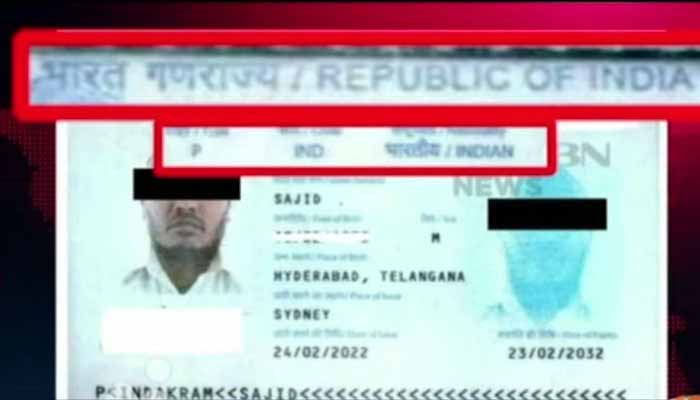
- Indian High Commission issued attacker’s passport in 2022.
- Passport lists Hyderabad, Telangana as place of origin.
- Indian efforts aimed at maligning Pakistan internationally.
An Indian passport of the attacker, Sajid Akram, involved in the Sydney’s Bondi Beach attack during a Jewish Hanukkah celebration, which left at least 15 dead, has emerged, according to Filipino media.
Father and son duo, identified as Sajid Akram and Naveed, opened fire during the Jewish event on December 14, in an attack that shook the nation and intensified fears of rising antisemitism and violent extremism.
The 15 victims ranged from a rabbi who was a father of five, to a Holocaust survivor, to a 10-year-old girl named Matilda Britvan, according to interviews, officials and media reports. Two police officers remained in critical but stable condition in the hospital, New South Wales police said.
According to records obtained by the Philippines’ ABS-CBN News, Naveed had an Australian passport while his 50-year-old father, Sajid, entered the country with an Indian passport.
The Indian High Commission issued Sajid a 10-year passport on February 24, 2022.
The passport, which has now surfaced publicly, lists Hyderabad in the Indian state of Telangana as Sajid Akram’s place of origin and shows an expiry date of February 23, 2032.
Authorities were reportedly aware of the attacker’s Indian citizenship from the first day, yet the incident was allegedly portrayed otherwise, with claims attempting to link the attack to Pakistan, Geo News reported.

Further information revealed that Sajid’s son, Naveed Akram, also holds an Indian passport. Despite this, Indian officials allegedly concealed the facts, allowing local media time to circulate misleading reports that identified the attacker as a Pakistani national.
Following the attack, Indian media outlets were accused of running a disinformation campaign before it became clear the assailant was an Indian citizen.
The effort, according to sources, was aimed at maligning Pakistan internationally, a narrative that collapsed the following day when evidence of the attacker’s Indian nationality became public.
Last year, British newspaper The Guardian noted that Australia expelled two Research & Analysis Wing (RAW) operatives in 2020 over illegal activities, including profiling members of the Indian diaspora.
‘No evidence alleged Bondi gunmen received military training in Philippines’
Meanwhile, the Philippines’ National Security Adviser on Wednesday said there was no evidence indicating that the two suspects involved in the Bondi Beach attack received any form of military training while in the country.
In a statement, Eduardo Ano said that a mere visit to the country does not substantiate allegations of terrorist training, and the duration of their stay would not have permitted any meaningful or structured training.
Ano said the government was investigating the two men’s travel from November 1 to 28 and coordinating with Australian authorities to determine the purpose of the visit, dismissing media reports portraying the southern Philippines as a hotspot for violent extremism as “outdated” and “misleading”.
Immigration records show the pair landed in Manila and travelled to Davao City in Mindanao, a region long-plagued by militancy, before the attack that Australian police say appeared to have been inspired by Daesh.
Quoting the Bureau of Immigration, the Filipino media reported that the father-son duo arrived in the Philippines from Sydney, Australia, on November 1. “Both reported Davao as their final destination,” the BI said.
Based on BI records, the two left the country on November 28 on a connecting flight from Davao to Manila, with Sydney as their final destination.
Philippines’ regional police conduct probe
Separately, the Davao Regional Police said it was investigating reports that the father-son duo visited the region.
Speaking to journalists, spokesperson of the Police Regional Office 11, Maj Catherine Dela Rey, said the multi-agency investigation would try to determine “if ever they arrived in Davao, where did they stay, or the people they met… or if they only passed by Davao or indeed they did not arrive in Davao and stayed in another place.”
The police also assured the public that the Davao region remains peaceful despite being linked to an overseas terror incident. “Overall, the whole Davao region is very peaceful. And we have maintained this status all over the year,” she was quoted as saying.
— With additional input from Reuters