

Business
Can Primark stay relevant, or is Shein taking over?


 BBC
BBCPrimark has long been a staple of UK high streets, luring in shoppers with low-priced clothes, accessories and homeware.
But in its UK and Ireland stores, like-for-like sales – a key metric in the retail industry – were down 3.1% in the year to September, which it attributed to a “weak” consumer environment and fewer people buying winter clothes during last year’s mild autumn.
As online stores like Shein and Vinted continue to attract young shoppers, does Primark face a fight to remain relevant – or is it just fine?
“While the UK clothing market is seeing subdued growth, Primark has significantly underperformed the overall market,” says Tamara Sender-Ceron, an associate director at market-research agency Mintel, adding that it faces “increased competition”.
Some shoppers point out that online marketplaces like Shein and Temu have even lower prices, a huge range of products, and – crucially – home delivery, something Primark lacks.
At Primark’s biggest London store on Oxford Street, which BBC News visited this week, Serena Milius has just popped in with her 12-year-old daughter to look at pyjamas, socks and the new Stranger Things range.
Serena used to do most of her shopping at Primark – until Shein took over.
“Shein’s our main thing,” the 34-year-old finance manager from Tooting, south-west London, says.
She says her wardrobe is now 90% Shein, and goes to Primark for “little bits and bobs” like flipflops, candles, socks and cosmetics dupes.

 Serena Milius
Others tell the BBC they’d rather splash out on better-quality products. This includes Martha, a 23-year-old student in Leeds, who only shops at Primark for basics like T-shirts, socks, underwear and cotton buds. For other items, she turns to Weekday, Zara and independent shops.
“I like to buy more expensive items that I’m going to wear over the years,” she tells the BBC as she browses clothes in a Primark store with her mum. With Primark, “it’s not always a lasting item,” she says.
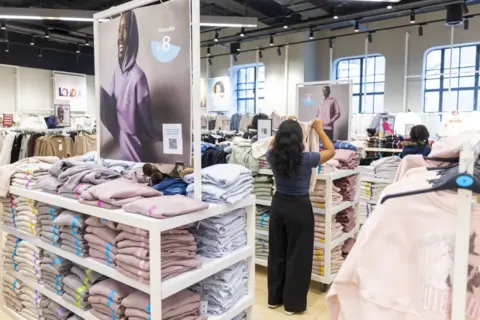
The store was busy when the BBC visited on a late Wednesday afternoon, with mainly female shoppers browsing alone or in pairs. Some said they’d gone out of their way to visit, others popping in after finding themselves in the area.
Some say they’re deterred by Primark’s huge, sprawling stores which can sometimes get very busy.
“I do not enjoy shopping in a Primark,” says Abbi Lily, a 24-year-old content creator from near Bournemouth. She describes the experience as “very overwhelming” and “overstimulating” and says it can be “impossible” to find things.
 Abbi Lily
She used to buy most of her clothes from Primark, but feels it isn’t as cheap as it used to be. “They just don’t have the bargains as much anymore,” she says, echoing comments some other shoppers made to the BBC.
Though Abbi sometimes shops at Shein, she’s trying to become more “intentional” with her shopping and buy more second-hand items, including through Vinted and Depop.
A Primark spokesperson told BBC News that 85% of its products were £10 or under, and said it “continually benchmarks” its prices against competitors.
Shein uses AI to identify trends and launch “thousands of new styles daily”, says Ms Sender-Ceron at Mintel.
According to a survey by Mintel in May, 46% of UK women aged 16 to 34 had bought fashion items from Shein in the last 12 months.
It has held pop-up shops in London and this week opened its first permanent physical shop in a department store in Paris, with long queues of people waiting to get their hands on cut-price garments.
“You can buy anything from Shein,” said one shopper waiting in the French capital to visit on its opening day. “It’s such a cool thing for people my age who are struggling in this economy.”
Critics point to the environmental impact of fast fashion and working conditions in its factories. At the Paris launch, protestors gathered outside calling for a boycott of the brand.
 Firas Abdullah/Anadolu via Getty Images
Should Primark offer delivery?
With Shein specialising in delivering clothes to your door, Primark does offer click-and-collect services in its nearly 200 UK stores – but not deliveries.
Some high-street retailers have been struggling in the UK, but Primark has largely bucked the trend – it’s closing a store in Dartford, Kent, next year, which reports say will be its first store closure in a decade. It also opened dedicated Primark Home stores in Belfast and Manchester.
Primark relies on its customers shopping in bulk, Mr Stevenson says. “You might be going in for one thing, but you end up buying seven things that you hadn’t really thought about,” he says. This doesn’t happen as much with online shopping, he says.
Would Primark’s sales be boosted if it did offer delivery? Mr Stevenson is sceptical, saying “it doesn’t feel like they’re losing out by not doing that”, but that it could be an option in future.
“If you wanted to buy a couple of things from Primark for £5 each, are you going to pay 50% of that in delivery charge?” he asks. “Because buying £10 of stuff is going to cost me £5 to get it tomorrow.”
Primark’s spokesperson said that its online model was a “deliberate choice to streamline operations and pass the savings directly to customers”.
 Jason Alden/Bloomberg via Getty Images
Though Primark’s like-for-like sales in the UK and Ireland are down, “I absolutely don’t think they’re doing badly,” says Mr Stevenson, the Peel Hunt analyst. Its UK and Ireland market share has grown, according to data from market-research company Kantar.
And its total sales globally in the year to September were up 1% compared to the previous year as it opened more stores in Europe and the US.
For some shoppers, Primark will always have a hold on them. “I absolutely love Primark,” says Khloe Lightholder, a 34-year-old childcare worker from Essex.
She says Primark is “actually quite good quality for the price” and she visits every few months for a couple of hours, usually spending £200 or more on shoes, bags, perfume and homeware. She sets herself a monthly budget, “but every time I go to Primark that budget is out of the window”.
How much of a threat Shein and other budget retailers pose is an ongoing challenge, but it doesn’t feel like Primark’s brown shopping bags will disappear from our high streets any time soon.
Business
Iran oil returns: India set to receive first cargo in 5 years, tanker heads to Gujarat – The Times of India

India is set to receive its first shipment of Iranian crude oil since 2019, with a tanker carrying 600,000 barrels of oil en route to Gujarat following a temporary sanctions waiver by the US, according to PTI.Ship-tracking data indicates that the vessel Ping Shun is headed towards Vadinar port, marking a potential revival of Indo-Iran oil trade after nearly five years.“The Indo-Iranian oil trade has flickered back to life. Following the US administration’s decision to grant a 30-day window for Iranian oil “on the water” due to regional conflict, the vessel Ping Shun is now en route to Vadinar (in Gujarat) with 600,000 barrels of crude. This is the first such delivery since May 2019 and comes at a critical time for Indian refiners facing tightening inventories,” said Sumit Ritolia, Lead Research Analyst, Refining and Modelling at Kpler.The development follows Washington’s decision earlier this month to allow a 30-day window for the purchase of Iranian oil already at sea, aimed at easing global oil prices amid the ongoing US-Israel conflict with Iran. The window is set to expire on April 19.While the buyer of the cargo remains unidentified, Vadinar houses a 20 million tonnes per annum refinery operated by Rosneft-backed Nayara Energy and also serves as a landing point for crude supplies to inland refineries such as BPCL’s Bina unit.India’s oil ministry has so far maintained that any decision to resume imports from Iran will depend on techno-commercial viability.Before sanctions were tightened in 2018, India was among the largest buyers of Iranian crude, importing both Iran Light and Iran Heavy grades due to refinery compatibility and favourable pricing terms.Imports ceased in May 2019 after US sanctions were reimposed, with India shifting to alternative suppliers including the Middle East and the US. At its peak, Iranian crude accounted for 11.5 per cent of India’s total imports.India had imported about 518,000 barrels per day (bpd) of Iranian oil in 2018, which declined to 268,000 bpd between January and May 2019 during a sanctions waiver period before dropping to zero thereafter.“The Aframax Ping Shun (IMO 9231901) loaded with Iranian crude oil from Kharg Island in early March has emerged as the first vessel observed signalling a destination of Vadinar, India since May 2019, following sanction reimposition on Iranian oil by the first Trump administration,” Ritolia said.The tanker is estimated to have loaded around 600,000 barrels from Kharg Island around March 4 and is expected to reach Vadinar on April 4.An estimated 95 million barrels of Iranian oil are currently stored on vessels at sea, of which around 51 million barrels could be supplied to India, while the rest may be directed to China and Southeast Asian markets.However, payment mechanisms remain uncertain as Iran continues to be excluded from the SWIFT global banking system, complicating international transactions.Earlier, payments were routed in euros through Turkish banks, but that channel is no longer available following renewed sanctions restrictions.Iran was first disconnected from SWIFT in 2012 due to EU sanctions over its nuclear programme, with further disruptions in 2018 after the US reimposed sanctions, limiting its ability to receive payments and access foreign currency reserves.

The 217-year-old firm says it appointed FRP Advisory as administrators on Tuesday.
Source link

The Iran war continues to push up prices at the pump for US motorists.
Source link


Italy veterans aware 2026 World Cup is their ‘last chance’

Iran air defenses shoot down MQ-9 drone in Isfahan, LUCAS drone over Qeshm Island
Iran oil returns: India set to receive first cargo in 5 years, tanker heads to Gujarat – The Times of India

-

 Politics1 week ago
Afghanistan announces release of detained US citizen
-

 Sports1 week ago
Broadcast industry CEO says consolidation is ‘essential’ to compete for NFL soaring media rights prices
-

 Entertainment1 week ago
UN warns migratory freshwater fish numbers are spiralling
-
 Business1 week ago
Property Play: Home flippers see smallest profits since the Great Recession, real estate data firm says
-

 Tech1 week ago
Can a Home Appliance Fix the Problem of Soft-Plastic Waste?
-
 Business1 week ago
Gold prices soar in Pakistan – SUCH TV
-

 Fashion1 week ago
ICE cotton slips on weaker crude, profit booking
-
 Business1 week ago
More women are entering wealth management, but few are in advisory roles, study finds