

Business
Car headlights to be reviewed after drivers complain of being ‘blinded’ at night


Katy Austin,Transport correspondent and
Lucy Hooker,Business Reporter
 EPA
EPACriticism from drivers over the dazzle from oncoming headlights has prompted the government to take a closer look at the design of cars and headlamps on UK roads.
Drivers say LED headlamps, which are increasingly common in new vehicles, are causing them problems and making it harder to drive at night
Research into the issue on behalf of the Department for Transport (DfT) has still not been published, but the BBC has learned that the government now plans to launch a new assessment of the causes and remedies.
New measures will be included in the government’s upcoming Road Safety Strategy, reflecting what is becoming an increasingly fraught issue for road users.
Both Ruth Goldsworthy and Sally Burt say bright headlights make it harder for them to get to their weekly SO Sound choir meetings in Totton, in Hampshire.
“Some of the lights are so bright you are blinded by them, for seconds,” says Ruth.
The beam from LED headlights is whiter, more focused and brighter than the more diffuse light from halogen lamps fitted in older cars.
“I’m not sure where to look, I look into the gutter,” says Sally. They are both relieved if someone else offers to drive.
Evening driving becomes a bigger problem as the winter evenings draw in, and especially after the clocks change, which means more people are driving in the dark.
The problem is worse for older people, whose eyes take around nine seconds to recover from glare, compared to one second for a 16-year-old, according to road safety consultant, Rob Heard.
“In severe cases, we might need to stop until our sight can recuperate,” he said.
A survey from the RAC motoring organisation found that more than a third of drivers were nervous about getting behind the wheel as the evenings get darker. Three quarters of respondents said driving was getting more difficult due to brighter lights.


The RAC’s senior policy officer, Rod Dennis, said so far little progress has been made on tackling glare, with regulations governing headlights dating back to 1989.
A Department for Transport spokesperson said: “We know headlight glare is frustrating for many drivers, especially as the evenings get darker.”
What to do in the face of brighter headlamps:
- Ensure your windscreen is clean
- Wear glasses and keep them clean
- Avoid looking straight ahead, instead focus on the edge of the road
- Do not wear night sunglasses sold for night-driving, as they reduce overall light and won’t reduce glare.
Source: College of Optometrists
New research
The results of last winter’s government commissioned research into the “causes and impact of glare” have been delayed since the summer but are now expected in the next few weeks, the DfT said.
They will inform the upcoming Road Safety Strategy, which is also expected to tighten rules on drink-driving and eye-sight tests for older drivers.
The BBC understands the government is commissioning new research into the role of vehicle design in causing glare, and possible solutions, which will feed into international discussion of the issue.
 Getty Images
One already well-understood source of glare is drivers retrofitting their vehicles, replacing old halogen bulbs with LEDs.
The housing for halogen bulbs is not compatible with LED bulbs, and a retrofitted car will not pass its annual MOT check-up.
As part of the government’s new approach the Driver and Vehicle Standards Agency has “stepped up surveillance” to stop the sale of illegal retrofit headlamp bulbs, the DfT said.
Seeing better
Cars sold with LED lights can improve road safety, Thomas Broberg, senior adviser for safety at Volvo told the BBC.
“Headlights have become brighter over the years to help drivers see better,” he said.
However, avoiding dazzle was “equally important”, he said.
“I would say poor aiming of the headlights and also the road shape are the major factors for glare,” he said.
For larger vehicles, such as SUVs, where lamps are higher off the ground, there is a requirement for the beam to point more sharply downwards, to protect oncoming drivers. But the angle can be affected by how many passengers it is carrying.
Some new cars with “adaptive features” adjust the lamps automatically if there is a change in load, but cars without that will need manual adjusting, Mr Broberg said.
Some new cars also have automatic headlamp dipping, which lowers the lights when an oncoming vehicle is detected.
 Getty Images/Stephen Robinson Pictures
However, Daniel Harriman-McCartney, clinical advisor at the College of Optometrists, said automatic dimming features can be “slow to kick in”.
“If it only works when the car is closer than it needs to be, or doesn’t work for cyclists, that can be a problem,” he said.
He is seeing an increasing number of patients concerned about headlamp glare, he added.
Dazzling headlights are cited as a factor in around 250 accidents a year, but there is no evidence that brighter lights are causing more collisions than previously, the RAC concedes.
Instead, worried drivers may simply be “taking the risk off the road” by not driving at night, with a big social impact, the RAC’s Mr Dennis warned.
He would like to see action that “strikes a balance”.
“We don’t want to go back to worse headlights. It is about what is bright enough.”

Three-month waiver on bank guarantees, credit letters covers rice, seafood, pharmaceuticals among other commodities
Increased sourcing from the US reduces reliance on the Strait of Hormuz — a narrow maritime corridor through which a substantial proportion of global oil trade passes and which remains vulnerable to geopolitical tensions. Photo: Reuters
ISLAMABAD:
The Ministry of Commerce has approved a temporary exemption from financial instruments, including bank guarantees and letters of credit, for exports to Iran, the Central Asian Republics and Azerbaijan via Iran’s land route, it emerged on Saturday.
The development arose from a March 24 notification by the Ministry of Commerce received by The Express Tribune.
The exemption, issued under the Import and Export Control Act 1950, waived the requirement under Paragraph 3 of the Export Policy Order 2022, which mandates that all exports from Pakistan be made in compliance with Foreign Exchange Rules, regulations, and procedures notified by the State Bank of Pakistan (SBP).
The concession will remain effective for three months, from March 24 to June 21. The ministry stated that the federal government had taken the step to facilitate exporters and enhance regional trade.
Read: Local exports hit by ‘triple threat’
Under the exemption, rice may be exported to the Central Asian Republics and Azerbaijan through Iran’s land route. Exports of the following commodities to Iran via land route were also permitted: rice (milled), seafood, potatoes, meat, onions, maize, citrus, banana, tomato, frozen chicken, pharmaceuticals and tents.
However, the exemption from financial instruments, according to the notification, would be subject to the submission of an undertaking by the exporter that the export proceeds would be submitted within the stipulated time period.
Commerce Minister Jam Kamal Khan said Pakistan would now be able to export rice to Central Asia and Azerbaijan via Iran, adding that removing barriers to pharmaceutical exports was the government’s top priority.
He added that trade through Iran would significantly reduce exporters’ costs and time, and that increasing exports would steer the country towards economic stability.
Read More: Attack on Iran jolts Pakistan’s economy
The Ministry of Commerce said it was utilising all resources to enhance regional connectivity and increase trade volume, adding that the measure would strengthen trade links in the region.
A week ago, Pakistan’s Ambassador to Iran, Mudassir Tipu, said bilateral and transit trade between the two countries remained operational despite ongoing regional tensions.
The envoy expressed gratitude to the Iranian government for extending “full facilitation” to Pakistan’s trade, including transit trade through Iran during “challenging times”.
He added that land border crossings between Pakistan and Iran were functioning “optimally”, with green channels at multiple routes ensuring swift movement of goods on both sides. Further, Tipu said that Pakistan was extending maximum cooperation to Tehran to ensure trade flows remain unaffected by the evolving situation.
Business
Noida International Airport inauguration: Delhi-NCR gets new airport – all you need to know – The Times of India

NEW DELHI: Prime Minister Narendra Modi on Saturday inaugurated Phase I of the Noida International Airport at Jewar in Uttar Pradesh, marking a significant milestone in India’s expanding aviation infrastructure.PM Modi was accompanied by Uttar Pradesh chief minister Yogi Adityanath and Governor Anandiben Patel.
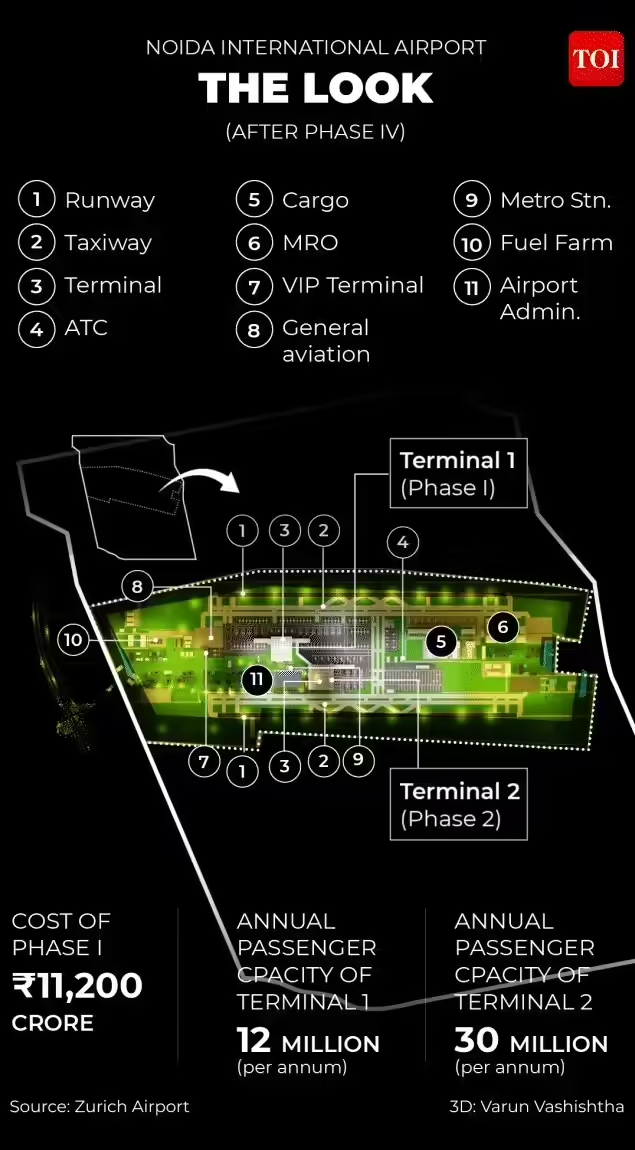
Developed at an investment of around Rs 11,200 crore under a Public–Private Partnership (PPP) model, the project is expected to enhance both regional and international connectivity for the National Capital Region (NCR).The airport is being positioned as a key addition to India’s aviation network, aimed at easing pressure on existing infrastructure while supporting the country’s ambition of becoming a global aviation hub.
Second international gateway for Delhi NCR
Noida International Airport has been developed as the second international gateway for Delhi NCR, complementing the existing Indira Gandhi International Airport, which currently handles the majority of the region’s air traffic.
.
With rising passenger demand and capacity constraints at IGI Airport, the new facility is expected to play a crucial role in distributing traffic more efficiently.Together, the two airports will function as an integrated aviation system, helping reduce congestion, improve connectivity, and enhance the region’s standing among leading global aviation hubs.
Phase I capacity and future expansion plans
Phase I of the airport is designed to handle 12 million passengers per annum (MPPA), providing immediate relief to the region’s growing air travel demand.The project has been planned with scalability in mind, with provisions to expand capacity to 70 million passengers annually in subsequent phases. This long-term vision reflects the government’s strategy to future-proof infrastructure and accommodate sustained growth in air travel.
Modern infrastructure and all-weather operations
The airport features a 3,900-metre runway capable of handling wide-body aircraft, making it suitable for both domestic and international long-haul operations.
.
Equipped with advanced navigation systems such as the Instrument Landing System (ILS) and modern airfield lighting, the facility is designed to support efficient, all-weather, round-the-clock operations. These features ensure operational reliability even under challenging weather conditions.
Cargo hub and logistics ecosystem
In addition to passenger services, the airport includes a comprehensive cargo ecosystem aimed at strengthening logistics and trade.The Multi-Modal Cargo Hub comprises an Integrated Cargo Terminal and dedicated logistics zones, with an initial handling capacity of over 2.5 lakh metric tonnes annually. This capacity is expected to expand significantly to around 18 lakh metric tonnes in the future, positioning the airport as a major cargo and logistics centre in North India.
Dedicated MRO facility to enhance efficiency
A key component of the airport’s infrastructure is a 40-acre Maintenance, Repair and Overhaul (MRO) facility.This dedicated facility is expected to improve operational efficiency by enabling airlines to service and maintain aircraft locally, reducing turnaround times and operational costs. It also strengthens India’s capabilities in aviation maintenance services.
Sustainability and future-ready design
Noida International Airport has been designed as a sustainable and future-ready infrastructure project, with a focus on achieving net-zero emissions.The project incorporates energy-efficient systems and environmentally responsible practices, aligning with India’s broader climate goals. The airport’s development reflects a growing emphasis on green infrastructure in large-scale projects.
Architecture inspired by Indian heritage
Blending modern infrastructure with cultural aesthetics, the airport’s architectural design draws inspiration from traditional Indian elements such as ghats and havelis.This approach aims to create a distinctive identity for the airport while offering passengers a sense of place rooted in Indian heritage.
Strategic location and multi-modal connectivity
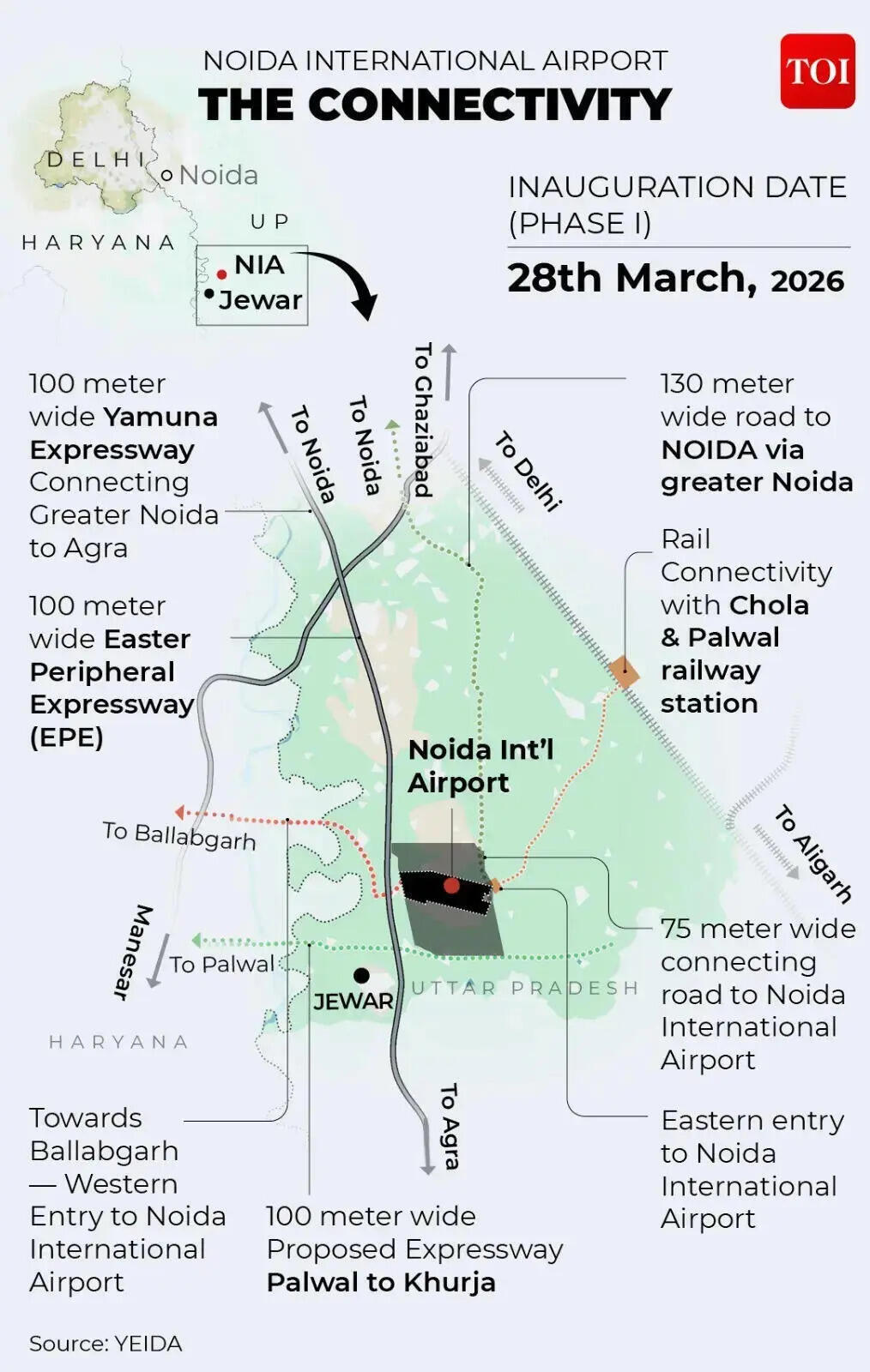
Strategically located along the Yamuna Expressway in Gautam Buddha Nagar district, the airport is planned as a multi-modal transport hub.It will feature seamless integration with road, rail, metro and regional transit systems, ensuring smooth connectivity for passengers and cargo. This connectivity is expected to significantly improve accessibility for travellers across Delhi NCR and neighbouring regions.
Boost to India’s aviation ambitions
The inauguration of Phase I of Noida International Airport is being seen as a major step in strengthening India’s aviation ecosystem.By expanding capacity, improving connectivity, and integrating modern infrastructure with sustainability, the project is expected to play a key role in positioning Delhi NCR as a major global aviation hub while supporting economic growth and regional development
Business
Iran permits 2 Pakistani cargo ships to pass through Strait of Hormuz | The Express Tribune

Iran has permitted two Pakistani cargo ships to transit through the Strait of Hormuz, sources in the Ministry of Maritime Affairs confirmed on Saturday.
The vessels, Multan and P-Akili, which were previously held after Iranian forces took control of the strait — a key global oil supply route — have now crossed and are en route to Karachi. They are expected to dock at Karachi port on March 31, a source familiar with the matter said.
Multan is a general cargo ship, while P-Akili is carrying over 80 million litres of crude oil. Sources added that Iranian authorities not only allowed the vessels to pass but also provided an escort until they cleared the strait’s flashpoint line.
Read: Global poll says Iran war leaves US increasingly isolated internationally
This move comes amid ongoing mediation efforts by Islamabad, in coordination with Turkiye and Egypt, to curb the escalating conflict in the Middle East.
It is the second time Tehran has permitted a Pakistani ship to pass through the Strait of Hormuz since the conflict began on February 28. Previously, a Pakistani oil tanker transited the strait on March 16.
The Middle East region remains on high alert following the joint US-Israel offensive on Iran that began on February 28, which has resulted in over 1,900 deaths, including then-Supreme Leader Ali Khamenei.
Tehran has retaliated with drone and missile strikes targeting Israel, Jordan, Iraq, and Gulf countries hosting US military assets, causing casualties, infrastructure damage, and disruption to global markets and aviation.


Ukraine’s Zelenskiy agrees defence cooperation with UAE, Qatar during Gulf visit

Transfer rumors, news: Salah eyes Roma after Liverpool exit

NHL playoff watch: Guide to all 15 games on Showdown Saturday

-
 Business1 week ago
Flipkart group CFO to leave co amid IPO plans – The Times of India
-
 Business1 week ago
Video: The Effects of High Oil Prices
-

 Fashion1 week ago
China’s textile & apparel exports surge 17% to $50 bn in Jan-Feb 2026
-

 Sports1 week ago
Rating Adidas’ 2026 World Cup away shirts: Argentina, Spain, Mexico and more
-

 Sports1 week ago
American Conference Commissioner Tim Pernetti thanks Trump for Army-Navy game executive order
-
Tech1 week ago
The Corsair 4000D RS PC Case Keeps Your System Cool
-

 Tech1 week ago
Gamers Hate Nvidia’s DLSS 5. Developers Aren’t Crazy About It, Either
-

 Tech1 week ago
‘Uncanny Valley’: Nvidia’s ‘Super Bowl of AI,’ Tesla Disappoints, and Meta’s VR Metaverse ‘Shutdown’