

Business
Chinese Smart Glasses Companies Target Global Markets – SUCH TV


In China, AI-powered smart glasses now allow wearers to make payments in shops with just a glance at a QR code and a simple voice command, as more companies set their sights on both domestic and international markets.
After over a decade of limited progress, interest in smart eyewear is surging worldwide, driven by advances in artificial intelligence that have revitalized the sector.
While U.S. tech giant Meta currently leads the global market, a range of Chinese companies from major players like Alibaba and Xiaomi to startups such as Rokid and XREAL—are working to catch up.
“China’s advantages are self-evident,” Rokid CEO Misa Zhu told AFP after a recent launch in Hangzhou. “The ecosystem and supply chain are all in China, and production is strong.”
Chinese firms enjoy a significant domestic edge, as Meta’s services are largely inaccessible without a VPN. The country also represents a potentially huge and lucrative market for wearable technology.
Smart glasses sales in China are projected to grow by 116 percent year-on-year in 2025, according to market research firm IDC. Daily life in China is highly digitalized, with even older citizens routinely using smartphones for payments, transport, and other services.
Zhu added that China’s digital infrastructure, including widespread QR code payment systems, is already more advanced than in Europe or the United States, giving local companies a strategic advantage in developing and selling smart eyewear.
‘Dark horse’ Xiaomi
Other Chinese companies like Xiaomi, RayNeo, Thunderobot and Kopin are active players in the smart glasses sector, wrote Flora Tang, an analyst at research firm Counterpoint.
Xiaomi in particular was a “dark horse”, she said, its debut AI glasses the third best-selling of their kind for the first half of 2025 despite only being on sale for about a week.
Interest is also being shown in smaller companies like Rokid, with the company raising more than $4 million on crowdfunding site Kickstarter recently.
Rokid is “observing and learning… from big global companies”, CEO Zhu said.
To straddle the domestic and overseas markets, the firm allows customers to use Chinese apps in China, and others elsewhere, unlike competitors like Meta, which limit the apps on offer.
The Rokid glasses are not locked to one generative AI model, either.
“We are very open that we use OpenAI, and can also connect with Llama, Gemini, and Grok” Zhu said.
“That’s why many people like us.”
Another feature Rokid demonstrated in Hangzhou was simultaneous translation, featuring phosphor-green English subtitles that rolled across the glasses’ inner lenses as an employee talked in Chinese.
But shattering Meta’s dominance overseas will be challenging.
In the first half of 2025, Meta commanded a 73 percent share of the growing global smart glasses market, according to Counterpoint.
Its success has been attributed to the Ray-Ban Meta Smart Glasses, almost indistinguishable from everyday, and crucially fashionable, eyewear.
Privacy concerns
In Hangzhou, Rokid unveiled new collaborations with Bolon, which is also owned by Ray-Ban’s parent company EssilorLuxottica.
With weight also a crucial factor, Rokid says its models are among the world’s lightest.
“Appearance remains the top priority — it has to make people actually want to wear it,” 25-year-old customer Wu Tianhao told AFP.
Chinese firms showcase “numerous brands and models, rapid iteration, and ability to quickly adapt to market changes”, industry expert Zhu Dianrong said.
However, “overseas brands still hold an advantage in hard tech like full-colour displays and optical waveguides”.
Rokid’s vice president Gary Cai acknowledged an “obvious gap” in chip technology available in China and overseas, but noted the difference between AI models “has narrowed considerably”.
Despite interest in smart glasses rising, Chinese and foreign firms alike face major challenges ahead of widespread adoption.
Across the board, the user experience needs more polish and accessibility, said Will Greenwald, writer for consumer electronics outlet PCMag.
“I don’t think anyone has really made it a smooth experience just yet,” he told AFP.
Privacy concerns remain a hurdle, with the ramifications of widely worn glasses discreetly and near-constantly recording throwing up potential regulatory pitfalls.
Still, manufacturers such as Zhu remain confident.
“Today, our AI glasses are phone peripherals,” he said. “But in the near future… phones will become accessories to the glasses.”











Business
Stock market today: Which are the top losers and gainers on March 6- check list – The Times of India

Benchmark equity indices Sensex and Nifty fell sharply on Friday, retreating by more than 1 per cent after a brief recovery in the previous session as escalating tensions in West Asia and surging crude oil prices weighed on investor sentiment.The 30-share BSE Sensex declined 1,097 points, or 1.37 per cent, to close at 78,918.90. During the session, it had plunged 1,203.72 points, or 1.50 per cent, to 78,812.18. The NSE Nifty dropped 315.45 points, or 1.27 per cent, to settle at 24,450.45.
Nifty50 top gainers
- Bharat Electronics (1.84%)
- Reliance Industries (1.11%)
- ONGC (0.95%)
- Sun Pharma (0.84%)
- NTPC (0.68%)
- Hindalco (0.42%)
- HCL Tech (0.20%)
- Infosys (0.20%)
- Bajaj Auto (0.12%)
- Nestle India (0.12%)
Nifty50 top losers
- ICICI Bank (-3.26%)
- Eternal (-3.16%)
- Shriram Finance (-3.08%)
- Axis Bank (-2.47%)
- UltraTech Cement (-2.45%)
- Kwality Wall’s (-2.42%)
- InterGlobe Aviation (-2.41%)
- Adani Enterprises (-2.36%)
- HDFC Bank (-2.36%)
- HDFC Life (-2.31%)
BSE Sensex top gainers
- Bharat Electronics (1.84%)
- Reliance Industries (1.11%)
- Sun Pharma (0.84%)
- NTPC (0.68%)
- HCL Tech (0.20%)
- Infosys (0.20%)
BSE Sensex top losers
- ICICI Bank (-3.26%)
- Eternal (-3.16%)
- Axis Bank (-2.47%)
- UltraTech Cem. (-2.45%)
- Kwality Wall’s (-2.42%)
- InterGlobe (-2.41%)
- HDFC Bank (-2.36%)
- SBI (-2.27%)
- Bajaj Finserv (-2.25%)
- L&T (-2.21%)
The decline came as Brent crude, the global oil benchmark, jumped 2.53 per cent to $87.57 per barrel, raising concerns about inflation and macroeconomic stability.“Indian equity markets extended their decline following the prior session’s relief rally, as escalating US-Iran tensions disrupted key Middle Eastern oil and gas supplies, driving crude prices higher. A sustained rise in oil prices could weigh on investor sentiment and adversely affect India’s twin deficits, inflation trajectory, and the RBI’s monetary stance,” said Vinod Nair, Head of Research, Geojit Investments Ltd, PTI quoted.Elsewhere in Asia, South Korea’s Kospi, Japan’s Nikkei 225, Shanghai’s SSE Composite index and Hong Kong’s Hang Seng index ended higher.European markets, however, were trading in the red, while US markets ended lower on Thursday.Foreign Institutional Investors (FIIs) sold equities worth Rs 3,752.52 crore on Thursday, while Domestic Institutional Investors (DIIs) purchased stocks worth Rs 5,153.37 crore, according to exchange data.On Thursday, the Sensex had rebounded 899.71 points, or 1.14 per cent, to settle at 80,015.90, snapping its four-day losing streak. The Nifty had climbed 285.40 points, or 1.17 per cent, to close at 24,765.90, ending its three-day decline.

As the US and Israel continue strikes on Iran, and with retaliatory strikes hitting nearby Middle East states, key shipping routes are being disrupted. Oil and gas production in the region is also being affected.
The BBC’s Nick Marsh examines how the war could cause a rise in living costs around the world.
Business
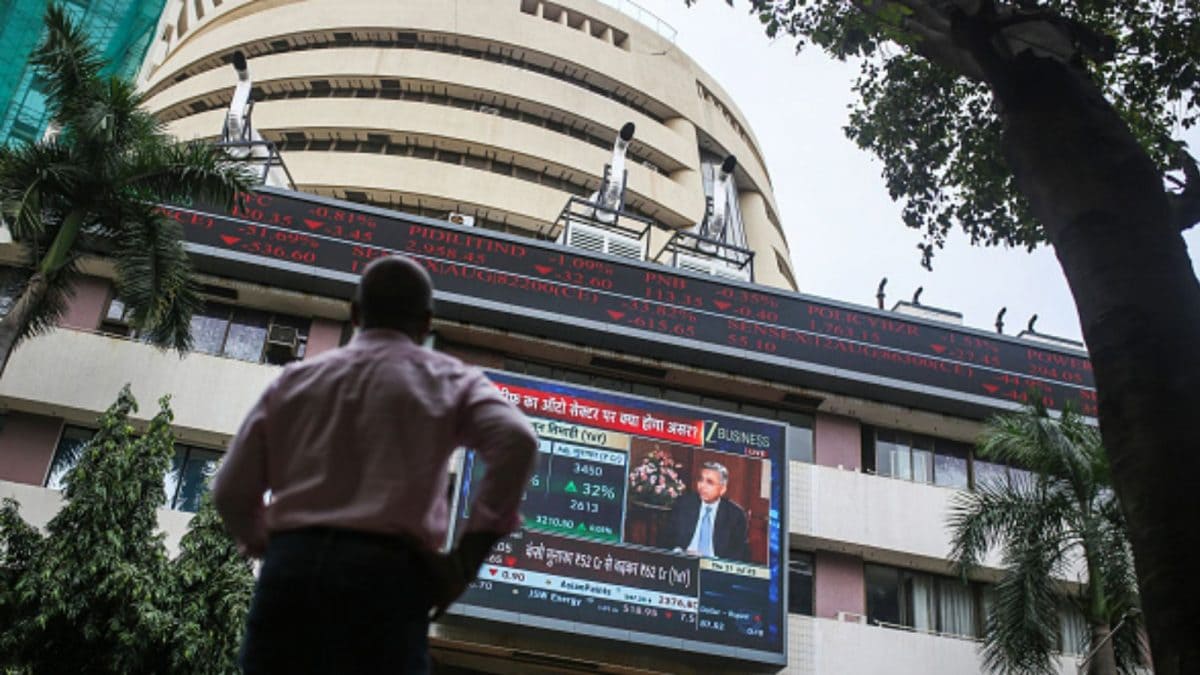
Stock Market Updates: Sensex Tanks 1,100 Points, Nifty Tests 24,450; India VIX Jumps Over 11%
Last Updated:
The Nifty50 and the Sensex declined at open amid weak global cues.




Sensex Today
Indian benchmark equity indices extended their losses in a volatile trading session on Friday as investors remained cautious amid escalating tensions in West Asia linked to the US-Iran conflict.
As of 3:19 PM, the Nifty50 was trading 1.21 per cent or 300 points down at 24,465, and the Sensex was trading 1,136 points or 1.42 per cent down at 78.879.
Market volatility spiked during the session, with the India VIX rising as much as 11.31% to 19.88.
Among Nifty50 constituents, InterGlobe Aviation, ICICI Bank, and Max Healthcare Institute were the top losers. On the other hand, Bharat Electronics Limited, Reliance Industries, and NTPC Limited were among the top gainers.
Broader markets also traded lower, with the Nifty Midcap 100 and Nifty Smallcap 100 declining 0.47% and 0.06%, respectively.
On the sectoral front, the Nifty IT Index was the only major gainer, rising 0.34% on the back of gains in Persistent Systems and Infosys.
Meanwhile, the Nifty Realty Index emerged as the worst-performing sector, falling nearly 2%, dragged down by losses in Godrej Properties, The Phoenix Mills, and Prestige Estates Projects.
The Nifty Private Bank Index and Nifty Financial Services Index were also among the major laggards during the session.
Global cues
Most markets across the Asia-Pacific region traded in the red as crude oil prices climbed amid rising concerns over supply disruptions linked to the escalating conflict involving the United States, Israel, and Iran.
In Asia, mainland China’s CSI 300 Index slipped around 0.1%, while South Korea’s Kospi Index declined 1.6%.
Overnight on Wall Street, the S&P 500 fell 0.57%, while the Dow Jones Industrial Average dropped 1.61%. The Nasdaq Composite ended 0.26% lower.
Market uncertainty also intensified after Letitia James and attorneys general from 23 US states reportedly filed another lawsuit seeking to block tariff measures announced by Donald Trump.
Oil and gold prices
Oil prices surged as traders remained concerned about potential supply disruptions. According to a Reuters report, Brent crude futures rose nearly 5% to $85.41 per barrel in the previous session.
During the Asian trading session, Brent Crude Oil was trading 0.15% higher at $84.16 per barrel.
Meanwhile, safe-haven demand pushed Gold Futures up 1.34% to $5,146.39, supported by ongoing geopolitical tensions.
 Click here to add News18 as your preferred news source on Google.
Follow News18 on Google. Join the fun, play games on News18. Stay updated with all the latest business news, including market trends, stock updates, tax, IPO, banking finance, real estate, savings and investments. To Get in-depth analysis, expert opinions, and real-time updates. Also Download the News18 App to stay updated.
March 06, 2026, 09:20 IST
Read More

Stock market today: Which are the top losers and gainers on March 6- check list – The Times of India

Bangladesh road map aims at raising tax-to-GDP ratio to 15% by 2035
Watch: How war in Iran may affect food and fuel prices

Attock Cement’s acquisition approved | The Express Tribune

India Us Trade Deal: Fresh look at India-US trade deal? May be ‘rebalanced’ if circumstances change, says Piyush Goyal – The Times of India

Policy easing drives Argentina’s garment import surge in 2025

-
Business1 week ago
Attock Cement’s acquisition approved | The Express Tribune
-
Business1 week ago
India Us Trade Deal: Fresh look at India-US trade deal? May be ‘rebalanced’ if circumstances change, says Piyush Goyal – The Times of India
-
 Fashion1 week ago
Policy easing drives Argentina’s garment import surge in 2025
-

 Politics1 week ago
What are Iran’s ballistic missile capabilities?
-

 Politics1 week ago
US arrests ex-Air Force pilot for ‘training’ Chinese military
-

 Sports7 days ago
LPGA legend shares her feelings about US women’s Olympic wins: ‘Gets me really emotional’
-
 Entertainment7 days ago
What’s new in Pokémon? Every game, update, surprise from 30th anniversary event
-
 Business7 days ago
Greggs to reveal trading amid pressure from cost of living and weight loss drugs