

Business
Deepening Pak-Indonesia ties | The Express Tribune

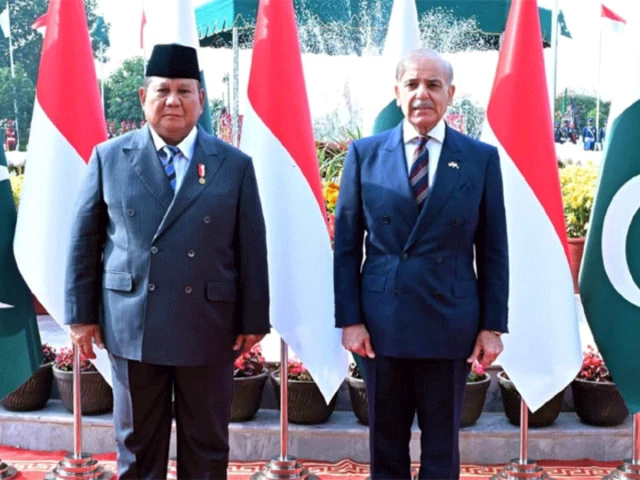
With supportive tariffs, electronics manufacturing can emerge as major pillar of Indonesia’s investment footprint
President of Indonesia Prabowo Subianto and Prime Minister Shehbaz Sharif Photo: Radio Pakistan
ISLAMABAD:
Pakistan and Indonesia are steadily shaping one of South and Southeast Asia’s most consequential, yet under-reported, economic relationships. What began as a tariff-centred arrangement has matured into a broader commercial partnership driven by commodity flows, rising business-to-business engagement, and an expanding agenda for investment cooperation.
Recent figures underline this momentum. Bilateral trade reached $4.2 billion in 2024, and early 2025 numbers continue to climb. Between January and September 2025, trade volumes touched $2.92 billion, up from $2.69 billion during the same period of last year. This steady rise reflects both the resilience of commodity flows and the gradual expansion of non-traditional product lines entering each other’s markets. Yet the structural imbalance persists – Indonesia remains the dominant exporter, while Pakistan’s outbound shipments largely remain confined to a narrow set of labour-intensive items.
Palm oil remains the anchor of this asymmetry. As one of the world’s largest consumers of imported edible oils, Pakistan depends heavily on Indonesian supply – a reality that shapes pricing, availability, and strategic planning for domestic refiners and food manufacturers. The Indonesian Palm Oil Association reaffirmed in late 2024 and again in 2025 that Indonesia will continue prioritising Pakistan’s edible oil requirements. This stable flow is a valuable assurance for Pakistan, though vulnerability to biodiesel mandates, domestic Indonesian policy shifts, and global price cycles remains.
The policy framework for bilateral trade is robust on paper but under-leveraged in practice. The Indonesia-Pakistan Preferential Trade Agreement (IP-PTA) provides a predictable tariff structure, yet businesses on both sides note that the agreement has not kept pace with evolving supply chain realities. Rules of origin, digital documentation, sanitary and phytosanitary alignment, and services-sector protocols require updating. In short, the scaffolding exists; the operational architecture needs modernisation.
On the export diversification front, opportunities remain substantial but under-exploited. Pakistani exporters identify textiles, home linen, surgical instruments, rice, leather, and processed foods as areas with strong potential in Indonesia’s consumer-driven market. Conversely, Indonesian firms see Pakistan as an attractive destination for electronics, machinery, processed foods, and – significantly – investments in logistics, refining, and distribution infrastructure. Joint ventures in edible oil refining, port-side storage terminals, and downstream food processing plants have been actively discussed at recent business forums.
Business-to-business engagement is deepening faster than government-led initiatives. Delegations from Karachi, Lahore and Islamabad continue to visit Jakarta, Bandung, and Surabaya for sector-specific roundtables and trade fairs. Chambers of commerce on both sides are pushing for SME-focused engagement, with a growing emphasis on using Indonesia as a gateway to Asean and encouraging Indonesian firms to view Pakistan as an entry point to South Asia and Central Asia. This bottom-up momentum is likely to be a major driver of bilateral expansion in the years ahead.
The constraints are equally real. Pakistan’s exporters face high freight costs, fragmented market intelligence, and complex Indonesian non-tariff standards. Indonesian suppliers, meanwhile, must navigate Pakistan’s volatile exchange conditions and inconsistent regulatory signals. Domestic Indonesian policies – particularly biodiesel blending requirements and temporary export curbs – periodically disrupt Pakistan’s edible oil supply chain. For both sides, these frictions complicate long-term planning.
To strengthen and stabilise the partnership, a series of practical measures merit serious consideration. Upgrading the IP-PTA into a broader Free Trade Agreement would be a critical first step, incorporating services, digital trade, clearer investment rules, and mutual recognition of standards. Securing long-term edible oil supply contracts, supported by dedicated storage and port-side infrastructure in Pakistan, would help cushion policy shocks. Joint ventures in refining and downstream processing could add value locally while reducing dollar-based import exposure.
Equally important would be establishing bilateral certification and standards alignment centres to help SMEs meet regulatory requirements more easily. A dedicated Pakistan-Indonesia trade portal could provide real-time tariff data, logistics options, and a digital dispute resolution window – the essential tools for smaller exporters. An investment facilitation desk, jointly staffed by the two governments and linked to export credit agencies, could accelerate approvals and de-risk early-stage projects.
Recent diplomatic and business activity suggests that both sides recognise the importance of moving in this direction. In 2024 and 2025, the Pakistan-Indonesia Business Council and Indonesian diplomatic missions in Karachi engaged in active discussions around agriculture, manufacturing, energy, halal products, and logistics investment. There is also renewed advocacy for finalising a comprehensive trade agreement and introducing direct flights to reduce logistics costs and expand business mobility. These developments signal that investment is becoming a central theme of the bilateral agenda.
A promising new area is Pakistan’s fast-growing electronic appliances market. Demand for air-conditioners, refrigerators, fans, small home appliances, and LED TVs is expanding at a pace that now requires fresh global investment. Indonesian manufacturers – already competitive in mid-range electronics – see Pakistan as an attractive destination due to its large consumer base, improving localisation policies, and lower production costs compared to many Asean peers. Early conversations between Indonesian appliance makers and Pakistani industry groups indicate serious interest in assembling and eventually manufacturing select product lines inside Pakistan.
If realised, Indonesian investment in this sector could have significant spillovers. Local assembly partnerships would reduce import dependence, stabilise prices, and generate jobs across the electrical, metal works, plastic moulding, and logistics value chains. With supportive tariff policies and streamlined approvals, electronics manufacturing could emerge as one of the next major pillars of Indonesia’s investment footprint in Pakistan.
The writer is a Mechanical Engineer





Co-op chair Debbie White said: “We thank Shirine for her leadership and for the significant contribution she has made to our Co-op, to our communities and to the co-operative movement during her tenure. The Board is grateful for her commitment and leadership, particularly during a challenging few years, and we wish her every success in the future.”

Air travel is all set to become highly expensive as the airlines are indicating at doubling the air ticket prices following a whopping increase in jet fuel rate.
The jet fuel price has rocketed to Rs417 from Rs388 per litre in Pakistan and the airlines have started to increase the airfares through enhancing fuel surcharge rates.
The airlines maintained the basic fare but added the fuel price surge into the fuel surcharge.
The one-way fare from Karachi to Islamabad and Lahore has shot up to Rs40,000 while air travel on chance seats for Islamabad and Lahore has soared by 150 percent.
Accordingly, the Pakistan International Airlines (PIA) has boosted the airfares by 10 to 100 dollars.
Domestic flights will now carry additional $10 fuel surcharge which on Canada routes extra $100 will be received as fuel charge.
Passengers on UK-bound flights to pay 75 dollars additional surcharge while 50 dollars will be received on Middle East routes.
Private airlines have gone a step ahead as they enforced charging additional 15 dollars to 150 dollars on different routes.
The airlines were under pressure after closure of many air routes with the airlines administrations are saying that extraordinary rise in airfares has become inevitable.
Earlier on Wednesday, Pakistan fuel NOTAM forced foreign airlines to tanker Jet A-1 fuel from abroad and limit uplift at Karachi and Lahore airports.
The Pakistan Airports Authority issued the order to protect local supplies amid supply disruptions.
Foreign carriers now arrive with enough fuel for their return flights while Pakistani airlines receive full requirements.
This change hit operations on March 25 when one Karachi-to-Doha flight diverted to Muscat.
The Pakistan fuel NOTAM A0147/26 took effect on March 13 and runs through March 31 2026. It targets Jinnah International Airport in Karachi and Allama Iqbal International Airport in Lahore.
Airlines follow the rule and carry maximum fuel on inbound legs. Officials confirm foreign airlines get only the minimum quantity inside Pakistan.
Pakistan fuel NOTAM creates immediate changes on the ground. Foreign airlines offload passenger baggage and cargo to stay within weight limits.
The extra fuel adds weight that reduces payload capacity on every affected flight.
According to a Notice to Airmen (NOTAM) issued by the PAA, the supply of aviation fuel at domestic airports has been significantly curtailed due to regional supply chain disruptions, advising international carriers to maximize their fuel “uplift” at foreign stations and minimize refuelling within Pakistan.
The directive has already begun to impact international flight schedules.

The government-backed bank has been accused of a series of errors, including not paying bereaved families money that was rightfully theirs.
Source link


2026 NFL draft team needs: Depth chart holes, prospect fits

China’s coal-to-chemicals: Winning the Iran war energy crisis

King Charles hopes for peace in new message as US tour hangs in balance

Sales at US apparel, clothing accessories stores up 4% YoY in Jan 2026

Justice Department Says Anthropic Can’t Be Trusted With Warfighting Systems

March Madness 2026 – How to watch in SA, start time, schedule, TV channel for NCAA championship basketball tournament

-
 Fashion1 week ago
Sales at US apparel, clothing accessories stores up 4% YoY in Jan 2026
-
 Tech1 week ago
Justice Department Says Anthropic Can’t Be Trusted With Warfighting Systems
-
 Sports1 week ago
March Madness 2026 – How to watch in SA, start time, schedule, TV channel for NCAA championship basketball tournament
-

 Entertainment1 week ago
Val Kilmer revived 1 year after death through AI
-
 Business1 week ago
Stocks and pound rise as US rate call approaches
-
 Business1 week ago
Brits cashing in jewellery as gold price hits record high
-

 Politics1 week ago
Iran strikes Tel Aviv with cluster-warhead missiles in retaliation of Larijani’s martyrdom
-

 Fashion1 week ago
Spain’s Inditex FY25 sales rise 3.2% to $46.28 bn amid strong demand