

Entertainment
desperate search for the missing after Swiss fire

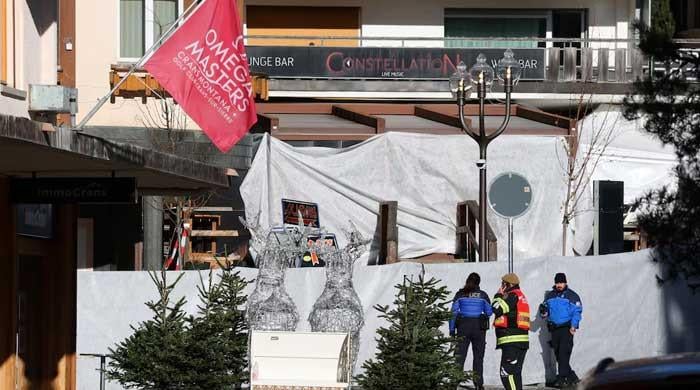
CRANS MONTANA: Teenagers Eleonore and Elisa started the year with a frantic search for friends who have been missing since a deadly fire tore through a bar in a neighbouring Swiss town.
“Are they OK? Are they just at the hospital?” one of the 17-year-olds says.
They have not heard from them since a blaze tore through a New Year’s celebration in the luxury resort town of Crans Montana, turning what should have been a night of revelry into a globe-spanning tragedy.
Police estimate around 40 people have been killed and about 115 injured, many of them young visitors to the Swiss Alps.
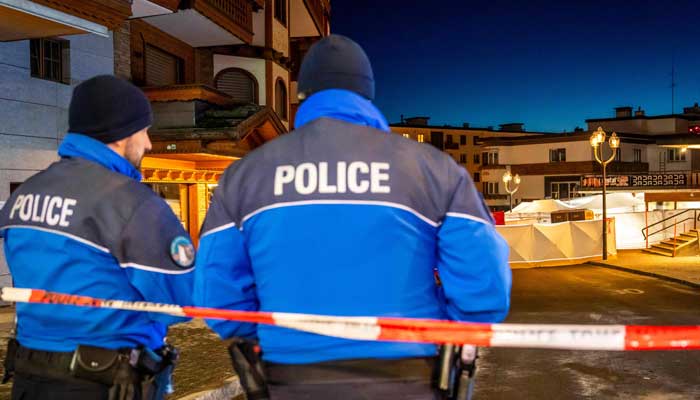
Officials have started the arduous process of identifying the victims, but with some of the bodies badly burned, police warned the process could take days or even weeks.
Relatives and friends have been scrambling to find their loved ones, with many circulating photos on social media.
“We tried to reach them; some of their locations are still showing here,” said one of the teenagers from Valais, nodding at the bar now shielded by opaque white tarpaulins and behind a wall of temporary barriers.
“We took loads of photos [and] we put them on Instagram, Facebook, every social network possible to try to find them,” Eleonore said.
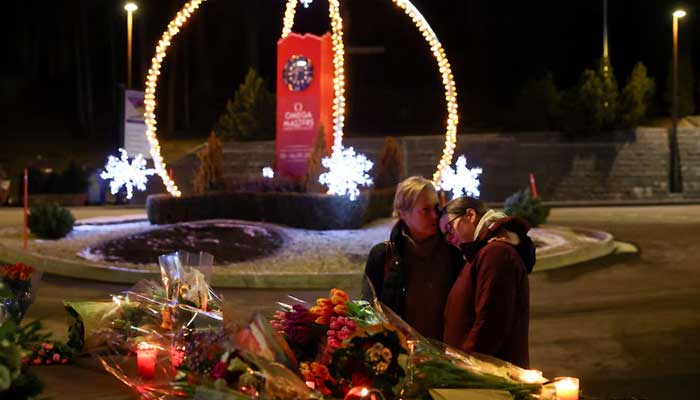
“But there’s nothing. No response. We called the parents. Nothing. Even the parents don’t know,” she added.
They managed to get news that one friend was in a coma in a hospital in the city of Lausanne.
More than 30 victims were taken to hospitals with specialised burns units in Zurich and Lausanne, and six were taken to Geneva, according to a Swiss news agency.
There is no official estimate of the missing or headcount from Le Constellation bar that night.
Italy’s ambassador Gian Lorenzo Cornado told AFP that five of the injured have not yet been identified.
A few hundred metres from the remnants of the burned bar, the nearby convention centre has been turned into a crisis unit.
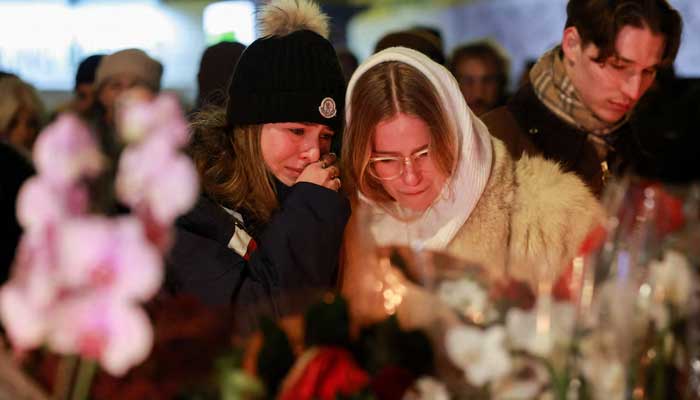
Away from the press and guarded by police, families of the victims are received and offered assistance by authorities, diplomats and chaplains.
Swiss President Guy Parmelin said the support on offer would be “long-lasting”.
Nathan, a 19-year-old who was in the bar just before it caught fire, told AFP he keeps expecting to wake up from the “nightmare”.
“It feels like… I’m going to wake up tomorrow and get all my loved ones back who sadly died in this incident,” he said.
“Normally a new year is full of happiness, but unfortunately, this has happened.”
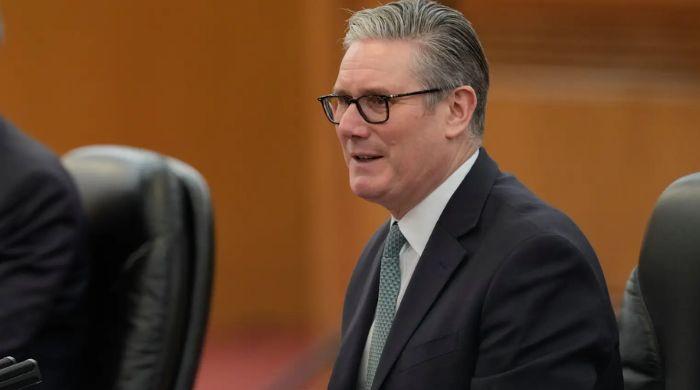
UK Prime Minister Keir Starmer unveiled sweeping new rules to keep children safe online.
On Monday, February 16, Starmer extended regulations to AI chatbots, paving the way for a potential social media ban for under-16s following the Grok AI scandal involving Elon Musk’s X platform.
With these new rules, the government plans to close a legal loophole that previously exempted AI chatbots from key provisions of the Online Safety ACT.
This means that AI chatbots such as Musk’s Grok and OpenAI’s ChatGPT must now prevent children from accessing harmful content or face fines of up to 10% of global revenue.
Starmer said: “These AI chatbots are forming friendships with children that can take them into all sorts of places they shouldn’t be going.”
Major key actions include:
- The government plans to amend the children’s well-being bill with “Henry VIII powers” to implement any future under 16s social media ban without any hinderance
- AI chatbots will follow illegal content duties similar to traditional social media platforms, curbing infinite scrolling and setting age limits on VPNs used to bypass restrictions
- Ministers will introduce “Jool’s law” needing platforms to preserve deceased children’s data within five days of a death being reported and make it accessible to coroners
Chief executive of the UK’s leading children’s charity, the National Society for the Prevention of Cruelty to Children, warned: “Social media has produced huge benefits but lots of harm. AI is going to be that on steroids if we’re not careful.”
Entertainment
Robert Duvall, Oscar-winning actor known for “The Godfather” and “Apocalypse Now” roles, dies at age 95
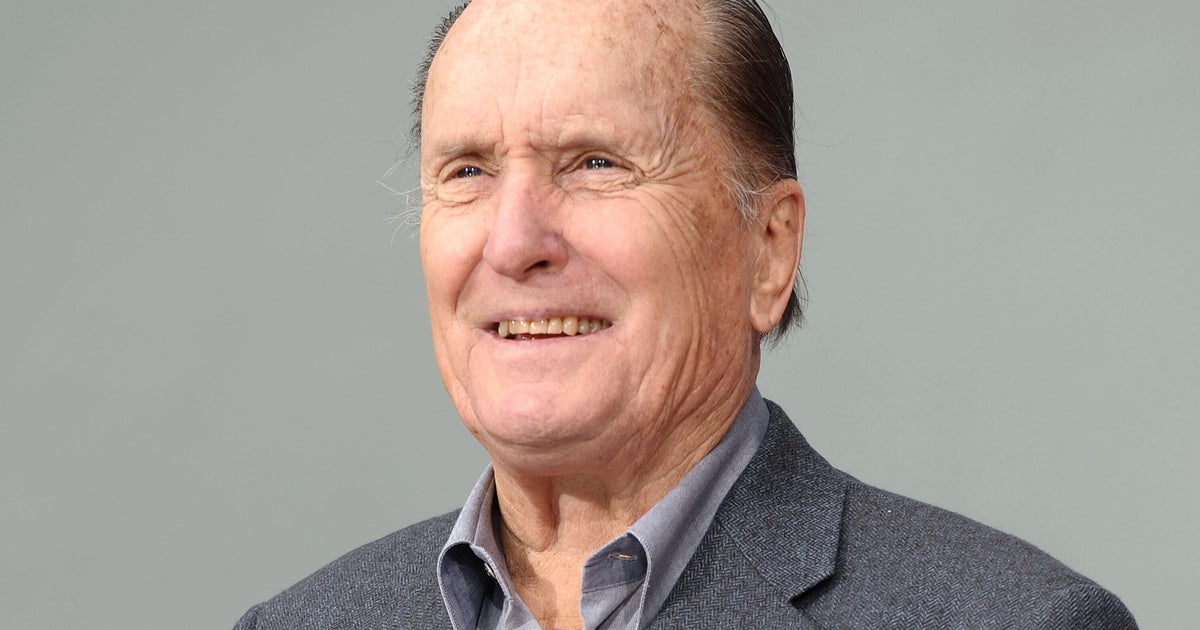
Robert Duvall, who starred in such classics as “The Godfather” and “The Godfather Part II,” “M*A*S*H,” “Apocalypse Now” and “Tender Mercies,” for which he won the Academy Award, has died, his wife announced in a social media post Monday. He was 95.
Luciana Duvall said in a statement that her husband died Sunday at their home “surrounded by love and comfort.”
“To the world, he was an Academy Award-winning actor, a director, a storyteller. To me, he was simply everything,” she wrote. “His passion for his craft was matched only by his deep love for characters, a great meal, and holding court. For each of his many roles, Bob gave everything to his characters and to the truth of the human spirit they represented. In doing so, he leaves something lasting and unforgettable to us all.”
One of the best actors of his generation with a career spanning nearly seven decades, Duvall was noted for his understated performances, subsuming himself into characters that manifested moral conflicts or ethical struggles.
Some of his most indelible portrayals included Tom Hagen, the Corleone family’s consigliere, in the first two “Godfather” films; Mac Sledge, a country singer seeking to redeem himself, in “Tender Mercies”; and his debut film appearance, as Boo Radley, a shy man who befriends young Scout, in the 1962 adaptation of “To Kill a Mockingbird.”
Jason LaVeris/FilmMagic
But Duvall could also go large, as shown by his full-throttle performances as Lt. Col. Kilgore in “Apocalypse Now,” who leads a helicopter attack on a Vietnamese village in order to secure a safe zone for surfing; Bull Meechum, the overbearing Marine pilot and father in “The Great Santini”; and Frank Hackett, a corporate TV executive who runs roughshod over a news division in “Network.”
Working with such directors as Francis Ford Coppola, Robert Altman, Sidney Lumet, George Lucas, Philip Kaufman and Dennis Hopper, Duvall was one of the most visible and dependable actors in the 1970s and ’80s. He brought gravitas and a touch of subversion to such films as “True Confessions,” “The Stone Boy,” “Rambling Rose,” “The Natural,” “Colors,” “The Handmaid’s Tale” and “A Civil Action.”
And as he aged into mentor roles — as race car driver Tom Cruise’s pit crew chief in “Days of Thunder”; a hostage negotiator opposite Denzel Washington in “John Q.”; Michael Keaton‘s editor-in-chief in “The Paper”; an astronaut leading his crew to save the planet in “Deep Impact” — Duvall brought a commitment to anchoring a story in reality. In all, he earned seven Oscar nominations.
Keystone/Getty Images 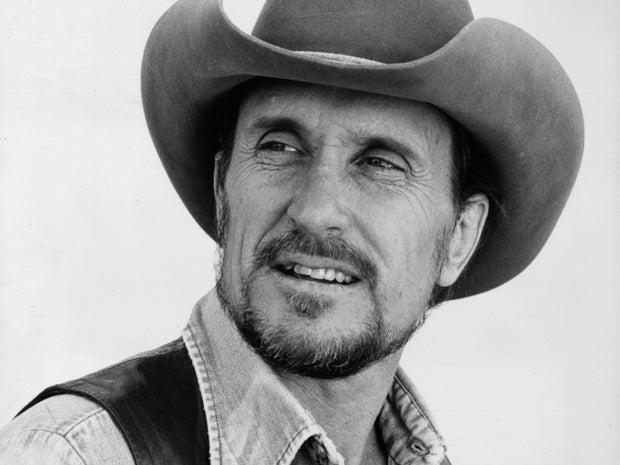
Even in small parts, he could steal a movie. In 2004, he explained to CBS’ “60 Minutes II” that, whether his characters were heroic or villainous, down-to-earth or tenacious, there’s a bit of Robert Duvall in all of them. “Has to be. It’s you underneath,” he said. “You interpret somebody. You try to let it come from yourself.”
“You can’t step over the line”
A Navy brat (his father retired as a rear admiral), Duvall was born on Jan. 5, 1931, in San Diego, California, and raised in Maryland, Missouri and Illinois. He took drama classes in school, appeared in stage productions, served for a year in the Army in the 1950s, and then studied acting in New York alongside Gene Hackman, Dustin Hoffman and James Caan. He made his off-Broadway debut in 1958’s “Mrs. Warren’s Profession.”
Duvall had early TV roles on shows like “Playhouse 90,” “Naked City,” “Alfred Hitchcock Presents,” “The Twilight Zone,” “Route 66” and “The Untouchables,” and he made his first film appearance in “To Kill a Mockingbird.”
He continued with a hefty resume of TV roles, including “The Outer Limits,” “Voyage to the Bottom of the Sea,” “The Time Tunnel,” “The Wild Wild West,” “Judd for the Defense,” “Mod Squad” and “The F.B.I.” But Duvall began making bigger and bigger appearances on movie screens, including in “Countdown,” “Bullitt,” “True Grit” (as outlaw Ned Pepper) and a starring role in Coppola’s “The Rain People.” He also appeared on Broadway in the thriller “Wait Until Dark.”
Then came “M*A*S*H,” Altman’s 1970 satire of war, in which Duvall played Maj. Frank Burns, a by-the-book Army surgeon whose religious zeal didn’t get in the way of his having an affair with the hospital’s chief nurse, Maj. Margaret “Hot Lips” Houlihan (Sally Kellerman). Burns becomes a foil and the butt of jokes of other doctors at the M*A*S*H unit until he is literally driven into a straitjacket.
Duvall followed “M*A*S*H” with a lead role in a science fiction film directed by one of Coppola’s friends, George Lucas. Inspired by one of Lucas’ film school shorts, “THX 1138” starred Duvall as a worker in a dystopian future who breaks free of the state’s mind-control efforts and escapes to a ravaged landscape.
But an even bigger role – in the context of popular culture – was Duvall’s supporting turn in Coppola’s “The Godfather.” Cast opposite Marlon Brando, James Caan and Al Pacino, Duvall played an Irish lawyer who had been “adopted” into the Corleone family – his sole client. Balancing the wishes of Brando’s Vito Corleone, the hot-headed antics of Caan’s Sonny and the resistance of Pacino’s Michael, Tom Hagen was a tested voice of reason, a deliverer of bad news and an instrument of revenge (as when he directed the dismemberment of a movie studio head’s prized horse).
Bettmann Archive/Getty Images 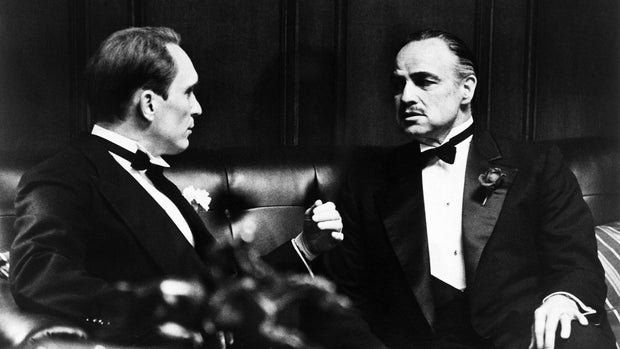
“As an actor and a character both, you can’t step over the line,” Duvall told the A.V. Club in 2022. “[Hagen’s] an adopted son, so he is a member of the family, kind of; maybe not a thousand percent, but he’s very important to the family. And as an actor, you can’t step over that line, either. You have to kind of keep yourself in the background a little bit and then be called upon when needed.”
He would repeat the role in Coppola’s sequel, “The Godfather Part II.” But when Coppola went to film Part III of his gangster saga, Duvall and the studio couldn’t come to terms on salary, and so Tom Hagen was killed off.
“It smells like victory”
Duvall’s work in the 1970s included crime films (“Badge 373,” “The Outfit,” “Breakout”) and Westerns (“Lawman,” “Joe Kidd,” “The Great Northfield Minnesota Raid”). He appeared uncredited in Coppola’s “The Conversation”; starred in a barely released adaptation of a William Faulkner short story, “Tomorrow”; played Dr. Watson opposite Nicol Williamson‘s Sherlock Holmes in “The Seven-Per-Cent Solution”; and had a showy turn in the Sidney Lumet-Paddy Chayefsky satire “Network,” about a fictional TV network that boosts a mentally unstable news anchor to raise its moribund ratings. He also starred as Gen. Dwight Eisenhower in an ABC miniseries, “Ike.”
But 1979 marked two of Duvall’s most celebrated roles. In Coppola’s “Apocalypse Now,” he played Lt. Col. Kilgore, who leads a helicopter attack on a suspected Viet Cong village, blaring Wagner on loudspeakers. Kilgore’s bare-chested speech (“I love the smell of napalm in the morning … it smells like victory”), as a forest is incinerated nearby, articulated the brutality and insanity of war and became one of cinema’s iconic moments.
Duvall took his role seriously, even as explosives were discharged all around him. “I played a guy that didn’t flinch, so I didn’t flinch. You know what I mean?” he told Esquire magazine in 2014. “I played that kind of guy – a non-flinching guy. If you flinch when the script says not to flinch, you should be fired.”
The film, an independent production backed by Coppola, became a high-water mark in Hollywood’s approach to the Vietnam War. It also earned Duvall his second supporting actor Oscar nomination.
CBS via Getty Images 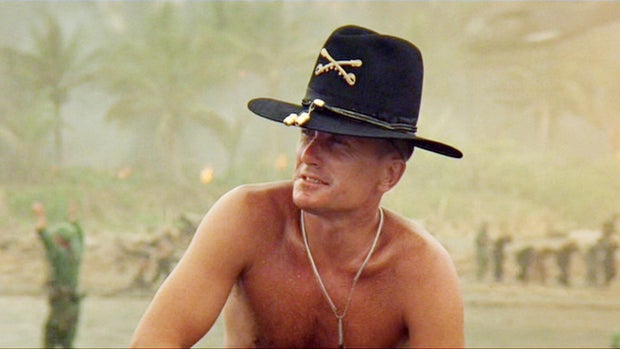
On the opposite end of the theatrical marketing spectrum from “Apocalypse Now,” Warner Bros. had little faith in “The Great Santini,” adapted from the Pat Conroy novel. Duvall played Col. Bull Meechum, a hard-as-nails Marine fighter pilot whose domineering personality collides with his family, in particular his 18-year-old son, Ben (Michael O’Keefe). The movie received little love when it was barely released in 1979; it was even shown on airplanes under a different title (“The Ace”). It wasn’t until summer 1980, when it received a belated release in a New York theater, followed by cable TV play, that it won positive reviews and a following. The movie earned Oscar nominations for both Duvall and O’Keefe.
In 1983, Duvall starred in the drama “Tender Mercies,” playing Mac Sledge, a country singer whose alcoholism derailed his career and who tries to make a spiritual and professional comeback. Written by Horton Foote, “Tender Mercies” was a quiet movie about a broken soul seeking redemption with a new family, his longings and aspirations voiced through country and gospel songs.
He sang every song himself. (That was part of his deal.) “They were trying to get around it,” Duvall told CBS’ “Sunday Morning” in 2006, “but I said, ‘No, no. This has to be part of it. You cannot dub later. I have to do that.'”
He won the Academy Award for his performance. “Not to brag, but I got calls from Willie Nelson, Waylon Jennings and Kris Kristofferson telling me I had the character just right,” he told Roger Ebert in 2012.
Duvall had said his favorite role was Gus McCrae, the Texas Ranger turned philosopher cowboy, in the 1989 TV miniseries “Lonesome Dove.”
He admitted in a 2014 interview with Cowboys and Indians magazine that he didn’t always see eye to eye with the series’ Australian director Simon Wincer. “Sometimes when you have a little turmoil, it can turn out better than if everything is in total harmony,” he said.
CBS Photo Archive/Getty Images 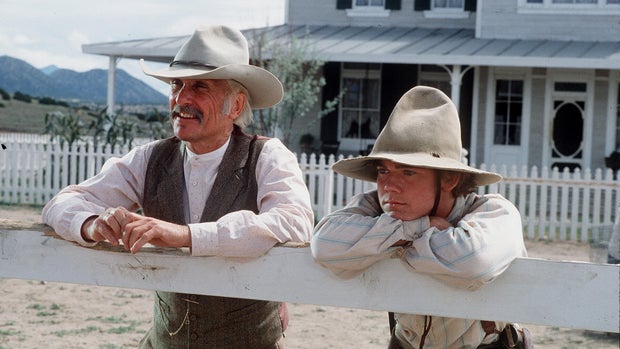
In playing such roles — stoic, quiet, complicated — Duvall told the Los Angeles Times in 1992, “I have a certain confidence. But this is an unforgiving milieu. You have to approach it by being unforgiving of yourself. You always start with zero, starting with the simplest things. I talk, you listen. You talk, I listen. With each part, you begin with the basics.”
Other films included “Rambling Rose,” “Newsies,” the TV movie “Stalin,” “Falling Down,” “Sling Blade,” “The Man Who Captured Eichmann,” “Wrestling Ernest Hemingway,” “Secondhand Lions,” “The Road,” “Get Low,” “Crazy Heart,” “Jack Reacher” and “The Judge.”
He filmed a 1974 documentary about rodeo riders, “We’re Not the Jet Set,” and then directed his first narrative feature, in 1983: “Angelo, My Love,” set in the world of the Roma. He was back in the director’s chair three more times, including “The Apostle” (which he also wrote), in which he played a Pentecostal preacher on the run from the law. The performance earned him his fifth Oscar nomination. He later directed “Assassination Tango” and “Wild Horses.”
Filmed in Buenos Aires, Argentina, the thriller “Assassination Tango” was Duvall’s tribute to the tango. He starred opposite his girlfriend, Luciana Pedraza, who he’d met years earlier when she invited him to the opening of a tango shop. She and the three-times-married Duvall — four decades older than Pedraza — discovered they shared a passion for tango. They married in 2005.
Duvall talked with “60 Minutes” about his obsession with the Argentine dance: “It gets in your blood in a quiet way, kind of a sweet thing that sits there. He’s leading, he’s telling her what to do, but she embellishes. But in our politically correct world, up in the United States, they call it the leader and the follower. Down here, they call it the man and the woman.”
The qualities of Duvall’s work, from the histrionic to the silent, were evident in the naturalness of his delivery. As he said to “Sunday Morning,” “What makes what I do work? It’s this, what we’re doing right now: talking and listening. … That’s the beginning and the end. The beginning and the end is to be simple.”
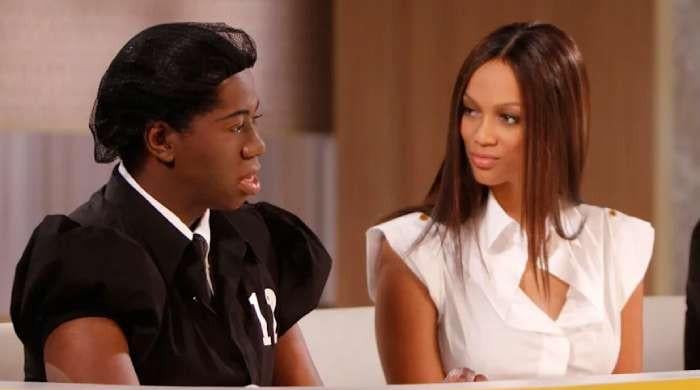
Miss J. Alexander had all but one of his America’s Next Top Model family by his side when he suffered a life-altering illness.
In Netflix’s bombshell new docuseries Reality Check: Inside America’s Next Top Model, the longtime ANTM runway coach shared that he suffered a stroke on December 27, 2022 — one that left him paralyzed from the waist down.
“I had a stroke. I woke up, I didn’t know where I was, other than the hospital,” Miss J said in the series finale. “I spent five weeks in a coma, and I couldn’t walk. I couldn’t talk. I thought to myself, what was I going to do?”
Jay Manuel and Nigel Barker — his former ANTM co-judges — showed up during his recovery, but when asked if Tyra Banks visited, Miss J responded, “No, not yet. She just sent me a text that she wants to come and visit me. But, no, not yet.”
The reunion with Manuel and Barker was emotional. “I thought back to how we used to do shows together. I cried because I just missed them so much,” Miss J recalled.
Still, the fashion icon remains determined. “I miss being the queen of the runway. The catwalks, of course,” he said. “I taught models how to walk, and now I can’t walk — not yet! Not yet. I’m determined to walk… It’s not over for me yet.”


What new AI rules has UK PM Keir Starmer announced for AI chatbots, social media?

Browns safety Ronnie Hickman assaulted at New York City hotel, team says

Three ways the Champions League format could be fixed

-
 Business6 days ago
Aye Finance IPO Day 2: GMP Remains Zero; Apply Or Not? Check Price, GMP, Financials, Recommendations
-

 Fashion6 days ago
Comment: Tariffs, capacity and timing reshape sourcing decisions
-

 Tech7 days ago
Removing barriers to tech careers
-

 Fashion6 days ago
ADB commits $30 mn to support MSMEs in Philippines
-
 Entertainment6 days ago
‘Harry Potter’ star David Thewlis doesn’t want you to ask him THIS question
-

 Sports6 days ago
Winter Olympics opening ceremony host sparks fury for misidentifying Mariah Carey, other blunders
-

 Fashion4 days ago
$10→ $12.10 FOB: The real price of zero-duty apparel
-

 Fashion6 days ago
Saint Laurent retains top spot as hottest brand in Q4 2025 Lyst Index