

Business
Ducati Launches Panigale V4 R In India At Rs 84.99 Lakh: Check Key Specs Of This Track-Focused Superbike

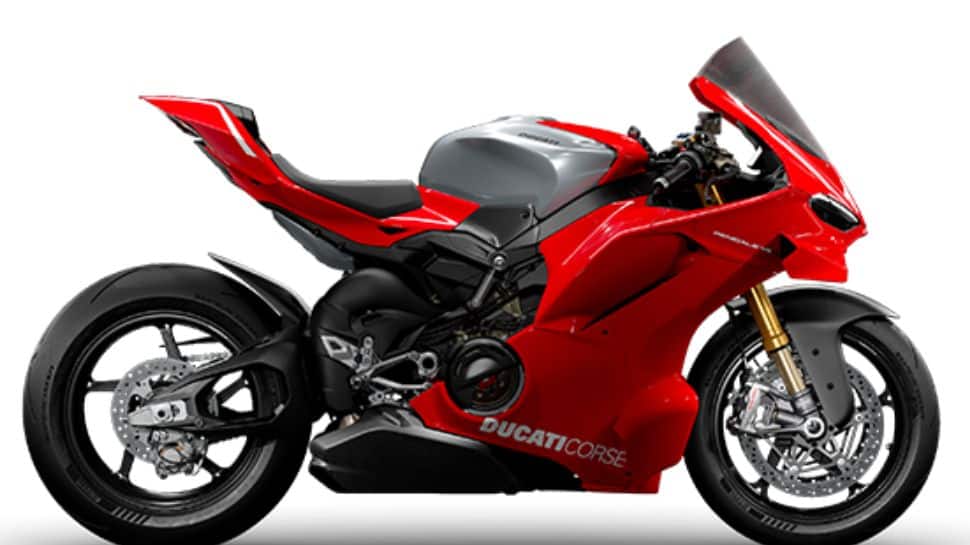
Ducati has officially launched the Panigale V4 R in India, marking the arrival of its most race-focused motorcycle yet. The first unit of the 2025 Panigale V4 R was delivered on January 1, 2026, by Ducati Chennai. Bookings for the high-performance superbike are now open across Ducati dealerships in the country.
The Panigale V4 R is a homologation model developed for the World Superbike Championship. It carries forward Ducati’s long-standing “R” lineage that began with the iconic 996R. Each unit is produced in limited numbers and features a unique serial number engraved on the clip-on handlebars.
The bike is powered by a 998cc Desmosedici Stradale R V4 engine derived directly from Ducati’s MotoGP and WorldSBK machines. The engine produces 218 hp at 15,500 rpm, with a redline stretching to 16,500 rpm. With an optional racing exhaust, output rises to 235 hp, and up to 239 hp with Ducati Corse Performance Oil. Ducati claims a top speed exceeding 330 km/h in full race trim.
Advanced Aerodynamics
The Panigale V4 R features MotoGP-inspired aerodynamics, including new side-mounted aerodynamic wings that generate downforce at high lean angles. These are paired with larger biplane wings that improve stability and front-end grip at high speeds.
The motorcycle uses an aluminium chassis and a hollow swingarm designed for better feedback and handling. Suspension duties are handled by fully adjustable Öhlins components, while braking is managed by Brembo Hypure monobloc calipers.
Racing Electronics
The bike is equipped with Ducati’s advanced electronic suite, including traction control, wheelie control, slide control, launch control, and engine brake management. A 6.9-inch TFT display with a dedicated “Grip Meter” provides real-time feedback to the rider.
Price and Availability
The Ducati Panigale V4 R is priced at Rs 84.99 lakh (ex-showroom) in India. Available only in Ducati Red, it is a limited-production, track-focused motorcycle.






Last Updated:
Every $10 rise in global crude oil prices could shave around 0.5 percentage points off India’s GDP growth, say experts




India imports nearly 50 percent of crude oil from the Middle East
Every $10 rise in global crude oil prices could shave around 0.5 percentage points off India’s GDP growth, underscoring the country’s heavy reliance on imported oil and vulnerability to global energy volatility, Vandana Bharti, Research Head–Commodity at SMC Global Securities, told ANI.
In an interview with ANI, Bharti said escalating geopolitical tensions in West Asia pose a significant economic risk for India as crude prices climb and supply chains face potential disruptions.
“Every $10 increase in crude oil prices impacts India’s GDP by roughly 0.5%. We have already seen prices rise by about $10–$15 recently, and the economic impact will eventually reflect in growth numbers,” she said.
West Asia tensions driving oil prices higher
The surge in oil prices follows intensifying tensions involving the United States, Israel and Iran, particularly around the Strait of Hormuz — a critical maritime corridor through which roughly 20–25% of global oil shipments pass.
Bharti said the conflict has injected additional uncertainty into global energy markets and added what she described as a “war premium” to crude prices.
“It’s not just about the possibility of the Strait of Hormuz closing. Insurance costs and freight charges are rising, and shipments are being rerouted. All these factors add a war premium to crude oil prices and increase market uncertainty,” she said.
Risks extend beyond shipping
According to Bharti, the risks go beyond maritime routes and extend to energy infrastructure itself.
“Energy sites such as crude oil facilities and LNG plants are potential targets. There are also concerns about seabed cables and other critical infrastructure. So the threat is not only to energy supply but also to broader global trade and connectivity,” she noted.
Crude prices rise sharply
Oil prices have already surged as tensions intensified in the region.
Bharti said crude climbed from around $69 per barrel to nearly $78 per barrel within a week.
“In just one week we have seen prices move from about $69 to $78 per barrel. If tensions persist, crude could rise further to around $85–$87 per barrel in the coming days,” she said.
India’s reliance on Middle Eastern crude
India remains particularly vulnerable to such price shocks due to its heavy dependence on imported oil.
Bharti noted that roughly half of India’s crude imports come from the Middle East, and many domestic refineries are specifically configured to process Middle Eastern crude grades.
“India imports nearly 50% of its crude from the Middle East, so any disruption in the region directly impacts supply availability and pricing,” she said.
India maintains strategic petroleum reserves that can help cushion short-term disruptions, but Bharti emphasised that these are primarily meant for emergencies.
“We have reserves that can last about 25–30 days in emergency situations, but the structural dependence on Middle Eastern supply remains,” she said.
She added that even brief supply disruptions could trigger volatility across Asian financial markets.
“Even a two-week disruption could create significant volatility in Asia. We are already seeing pressure on currencies, equity outflows and rising economic uncertainty,” Bharti said.
Diversification may cushion the impact
Bharti said India could mitigate some risks by diversifying crude supply sources.
“Russia has been offering crude at discounted prices, so India may increase purchases from Russia or other suppliers if required. Adjusting supply chains and renegotiating trade arrangements can provide some relief,” she said.
She also pointed out that members of the Organization of the Petroleum Exporting Countries (OPEC) may attempt to stabilise prices, although security concerns could limit immediate production increases.
Impact on fertilisers and agriculture
Higher crude prices could also ripple into other sectors of the economy.
Bharti warned that rising energy costs may push up fertiliser prices and agricultural input costs, potentially affecting the upcoming kharif crop season.
“Higher energy costs could make fertilisers and farm inputs more expensive, which may increase the cost of cultivation for farmers,” she said.
Renewables gain strategic importance
Bharti added that the ongoing geopolitical tensions highlight the need for countries to accelerate the transition to renewable energy.
“Events like this are a wake-up call. Governments may increasingly prioritise renewable energy such as solar to reduce dependence on volatile fossil-fuel supply routes,” she said.
 Click here to add News18 as your preferred news source on Google.
Follow News18 on Google. Join the fun, play games on News18. Stay updated with all the latest business news, including market trends, stock updates, tax, IPO, banking finance, real estate, savings and investments. To Get in-depth analysis, expert opinions, and real-time updates. Also Download the News18 App to stay updated.
March 06, 2026, 08:16 IST
Read More

The supply chain risk designation of the artificial intelligence firm is a first for a US company.
Source link

Thomas Fuller | SOPA Images | Lightrocket | Getty Images
UniQure needs to run another study to prove that its gene therapy “actually helps people with Huntington’s disease,” a senior U.S. Food and Drug Administration official said on a call with reporters Thursday.
The official, who requested anonymity before discussing sensitive information, confirmed the agency has asked the company to run a placebo controlled trial of its treatment, which is administered directly into the brain. UniQure has said that type of study isn’t ethical because it would require putting people under general anesthesia for hours, a characterization the official disputed.
“So what is really going on? UniQure is the latest company to make a failed therapy for Huntington’s patients,” the official said. “They likely acknowledge or understand at some deep level that their trial failed years ago, and instead of doing the right thing and running the correct clinical study, UniQure is performing a distorted or manipulated comparison in the mind of FDA.”
The comments mark the latest development in a messy public spat between UniQure and the FDA, and as the agency comes under fire for a number of recent drug approval application rejections, including some where companies have accused it of going back on previous guidance. FDA Commissioner Marty Makary in an interview with CNBC’s Becky Quick last week seemingly criticized UniQure’s gene therapy for Huntington’s disease. Makary didn’t name UniQure but described its treatment.
UniQure then accused the FDA of reversing its stance that the company’s clinical trial data would be sufficient to seek approval. UniQure’s study used an outside database to measure how patients with Huntington’s disease might decline without treatment, known as an external control. UniQure has said it wouldn’t be feasible to run a true randomized, double-blind placebo-controlled study, considered the gold standard, because it wouldn’t be ethical to make people undergo a sham hours-long brain surgery.
The FDA official said the agency “never agreed to accept this distorted comparison” and the FDA “never makes such assurances.” Instead, the “FDA will always say, ‘Well, we have to see the data when we get it.'”
UniQure didn’t immediately comment.
The company’s stock rose more than 10% on Thursday and has fallen 58% this year as of Thursday afternoon.

How Costly Is A $10 Oil Spike For India’s Economy?

Jayson Tatum, 10 months after Achilles injury, expected to return to Celtics Friday vs Mavericks: report

Maisie Peters surprises fans in Australia with Ed Sheeran

Policy easing drives Argentina’s garment import surge in 2025

What are Iran’s ballistic missile capabilities?

India Us Trade Deal: Fresh look at India-US trade deal? May be ‘rebalanced’ if circumstances change, says Piyush Goyal – The Times of India

-
 Fashion1 week ago
Policy easing drives Argentina’s garment import surge in 2025
-
 Politics1 week ago
What are Iran’s ballistic missile capabilities?
-
Business7 days ago
India Us Trade Deal: Fresh look at India-US trade deal? May be ‘rebalanced’ if circumstances change, says Piyush Goyal – The Times of India
-
 Business1 week ago
Attock Cement’s acquisition approved | The Express Tribune
-

 Politics1 week ago
US arrests ex-Air Force pilot for ‘training’ Chinese military
-
 Business6 days ago
Greggs to reveal trading amid pressure from cost of living and weight loss drugs
-

 Sports6 days ago
LPGA legend shares her feelings about US women’s Olympic wins: ‘Gets me really emotional’
-

 Fashion7 days ago
Texwin Spinning showcasing premium cotton yarn range at VIATT 2026