

Business
Ever Seen A Saree Being Woven Live? This Bengaluru Area Lets You Do That

Last Updated:
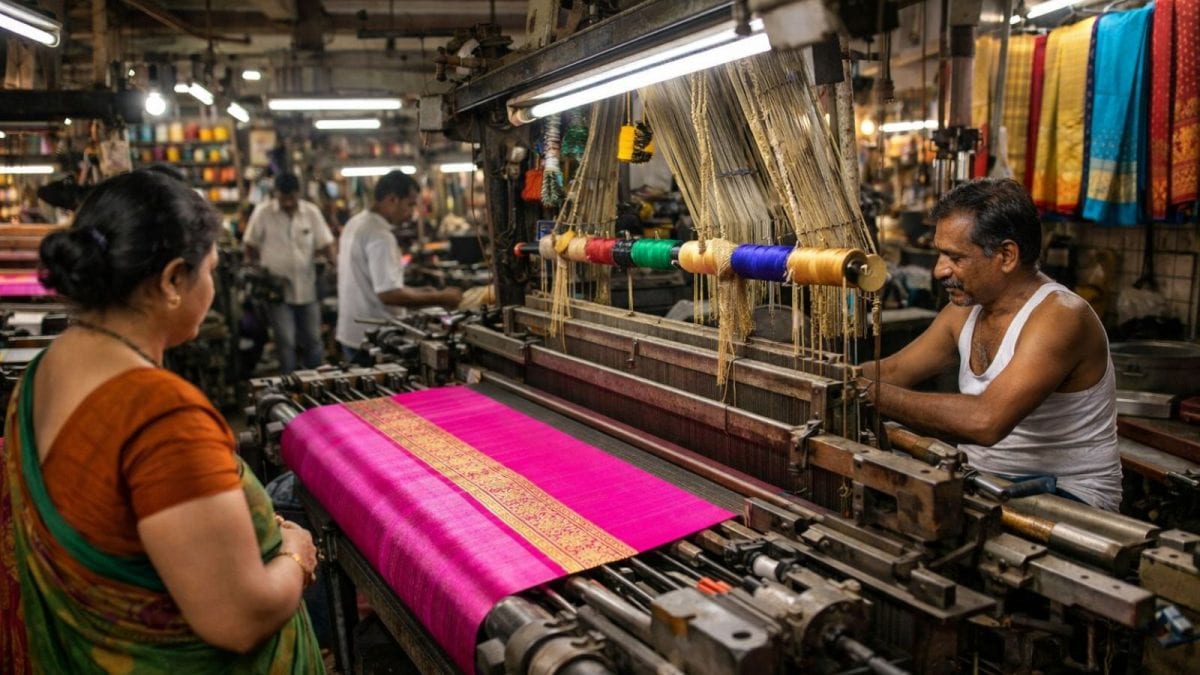
Step into one of the narrow units and you will see looms humming non-stop, spools of coloured yarn stacked against walls, workers adjusting threads with the focus of muscle memory.



For those who love sarees, Cubbonpete offers something rare, transparency. You see how your saree is made, who makes it, and how much work goes into every fold. Image: AI
In the middle of Bengaluru’s rush, between honking autos, wholesale lanes and half-hidden bylanes, there is a place where time slows down to the rhythm of clacking looms. Cubbonpete does not announce itself. You stumble into it. And suddenly, you are watching a saree come alive thread by thread.
Tucked near KR Market and Chickpet, Cubbonpete is one of the city’s oldest weaving clusters. The area is home to power looms that produce everything from everyday synthetic sarees to silk blends, cotton-silk mixes and festive fabrics.
This is not a retail street. It is a working neighbourhood that is noisy, warm, unapologetically industrial, where sarees are still made in real time.
Step into one of the narrow units and you will see looms humming non-stop, spools of coloured yarn stacked against walls, and workers adjusting threads with the focus of muscle memory. Patterns are not just designed here; they are executed live, metre by metre.
Watching A Saree Being Born
What makes Cubbonpete special is not just the price or the variety. It is the experience. Buyers can stand next to a loom and watch their saree being woven. The colours they chose roll out slowly, the border takes shape, the pallu reveals itself inch by inch.
For many, this is the first time they understand what goes into making a saree — the coordination, the patience, the precision. It changes the relationship between buyer and fabric. This is no longer just a garment pulled off a rack. It is something you saw being made.
Bulk Orders And Wholesale Culture
Cubbonpete largely works on bulk orders. Most weavers and unit owners cater to retailers, boutique owners and traders who place large quantity requests. A single design may be woven in dozens or hundreds of pieces.
This means it is not the easiest place for someone looking to buy just one saree. Walk-in retail is rare. But if you know a wholesaler, or if you are willing to place a small bulk order for weddings or functions, doors open. And once they do, the experience is worth the effort.
The range here is wide. Synthetic sarees dominate daily production, but silk blends, cotton silks and festive fabrics are also woven depending on demand. Designs are often customised colour changes, border tweaks, pallu variations, all discussed on the spot.
Prices are lower than retail stores because there is no showroom mark up. What you pay for is fabric and labour, not air conditioning and display lighting.
A Living Craft In The City’s Heart
Cubbonpete is a reminder that Bengaluru is not just a tech city. It is also a manufacturing city, a trading city, a place where traditional livelihoods still survive between flyovers and metro lines.
For those who love sarees, Cubbonpete offers something rare, transparency. You see how your saree is made, who makes it, and how much work goes into every fold.
You may not walk out with a single neatly packed saree bag. But you walk out with something else – the quiet joy of having witnessed creation, right in the heart of the city.u
January 26, 2026, 16:53 IST

Stay Ahead, Read Faster
Scan the QR code to download the News18 app and enjoy a seamless news experience anytime, anywhere.

Vets will be legally bound to prescription fee caps and publishing price lists among new measures which will start coming into force later this year, the competition watchdog has announced.
The Competition and Markets Authority (CMA) said its final reforms for the sector will help pet owners better navigate the vet services market.
Other legally binding measures will include a price comparison website and mandatory branding by the large groups to boost competition and drive down prices.
The CMA said pet owners using a vet practice that is part of a larger chain can expect to see changes before Christmas, including standard price lists.
The measures follow the CMA finding that fees have risen at almost twice the rate of inflation, with pet owners not being given enough information about their vet and the prices of treatments.
Martin Coleman, chairman of the independent Inquiry Group, said: “This is the most extensive review of veterinary services in a generation, and today’s reforms will make a real difference to the millions of pet owners who want the best for their pets but struggle to find the practice, treatment and price that meets their needs.
“Too often, people are left in the dark about who owns their practice, treatment options and prices – even when facing bills running into thousands of pounds.
“Our measures mean it will be made clear to pet owners which practices are part of large groups, which are charging higher prices, and for the first time, vet businesses will be held to account by an independent regulator.
“Our changes put pet owners at the centre but also help vets by enhancing trust in the profession and protecting clinical judgment from undue commercial pressure – and that is important to ensure our pets continue to get the best care.”
The CMA said practices must publish a comprehensive price list for standard services, including consultations, common procedures, diagnostics, written prescriptions and cremation options under its new rules.
Prescriptions – for which “many” practices charge £30 or more for each – are to be capped at £21 for the first medicine and £12.50 for any additional medicines.
Practices must also provide a written estimate in advance for any treatment expected to cost £500 or more, including aftercare costs, as well as an itemised bill.
Emergency care will be the only exception for written estimates.
Prices and information about who owns the surgery are to be made available to pet owners through the Royal College of Veterinary Surgeons (RCVS) ‘Find a Vet’ service, which will share the data with third-party comparison sites.
Vet businesses must make it clear whether they are part of a group or an independent business, with details of group ownership to be displayed on signs at the surgery and online.
British Veterinary Association president Rob Williams said: “The majority of the CMA’s measures focus on increasing transparency and information, which will help pet owners make more informed choices and support competition, which is a really positive step.”
He added: “Delivering highly skilled veterinary medicine is costly and whilst we recognise prices have risen sharply in recent years this is due to a number of factors, including the higher costs all businesses are experiencing – and vet practices are not immune.
“Plus, thanks to advances in diagnostics and medical technology over the last 20 years, vets can now do much more to manage disease and injury in animals, whereas in the past the only option available may have been to euthanase.
“Owners today also have a greater expectation of their vet, with many expecting human quality healthcare for their pets and whilst this is possible to deliver, it comes at a cost.”
Business
Gold price prediction today: Pressure on gold prices to continue on March 24, 2026 amid US-Iran war? Check outlook – The Times of India

Gold price prediction today: Gold prices are likely to remain range-bound in the near future, says Praveen Singh, Head Currencies and Commodities, Mirae Asset ShareKhan
Source link

An Estée Lauder pop-up store is seen inside a Daimaru store on Nanjing Road in Shanghai, China, Aug. 6, 2021.
Costfoto | Future Publishing | Getty Images
Estée Lauder Companies said Monday that it is in talks with Spanish beauty group Puig to potentially merge the two companies.
“No final decision has been made, and no agreement has been reached,” Estée Lauder said in a statement.
Shares of the U.S. beauty company were down nearly 8% following the news, which was first reported by the Financial Times. Puig’s stock rose roughly 3%.
Puig owns major beauty brands including Charlotte Tilbury, Jean Paul Gaultier and Rabanne. The companies did not disclose any financial details of the potential deal.
Estée Lauder has been struggling amid ongoing headwinds from tariffs and its restructuring as it enacts its “Beauty Reimagined” turnaround plan to revitalize the business. In its second-quarter earnings report last month, the beauty retailer said it’s expecting a $100 million hit to its full-year profitability due to tariff impacts.
Estée Lauder’s stock has dropped roughly 25% this year.


How Jaxon Smith-Njigba’s contract extension impacts Seahawks

China sees rise in new FDI firms despite lower inflows
Vets to be legally required to publish price lists and cap prescription fees

Japan suffers shocking collapse to Venezuela in World Baseball Classic

Strategic oil stocks to be released ‘immediately’ in Asia and Oceania: IEA

New Income Tax Act 2025 To Take Effect From April 1: 10 Key Changes That Will Affect Your Money

-
 Sports1 week ago
Japan suffers shocking collapse to Venezuela in World Baseball Classic
-
 Entertainment1 week ago
Strategic oil stocks to be released ‘immediately’ in Asia and Oceania: IEA
-
Business1 week ago
New Income Tax Act 2025 To Take Effect From April 1: 10 Key Changes That Will Affect Your Money
-

 Sports1 week ago
Transfer rumors, news: Real Madrid open to Camavinga exit, as Premier League clubs circle
-

 Tech6 days ago
Justice Department Says Anthropic Can’t Be Trusted With Warfighting Systems
-

 Sports6 days ago
March Madness 2026 – How to watch in SA, start time, schedule, TV channel for NCAA championship basketball tournament
-

 Sports1 week ago
PCB files complaint over allowing Bangladesh to take review on penultimate ball – SUCH TV
-
 Business7 days ago
Stocks and pound rise as US rate call approaches