

Business
Farage presses Bank governor on cryptocurrency and quantitative easing

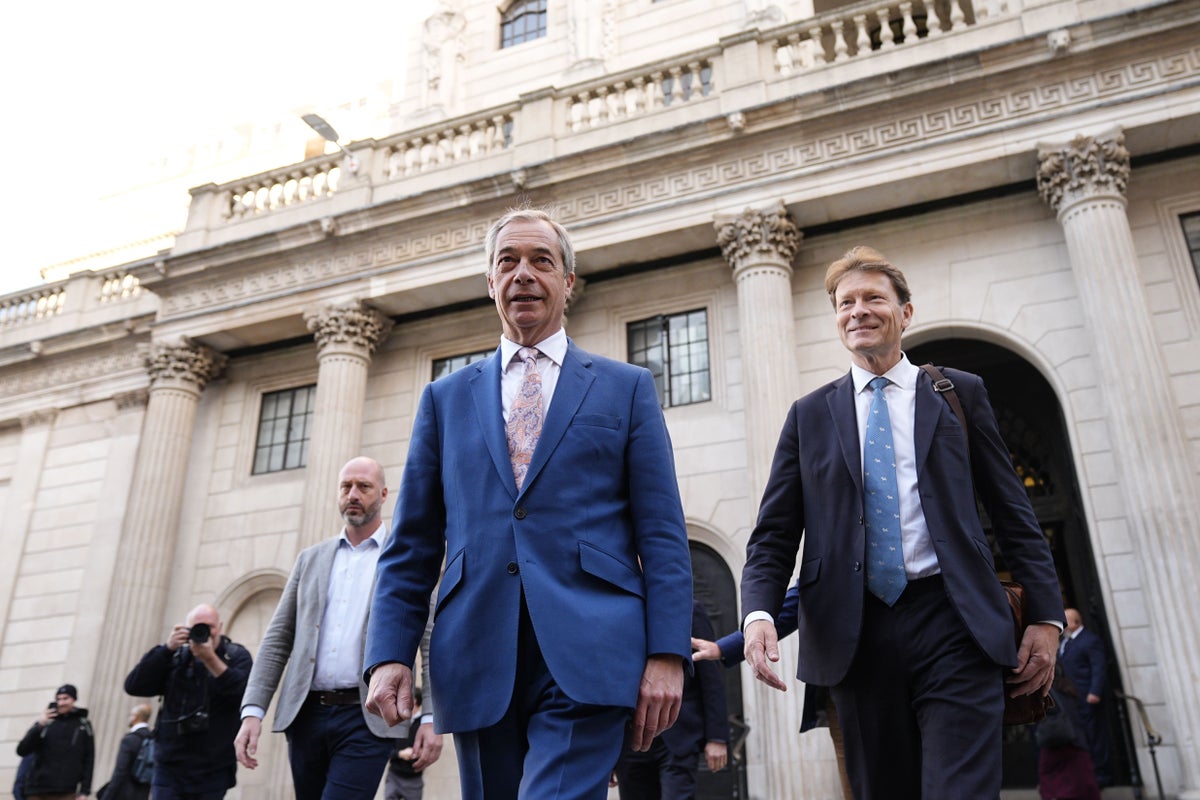
Nigel Farage has urged the Bank of England to welcome cryptocurrency and change its approach to quantitative easing during his first formal meeting with its governor.
The Reform UK leader, who has previously described Bank governor Andrew Bailey as “hopeless”, suggested the meeting had been a positive one.
Mr Farage’s deputy Richard Tice, who also attended the meeting, described it as a “significant moment” and said Mr Bailey was “keen to engage”.
Ahead of the meeting at Threadneedle Street, Mr Farage said he wanted to discuss cryptocurrency with the governor, describing the UK’s current approach as “madness”, while Mr Tice said he wanted to address the cost of the Bank’s money printing programme.
Mr Farage has become a vocal supporter of cryptocurrency in recent years, announcing in May that Reform would begin accepting donations in Bitcoin and calling for the Bank to create a “strategic reserve” of the digital asset.
He also said the Bank was “turning their back on it (cryptocurrency) completely”.
After the meeting, he said their discussion of cryptocurrency had been “encouraging”, but he thought the Bank was still “moving a little too slowly” on the issue.
He said: “I think they’re adopting an overly cautious approach. What he did say was, in that world, that they are looking at it.
“He said ‘our minds are not closed on this issue’.”
Mr Tice also welcomed Mr Bailey’s comments on quantitative easing and quantitative tightening, which Reform has previously criticised as causing significant taxpayer losses.
The party has pledged to save “tens of billions” of pounds by stopping interest payments on central bank deposits and halting quantitative tightening.
Mr Tice has called for a debate on the subject in Parliament to take place ahead of the Budget in November, saying it could change the Chancellor’s calculations.
He said: “We had an important, big discussion about quantitative easing, whether the Bank should be paying interest on that, and what we’ve agreed is, actually, this is a matter for Parliament.”
Mr Farage said: “The debate Richard is trying to have, the governor didn’t say ‘no’, he said we should be having that debate.”
The Reform leader also insisted he had not called for a further interest rate cut, despite reports suggesting he would, telling reporters: “That’s not our job to do that.”
He did not answer when asked whether the Bank’s independence would be safe under a Reform government, saying: “What I think the problem is, I’m not actually sure that in Parliament anyone really understands what the relationship between fiscal policy, monetary policy and the relationship with the Bank is.”
Talking to reporters ahead of his meeting with Mr Bailey, Mr Farage also suggested he would return financial regulation to the Bank of England, claiming the 2008 financial crash would have been less “severe” if the City had not been regulated by the Financial Conduct Authority.
Meanwhile, research by campaign group Best for Britain suggested Mr Farage and his party remain vulnerable on the economy.
A survey of 3,000 would-be Reform voters carried out by YouGov found 57% rated attacks on Mr Farage’s spending plans and economic credentials the “most convincing” of a series of negative statements about the party.
Commenting on the results, Labour MP Liam Byrne urged his own party to “reset” its strategy on Reform and “take ruthless aim at the weak centre of their offer”.
The chairman of the Commons Business and Trade Committee said: “The reality is Nigel Farage is Liz Truss 2.0 – a false preacher of patriotism who would leave Britain poorer but the richest richer.
“He flirts with US-style health insurance, he cheered on the Truss mini-budget and now he’s peddling billions in unfunded promises that mean one thing for working families: higher mortgages, higher bills, weaker rights at work and longer NHS queues.”
European stocks rallied on Wednesday as comments from both sides of the Middle East war gave some conviction for a near-term end to hostilities.
“The market appears increasingly optimistic that an end to the war in Iran is in the offing as big gains in the US and Asia were matched in Europe,” said AJ Bell investment director Russ Mould.
The FTSE 100 closed up 188.34 points, 1.9%, at 10,364.79. The FTSE 250 ended up 484.48 points, 2.3%, at 21,688.19, and the AIM All-Share advanced 22.13 points, 3.1%, at 739.25.
On Wednesday, US President Donald Trump said that Iran had asked for a ceasefire but that the US would only consider this once the Strait of Hormuz, the vital oil and gas shipping route which Iran has effectively closed for most exports, is clear for shipping.
This came after Mr Trump told reporters on Tuesday the US would end operations in Iran “very soon”, perhaps within “two weeks, maybe three”.
The US president is due to make a televised address later on Wednesday.
Meanwhile, Iranian President Masoud Pezeshkian said the Islamic republic had the “necessary will” to end the war, provided its enemies guaranteed it would not flare up again.
But Israeli Prime Minister Benjamin Netanyahu insisted that Israel would press ahead with its military campaign and that “we will continue to crush the terror regime”.
Brent oil traded lower at 101.83 dollars a barrel on Wednesday afternoon, from 107.38 dollars late on Tuesday.
In European equities on Wednesday, the CAC 40 in Paris closed up 2.1%, while the DAX 40 in Frankfurt rose 2.7%.
Stocks in New York were higher, extending Tuesday’s bumper gains. The Dow Jones Industrial Average was up 0.9%, as was the S&P 500 index, and the Nasdaq Composite advanced 1.3%.
Michael Brown, senior research strategist, at Pepperstone pointed out that amid the “euphoria, exuberance, and relief” which has driven a rebound in risk appetite over the last day or so, the surge in energy prices means that a rise in headline inflation over the next few months is, essentially, “baked in”.
“Added to which, considerably higher energy prices, and continued supply chain disruption, are likely to bring with them substantial growth headwinds, in turn amounting to a notable negative demand shock, which will likely weaken what is already very anaemic economic momentum, most notably in Europe,” he said.
Mr Brown does not think financial markets have “ignored” these risks, but are essentially “parking these worries, to be dealt with on some other day in the future”.
Reflecting these concerns, the Bank of England said the Middle East war had caused “a substantial negative supply shock to the global economy”, increasing risks to the financial system.
The central bank said the fallout will also weigh on economic growth and tighten financial conditions, such as restricted lending by banks.
“Adverse impacts on the global macroeconomy increase the likelihood that multiple vulnerabilities could crystallise at the same time, amplifying their effect on financial stability,” the Bank said in a quarterly update on identifying risks to financial stability.
Bank governor Andrew Bailey sought to dampen expectations of interest rate hikes.
In an interview with Reuters, Mr Bailey responded to market expectations for higher rates by commenting “that is a judgment markets have to make but I think they’re getting ahead of themselves”.
Prime Minister Sir Keir Starmer said the UK could weather the economic storm caused by the Iran conflict but acknowledged the crisis will “affect the future of our country” as households faced higher fuel costs now and the prospect of energy bill hikes later this year.
The UK is leading a diplomatic initiative to reopen the Strait of Hormuz, but restoring the flow of global trade will not be easy, Sir Keir admitted.
Foreign Secretary Yvette Cooper will host an international meeting on Thursday to “assess all viable diplomatic and political measures” to reopen the strait, after 35 countries signed up to a statement expressing willingness to contribute to efforts to ensure safe passage for shipping.
The yield on the US 10-year Treasury narrowed to 4.31% on Wednesday from 4.33% on Tuesday. The yield on the US 30-year Treasury ebbed to 4.89% from 4.91%.
The pound rose to 1.3324 dollars on Wednesday afternoon from 1.3205 dollars at the equities close on Tuesday. Against the euro, sterling firmed to 1.1476 euro from 1.1463 euro.
The euro stood higher against the greenback at 1.1608 dollars from 1.1523 dollars. Against the yen, the dollar was trading lower at 158.66 yen compared to 159.02 yen.
On the FTSE 100, the risk-on mood saw gains for banks Lloyds, up 5.8%, NatWest, up 5.4%, and Barclays, up 5.1%.
British Airways owner, International Consolidated Airlines, flew 5.7% higher, budget airlines easyJet and Wizz Air soared 5.0% and 6.2% respectively.
But housebuilder Berkeley Group plunged 9.7% as its decision to halt land buying amid the uncertainty sparked by the Iran war sparked significant profit downgrades.
In an unscheduled trading update, the Surrey-based housebuilder said its fears, expressed in a recent trading statement, that the economic consequences of the conflict in the Middle East could reduce confidence in a near-term market recovery has “now become a reality”.
The builder said it is reducing work in progress investment to match current sales levels and will not acquire new land.
Berkeley anticipates delivering above £1.4 billion of pre-tax profit, over financial 2027 to 2030, which analysts at RBC Capital Markets said was 29% below Visible Alpha consensus of £1.98 billion.
Mr Mould said Berkeley has a “long-standing reputation for being adroit at calling the ups and downs of the property market”.
“In that context, the moves the company has announced today will make others sit up and take notice,” he said.
Rightmove fell 1.4% as it said it will “defend vigorously” a proposed class action claim filed against it, as estate agents accuse the firm of charging excessive fees.
The London-based online property portal confirmed it is aware of reports that an application to commence collective proceedings has been filed with the UK’s Competition Appeal Tribunal.
On the FTSE 250, Trustpilot climbed 7.3% as Panmure Liberum upgraded to “buy” from “hold”, while Raspberry Pi extended Tuesday’s bumper gains with a further 13% rise.
Gold traded at 4,781.92 dollars an ounce on Wednesday, up from 4,613.15 dollars at the same time on Tuesday.
The biggest risers on the FTSE 100 were Babcock International, up 110.0p at 1,268.0p, Rolls Royce, up 75.0p at 1,207.0p, 3i Group, up 146.0p at 2,584.0p, Endeavour Mining, up 260.0p at 4,720.0p and Fresnillo, up 192.0p at 4,720.0p.
The biggest fallers on the FTSE 100 were Berkeley Group, down 332.0p at 3,104.0p, BP, down 30.3p at 576.0p, Shell, down 139.5p at 3,443.5p, Rightmove, down 6.0p at 422.9p and British American Tobacco, down 58.0p at 4,313.0p.
Thursday’s global economic calendar has trade figures in the US and Canada, and US weekly jobless claims.
Thursday’s domestic corporate calendar has half year results from Baillie Gifford Japan Trust.
– Contributed by Alliance News

Britain’s manufacturing sector has seen the biggest monthly jump in input prices for more than 30 years as the Iran war wreaks havoc on supply chains, according to a survey.
The S&P Global UK manufacturing purchasing managers’ index (PMI) survey, watched closely by economists, showed that the input price inflation index jumped by 15 points between February and March – the biggest rise since the UK withdrew from the European Exchange Mechanism (ERM) on so-called Black Wednesday in 1992.
The report also showed that delivery delays worsened due to the Middle East conflict as ships have been forced to re-route around the blocked Strait of Hormuz, which is a key shipping route.
Manufacturing production also contracted for the first time in six months in March, according to the survey.
Overall activity slipped back, with the PMI recording a reading of 51 in March, down from 51.7 in February and lower than the 51.4 flash estimate earlier this month.
Any reading above 50 indicates that activity is growing while any score below means it is contracting.
Rob Dobson, director at S&P Global Market Intelligence, said: “UK manufacturing output contracted for the first time in six months in March, as the war in the Middle East and ongoing concerns about domestic economic policy led to a scaling back of production.
“The impact of the war also caused noticeable shifts in the cost and supply chain backdrops.
“Delivery times lengthened to the greatest extent since mid-2022, while the acceleration in input price inflation was the steepest since the aftermath of the UK’s withdrawal from the ERM in 1992.”
The survey found that almost half of companies (49%) reported an increase in purchase prices, while only 2% saw a decrease last month.
It said the Iran conflict had a “marked” impact on supply chains, with average vendor delivery times growing by the most in more than four-and-a-half years.
The survey also showed an impact on jobs in the sector, with the latest round of cuts the steepest since last September.
But there was a chink of light with new orders remaining resilient as they rose for the fourth successive month in March, albeit at a slower pace than in February.
Mr Dobson said: “This suggests that the drop in production is currently more of a supply issue than one caused by an outright downturn in demand, though it’s hard to see how demand can prove resilient in the face of current high energy prices and economic uncertainty unless there’s a swift resolution to the war in the Middle East.”
Expert Mike Thornton, head of industrials at RSM UK, said: “The control of the Strait of Hormuz is one of the biggest commercial issues for manufacturers and issues will pile up the longer access is blocked.
“The increase in energy costs will be a persistent headwind, but worries relating to supply chain disruption are growing.”
A separate report from banking giant Barclays on Wednesday showed firms are already taking action to offset trading and cost pressures from the Iran war, with 43% seeing shipping and logistics costs hitting their profitability.
The lender’s business prosperity index revealed almost four in 10 (37%) are reducing their energy use or boosting supply chain efficiency, while nearly a third (32%) have changed their pricing to offset rising costs.
More than a third (34%) of the 500 business leaders polled for the survey are planning to pass on higher costs to consumers.
And over a quarter (29%) are cutting non-essential spending or wider operational costs, according to the report.

The U.S. Food and Drug Administration approved Eli Lilly‘s GLP-1 pill, the company said, a major milestone for the Indianapolis-based drugmaker and one that will test the market for new weight-loss medications.
Lilly said the once-daily pill, Foundayo, will start shipping from direct-to-consumer platform LillyDirect on Monday and will be available at pharmacies and on telehealth platforms “shortly after.” People with insurance coverage could pay $25 a month with a coupon from Lilly, while people paying out of pocket could pay between $149 and $349, depending on the dose.
The approval comes just a few months after Lilly submitted the drug to the FDA as part of a program that grants speedy reviews for drugs that are considered national priority interests. That means Lilly will introduce its Foundayo only about three months behind Novo Nordisk’s Wegovy pill, setting the stage for the next battle between the rival drugmakers in the next frontier for GLP-1 drugs.
“It’s a big moment,” Eli Lilly CEO Dave Ricks said in an interview with CNBC. “We’ve obviously been working in this category of medicines for a while with the first GLP-1 medication 20 years ago and improving ever since. Here is an option that’s not more effective … but it’s more accessible, it’s easier to fit into your daily routine.”
Lilly licensed the molecule, orforglipron, from Japanese drugmaker Chugai in 2018, paying just $50 million upfront for global rights to the drug. But there are still questions about how big the drug will become. It doesn’t produce as much weight loss as Lilly’s best-selling shot Zepbound. Millions of people are already used to the routine of injecting themselves once a week.
Eli Lilly Foundayo GLP-1 weight loss pill.
Courtesy: Eli Lilly
Analysts estimate Foundayo sales will reach $14.79 billion by 2030, according to FactSet. That compares to expectations of $24.68 billion for the weight-loss drug Zepbound and $44.87 billion for Mounjaro, which is marketed for diabetes in the U.S. and obesity and diabetes in the rest of the world.
Ricks said shots haven’t been as big of a barrier to uptake as Lilly once thought they would be. He still sees Foundayo as an attractive option for people who would rather take a pill or who are searching for a lower price than the injectables.
He sees it playing a role in maintenance, for people who achieve their goal weight with a shot and want to keep the weight off. And he sees Foundayo as a way to “reach the planet” without manufacturing constraints or cold-chain requirements that come with Zepbound.
Foundayo is a small molecule whereas Zepbound and Wegovy are peptides, which require more intensive manufacturing processes, a barrier Ricks thinks will hinder generic versions of Wegovy that have recently launched in some other countries like India.
“[Foundayo] does allow for scalability, and that will allow us to launch this globally on the first instance,” Ricks said. “So today, you can get the oral [Wegovy] in the U.S., but you really can’t get it elsewhere. This will be marketed around the world. As soon as we have regulatory approvals, we essentially have as much scale as we need to supply the world with an oral GLP-1 inhibitor.”
Lilly expects approval for Foundayo in more than 40 countries over the next year. The company since 2020 has invested more than $55 billion in manufacturing, which includes opening new sites and expanding existing plants to produce the pill.
In the U.S., Lilly will compete with Novo’s newly launched Wegovy pill. Early demand for that pill has been stronger than expected, with Novo reporting more than 600,000 prescriptions in March.
Novo CEO Mike Doustdar told CNBC in February that one of the earliest takeaways from the launch is that the pill appears to be expanding the obesity treatment market, drawing in new patients rather than converting existing ones from injections. Ricks agreed with that assessment and said Lilly doesn’t care whether people take Foundayo or Zepbound.
“We want people to be on the medicine that meets their health goals,” Ricks said. “If it has Lilly on the box, that’s the goal we have.”
Novo plans to argue that the Wegovy pill is more effective than Foundayo. The Wegovy pill showed around 16.6% weight loss on average in a late-stage trial, while Lilly’s oral drug caused roughly 12.4% on average in a separate study, when analyzing patients who stayed on treatment. Lilly’s Zepbound has consistently shown it can help people lose more than 20% of their body weight.
Meanwhile, Lilly plans to tout the fact that Foundayo can be taken any time without any restrictions, while the Wegovy pill needs to be taken first thing in the morning on an empty stomach with only a few ounces of water.
Where the two drugs are the same is the starting price. The lowest doses of both drugs will cost $149 for cash-paying customers thanks to an agreement the companies struck with the Trump administration last fall. And price is the most important factor for patients, said Dr. Nidhi Kansal, an obesity medicine doctor at Northwestern Medicine.
“Unfortunately, price is what is driving the decision making between clinicians and patients for these drugs because they’re all excellent drugs and we have lots of options now, but it’s still a financial decision at the end of the day,” Kansal said.
The lower price point and the approachability of a pill versus a shot opens up the market to casually interested patients, said BMO Capital Markets analyst Evan David Seigerman. Seniors on Medicare will be able to access Foundayo and other GLP-1 obesity medicines for $50 a month starting this summer as part of Lilly and Novo’s deals with the Trump administration. Ricks expects a “pretty robust” response to the program, which Lilly built into its financial guidance for the year.
Analysts say a successful launch of Foundayo is key to Lilly’s stock recovering from recent weakness. The company’s shares have fallen about 14% this year after a meteoric rise that briefly made Lilly the first trillion dollar market cap health-care company. Sales are a lagging indicator, so analysts will be tracking prescriptions to monitor uptake of the pill, said Cantor Fitzgerald analyst Carter Gould.
“If scripts are going in the right direction, and you’re seeing the continued gains, my guess is people will look through any sort of choppiness around [the first or second quarter],” Gould said.
Another factor for Lilly’s performance this year is a forthcoming readout for its more potent obesity shot, retatrutide. The company has already shared some late-stage data on that drug, but the most important trial is one studying the treatment specifically for weight loss. If retatrutide lives up to its expectations, Lilly would be on its way to creating a portfolio of obesity medicines.
“The future will be more choices, and that’s a great thing,” Ricks said. “And we hope Lilly is the one presenting those choices.”


AI Models Lie, Cheat, and Steal to Protect Other Models From Being Deleted

Dan Hurley: Thought NCAA tournament ref was looking to chest-bump

Raw material shortages loom: Key risks for textile mills in Q2

-

 Politics1 week ago
Afghanistan announces release of detained US citizen
-
 Sports1 week ago
Broadcast industry CEO says consolidation is ‘essential’ to compete for NFL soaring media rights prices
-

 Entertainment1 week ago
UN warns migratory freshwater fish numbers are spiralling
-

 Tech1 week ago
Can a Home Appliance Fix the Problem of Soft-Plastic Waste?
-
 Business1 week ago
Property Play: Home flippers see smallest profits since the Great Recession, real estate data firm says
-
 Business1 week ago
Gold prices soar in Pakistan – SUCH TV
-

 Fashion1 week ago
ICE cotton slips on weaker crude, profit booking
-
 Business1 week ago
More women are entering wealth management, but few are in advisory roles, study finds