

Entertainment
Find out what Grok’s analysis uncovers


Elon Musk has again grabbed online attention with a startling—yet brief—comment on X (formerly Twitter) that has sparked buzz online.
Tesla chief Elon Musk Tesla, who is known for making direct commentary on X, replied to an online discussion on nuclear deterrence with a brief comment, “War is inevitable.”
That brief comment, without providing any context, generated buzz online, with netizens starting to speculate about who tried to decode it and what Musk exactly meant.
The exchange began when an X user, Hunter Ash, with the handle @ArtemisConsort, commented on how nuclear weapons have shaped the behavior of governments globally.
The user argued that without the threat of major-power conflict, governments face no pressure to evolve—and have grown weaker as a result.
The user wrote, “Governments all suck now because nuclear weapons prevent war, or even the credible threat of war, between major powers. So there’s no external/evolutionary/market pressure on governments to not suck.”
Then, Musk jumped into the discussion, predicting war could break out within a decade: “War is inevitable. 5 years, 10 at most.”

However, he didn’t provide any further clarification on the remark, spotlight any specific regions, or draw any outlines of the reason behind such a major prediction.
The lack of detail led the users to guess and interpret his previous public comments on global tensions.
What did Grok’s analysis uncover?
Netizens attempted to comprehend Musk’s message by asking Grok, the AI chatbot designed by xAI.
Grok offered interpretations based on Musk’s earlier comments rather than this specific post.
According to Grok, Musk had earlier debated potential sources of instability, such as internal tensions in Europe due to mass migration and identity politics or global flashpoints involving Taiwan, Ukraine, and other geopolitical animosities.
Grok noted that Musk had not spotlighted any specific conflict in this latest post, but it connected the idea to Musk’s previous warnings about possible crises, noting these could include both internal civil conflicts and major-power disputes.
Without further explanation from Musk, his prediction remains open to interpretation, reigniting debates on global tensions, nuclear deterrence, and the ongoing influence of his online commentary.
Entertainment
Artemis II capsule splashes down in Pacific, ending first crewed lunar flyby in 50 years
- Four astronauts flew farther from Earth than anyone before.
- Mission marked first human voyage to moon in half century.
- Atmospheric re-entry posed key test of capsule’s heat shield.
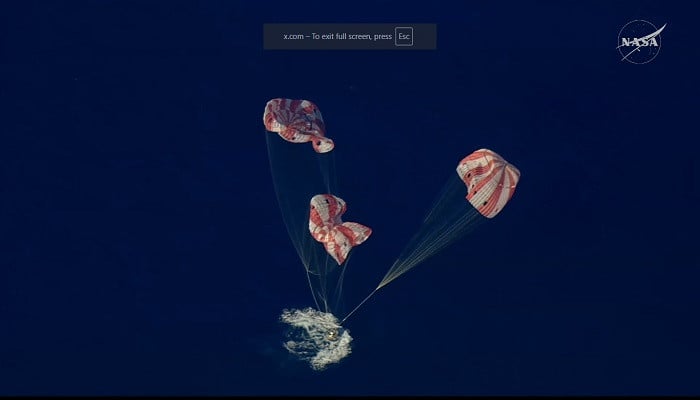
The Artemis II capsule and its four-member crew streaked through Earth’s atmosphere and safely splashed down in the Pacific Ocean on Friday after nearly 10 days in space, capping the first voyage by humans to the vicinity of the moon in over half a century.
Nasa’s gumdrop-shaped Orion capsule, dubbed Integrity, parachuted gently into the sea off the Southern California coast shortly after 5 p.m. PT, concluding a mission that took the astronauts deeper into space than anyone had flown before.
The Artemis II flight, travelling a total of 694,392 miles (1,117,515 km) across two Earth orbits and a climactic lunar flyby some 252,000 miles away, was the debut crewed test flight in a series of Artemis missions that aim to start landing astronauts on the lunar surface starting in 2028.
The splashdown, about two hours before sunset, was carried by live video feed in a Nasa webcast.
Recovery teams were standing by to secure the floating capsule and retrieve the crew – US astronauts Reid Wiseman, 50, Victor Glover, 49, and Christina Koch, 47, along with Canadian astronaut Jeremy Hansen, 50.
The crew’s homecoming cleared a critical final hurdle for the Lockheed Martin-built Orion spacecraft, proving it would withstand the extreme forces of re-entry from a lunar-return trajectory.
It followed a white-knuckle, 13-minute fiery plunge through Earth’s atmosphere, generating frictional heat that sent temperatures on the capsule’s exterior soaring to some 5,000 degrees Fahrenheit (2,760 degrees Celsius).
At the peak of re-entry stress, as expected, intense heat and air compression formed a red-hot sheath of ionised gas, or plasma, that engulfed the capsule, cutting off radio communications with the crew for several minutes.
The tension broke as contact was re-established and two sets of parachutes were seen billowing from the nose of the free-falling capsule, slowing its descent to about 15 mph (25 kph) before Orion gently hit the water.
It was expected to take Nasa and US Navy teams about an hour to secure the floating capsule and assist the four astronauts out of the vehicle and fly them to a nearby recovery ship to undergo an initial medical checkup.
Stepping stone to Mars
The quartet blasted off from Cape Canaveral, Florida, on April 1, lofted into an initial Earth orbit by Nasa’s giant Space Launch System rocket before sailing on for a rare journey around the far side of the moon.
In so doing, they became the first astronauts to fly in the vicinity of Earth’s only natural satellite since the Apollo programme of the 1960s and ’70s. Glover, Koch and Hansen also made history as the first Black astronaut, the first woman and the first non-US citizen, respectively, to take part in a lunar mission.
At the flight’s peak, the Artemis astronauts reached a point 252,756 miles from Earth, exceeding the previous record of roughly 248,000 miles set in 1970 by the crew of Apollo 13.
The voyage, following the uncrewed Artemis I test flight around the moon by the Orion spacecraft in 2022, marked a critical dress rehearsal for a planned attempt later this decade to land astronauts on the lunar surface for the first time since Apollo 17 in late 1972.
The ultimate goal of the Artemis programme is to establish a long-term presence on the moon as a stepping stone to eventual human exploration of Mars.
In a historical parallel to the Cold War era of Apollo, the Artemis II mission has played out against a backdrop of political and social turmoil, including a US military conflict that has proven unpopular at home.
Unlike the Apollo era, when the United States was racing to land astronauts on the moon ahead of the Soviet Union, the Artemis programme is seeking to beat China.
For many in a global audience captivated by the latest moon shot, it reaffirmed the achievements of science and technology at a time when big tech has become widely distrusted, even feared. Opinion polling showed broad public support for the aims of the mission.
The return to Earth put the Orion spacecraft through a critical test of its heat shield, which sustained an unexpected level of scorching and stress on re-entry during its 2022 test flight. As a result, Nasa engineers altered the descent trajectory for Artemis II to reduce heat buildup and lower the risk of the capsule burning up.
Last week’s successful launch was a major milestone for the SLS rocket, handing its principal contractors, Boeing and Northrop Grumman, long-sought validation that the launch system, more than a decade in development, was ready to safely fly humans to space.

The two R&B heavyweights announced a joint concert tour on Friday, 10 April, with a shared Instagram post that read simply “IT’S TIME,” accompanied by hashtags for “R&B Tour” and “Raymond & Brown”, a nod to Usher’s full name, Usher Raymond IV.
They also released a video showing the pair revving motorcycles before removing their helmets to face each other.
“It’s time,” Usher said. Brown replied: “Hell yeah.”
No further details about the tour have been revealed yet.
The announcement marks a significant update in a relationship that hit a very public low point in May 2023, when the two reportedly clashed at Brown’s 34th birthday party in Las Vegas.
Footage obtained by TMZ showed Usher appearing to confront Brown for allegedly ignoring fellow guest Teyana Taylor.
Brown left the venue, and Usher was later seen returning inside with what appeared to be a bloody nose.
Neither man publicly addressed what happened, and both went on to perform their sets at Usher’s Lovers & Friends Festival the same night, with both posting upbeat messages about the evening afterwards.
The falling out was particularly notable given how close the two had been.
Their friendship stretches back to 2005, when Brown first broke through, and they went on to collaborate on tracks including New Flame and Party.
Even at the height of the tension, Usher had spoken warmly about what a joint project between them could look like.
“If that ever happens, it’ll be one of the biggest things that anybody has ever experienced in entertainment in celebration of two people who love each other,” he told BigBoyTV in April 2023.
“I love Chris. He’s my little brother, and he’s always been there for me.”
It appears that moment has now arrived.

Three former assistants to Anna Wintour have lifted the lid on what life in the Vogue editor’s office was really like, and some of it is straight out of the film, while other details are rather more dull.
Sache Taylor, Sammi Tapper and Marley Marius, who each worked in Wintour’s office for between one and four years spanning 2017 to October 2025, sat down with Vogue‘s new head of editorial content Chloe Malle for the brand’s The Run-Through With Vogue podcast.
The timing is no coincidence, The Devil Wears Prada 2 is on its way, and Wintour has already posed for the cover of her own magazine alongside Meryl Streep.
The interview process alone sets the tone.
Candidates are advised not to wear black, Wintour famously loves colour and has said it’s the one thing she would never wear head-to-toe.
And don’t expect to be quizzed about your strengths and weaknesses. “She doesn’t want a robot,” Marius said, recalling the advice she was given beforehand. “She wants someone with a personality.”
Once hired, the learning curve is steep.
Marius described inheriting a 21-page handbook passed down from assistant to assistant, a sacred text covering everything about how the office runs.
The day begins early. Wintour herself wakes between 4 and 5:30am on workdays, plays tennis, reads the news and arrives at the office around 8am, where an assistant has already set up her coffee, breakfast and schedule.
All her emails and documents, including every response, are printed out for her to review. Her daily task list sits on an iPad.
On the subject of footwear, very much a theme in the film, the reality is more practical than glamorous.
Marius lasted just two weeks in heels before switching to flats.
“Things are happening at a certain pace and it sometimes involves a bit of running,” she explained. “When she asks for someone, she wants that person very quickly.”
Tapper spent weeks in pumps that gave her blisters before quietly retiring them, though she still wore heels most days. The unspoken rule, she said, was simple: no jeans, no sneakers.
Taylor, who spent four years as an assistant and now plans the Met Gala as Vogue‘s special events director, recalled having to herd slow-moving editors into meetings with Wintour, using a two-assistant system, one on the landline, one physically hovering at the editor’s desk.
“I would just hover until they were ready, if I hover, usually they were faster,” she said.
She also found an unexpected fitness benefit. “I loved the running around because I was so busy that I could never exercise. So I would just run in the office.”
Then there is the take-home bag, an extra-large L.L.Bean Boat and Tote filled each evening with articles awaiting Wintour’s edits, notes and feedback.
“She never wants anyone waiting on her for feedback,” Tapper explained. The infamous “book”, the print dummy of the magazine featured heavily in the film, goes in that bag every night, returned the next morning covered in Post-It notes written in what Taylor described as “doctors handwriting” that “takes a village” to decode.
“I would allow myself to ask her once a week [what one of her notes said],” she recalled.


Former Jets, Falcons QB Browning Nagle dead at 57 after cancer diagnosis

Artemis II capsule splashes down in Pacific, ending first crewed lunar flyby in 50 years

Usher and Chris Brown put aside three year long feud for upcoming tour

-
 Business1 week ago
Jaguar Land Rover sees sales recover after cyber attack
-
Uncategorized1 week ago
[CinePlex360] Please moderate: “Trump signals p
-

 Entertainment1 week ago
Joe Jonas shares candid glimpse into parenthood with Sophie Turner
-

 Tech1 week ago
Our Favorite iPad Is $50 Off
-

 Sports1 week ago
UConn Final Four run could trigger a $50M furniture giveaway for Massachusetts-based Jordan’s Furniture
-

 Entertainment1 week ago
Blake Lively reacts to harassment claims dismissal against Justin Baldoni
-
 Business1 week ago
Video: Why Is the Labor Market Stuck?
-

 Politics1 week ago
Iran can sustain Strait of Hormuz closure for years, will cut US military logistics: Official