

Business
FTSE 100 ends down amid New York tech slump

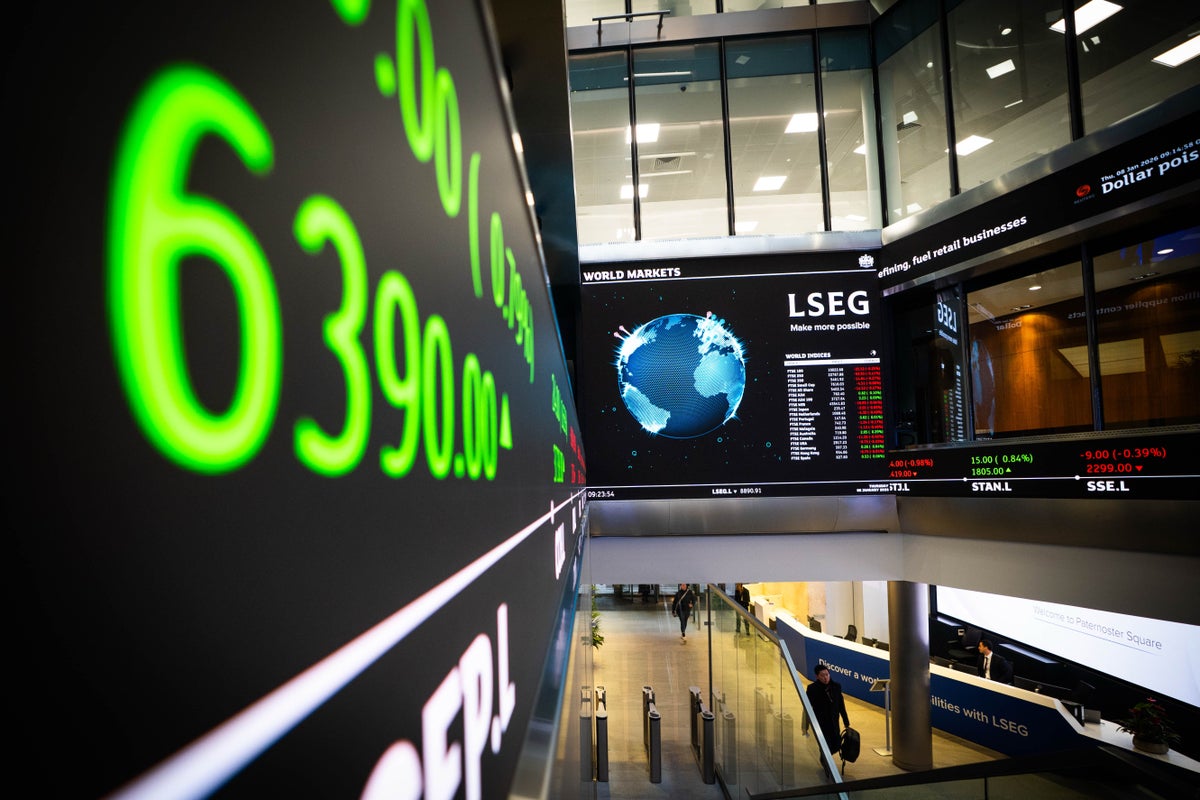
Stock prices in London closed lower on Thursday, falling into the red after downbeat early trade in New York, before eyes turn to a US inflation reading on Friday.
The FTSE 100 index closed down 69.67 points, 0.7%, at 10,402.44. The index spent the bulk of the day in the green, before declining as the afternoon progressed.
The FTSE 250 ended down 111.55 points, 0.5%, at 23,304.99, and the AIM all-share closed down 4.13 points, 0.5%, at 811.16.
Stocks in New York were lower, with tech shares bearing the brunt of the declines. The Dow Jones Industrial Average was down 0.8%, the S&P 500 index lost 1.1%, and the Nasdaq Composite shed 1.6%.
The yield on the US 10-year Treasury was quoted at 4.12%, narrowing from 4.17%. The yield on the US 30-year Treasury was quoted at 4.76%, narrowing from 4.81%.
The latest number of new US unemployment insurance claims was 227,000 in the week that ended February 7, a decline of 5,000 from last week’s revised figure of 232,000, data published by the US Department of Labour showed.
The latest reading exceeded market consensus for 222,000 initial jobless claims.
“Attention now turns to the upcoming inflation release,” said Naga analyst Frank Walbaum.
“Headline and core prices are expected to rise 0.3% on the month. An upside surprise would likely push yields higher and strengthen the dollar by dampening [Federal Reserve interest rate] easing bets. Conversely, if figures come in line with expectations, the currency could remain confined to consolidation, particularly as investors remain attentive to leadership dynamics at the Fed and what they may imply for the policy outlook in 2026.”
Meanwhile, in the UK, the economy eked out modest growth at the end of 2025.
According to the Office for National Statistics, real GDP rose 0.1% in the fourth quarter from the third, matching the prior quarter’s expansion, but below the FXStreet-cited consensus of 0.2% growth.
For 2025 as a whole, the economy grew 1.3%, up from 1.1% in 2024. However, back in November on the day of the UK Government budget release, the Office for Budget Responsibility expected UK GDP growth of 1.5% for 2025.
The pound was quoted at 1.3628 dollars at the time of the London equities close on Thursday, lower compared with 1.3640 dollars on Wednesday. The euro stood at 1.1869 dollars, higher against 1.1861 dollars. Against the yen, the dollar was trading at 152.56 yen, down sharply from 154.23 yen.
In European equities on Thursday, the CAC 40 in Paris closed up 0.3%, while the DAX 40 in Frankfurt closed flat.
On the FTSE 100, Schroders was the best-performing stock, jumping 30% after the fund manager agreed to an all-cash takeover by a subsidiary of Nuveen.
The deal values Schroders at up to £9.9 billion, 612 pence per share.
Separately, Schroders reported 2025 results, with assets under management rising 6% to £823.7 billion and statutory pre-tax profit increasing 21% to £673.8 million.
Admiral rose 3.4%. The Cardiff-based insurer is buying commercial motor insurer Flock in a deal which values the latter’s equity at £80 million.
“This acquisition aligns with the group’s commitment to continuously evolve and futureproof its motor proposition and broaden its product offering,” Admiral said.
It plans to close the deal in the second quarter and expects the purchase to reduce its solvency ratio by less than 10 points, leaving its financial position “well in excess of target levels”.
On AIM, Sancus Lending surged 11% after increasing its existing credit facility with Pollen Street Capital to £300 million and extending its maturity to no earlier than February 11 2031.
The property-backed lender said the extension reflects strong recent operational and financial performance and continued confidence from its funding partner.
TPXimpact jumped 16%, after announcing a £39 million, four-year contract with the UK’s Department for Environment, Food and Rural Affairs under its Digital, Data & Technology “capability as a service” model.
TPXimpact said it was awarded the deal following a competitive tender process, strengthening its existing role as an incumbent provider within the department.
Brent oil was quoted at 68.08 dollars a barrel at the time of the London equities close on Thursday, down from 69.82 dollars late on Wednesday.
“Oil prices have experienced volatility today, as markets react to geopolitical uncertainty and inventory data,” said Tickmill’s Joseph Dahrieh.
“The unresolved tensions between the United States and Iran remain the primary focus. The absence of any firm decisions following diplomatic talks has kept the geopolitical risk premium alive, supporting prices.”
He further noted that “the market faces headwinds from the bearish data… US crude stockpiles surged by 8.5 million barrels last week, a figure that exceeded expectations of a much smaller increase and confirmed earlier API data hinting at a build-up”.
Hurt by the fall in the oil price, Shell lost 0.9% and BP fell 1.0%.
Moving in lockstep with gold, meanwhile, miner Fresnillo gave back 4.1%.
Gold was quoted lower at 4,932.33 dollars an ounce against 5,055.15 dollars.
The biggest risers on the FTSE 100 were Schroders, up 135.00p at 592.00p, DCC, up 190.00p at 5,190.00p, Relx, up 74.65p at 2,087.65p, Admiral, up 94.00p at 2,824.00p, and BT, up 6.20p at 210.20p.
The biggest fallers on the FTSE 100 were Prudential, down 86.31p at 1,075.19p, Rentokil, down 24.95p at 447.35p, Standard Chartered, down 84.50p at 1,730.00p, Fresnillo, down 160.00p at 3,768.00p, and Endeavour, down 150.00p at 4,426.00p.
On Friday’s economic calendar, the US has its latest consumer price index reading.
On Friday’s UK corporate calendar there are full-year results from NatWest.
Contributed by Alliance News
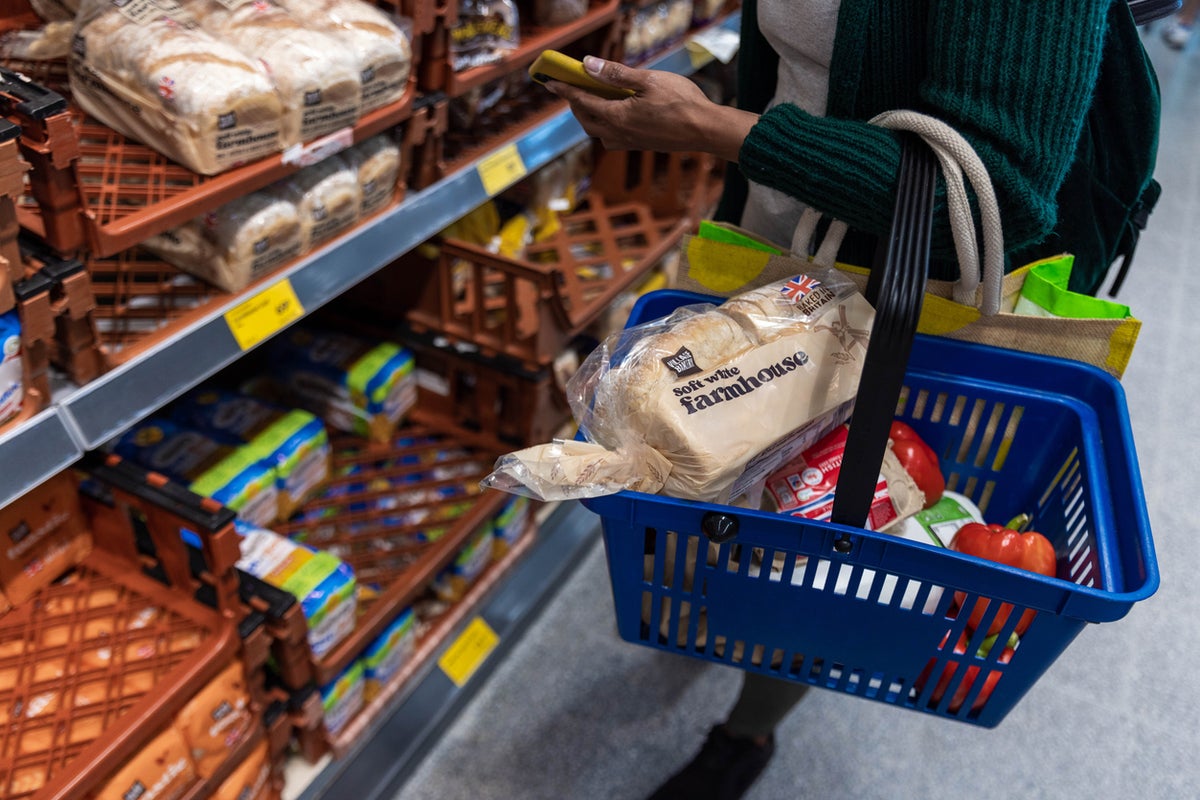
Food bills are set to soar as much as 10 per cent this year as a direct consequence of the Iran war, a key industry body has warned.
The Food and Drink Federation (FDF), which represents 12,000 food and drink manufacturers, has hiked its inflation forecast for the year from 3.2 per cent to between nine and 10 per cent.
During the 2022 cost of living crisis, food inflation rose at a rate of 10.9 per cent, figures from the Food and Drink Federation (FDF) show, while the following year was even worse at 14.6 per cent.
Since then, it had dropped back to 2.7 per cent (2024) and 4.2 per cent (2025), but while this year had originally been forecast to deliver food inflation of 3.2 per cent, the latest assessment is that it will instead see a huge rise in the second half of 2026.
The FDF said the current situation is “unprecedented and hard to predict”, but it’s “clear that food inflation is going to rise in the months ahead”.
How much that adds to the average bill depends on the size and frequency of a consumer’s usual grocery habits, but on average, bills could rise by around £588, according to some estimates.
Consumer rights and review site Which? frequently assesses UK supermarkets for cost, and at the start of 2026, an average basket of 89 shopping products cost £161.56 at Aldi and up to £217.02 at Waitrose.
Assuming food inflation lands at the mid-point of the FDF forecast, 9.5 per cent, and that all products and supermarkets applied that uplift equally, that would move the costs of those shops up to £176.91 and £237.64 respectively.
Research from confused.com suggested the average UK household spent £119 each week on food shopping, which is £6,188 each year; a 9.5 per cent uplift to that equates to an extra £588 annually, or a total of just over £130 per week and £6,775 annually.
Chancellor Rachel Reeves is due to meet with some supermarket chiefs on Wednesday, including Sainsbury’s and Tesco, over discussions to assess the upcoming impact of price rises on the cost of living. The Treasury has described it as a “fact-finding” conversation.
Last month, Asda boss Allan Leighton called on Labour to do more to help businesses after creating “a lot of constraints” for them.
For food manufacturers, there is both a concern now and another yet to come in terms of energy cost rises.
Diesel – used in farm machinery – is up by 80 per cent since the start of the war, while fertiliser costs could increase further, as well as supply being constrained. The FDF also points to lost sales due to cancelled shipments to the Middle East, with UK firms regularly exporting cheese, cereals, chocolate and more to the region.
Dr Liliana Danila, chief economist at The Food and Drink Federation, said: “The food and drink sector is already feeling the force of this geopolitical shock. As one of the UK’s energy-intensive industries, manufacturers are facing mounting energy bills, rising transport and packaging costs and disruption across key supply chains.
“These pressures are hitting simultaneously and are a significant challenge for businesses to absorb.
“The current situation is unprecedented and hard to predict; however, given the scale and speed of these cost increases, and despite companies’ best efforts not to pass price increases on, it’s clear that food inflation is going to rise in the months ahead.”
The FDF says its upgraded inflation figures were based on “assumptions that the Strait of Hormuz opens to cargo traffic within the next two to three weeks”, as has been suggested by Donald Trump this week, and that most commodities, including oil, gas and fertiliser production, return to normal within a year.
In the past few months, the FDF has repeatedly called for the government to offer support to businesses in the sector from rising energy bills in the same way as it does to those in some other manufacturing areas.

GST collections: India’s net Goods and Services Tax (GST) collections increased to Rs 1.78 lakh crore in March 2026, marking a rise of 8.2% compared to the previous month, according to official figures released on Wednesday.Gross GST revenue for March stood at Rs 2 lakh crore, which is an 8.8% increase over the same month last year.Abhishek Jain, Indirect Tax Head & Partner, KPMG says, “GST collections continue to show steady 9% annual growth, supported by strong import activity this month and consistent compliance. While export refunds have eased this month but remain healthy overall for the year”Refunds during the month totalled Rs 0.22 lakh crore, up 13.8% on a year-on-year basis, which resulted in net GST collections of Rs 1.78 lakh crore.Domestic GST revenue reached Rs 1.46 lakh crore, registering a growth of 5.9%, while revenue from imports was recorded at Rs 0.54 lakh crore, rising sharply by 17.8% during the period.Post-settlement GST figures across states presented a varied trend. While industrially advanced states recorded strong growth, several others reported a decline.Maharashtra contributed the highest amount to the overall collections at Rs 0.13 lakh crore on a pre-settlement basis, followed by Karnataka and Gujarat.Among states showing an increase in post-settlement SGST collections were Himachal Pradesh, Punjab, Uttarakhand, Haryana, Rajasthan, Uttar Pradesh, Bihar, Gujarat, Maharashtra, Karnataka, Kerala, Tamil Nadu, Telangana and Andhra Pradesh, among others.On the other hand, states such as Jammu and Kashmir, Chandigarh, Delhi, Arunachal Pradesh, Meghalaya, Assam, West Bengal, Jharkhand, Odisha, Chhattisgarh and Madhya Pradesh, among others, registered a decline in post-settlement SGST revenues.

A wave of bullishness swept the Pakistan Stock Exchange on Wednesday, pushing the 100 Index up by more than 5,000 points to reach 153,700.
The surge reflects increased investor confidence and strong trading activity across major sectors.

Food prices to rise by almost 10% due to Iran war, warns key industry body

Should the USMNT be concerned about Pulisic’s goal drought?

Who was Jessie Jones? ‘Most-produced female American playwright’ dies at 75

Afghanistan announces release of detained US citizen

Broadcast industry CEO says consolidation is ‘essential’ to compete for NFL soaring media rights prices

Property Play: Home flippers see smallest profits since the Great Recession, real estate data firm says

-
 Politics1 week ago
Afghanistan announces release of detained US citizen
-
 Sports1 week ago
Broadcast industry CEO says consolidation is ‘essential’ to compete for NFL soaring media rights prices
-

 Tech1 week ago
Can a Home Appliance Fix the Problem of Soft-Plastic Waste?
-
Business1 week ago
Property Play: Home flippers see smallest profits since the Great Recession, real estate data firm says
-

 Entertainment1 week ago
UN warns migratory freshwater fish numbers are spiralling
-
 Business1 week ago
Gold prices soar in Pakistan – SUCH TV
-

 Fashion1 week ago
ICE cotton slips on weaker crude, profit booking
-
 Business1 week ago
More women are entering wealth management, but few are in advisory roles, study finds