

Fashion
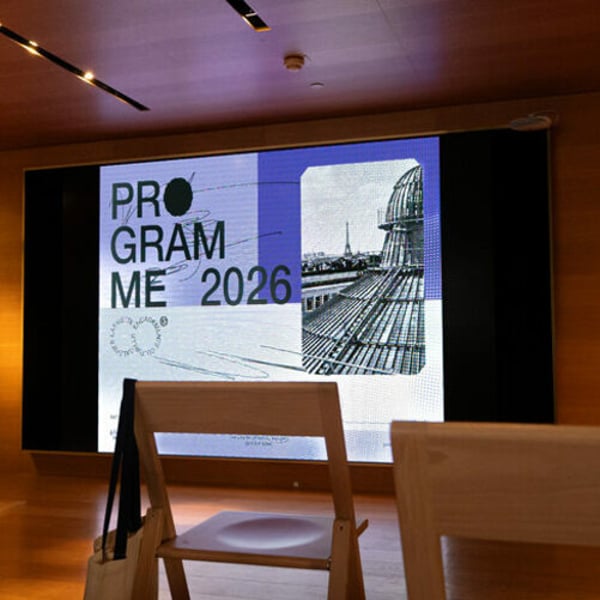
Galeries Lafayette unveils its 2026 cultural programme

Published
November 25, 2025
At 9 am, the doors of Galeries Lafayette Haussmann are closed, the lights are off, and the shop-in-shops lie shrouded in darkness. Yet teams are already at work preparing the shop floor. In fact, they have been taking turns since the previous day, without a pause.
This ceaseless ballet, scarcely noticed by visitors, is among the first things the Galeries Lafayette group shares with the artists it collaborates with. It casts the department store in a different light from the one customers know- an image the group hopes to weave into the capital’s art scene.
One grant, three support programmes
For the past 20 years, Galeries Lafayette has dedicated a 300-square-metre space in its Paris flagship on Boulevard Haussmann to artistic creation, under the name “Galerie des Galeries.” Since 2021, art installations have dotted the entire store, and the group as a whole is deepening its presence in the art world, with plans to expand into the performing arts after 2026.

Galeries Lafayette’s “cultural commitments,” led by Cécile Larrigaldie, rest on three pillars: the heritage division (past creations), the artistic actions division (programming and artistic commissions), and patronage (support for institutions and synergies with them within Galeries Lafayette spaces). These three pillars are reflected within the Bourse des regards, itself structured around the By Night audiovisual programme, the Savoir Faire Savoir support programme (support for the applied arts), and Open Archives (support for publishing and research, whose call for projects closes on December 8, 2025).
Artists on show and film sets
The group’s cultural programme opens on February 5 at 6 pm, with the launch of its By Night 2026 call for projects, in partnership with the Clermont-Ferrand International Short Film Festival. On this occasion, guests will be invited to screenings of the winning films from the 2025 edition, shot on the group’s premises (stores, warehouses, etc.). To date, ten films have already been shot behind the doors of Galeries Lafayette and are available online on the Galerie des Galeries website. The most recent, “Deux personnes échangeant de la salive”, by Alexandre Singh and Natalie Musteata, has received numerous awards.

From March 10 to April 27, the group will present the “Pour Toujours” project under the banner of its Carte Blanche programme, echoing the “Dimanche sans fin” exhibition at the Centre Pompidou-Metz, of which Galeries Lafayette Haussmann is a patron. The store is planning a route across its floors centred on four artists, three of whom have already been revealed. Under the dome, a work by German sculptor Gloria Friedmann, titled Mammalia, will be on display, exploring the relationship between humankind and nature. This installation will be complemented by photographs by Austrian artist Birgit Jürgenssen. The main dome will host Cypriot artist Christodoulos Panayiotou, and the terrace will be given over to a work by American artist Lawrence Weiner.
Stores as performance spaces
In June, Galeries Lafayette will reprise its after-hours behind-the-scenes tours, with By Night Live. During last year’s European Heritage Days, the group welcomed the public into its stores from 9 pm to 12:30 am for a trail combining projections, light shows, and performance, including that of Jonathan Fitoussi at the Champs-Élysées store.

To close the year, alongside partnerships with the European Heritage Days and the Lyon Contemporary Art Biennale, Galeries Lafayette will organise the third edition of its artist support programme, Savoir Faire Savoir, from September 3 to 17. It will launch a call for projects inviting reflection on Galeries Lafayette’s private collection (450 pieces of ready-to-wear, furniture, etc.), and present the laureates of the 2025 edition, Camille Mouchet and Camille Gasser, from Atelier Les Moires. The duo will be in residence at Galeries Lafayette Haussmann for around 10 months to develop their artistic project. In partnership with Paris Design Week, the event will also present the guest artists for the 2025 edition, Studio Döpel and Stéphanie d’Heygere.
This article is an automatic translation.
Click here to read the original article.
Copyright © 2025 FashionNetwork.com All rights reserved.






If the US administration imposes a 15-per cent levy, the US ETR would rise to 11.3 per cent.
President Donald Trump reinstated tariffs immediately following the US Supreme Court’s February 20 ruling that invalidated the reciprocal tariffs imposed under the International Emergency Economic Powers Act (IEEPA). The new blanket 10-per cent tariff rate is authorised under Section 122 of the Trade Act of 1974 and expires in 150 days unless extended by Congress.
The 10-per cent blanket reciprocal tariff imposed by the US on most trading partners has reduced the US effective tariff rate (ETR) to 9.4 per cent from 12.7 per cent, Fitch Ratings said.
If a 15-per cent levy is imposed, the ETR would rise to 11.3 per cent.
China has the highest ETR among trading partners, followed by Vietnam, Japan and Brazil.
China’s ETR is around 19 per cent from 29 per cent earlier.
Section 122 permits a maximum rate of 15 per cent but does not allow for tariff adjustments for individual countries.
Prior to the court decision, China was subject to two reciprocal tariffs: a fentanyl tariff of 10 per cent that applied to all imports and a 10-per cent reciprocal tariff on an import base subject to carveouts. The two tariffs have been consolidated into the 10-per cent blanket tariff, reducing China’s ETR to around 19 per cent from 29 per cent, Fitch said in a release.
China still has the highest ETR among major trading partners, followed by Vietnam, Japan and Brazil. Of the United States’ 31 largest trading partners, 26 will see their ETRs decline. Brazil benefits the most, with its ETR decreasing by 18 percentage points (pp) to 11 per cent from 29 per cent.
ETRs for most countries largely remain unchanged following the switch in tariff regimes, and no country will see an increase in its ETR if the Section 122 tariff rate remains at 10 per cent.
Fibre2Fashion News Desk (DS)
Unadjusted, it rose by 2.9 per cent for the 12 months ended January 2026.
Prices for final demand goods declined by 0.3 per cent, the largest decrease since falling 0.7 per cent in March 2025.
The seasonally-adjusted US producer price index (PPI) for final demand rose by 0.5 per cent in January.
Unadjusted, it rose by 2.9 per cent for the 12 months ended January 2026.
Prices for final demand goods declined by 0.3 per cent, the largest decrease since falling 0.7 per cent in March 2025.
Leading the January decline, the index for final demand energy dropped by 2.7 per cent.
Leading the January decline, the index for final demand energy dropped by 2.7 per cent.
The index for final demand less food, energy and trade services moved up by 0.3 per cent in January, the ninth consecutive increase. For the 12 months ended in January, such prices rose by 3.4 per cent, a BLS release said.
The index for final demand goods less food and energy advanced by 0.7 per cent in the month.
Fibre2Fashion News Desk (DS)
Ind-Ra expects sector revenues to grow around 9 per cent year on year (YoY) in FY26 and 10.5 per cent YoY in FY27 following uneven and subdued growth through FY24 and early FY25; the growth in FY25 was 8 per cent YoY.
Ind-Ra expects India’s apparel retail sector revenues to grow around 9 per cent YoY in FY26 and 10.5 per cent YoY in FY27 following uneven and subdued growth through FY24 and early FY25.
Premium, branded and ethnic players are expected to see steadier, high single-digit growth trends.
Ind-Ra feels value retailers will outperform other segments within apparel, with robust revenue growth.
Ind-Ra feels value retailers will outperform other segments within apparel, with robust revenue growth through healthy same store sales growth and rapid store additions, albeit at a lower profitability.
Healthy growth in operating profit coupled with strong inventory turns is expected to result in value retailers demonstrating stronger-than-industry return indicators and credit metrics.
Premium, branded and ethnic players are expected to see steadier, high single-digit growth trends as consumer confidence rebuilds with a better spread out wedding calendar than in FY26 and early signs of normalisation seen in the first nine months of FY26.
Listed apparel retail players from Ind-Ra’s sample set reported revenue growth of around 10 per cent YoY in these nine months as the government’s consumption push through lower taxation and mild inflation resulted in higher disposable income and improved affordability.
The operating profit margins also improved to 15.6 per cent in the nine months compared to 15.2 per cent in FY25 due to various cost optimisation measures adopted by companies.
Organised retailers are pivoting from aggressive expansion to productivity-led growth. After elevated store additions in FY24-FY25, Indian apparel retailers are moderating store roll-outs, sharpening site selection, right-sizing formats and targeting faster ramp-ups of recent openings, with omni-channel execution and scalable franchise models enhancing reach and capital efficiency, Ins-Ra said in a press note.
It expects store additions to ease to nearly 7 per cent YoY in FY26 and 6 per cent YoY in FY27, even as retail area continues to rise by 9 per cent YoY in FY26 and by 9.5 per cent YoY in FY27, reflecting larger average store sizes and assortments designed to lift footfalls, average transaction values and sales per square foot.
Value and luxury segments are set to lead sector performance. Value formats benefit from GST rationalisation at lower price points, improved affordability, and rising private-label penetration, while luxury gains from a widening affluent base and deeper global-brand access.
Fast fashion continues to capture Gen-Z-led, content-driven demand. Casual and athleisure remain ahead of ethnic-casual and formal wear, in line with comfort- and lifestyle-led dressing trends.
Ind-Ra expects profitability to improve gradually as cost optimisation, better sourcing/mix, disciplined advertising and marketing promotions, and operating leverage offset residual pressures from expansion and fixed costs.
The working capital cycle for value retailers is likely to improve YoY in FY27, due to higher inventory turns and improved store level operating metrics.
Overall, as the consumption upturn broadens and retailers prioritise productivity over pace, Ind-Ra expects a stable, sustainable improvement in revenues and operating metrics for organised apparel retailers over FY26–FY27.
The luxury segment is also expected to benefit from an increase in target customer segment through widening affluent base and deeper global-brand access.
Mid-premium and several incumbent retailers witnessed slower growth in FY25, due to entry price mix-shifts and loss of market share to value retailers. This, coupled with investments in store format revamps, has stressed their margin profiles. Profitability pressures and a dip in inventory turns have slightly weakened credit metrics for segment players.
Fibre2Fashion News Desk (DS)


Apple’s New MacBook Air and MacBook Pro Have New Chips, More Storage, and Higher Prices

Preview of UFC 326: Holloway vs. Oliveira

T20 World Cup: Aleem Dar ‘expressed reservations’ over inclusion of Babar, Shadab

-

 Politics5 days ago
What are Iran’s ballistic missile capabilities?
-
 Business7 days ago
Households set for lower energy bills amid price cap shake-up
-

 Sports1 week ago
Top 50 USMNT players of 2026, ranked by club form: USMNT Player Performance Index returns
-

 Politics5 days ago
US arrests ex-Air Force pilot for ‘training’ Chinese military
-

 Sports5 days ago
Sri Lanka’s Shanaka says constant criticism has affected players’ mental health
-
 Business7 days ago
Lucid widely misses earnings expectations, forecasts continued EV growth in 2026
-

 Fashion1 week ago
OECD GDP growth slows to 0.3% in Q4 amid mixed trends
-

 Fashion5 days ago
Policy easing drives Argentina’s garment import surge in 2025