

Business
Government borrowing for October higher than expected

Rachel ClunBusiness reporter
 Getty Images
UK government borrowing was higher than expected last month, according to the latest official figures.
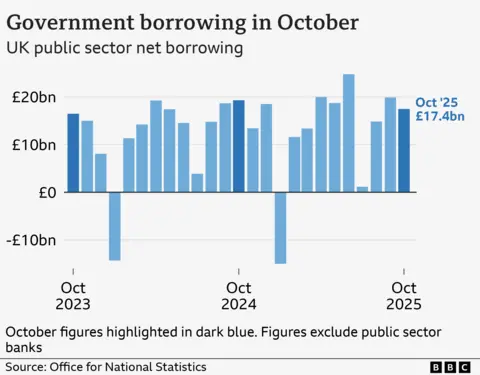
Borrowing – the difference between public spending and tax income – was £17.4bn in October, the Office for National Statistics (ONS) said, which was above analysts’ forecasts of about £15bn.
The borrowing figures come less than a week before Chancellor Rachel Reeves unveils her Budget, and she has previously confirmed both tax rises and spending cuts are on the table.
Separate figures from the ONS showed retail sales fell in October, with some retailers saying that shoppers were waiting for this month’s Black Friday deals.
Ruth Gregory, deputy chief UK economist at Capital Economics, said that together the latest government borrowing and retail sales figures painted a “pretty grim picture” of the economy.
Although October’s borrowing figure was above expectations, it was £1.8bn lower than the figure seen in the same month last year.
“While spending on public services and benefits were both up on October last year, this was more than offset by increased receipts from taxes and National Insurance contributions,” said ONS chief economist Grant Fitzner.
Despite the fall, it was still the third-highest October borrowing figure since monthly records began in 1993.
In the financial year to October, borrowing was £116.8bn, which was £9bn more than the same period in 2024. It was the second-highest borrowing for April to October since records began in 1993, after 2020.

James Smith from investment bank ING said the borrowing figures would not be welcomed by the chancellor ahead of her Budget, but said her fiscal rules were about what happens later this decade, rather than the current picture.
“Today’s data is not helpful, it shows that the government is borrowing more than expected, but it doesn’t necessarily change the decisions next week,” he told the BBC’s Today programme.
Nick Ridpath, research economist at the Institute for Fiscal Studies, noted government borrowing for the year to date had continued to exceed forecasts from the OBR, “to the tune of around £10bn”.
Mr Ridpath said that while the borrowing figures should not be given too much weight, ahead of the Budget they highlighted the uncertainty around pressures on spending and tax revenues and the “stubbornly high costs of servicing government debt”.
The chancellor needs to find more money in her 26 November Budget to meet her self-imposed rules for government finances, which she has described as “non-negotiable”.
The two main rules are:
- Not to borrow to fund day-to-day public spending by the end of this parliament
- To get government debt falling as a share of national income by the end of this parliament
The BBC understands that newer assessments from the OBR have put the gap in public finances that Reeves needs to fill at £20bn.
Mr Ridpath said: “Operating with minimal fiscal margin for error is risky, and this is one reason why the chancellor might sensibly take steps to increase her so-called ‘fiscal headroom’ at next week’s Budget.”
Chief secretary to the Treasury James Murray said the government aimed to reduce borrowing over the course of the parliament, with £1 of every £10 in taxpayer money currently spent on paying interest on national debt.
“That money should be going to our schools, hospitals, police and armed forces,” he said.
“That is why we are set to deliver the largest primary deficit reduction in both the G7 and G20 over the next five years – to get borrowing costs down.”
Shadow chancellor Sir Mel Stride said borrowing so far this financial year had been the highest on record outside the pandemic.
“If Labour had any backbone, they would control spending to avoid tax rises next week,” he said.
The ONS also released data showing that over the month of October retail sales fell by 1.1% – the first monthly drop since May.
“Supermarkets, clothing stores and online retailers all saw slower sales, with feedback from some retailers that consumers were waiting for November’s Black Friday deals,” Mr Fitzner said.
Ruth Gregory at Capital Economics noted the monthly fall in retail sales “isn’t quite as bad as it looks” as it comes off the back of four consecutive months of increases, but also said that consumer confidence had declined, which “suggests that consumers aren’t exactly chipper at the moment”.
Last Updated:
RBI has summoned senior officials of Yes Bank following a major data breach involving the Yes Bank–BookMyForex multi-currency forex card




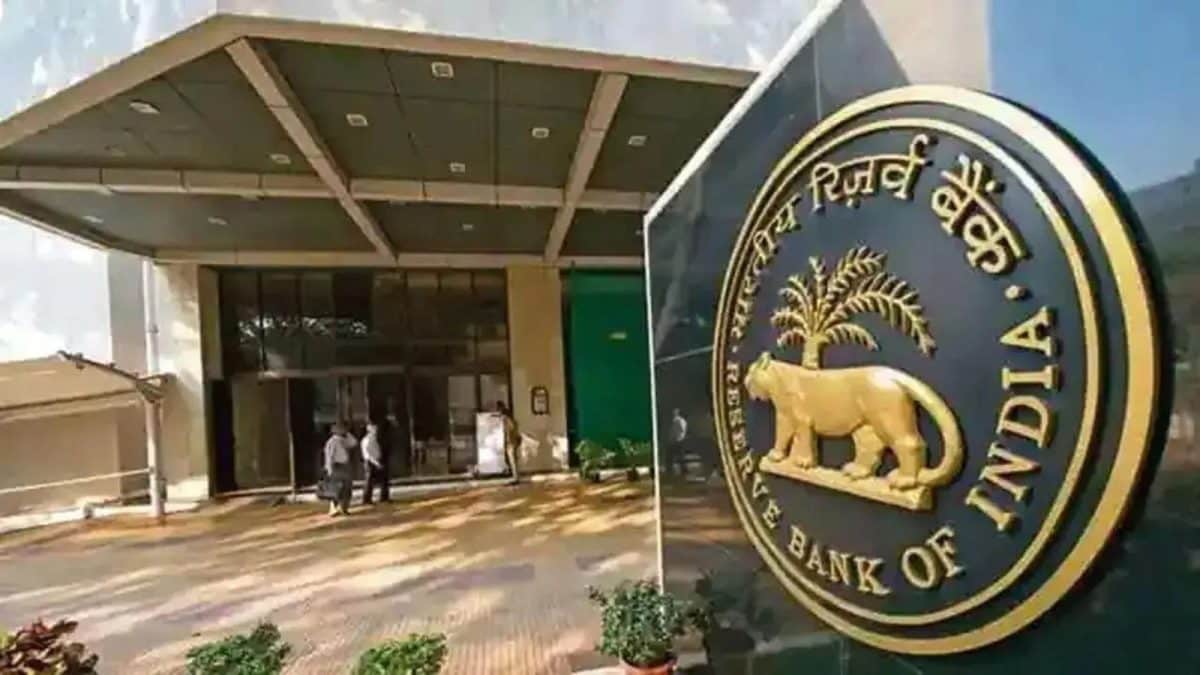
Reserve Bank of India headquarters in Mumbai.
The Reserve Bank of India (RBI) has summoned senior officials of Yes Bank following a major data breach involving the Yes Bank–BookMyForex multi-currency forex card, two people aware of the development told The Economic Times (ET).
According to the report, card details and CVV numbers of several users were allegedly compromised. The central bank has sought a detailed explanation from the bank on how its systems may have been breached and the sequence of events that led to the exposure of sensitive customer data.
“The RBI has sought a comprehensive briefing from Yes Bank’s senior management on the root cause of the breach, the timeline of events, and the adequacy of the bank’s cybersecurity framework,” one of the persons cited by ET said. “The regulator wants clarity on how sensitive card data, including CVV numbers, may have been exposed and what immediate containment measures have been implemented.”
Yes Bank declined to comment on the RBI’s queries but said an internal investigation had identified fraudulent transactions involving 15 merchants in a Latin American country on February 24. Transactions worth Rs 2.54 crore were approved across 5,000 customers, while 688 unauthorised attempts amounting to around Rs 90 lakh were blocked. The bank said it is working with the card network to initiate chargebacks and ensure that affected customers do not face financial losses.
Separately, BookMyForex said it does not store customers’ sensitive card information and that its systems were neither breached nor compromised during the period in question.
The RBI has also sought details on how sensitive card data—particularly CVVs—was stored and protected, whether encryption and prescribed security protocols were followed, and why existing cyber controls failed to prevent the breach. In addition, the regulator is reviewing the timeline of detection and reporting, the robustness of third-party risk management and oversight, the number of customers impacted, and the steps taken to block cards, prevent misuse and mitigate losses. It has also asked for clarity on internal accountability, supervisory lapses and remedial measures to prevent a recurrence, ET reported.
 Click here to add News18 as your preferred news source on Google.
Follow News18 on Google. Join the fun, play games on News18. Stay updated with all the latest business news, including market trends, stock updates, tax, IPO, banking finance, real estate, savings and investments. To Get in-depth analysis, expert opinions, and real-time updates. Also Download the News18 App to stay updated.
February 26, 2026, 07:53 IST
Read More

Soft drinks company Twig’s Beverage has a loyal following for its old-fashioned approach.
Source link

Queen’s University Belfast says there were more than 10,500 visits by students to its food bank in the students’ union.
Source link


US’ New Balance expands manufacturing amid record sales

UCF drains 14 3-pointers, runs away from No. 19 BYU in upset win

Bangladesh trade milieu hit by high rates, unstable law & order: DCCI

-

 Entertainment1 week ago
Queen Camilla reveals her sister’s connection to Princess Diana
-

 Tech1 week ago
Rakuten Mobile proposal selected for Jaxa space strategy | Computer Weekly
-

 Politics1 week ago
Ramadan moon sighted in Saudi Arabia, other Gulf countries
-

 Entertainment1 week ago
Robert Duvall, known for his roles in "The Godfather" and "Apocalypse Now," dies at 95
-

 Politics1 week ago
Tarique Rahman Takes Oath as Bangladesh’s Prime Minister Following Decisive BNP Triumph
-
 Business1 week ago
Tax Saving FD: This Simple Investment Can Help You Earn And Save More
-

 Sports1 week ago
Usman Tariq backs Babar and Shaheen ahead of do-or-die Namibia clash
-

 Fashion1 week ago
Australia’s GDP projected to grow 2.1% in 2026: IMF