

Business
How MSMEs Are Upgrading To Modern Tech For Lifting Indias Productivity


New Delhi: As India’s manufacturing ecosystem accelerates toward greater scale and sophistication, factories are increasingly turning to modern material-handling technologies to stay competitive. Manual load movement once the norm on most shop floors is no longer sufficient for today’s high-volume, fast-paced production demands. Manufacturers are now embracing advanced solutions such as Electric Overhead Travelling (EOT) cranes to save time, improve workflow management, and unlock higher productivity.
With automation, digital controls, and precision-engineered systems becoming more accessible, these cranes are helping industries streamline operations, reduce downtime, and enhance workplace safety, making them indispensable tools for the next generation of smart factories. EOT cranes, commonly visible in workshops and industrial sheds, play a vital role in lifting and transporting materials with precision. With rising production volumes, tighter delivery schedules and stricter safety norms, industries are adopting these systems to reduce physical strain on workers and streamline day-to-day operations.
A key driver behind this growing adoption is the emergence of Indian manufacturers who design cranes suited to local factory environments. Over the past three decades, companies such as LOADMATE have supplied EOT cranes, electric chain hoists and wire rope hoists to a wide range of sectors, from engineering and fabrication to textiles, chemicals and heavy manufacturing. Their familiarity with local usage conditions has resulted in systems that are robust, economical to maintain and aligned with Indian industrial requirements.
According to Manish Agarwal, CEO of LOADMATE, customization has become an important factor in equipment selection. “Every factory has its own layout, workflow and load-handling needs. When lifting systems are designed around these specific conditions, the result is better efficiency and better safety. Indian manufacturers are able to understand these needs more closely. The availability of service teams and spare parts within the country also gives long-term confidence to plant owners,” he said.
According to experts, imported cranes are often harder to service and more expensive to modify. For MSMEs operating on tight schedules, local manufacturers have filled a crucial gap by offering solutions tailor-made for load capacities, spans, duty cycles and operational environments. This allows factories to upgrade without major alterations to infrastructure, making the transition more cost-effective.
This shift mirrors a larger nationwide trend. As Indian factories adopt leaner processes and modern automation, reliable lifting systems have become integral to improving throughput and reducing downtime. The preference for domestically built cranes has also helped minimize delays related to maintenance and spare parts availability, challenges that previously disrupted production cycles.









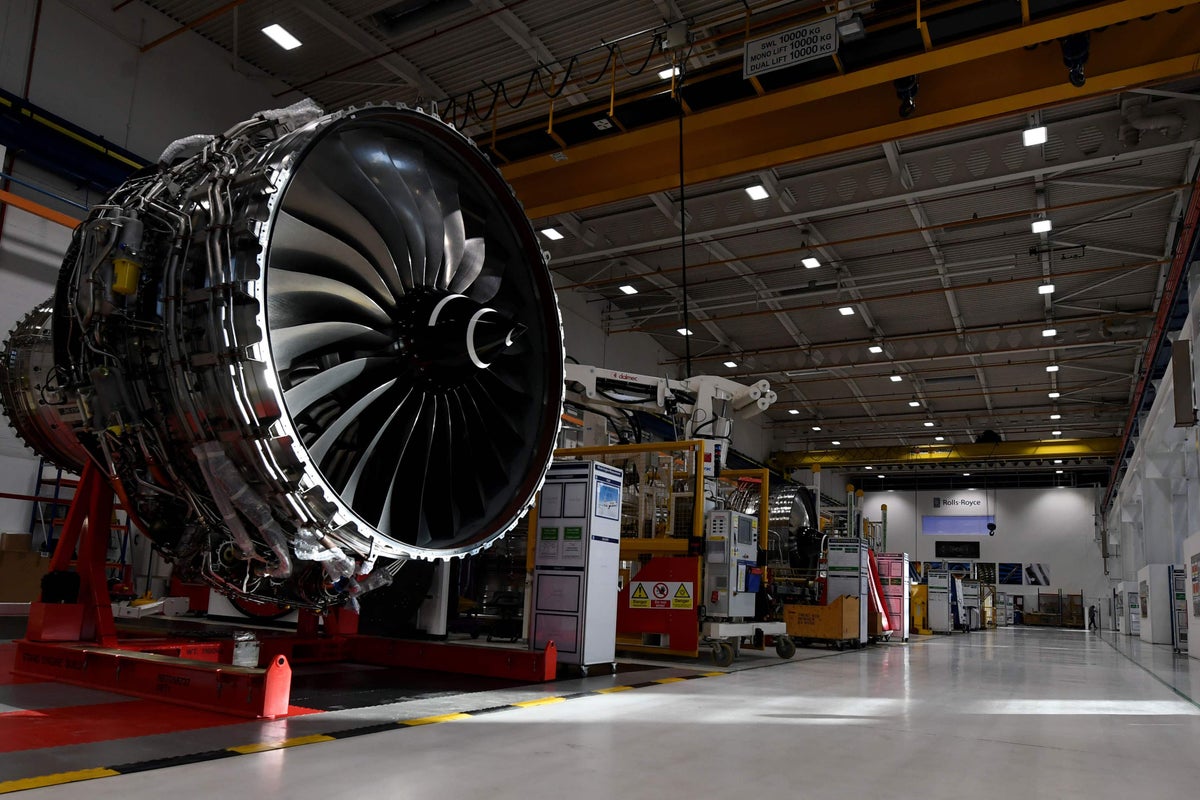
Rolls-Royce has revealed its annual profit surged by £1 billion and upgraded its outlook for the years ahead, following major military aircraft orders and soaring demand for powering data centres.
The engineering giant said its business divisions were in a good place to benefit from “key global trends” over the coming years.
It reported an underlying operating profit of £3.5 billion for 2025, a jump of 40% from the £2.5 billion made the prior year.
Underlying revenues surpassed £20 billion over the year, up about a 10th on 2024.
This was driven by profit and sales growth across its civil aerospace, defence, and power businesses.
Rolls-Royce said demand for its defence products was strong and it secured major orders during 2025.
This included contracts worth more than £1.5 billion with the UK’s Ministry of Defence and the US’s Department of War for EJ200 and AE 2100 engines to power military aircraft.
New orders for the Eurofighter aircraft engines from Italy, Germany and Spain, as well as export agreements from Turkey, will drive production into the 2030s, it said.
Furthermore, Rolls-Royce said it was benefiting from growing demand for power generation, driven by data centres with revenues up by more than a third.
Rolls-Royce said it was now expecting underlying operating profits to increase to between £4.9 billion and £5.2 billion by 2028 following the strengthened financial performance in 2025.
This is significantly higher than the £3.6 billion to £3.9 billion range that it had previously been targeting.
Chief executive Tufan Erginbilgic said growth would not have been possible “before our transformation”, with the business making £600 million worth of cost savings since 2022.
“With our new capabilities and mindset, we have navigated challenges from supply chain to tariffs, and delivered a strong performance in 2025, all while we built the foundations for significant growth for years to come,” he said.
“Based on our 2026 guidance, we expect to deliver underlying operating profit within the prior mid-term guidance range two years earlier than planned.
“Beyond the mid-term we continue to see significant growth from existing businesses as well as from new business opportunities.”
Business
RBI’s Rs 25,000-Crore Switch Auction On March 2nd And Its Impact On Bond Markets, Government Debt Strategy | Explained
Last Updated:
RBI Switch Auction On March 2: The Reserve Bank of India will conduct a government securities switch auction worth Rs 25,000 crore on March 2 between 10:30 AM and 11:30 AM




In the latest exercise, all securities, having maturities in FY27, are being replaced with bonds maturing after FY32.
RBI Switch Auction On March 2: The Reserve Bank of India (RBI) will conduct a government securities switch auction worth Rs 25,000 crore on March 2 between 10:30 AM and 11:30 AM, with results to be declared the same day and settlement scheduled for March 4. The move marks the third such operation this month and is aimed at smoothing India’s future debt repayment profile.
What is a switch auction?
A switch auction is a debt management tool through which the government exchanges bonds that mature soon with bonds that mature later. Instead of repaying investors in cash when near-term securities mature, the government offers them longer-dated securities. This effectively postpones repayment obligations without increasing total debt.
In the latest exercise, all securities, having maturities in FY27, are being replaced with bonds maturing after FY32, according to RBI data.
Why is RBI conducting it now?
The key trigger is the heavy redemption pressure expected in FY27, when government securities worth about Rs 5.47 lakh crore are scheduled to mature. By replacing these with bonds maturing after FY32, the authorities are spreading repayment obligations across future years. This reduces refinancing risk and prevents sudden spikes in borrowing needs.
How does it help the government?
India has already budgeted gross market borrowing of Rs 17.2 lakh crore. Large redemptions in a single year would force the government either to borrow more or use fiscal resources for repayment. Switch auctions smooth this maturity profile, making debt servicing more predictable and fiscally manageable.
What has happened so far this month?
Before this latest announcement, the RBI conducted two switch auctions in which securities worth Rs 84,804 crore were bought back and replaced. The repeated use of this tool signals a proactive debt-management strategy rather than a reactive measure.
Why markets watch switch auctions closely
Bond investors track such operations because they affect liquidity, yield curves and supply of long-term securities. Extending maturities can reduce pressure on near-term yields while increasing supply at the long end, influencing pricing across the sovereign curve.
The broader takeaway
The latest switch auction is part of a deliberate strategy to manage India’s rising debt stock more efficiently. By pushing repayments further into the future and avoiding bunching of maturities, policymakers aim to maintain stability in government borrowing costs and ensure smoother fiscal operations in coming years.
 Click here to add News18 as your preferred news source on Google.
Follow News18 on Google. Join the fun, play games on News18. Stay updated with all the latest business news, including market trends, stock updates, tax, IPO, banking finance, real estate, savings and investments. To Get in-depth analysis, expert opinions, and real-time updates. Also Download the News18 App to stay updated.
February 26, 2026, 11:11 IST
Read More

Last Updated:
Vellayan Subbiah, a scion of the Murugappa family, has reached a settlement with other promoter branches to realign ownership
Cholamandalam Investment Finance
Vellayan Subbiah, a scion of the Murugappa family, has reached a settlement with other promoter branches to realign ownership across key group companies, according to a report by Moneycontrol.com, citing people familiar with the matter. The agreement is expected to see Subbiah give up stake exposure linked to Cholamandalam Investment and Finance Company while consolidating his position in Tube Investments of India and CG Power and Industrial Solutions.
The arrangement, finalised after more than two years of negotiations, forms part of a broader plan by the Murugappa Group to separate ownership of the century-old conglomerate among three promoter factions while ensuring business continuity. Under the settlement, Subbiah is expected to relinquish exposure to Cholamandalam Investment — the group’s flagship lending arm — and instead retain and strengthen his alignment with Tube Investments and CG Power, including taking over or retaining stakes tied to those companies within the extended promoter structure, the report said. Emails sent to Subbiah and the Murugappa Group did not receive a response until publication.
The realignment follows prolonged internal discussions over the division of the diversified business empire, which reported revenue of more than $9 billion in FY23, after five generations of joint ownership through the family holding company Ambadi Investments.
Negotiations had earlier faced hurdles due to significant valuation divergences across group companies. As previously reported by The Economic Times on August 19, 2024, the turnaround of businesses overseen by Subbiah — particularly CG Power, Tube Investments and Cholamandalam Finance — had emerged as a sticking point in share-swap discussions among family factions.
The revival of CG Power proved especially pivotal. Since Tube Investments acquired control in 2020, CG Power has deleveraged, restored profitability and benefited from investor interest in domestic manufacturing, railways, power equipment and electronics supply chains. Its stock has surged since the takeover, making it one of the group’s most valuable listed assets. Tube Investments has also diversified beyond its legacy engineering base into green mobility, contract manufacturing and specialised industrial segments, strengthening its market position.
Cholamandalam Investment, meanwhile, has grown into one of India’s most valuable non-bank lenders, with a market capitalisation exceeding Rs 1 lakh crore. The uneven appreciation in these businesses complicated efforts to carve out three equal promoter blocs, with one faction seeking revisions to earlier share-swap assumptions and another resisting reopening agreed terms, people cited by Moneycontrol.com said.
Promoter ownership across Murugappa companies is largely routed through holding vehicles rather than direct individual shareholdings, but the concentration of value highlights why these firms were central to negotiations. The promoter group’s roughly 51–52 percent stake in Cholamandalam Investment is estimated to be worth about Rs 55,000–60,000 crore at current market levels. In Tube Investments, promoter ownership of around 45–46 percent translates into holdings valued at approximately Rs 20,000–22,000 crore. Through Tube Investments’ controlling position in CG Power, the promoter group effectively holds about 58–59 percent of that company, valued at roughly Rs 45,000–50,000 crore.
Beyond these, the family controls about 56–57 percent in Coromandel International, worth around Rs 18,000–20,000 crore; 42–43 percent in Carborundum Universal, valued near Rs 9,000–10,000 crore; and 44–45 percent in EID Parry, worth roughly Rs 3,500–4,000 crore. Tube Investments also indirectly controls about 70 percent of Shanti Gears, valued at approximately Rs 2,500–3,000 crore.
The final arrangement appears to align ownership more closely with operational leadership. Subbiah, a fourth-generation member of the family, is widely credited within the group for steering the revival of CG Power and expanding Tube Investments into new manufacturing and mobility segments, making these businesses natural anchors for his promoter bloc under the new structure.
The Murugappa Group, which comprises nearly 30 companies across fertilisers, engineering, financial services, abrasives, sugar and mobility solutions, operates under a long-standing governance charter that separates ownership from management, the Moneycontrol.com report noted.
Click here to add News18 as your preferred news source on Google.
Follow News18 on Google. Join the fun, play games on News18. Stay updated with all the latest business news, including market trends, stock updates, tax, IPO, banking finance, real estate, savings and investments. To Get in-depth analysis, expert opinions, and real-time updates. Also Download the News18 App to stay updated.
February 26, 2026, 10:51 IST
Read More

Rolls-Royce makes £1 billion more profit after major defence orders

Hormuz risk: The hidden polyester shock to global apparel

South Africa, West Indies Clash in Crucial T20 World Cup Super Eight Showdown – SUCH TV

-

 Entertainment1 week ago
Queen Camilla reveals her sister’s connection to Princess Diana
-

 Tech1 week ago
Rakuten Mobile proposal selected for Jaxa space strategy | Computer Weekly
-

 Politics1 week ago
Ramadan moon sighted in Saudi Arabia, other Gulf countries
-

 Entertainment1 week ago
Robert Duvall, known for his roles in "The Godfather" and "Apocalypse Now," dies at 95
-

 Politics1 week ago
Tarique Rahman Takes Oath as Bangladesh’s Prime Minister Following Decisive BNP Triumph
-
 Business1 week ago
Tax Saving FD: This Simple Investment Can Help You Earn And Save More
-

 Tech1 week ago
Businesses may be caught by government proposals to restrict VPN use | Computer Weekly
-

 Fashion1 week ago
Australia’s GDP projected to grow 2.1% in 2026: IMF