

Sports
How much is each position in soccer worth? A deep dive into the Premier League

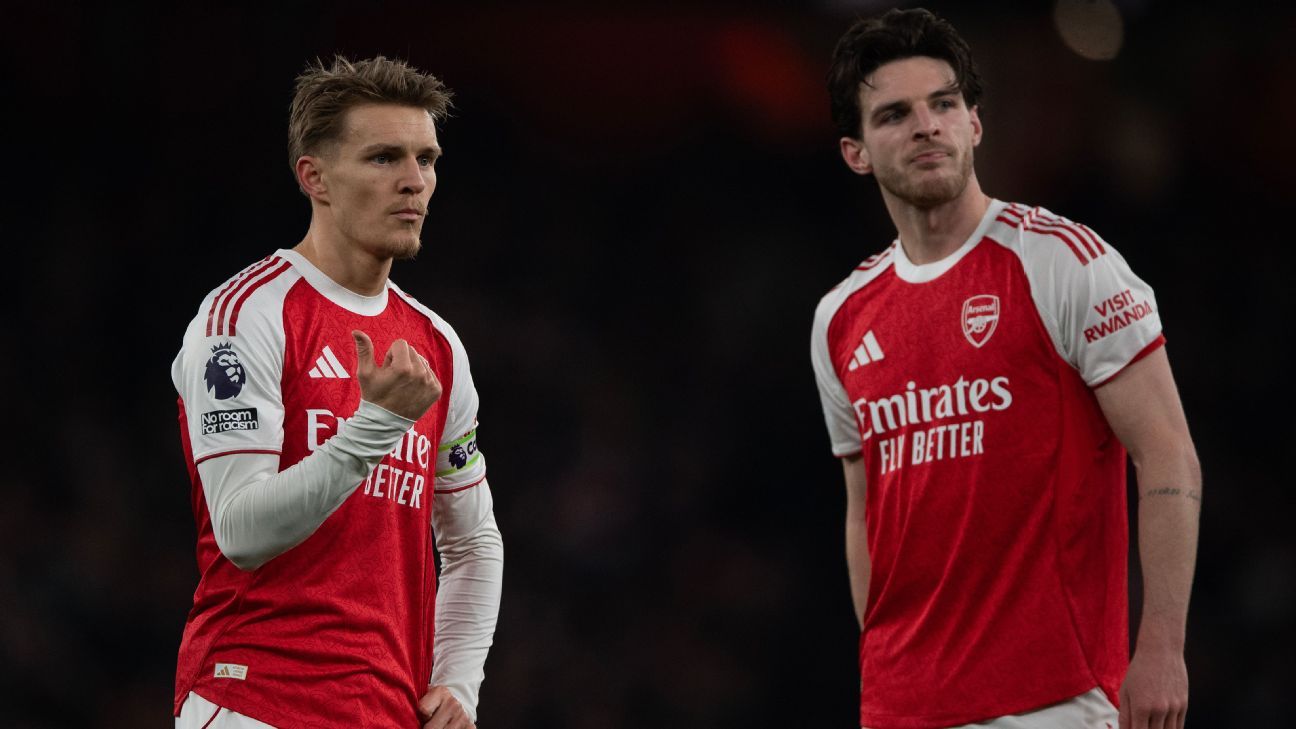
Are attackers the most valuable players in soccer? Or do we just think they’re the most valuable players because we’re better able to measure everything they do? The answer is obvious and impossible — at the same time.
The establishment of expected goals, or xG, showed, among other things, that the best goal-scorers score lots of goals mostly because they take lots of high-value shots. Finishing skill matters, but only at the margins. The ability to find space or create space near the goal, over and over again, is the unifying skill among all the best scorers on the planet.
From there, we can look at the players who created those expected goals with their passes, and we get a pretty good sense of who the best creators are. But once you take a step back from the pass that led to the goal, you’ll quickly find yourself subscribing to goals-only nihilism.
All efforts to quantify the things that happen farther away from the goal have led to similar conclusions: The stuff that happens between the boxes doesn’t have much of an effect on whether or not a goal is scored.
An elegant turn through pressure by a midfielder in his own half might take way more skill than a center-forward barreling over a defender to get his head on a cross, but the latter is what directly affects the score line. And goals win games, so congrats on your press-resistant manipulation of the cover shadow, but our big man just walloped one in with his beefy forehead and we’ve got the three points now.
This feels wrong and right, somehow. We know midfielders matter because we’ve seen so many teams change their midfields and totally change the way they play. But we also know a midfielder can’t single-handedly win games in the same way an on-fire attacker can.
With the proliferation of tracking and movement data, there are all kinds of PhD-level approaches that can be applied to these questions of player value: Particle physics, biomechanics, rocket science all can reveal new knowledge of how the sport works.
And I hope it does, but I am not a particle physicist, a biomechanist nor a rocket scientist. So, for today, I want to focus on a much more specific and universal definition of value: money. How much do Premier League teams pay the players at different positions, and what does that tell us about how the richest league in the world values each one?
– Why Strasbourg becoming Chelsea’s “farm team” is a big deal
– Premier League Future Power Rankings: All 20 teams projected
– Ranked: The top 50 women’s soccer players of 2025
The values of the average Premier League players
To start, let’s look at the average Premier League salary per position.
For this, we’re using the data from the site FBref. It’s a combination of confirmed and estimated data, but it’s broadly accurate and makes it more useful when looking at larger aggregate numbers. I made a somewhat arbitrary decision to cut off the list at players who, per FBref, make $500,000 per year. And that gives us 557 players: 145 forwards, 150 midfielders, 199 defenders and 63 goalkeepers.
We, of course, could get more granular than those designations, but the more you cut it down, the smaller the sample gets for each position. And while there’s even overlap between defenders and midfielders and forwards, the distinctions get even murkier once we start talking about wingbacks and fullbacks and box-to-box midfielders. For the actual designation for any given player, we’re going with whatever FBref lists as his primary position.
So, here’s what the average Premier League player at each of the four positions makes:
• Forward: $5.27 million/year
• Midfielder: $5.31 million/year
• Defender: $4.38 million/year
• Goalkeeper: $3.29 million/year
Based only on that, we’d say that forwards and midfielders are the premium positions in the Premier League, then there’s a gap down to defenders, and another gap down to goalkeepers.
That makes some intuitive sense, perhaps: Forwards and midfielders aren’t that different from each other, and given my arbitrary cutoff point, I think the gap between the two is mostly meaningless. should also note that attacking midfielders such as Phil Foden, Martin Odegaard and Florian Wirtz all get classified under the midfield designation here, which helps boost the value of the position group. So, the further you move from goal, the less players cost.
Still, it’s surprising that midfielders match, let alone, exceed attackers here — even with those caveats. My theory is that midfielders tend to be more interchangeable than attackers. So, there’s a bigger pool of relied-upon midfielders whom teams value, and that boosts the overall average of the position.
On top of that, teams are less willing to experiment with less experienced and therefore lower-paid midfielders in the same way they might with attackers. A mistake made by a young attacker is nowhere near as penalizing as a mistake made by a young midfielder, and so might result in a higher salary floor for midfielders than it does for attackers.
The values of the average Premier League starter
Continuing with that idea: Defenders are rarely getting subbed out in a match, and in an ideal world, most teams would use only one goalkeeper for an entire season. And so, the players beyond the starter level at those positions tend to make significantly less money than the starters, and it pulls down the averages.
So, what if we looked at starters only?
To define “starter,” I’m not going to look at who is actually starting matches but rather which players are being paid like starters. The 4-3-3 or 4-2-3-1 is the most popular formation in the Premier League, and there are 20 teams, so we can just multiply those numbers and come up with what quantity of players at each position are being paid as starters.
It obviously doesn’t work exactly like this in the unequal financial landscape of the Premier League, but I’m defining a starter as the 20 highest-paid goalkeepers, the 80 highest-paid defenders, the 60 highest-paid midfielders and the 60 highest-paid attackers.
The results:
• Forwards: $9.53 million/year
• Midfielders: $9.30 million/year
• Defenders: $7.48 million/year
• Goalkeeper: $6.55 million/year
Put another way, here’s the premium you have to pay to go from average player to starter at each position:
• Forward: 80.6%
• Midfielder: 75.1%
• Defender: 70.9%
• Goalkeeper: 99.3%
This, again, makes sense. Since only one goalkeeper can play at a time and one goalkeeper tends to keep playing unless he makes a bunch of mistakes or gets hurt, the starters make way more money than the average player at the position.
Starting forwards make a lot more than the average forward, which starts to confirm some of the ideas we talked about at the start. There’s less of a divide between midfield starters and average midfielders because more midfielders tend to play. And there’s less of a divide between defenders because, well, there’s simply fewer defenders who aren’t starters because more defenders start.
On top of that, I think there’s a bit of a risk premium in both of these areas, too: A backup goalkeeper or forward might be a lower-paid prospect, but teams tend to want players they think are more reliable in midfield and defense.
If we take the 4-3-3 as the base, here’s what the average “starting unit” in the Premier League earns:
• Goalkeeper: $6.55 million
• Defense: $29.9 million
• Midfield: $27.9 million
• Attack: $28.6 million
It’s interesting, I think, that there’s not really a huge gap in how teams are valuing each unit as a whole. And if we add goalkeepers to the defense, then we could even say that teams are spending the most money on “goal suppression”: $36.5 million.
Obviously many defenders, especially fullbacks, contribute to attacking play, too. But I actually think a sharper trend is coming into place.
If we accept that a good chunk of the midfield spending is coming from attacking midfielders whose value mainly comes from what they contribute near the goal, then we can boost up that “attack” value and lessen the midfield value. That would then mean teams are aligned with the analytical idea that everything happening near the goals, whether defending their own or attacking the other, is what’s most valuable.
The value of Premier League stars
We know that the cost of a point increases the higher you go in the table. In other words, it’s a lot easier to go from 44 points to 45 points than it is to go from 89 points to 90 points. But does that mean the best teams in the league are spending their money in the same way as everyone else — just devoting higher sums to the same positional distributions?
Here, I’m defining a star player as a starter on a top-four team in the league. So, with the framework from the starter section, that would give us the four highest-paid goalkeepers, 16 defenders, 12 midfielders and 12 forwards. Here’s how they average out:
• Forwards: $18.7 million
• Midfielders: $15.7 million
• Defenders: $13.5 million
• Goalkeepers: $11.6 million
And if we look at the premium you have to pay to go from “starter” to “star,” here’s what it looks like at each position:
• Forward: 96.1%
• Midfielder: 69.2%
• Defender: 80.8%
• Goalkeeper: 76.3%
To build a star-filled starting lineup, you’d be spending $11.6 million on your goalkeeper, $54 million on your defense, $47.1 million on your midfield and $56 million on your attack.
The Premier League is telling us a bunch of different things with where the teams are putting their money. The league places a high value on competence in the midfield, but there’s also a ceiling on the value a midfielder can provide, and that ceiling gets lower and lower the better the team gets. I hadn’t even thought of this before, but the way money is allocated in the Premier League suggests midfielders are actually more valuable to bad teams than they are to good teams. And I think I agree.
As a friend put it to me, adding a good midfielder to a bad team is like putting a new engine in your broken-down 1985 Nissan Sentra: All of a sudden it can get you from point A to point B. But the best teams in the leagues already have their engines; they need to add the higher-end details.
With goalkeepers and defenders, the higher up you go on the food chain, the more valuable they become. Perhaps that’s because defensive competence comes from teamwide organization lower down the table, but as you go higher, teams have to score more goals, so their defenses are frequently left unorganized and therefore more reliant on the individual talent of goalkeepers and defenders who can no longer be protected by the system around them.
As for attackers, they earn expensive salaries everywhere, and as you go higher up the competitive ladder, their relative cost actually increases. To go from an average Premier League starter in attack to a star attacker, it’s going to cost you twice as much as what you were already paying.
We started off by wondering what the comparative difference was between midfielders and attackers, and the richest teams in the league have given us one answer: Star attackers are more valuable, by about 20%.
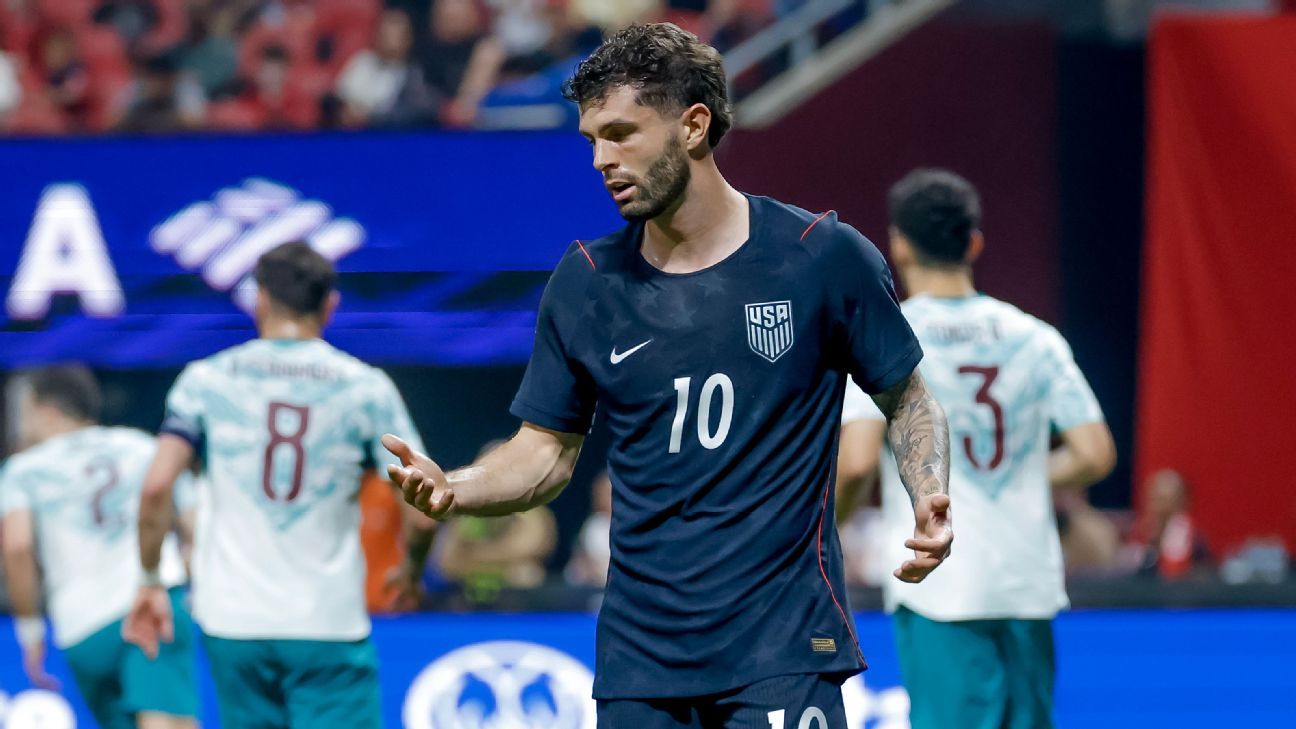
ATLANTA — On the day before the United States men’s national team’s 2-0 loss to Portugal, head coach Mauricio Pochettino mentioned that he might elect to make some tactical tweaks to help star attacker Christian Pulisic end a long scoring drought and build back some lost confidence.
“Maybe we help a little bit to [get him] a little bit more closer to the goal,” he said.
The coach was speaking literally. Pulisic started up front as a center forward on Tuesday and found familiar cohorts in Weston McKennie and Tim Weah feeding him the ball. He received more passes than any other U.S. attacker in the first half and attempted seven ground duels, the most on the team. But he won only one of those duels, and although he forced a couple of saves from Portugal keeper José Sá, he was indeed held scoreless once again.
– Player ratings: Pulisic 3/10 in USMNT’s loss to Portugal
– Ogden: Türkiye will be USMNT’s stiffest test in World Cup group stage
– O’Hanlon: Will USMNT’s depth be World Cup game-changer?
It was Pulisic’s eighth consecutive national team match without a goal, the longest drought of his career, and by the time he gets another opportunity, at least 18 months will have gone by since his last U.S. goal. Increasingly frustrated as the first half went on, the AC Milan star committed a couple of fouls and received a yellow card before halftime. He was subbed out after 45 minutes.
“We were able to create chances, which if I finish chances, which I know I’m going to, then things are going to be a bit different,” Pulisic said after the game.
Pulisic’s struggles — plus a 37th-minute Portugal goal after a turnover by McKennie and a perfect passing sequence from Vitinha to Bruno Fernandes to Francisco Trincão — overshadowed another solid first-half performance in which the U.S. attempted eight shots to Portugal’s three and generated 0.45 xG to Portugal’s 0.26. The U.S. had seen more touches in the box, too.
Neither team had started its entire first-choice lineup, but in the second half Portugal’s extreme depth advantage showed. While Patrick Agyemang (Derby County), Tanner Tessmann (Lyon) and Max Arfsten (Columbus Crew) subbed on for the U.S., Portugal coach Roberto Martinez was able to bring in Nuno Mendes (Paris Saint-Germain), Matheus Nunes (Manchester City), João Félix (Al Nassr), and Francisco Conceição (Juventus), among others.
Mendes, one of the best left backs in the world, was quickly able to test Alex Freeman down the Americans’ right side and, after Freeman conceded a corner, a wide-open João Félix slammed in Portugal’s second goal — both assisted by Fernandes — in the 59th minute. At that point, the match was effectively over.
The March international window before a World Cup is a particularly odd one. The U.S. scheduled a couple of heavyweights in Belgium and Portugal, knowing that the results would hold massive weight on perceptions and narratives heading into the summer. It’s safe to say that two losses by a combined 7-2 will certainly define discussions over the next few weeks.
At the same time, there’s a reason Portugal boss Martinez called team assessments in March “worthless” earlier in the week. With a number of prospective World Cup starters still out with minor injuries and a number of roster spots still up for grabs, however, Pochettino needed further impressions from a lot of the 24 players who saw the field over the two matches. What did he see?
-
Malik Tillman created five chances in 138 minutes while splitting time in a central attacking midfield role (against Belgium) and on the left wing (against Portugal). He created only two shot attempts for himself, however, putting one on goal.
-
McKennie scored from a set piece against Belgium and found another great chance early against Portugal, sending it wide. He wasn’t as sharp in the second match, and his turnover near midfield sent Portugal off toward their first goal.
-
Defender Auston Trusty played almost the entire match against Portugal and won five of seven duels. He was mostly stable out of possession, though you could make the case that he dropped back far too low on Portugal’s first goal, giving Trincão space to fire off an open shot.
-
After struggling at right back against Jérémy Doku and Belgium, Weah was the team’s most dangerous attacker against Portugal, making six progressive carries (the most on the team) and sending in a pair of dangerous crosses.
-
Aidan Morris and Sebastian Berhalter were given massive opportunities, starting against a dynamite Portuguese midfield. Morris, one of the best duel winners in the player pool, won a pair of duels and made seven defensive interventions, and each player completed four progressive passes.
-
Freeman played 79 minutes on Tuesday and won four of seven duels, though he very much had his hands full with Nunes in the second half.
-
Agyemang was mostly quiet against Portugal but was a lone bright spot against Belgium, scoring late.
For now, however, the biggest impression comes from Pulisic. The 27-year-old has now gone 14 matches for club and country without a goal, his longest drought since 2022.
“Physically I feel really good, feel really sharp and I’m doing a lot of good things,” Pulisic said. “I have to help my team to create assists and score goals and create chances. Obviously when I don’t do that it’s frustrating, but I feel like I’m close and I feel good things are coming.”
He will now return to Milan as they attempt to push up from second place in Serie A.
That’s two teams counting on his return to form.
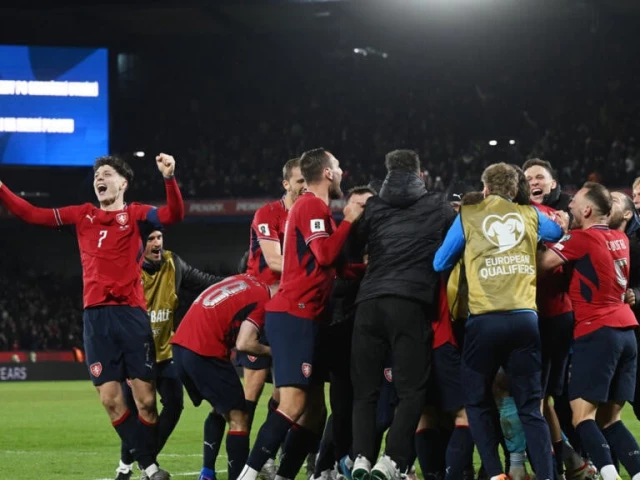
Czech Republic players celebrate after the penalty shoot out in Prague. Photo: AFP
PRAGUE:
Michal Sadilek’s penalty sent the Czech Republic to the World Cup as they beat Denmark in a shootout in Prague on Tuesday following a 2-2 draw after extra time.
The Czechs will play their first World Cup since 2006, facing Mexico, South Africa and South Korea in Group A of the tournament hosted by the United States, Canada and Mexico in June and July.
Tomas Chory and Tomas Soucek also scored for the Czechs in their second shootout in six days, while skipper Ladislav Krejci was denied by Danish goalkeeper Mads Hermansen.
For the visitors, Christian Eriksen was the only shootout scorer while Rasmus Hojlund hit the crossbar, Anders Dreyer failed to beat goalkeeper Matej Kovar and Mathias Jensen fired over the crossbar.
“I’m speechless. Hats off to everyone, I’m incredibly happy,” Krejci told Czech state television.
“Let’s be honest, we were not the better team but we showed more heart and we fought harder,” added the Wolverhampton defender.
“I had teary eyes, just a bit. I’m terribly happy and I want to thank the players,” Czech coach Miroslav Koubek told reporters.
“We suffered today. We played the best we could,” added the 74-year-old former goalkeeper.
On the chilly night in Prague, Pavel Sulc opened the score for the Czechs with a fine volley into the top corner three minutes into the game after the Danish defence had cleared a corner in his direction.
Denmark levelled in the 72nd minute when Mikkel Damsgaard’s free kick found Joachim Andersen in the box ready with a glancing header.
Krejci put the hosts ahead again in the 100th minute as he picked up a ball knocked down by Soucek in a goalmouth scramble following Vladimir Coufal’s cross.
His shot was deflected into the net by Danish defender Alexander Bah.
But Denmark levelled again in the 111th minute when substitute Kasper Hogh headed home Eriksen’s corner six minutes after coming onto the pitch.
‘Outstanding success’
In the play-off semi-finals on March 26, the Czechs beat Ireland on penalties while Denmark breezed past North Macedonia 4-0.
But they had a hard time beating the Czech defence as the hosts parked the bus after the quick opening goal, defending with 10 men.
Rasmus Hojlund had his low shot cleared by Kovar who also forced Gustav Isaksen’s curling free kick over the crossbar.
The hosts were a threat on the break but Lukas Provod tipped the ball past Hermansen and his right post.
Denmark kept pushing and missing or finding Kovar’s arms throughout the game, while the hosts often resorted to blindly clearing the ball.
Denmark will sit out their first World Cup since 2014, while the Czech Republic will record only the second appearance since it split with Slovakia to emerge as an independent country in 1993.
At the 2006 World Cup in Germany, the Czech Republic relied on the likes of Petr Cech, Pavel Nedved, Tomas Rosicky, Karel Poborsky and Jan Koller and bowed out after the group stage.
The 2026 World Cup berth is a rather unexpected triumph for the Czechs who struggled through the qualification, swapping coaches just before the play-offs amid mounting criticism from fans and pundits.
Long-time skipper Soucek lost the captain’s armband before the play-offs after a fumbled attempt to console fans particularly upset by a 2-1 qualifying defeat on the Faroe Islands last October.
“The faith that we can do it kept growing every day, every hour,” the veteran coach Koubek said.
“This is teamwork and an outstanding success and I’m really sincerely happy.”
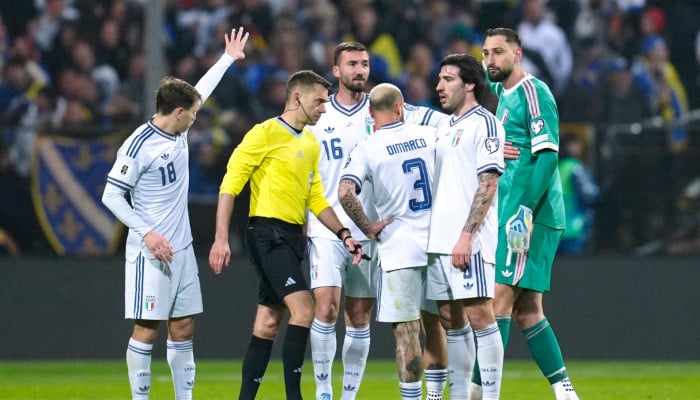
Italy failed to qualify for a third consecutive World Cup as a play-off defeat on penalties to Bosnia and Hercegovina on Tuesday meant the Azzurri will not go to this year’s tournament in North America, while Turkiye, the Czech Republic and Sweden all secured their places at the finals.
Italy have won the World Cup four times, but they failed to qualify for the 2018 and 2022 tournaments and will once again have to watch from afar as the field is expanded to 48 teams in the United States, Canada, and Mexico.
Bosnia won 4-1 in the shoot-out in Zenica after their play-off final finished 1-1 at the end of extra time, with Sandro Tonali the only Italy player to score from the spot as Francesco Pio Esposito blazed their first penalty over and Bryan Cristante smashed his kick against the crossbar.
Moise Kean had given Gennaro Gattuso’s Italy the lead on 15 minutes, but they were reduced to 10 men when Alessandro Bastoni was shown a straight red card late in the first half.
Bosnia equalised on 79 minutes through Haris Tabakovic, and with no further goals in extra time, the tie was decided on penalties.
“I don’t think the boys deserved to suffer such a blow,” said Gattuso. “It’s difficult to digest.”
Ranked 66th in the world, Bosnia finished second in qualifying Group H behind Austria before beating Wales on penalties in their play-off semi-final.
Their only previous World Cup appearance came in 2014. Now they go into Group B at this year’s tournament along with Canada, Qatar, and Switzerland.
The 2014 edition is the last time Italy qualified. They went out in the group stage, like in 2010. They have not won a World Cup knockout game since they last lifted the trophy in 2006.
In 2018, they failed to qualify after losing a two-legged play-off final to Sweden, and they also missed out in 2022 after losing a play-off to North Macedonia.
Kosovo dream over
Turkiye qualified as Kerem Akturkoglu’s 53rd-minute goal secured a 1-0 win in Kosovo, shattering their hosts’ dream of appearing at the tournament for the first time.
It will be Turkiye´s first appearance at a World Cup since reaching the semi-finals in 2002. Vincenzo Montella’s team will go into Group D along with co-hosts the United States, Paraguay, and Australia.
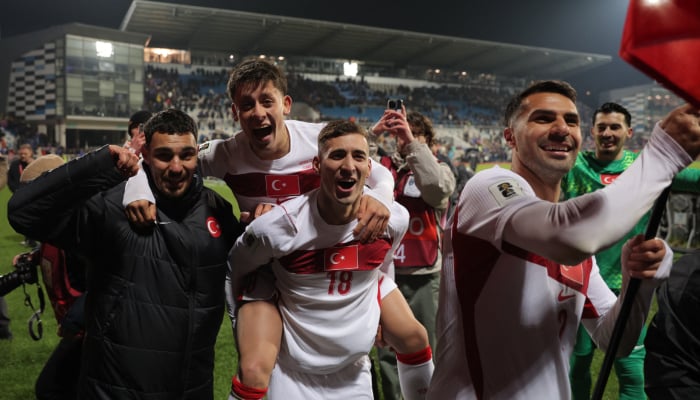
Montella’s side is ranked 22nd in the world, but this will only be Turkiye´s third ever appearance at the World Cup — they went to the 1954 tournament before coming third 24 years ago in South Korea and Japan.
“We achieved our dreams. The World Cup is the pinnacle in this profession,” Montella told UEFA.com.
Kosovo, ranked 78th, were targeting a first-ever World Cup appearance, having only been accepted as a Fifa member a decade ago.
Gyokeres heroics, Danes denied
Sweden recovered from a desperate performance in the group stage of qualifying to secure their place at the finals in dramatic fashion.
Having beaten Ukraine 3-1 in last week’s semi-final, they edged Poland 3-2 in Stockholm, with Arsenal’s Viktor Gyokeres scoring an 88th-minute winner.
Earlier, Sweden had twice taken the lead only to be pegged back, with Anthony Elanga’s opener on 20 minutes cancelled out by Nicola Zalewski, only for Gustaf Lagerbielke to put the hosts back in front before half-time.
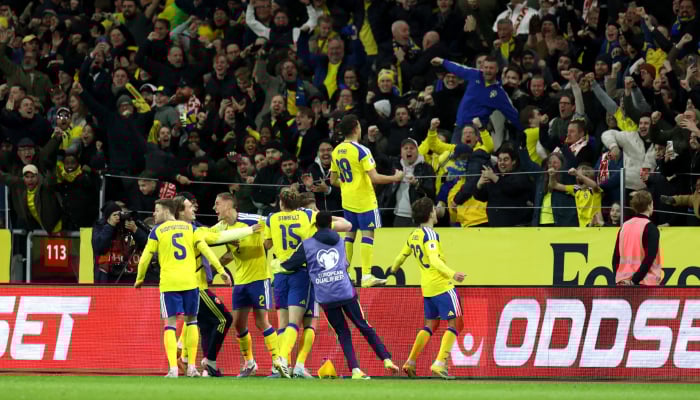
Karol Swiderski got Poland’s second early in the second half, but Gyokeres forced the ball over the line after a frantic goalmouth scramble late on.
They finished bottom of qualifying Group B without a win, but secured a play-off spot thanks to their performances in the UEFA Nations League.
Now coached by Englishman Graham Potter, they will go into Group F at the World Cup along with the Netherlands, Japan, and Tunisia.
The Czech Republic matched Bosnia’s achievement by qualifying thanks to back-to-back shoot-out victories, as they followed their success against Ireland last week by defeating Denmark 3-1 on penalties in Prague.
The match finished 2-2 after extra time, with Pavel Sulc firing the hosts ahead only for Joachim Andersen to head the Danes level.
Ladislav Krejci then put the Czechs back in front in extra time, but Kasper Hogh made it 2-2.
However, Denmark converted just one of their four penalties, with Rasmus Hojlund, Anders Dreyer and Mathias Jensen all failing from the spot as the Czechs qualify for a first World Cup since 2006.
They go into Group A with South Africa, South Korea and Mexico.


New Zealand’s apparel imports down 11% to $216 mn in Jan-Feb

Brandy Norwood reveals truth about Wanya Morris relationship in new memoir

Food prices to rise by almost 10% due to Iran war, warns key industry body

-

 Politics1 week ago
Afghanistan announces release of detained US citizen
-

 Sports1 week ago
Broadcast industry CEO says consolidation is ‘essential’ to compete for NFL soaring media rights prices
-

 Tech1 week ago
Can a Home Appliance Fix the Problem of Soft-Plastic Waste?
-
 Business1 week ago
Property Play: Home flippers see smallest profits since the Great Recession, real estate data firm says
-

 Entertainment1 week ago
UN warns migratory freshwater fish numbers are spiralling
-
 Business1 week ago
Gold prices soar in Pakistan – SUCH TV
-

 Fashion1 week ago
ICE cotton slips on weaker crude, profit booking
-
 Business1 week ago
More women are entering wealth management, but few are in advisory roles, study finds