

Business
How the new order of the Murdoch dynasty is playing out

Katie RazzallCulture and Media Editor

 BBC
BBCChristmas is a time when families get together if they can – and, until this year, the Murdochs were no different. With members of the media dynasty spread across the globe, full family gatherings were rare, although in 2008, according to biographer Michael Wolff, the Murdochs spent the festive season together on a flotilla of private yachts.
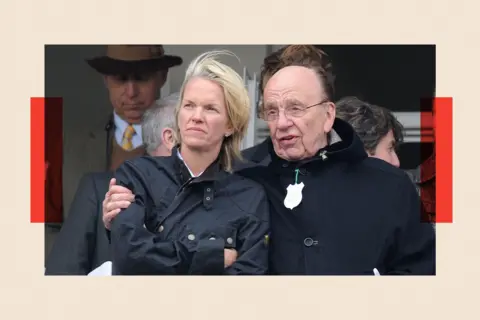
But more often in recent years it was Rupert – for many decades the most influential media titan in the world – and his daughter Elisabeth who would make time for each other.
She would certainly have room this year to host her father at the luxurious home she has renovated on the edge of the Cotswolds. But after a bruising closed-court battle in Nevada that became public and an eventual agreement that shut Elisabeth and two of her siblings out of the family firm for good, relations are likely still too strained for even the Murdoch family peacemaker to suggest communal tree-decorating.
 WireImage
Rupert’s eldest child by his second wife, Elisabeth is the co-founder and executive chairman of the production company, Sister, which is behind hit television series, including Black Doves, The Split and This is Going To Hurt. In my experience, she is generous, intelligent and hard-working.
Friends are fiercely loyal and protective of her privacy. Nobody I have spoken to has a bad word to say about her. Many acknowledge, though, that it has been an incredibly testing year on the family front – even if Elisabeth, her younger brother, James, and elder half-sister, Prudence, are each around a billion dollars richer.
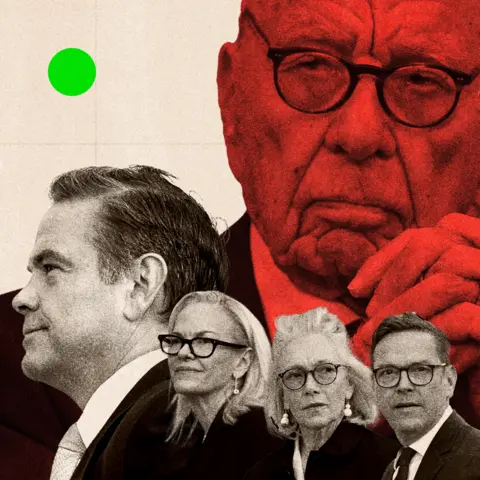
Money doesn’t compensate for a father who, in his mid-90s, decided to rip his family apart because he believed it was in the interests of his business. The Murdochs have never been a traditional family – one reason why their story is said to have inspired the power struggles and backstabbing in the acclaimed TV drama, Succession. But this time, the schism feels more permanent. And as one person put it to me, the TV show concluded too early by killing off Logan Roy: there was more drama to come.
‘James and Rupert will never patch up differences’
James Murdoch’s relationship with his father and older brother Lachlan appears irreconcilable. Earlier this year, he described his dad as a “misogynist” in an interview in US magazine The Atlantic, and referred to some of Rupert’s behaviour in the courtroom fight as “twisted”.
He is known to feel betrayed and angered by Rupert’s decision to force him, Elisabeth and Prudence formally to cut ties with Fox Corp and News Corp. Driven by fears over the more liberal direction they might want the companies to take after his death, the media mogul tried to change the terms of a trust that gave his four oldest children equal control when he dies.
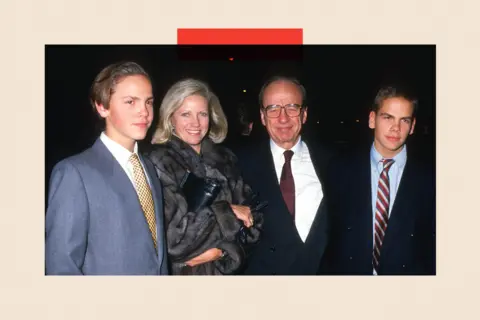 Ron Galella Collection via Getty Images
Lachlan, who Rupert had already chosen to run the business, is now – definitively – the only one who will take the reins after his father’s demise.
Lachlan and Rupert Murdoch actually lost the first round of their court fight. The trust had been set up in 1999, when Rupert divorced Anna, the mother of Lachlan, Elisabeth and James.
The judge ruled that changing it was in bad faith. But behind the scenes, the warring sides eventually came to an agreement. James, Elisabeth and Prudence agreed to sell their shares. They have accepted terms that include not being allowed to buy any equity in the family company in future.
“It’s a sad ending,” Claire Atkinson, whose biography of Rupert Murdoch will come out next year, told us on The Media Show.
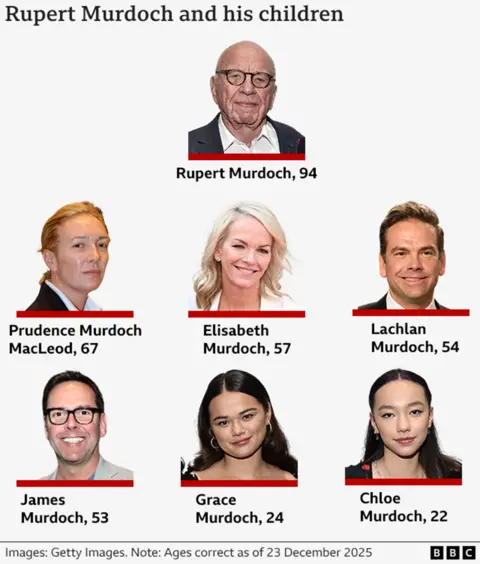
“These kids worked in the business, they grew up in the business, and the press release said, ‘You can’t buy shares in this company,’ and effectively said, ‘Don’t let the door hit you on the way out.'”
She also told me: “This break is extremely permanent. It feels like James and Rupert will never patch up their differences.”
Lachlan Murdoch has been quoted as saying that the resolution is “good news for investors” and “gives us clarity about our strategy going forward”.
Ironically, his successful leadership of Fox Corp, where he’s been CEO since 2019 (he became chairman of Fox and also News Corp in 2023 when his father became chairman emeritus), made the deal more costly.
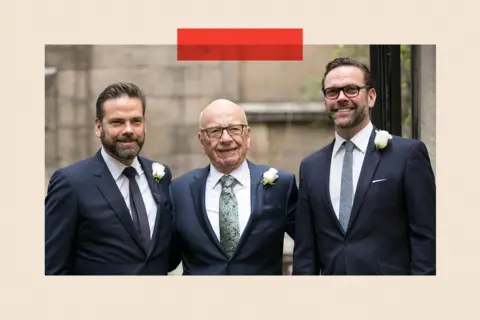 Getty Images
Fox Corp has seen its share price double under Lachlan and the Trump presidency has brought a ratings bonanza. It raised the amount he had to pay his siblings to get them out – a presumably unwelcome side effect.
Despite the payout, Atkinson says, “There is a fracture in the company and a fracture in the family.”
So where do the Murdochs go from here, privately and corporately?
Court battles, rifts and an ageing patriarch
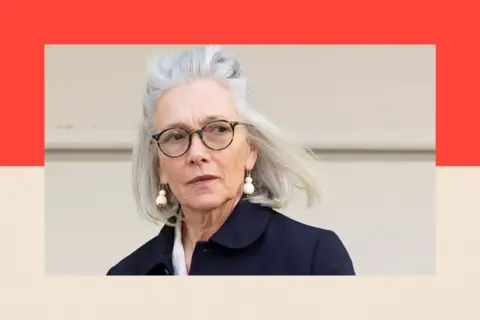
Elisabeth and her half-sister Prudence are said to be concentrating on moving on.
Their father turned 94 in March, with the court battle in full swing. The sisters are mindful that he won’t be around forever and I am told they are hoping at some point to repair the rift.
 Reuters
However much they have felt betrayed by him (and there is no doubt, they have felt it, very painfully), there’s an understanding of the dwindling number of years he has left.
But Christmas may still be too soon for reconciliation. Lachlan hosted his annual party for the Australian elite at his harbour-side Sydney home earlier this month. Fox Corp may operate out of the US, but he is said to prefer the laid-back nature of Australian life, even if the trade-off is business calls in the middle of the night because of the time difference, as well as a lot of flights.
Atkinson says he is popular and well-liked within the business. “The difficulty that Lachlan has is that he’s been in charge for years, but everybody is always going to project that every decision is Rupert’s. He’s never going to want to say, ‘Hey, that’s me,’ and so I think it’s a little hard to come out from Dad’s shadow.”
At the same time, Rodney Benson, professor of media, culture, and communication at New York University, says that while Rupert remains a presence in the company “what’s really unique about Lachlan’s approach, or what will be unique about his approach, won’t fully emerge”.
Lachlan’s ‘business over politics’ strategy
Fox News is the financial cash cow, which may explain Rupert Murdoch’s concerns that his children might have wanted to change its political affiliations.
Under Lachlan, there’s been a successful strategy to expand into digital and streaming, most notably the ad-supported video-on-demand service, Tubi.
In September, US President Donald Trump said Rupert and Lachlan Murdoch were expected to be part of a group of investors trying to buy TikTok in the US. On Thursday, TikTok parent company ByteDance announced to staff that it had signed an agreement to sell a portion of TikTok to a group of mostly US based investors. Lachlan and Rupert were not named as part of the deal.
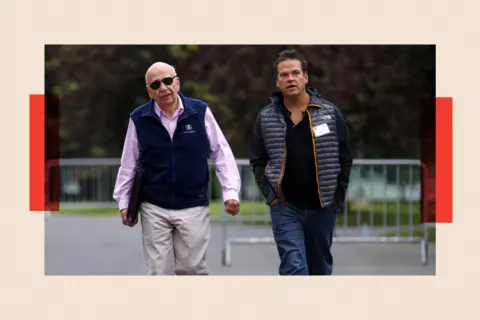 Reuters
Presenting the Fox Corporation’s results for July to September, Lachlan said Tubi had achieved rapid revenue growth and growth in view time, confirming its position as the top premium advertising-based video-on-demand platform in the US.
“And I’m happy to say Tubi reached profitability this past quarter,” he added. “It’s a great milestone.”
He also said Fox News had maintained strong ratings throughout the quarter, cementing its status as the most-watched cable network in prime time, and leading to the highest advertising revenue for July-September quarter in Fox’s history.
Rupert Murdoch’s 70-year career saw him as “both an interventionist editor-in-chief figure and a political kingmaker”, according to Paddy Manning, an investigative journalist who wrote The Successor: The High-Stakes Life of Lachlan Murdoch. But he adds, “Lachlan is less of the journalist and powerbroker than his father, and more of a businessman.
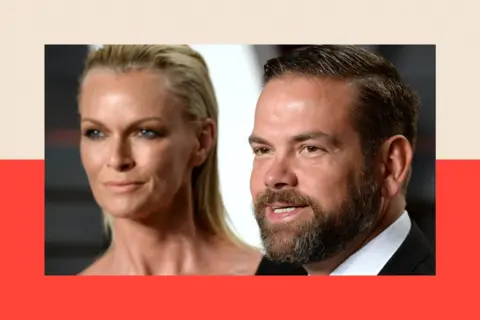 Getty Images
“If you look at the signature deals that Lachlan has made over his career, they have not been designed to increase his political influence. From digital real estate to sports betting to commercial radio to Tubi, Lachlan’s investment decisions are focused on the bottom line, not burnishing his political credentials.”
But Prof Benson suggests the significant debt the Murdoch businesses have taken on as part of the settlement with Lachlan’s siblings increases pressure to make profit, and therefore to pursue “politically sensationalistic… outrage journalism”.
“The proven way to be profitable in cable/streaming news is not by becoming more centrist and civil, it’s by becoming more extreme, more polarising, and more willing to stir outrage,” he says.
Rupert has had a hotline to major political figures for decades. In September he was on President Trump’s guestlist for the state banquet at Windsor Castle. I’m told he spent nearly two weeks in London and was in the News UK office most days.
While Lachlan now runs the company, his father is still very much involved. Rupert’s been described to me, at 94, as still “the sharpest person in the room” and a “phenomenon who loves papers and has ink in his veins”. His voice may be a little softer, but he is mentally as strong and influential as ever, I’m told.
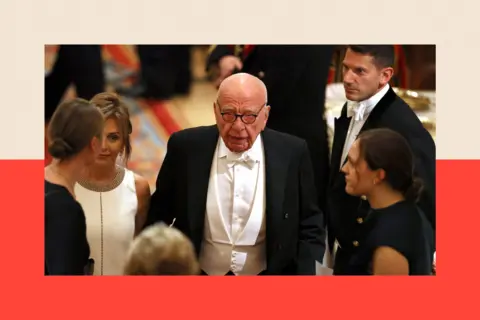 AFP via Getty Images
At one point the editor of the Times introduced Rupert to a slightly startled young journalist on the newsdesk and asked him to show the boss the paper’s recently launched Live app and what it showed around reader engagement on specific stories.
Rupert also spoke to Fraser Nelson, the former Spectator editor now Times columnist, who usually sits at the open plan table in the office. They discussed the company’s pivot to video and the work Nelson had been trialling around short form video. Rupert also wanted to talk to his paper’s new star about whether Nigel Farage would end up in government.
A family ‘deeply divided’
Three months on from the family trust dispute settlement, Mr Manning claims that the Murdochs are “deeply divided”.
“While Lachlan works closely with his father, I understand he remains estranged from his elder siblings,” he alleges.
Rupert Murdoch and his children Lachlan, James, Elisabeth and Prudence were all approached for comment.
Presciently, Anna Murdoch – Lachlan, James and Elisabeth’s mother – predicted much of the fallout back in the 1980s.
In her novel Family Business, Anna, a journalist and author, wrote about the rise of a fictional newspaper dynasty and explored sibling rivalry, jealousy and how parental power can negatively impact family relationships. The plot of the book, published while her children were in their teens, follows how a newspaper owner’s children are shaped by a parent who turns them into competitors in a power struggle.
 Getty Images
A decade after it was published – by which time the pair had divorced and Rupert had married third wife Wendi Deng – Anna gave an interview to an Australian women’s magazine, during which she was asked which of her children would be best suited to take over from her ex-husband.
“Actually I’d like none of them to,” she said. “I think they’re all so good that they could do whatever they wanted really. But I think there’s going to be a lot of heartbreak and hardship with this [succession]. There’s been such a lot of pressure that they needn’t have had at their age.”
The family trust, agreed between Rupert and Anna as part of their divorce settlement, was her way of safeguarding her children’s futures, by ensuring they had equality after Rupert’s death. But that blew up – through a court fight in Nevada and a settlement.
And with that, relations with three of his six children may have blown up too – perhaps for good.
Top picture credits: Getty Images and Reuters

BBC InDepth is the home on the website and app for the best analysis, with fresh perspectives that challenge assumptions and deep reporting on the biggest issues of the day. You can now sign up for notifications that will alert you whenever an InDepth story is published – click here to find out how.
Business
India-US trade deal update: Piyush Goyal meets USTR Jamieson Greer, discusses next steps in BTA talks – The Times of India
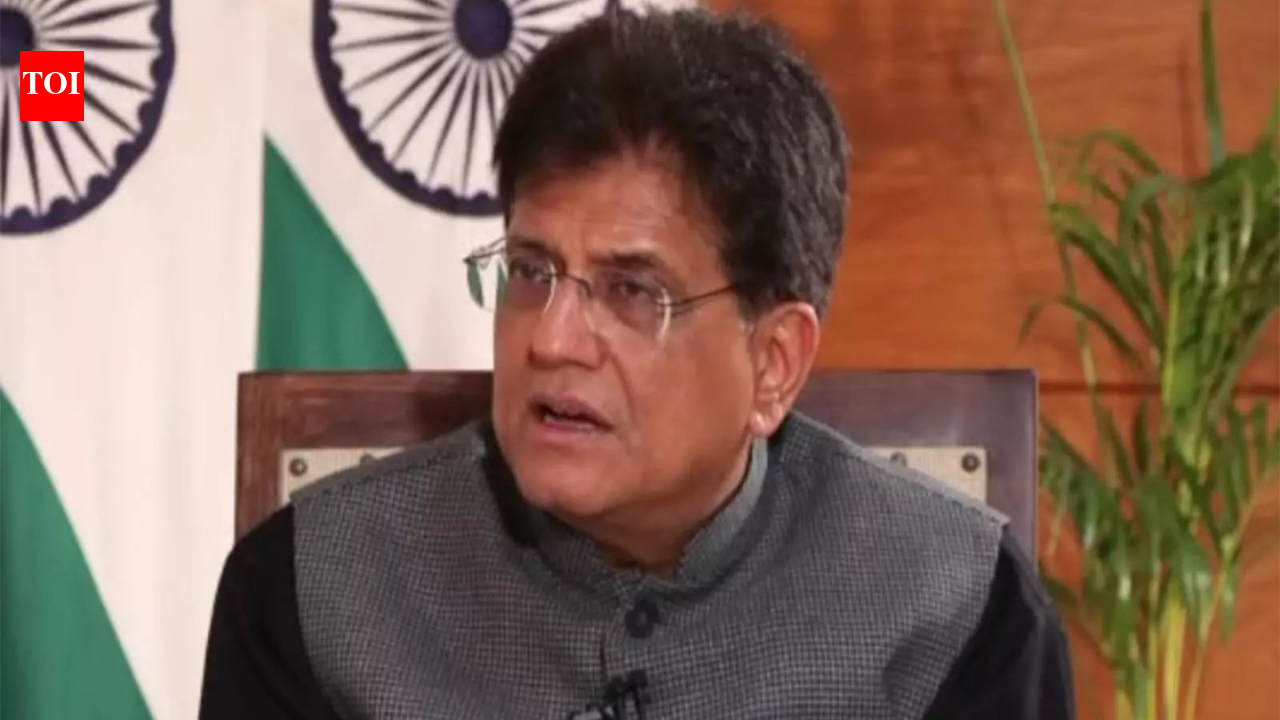
Commerce and industry minister Piyush Goyal on Friday met US Trade Representative Jamieson Greer and reviewed the next steps in negotiations for the proposed India-US bilateral trade agreement (BTA).The meeting took place on the sidelines of the 14th ministerial conference (MC14) of the World Trade Organisation in Yaounde, Cameroon, where both sides also exchanged views on issues related to the WTO agenda.“Had a very productive discussion with @USTradeRep Jamieson Greer on the sidelines of the WTO Ministerial Conference. Exchanged views on the #WTOMC14 agenda, next steps in the India-US BTA negotiations and explored ways to further deepen our economic cooperation and bilateral trade ties,” Goyal said in a social media post.The development comes amid ongoing efforts by both countries to finalise an interim trade pact. Last month, India and the US announced that they had finalised a framework for the first phase of the agreement, though it is yet to be signed.The two sides had earlier announced a trade deal on February 2, followed by a joint statement on February 7 outlining the contours of the agreement.As part of the framework, the US had agreed to reduce tariffs on Indian goods to 18%. However, the tariff structure has since undergone changes after the US Supreme Court struck down sweeping tariffs imposed under earlier measures.Following the ruling, US President Donald Trump introduced a 10% tariff on all countries for a period of 150 days starting February 24.In view of these developments, a planned meeting between chief negotiators of India and the US — aimed at finalising the legal text of the agreement — has been postponed. The pact was earlier expected to be signed this month.An official had earlier said that the interim trade agreement would be signed once the new global tariff framework of the US is fully in place.

When you think of an investor, what kind of person comes to mind? What are their interests, their job? Are they an older man wearing a pin-striped suit and a bowler hat?
It might surprise you that the average investor age in the UK is 49 years old – down from 55 years old over the last five years.
And with more than 13 million DIY investor accounts in the UK, it’s likely that the average investor looks more like one of your mates than someone out of The Wolf of Wall Street.
The UK is historically quite wary of investing, and it’s been something that the financial industry and governments have been trying to tackle for years.
We’re starting to see the fruits of these efforts trickle through; latest Boring Money data reveals that DIY investing accounts grew over 19 per cent in the last year. Roughly one-third of the population now invests, up from about a quarter in 2020, and it’s becoming more mainstream by the day.
Start small, stay consistent – let the market do the work
It’s a common misconception that you need to have a lot of money to be an investor. The median amount invested by DIY investors is around £15,000, but you can start with as little as £1.
Neither does it have to be done in one big hit. Lots of providers allow you to set up regular investing – often £25 a month minimum, but a few let you regularly invest less.
Setting up these direct debits can also be a good idea – you drip feed into markets and average out the price which you buy at, so smoothing out any ups and downs along the way.
And you don’t have to be a maths genius or obsessively checking the markets – there are plenty of tools and account types that can do this for you.
Get a free fractional share worth up to £100.
Capital at risk.
Terms and conditions apply.
ADVERTISEMENT

Get a free fractional share worth up to £100.
Capital at risk.
Terms and conditions apply.
ADVERTISEMENT

Robo-advisors are automated, algorithm-driven financial planning and investment services requiring little to no human supervision. A typical robo-advisor asks questions about your financial situation and future goals when you set up the account, then will match you to one of their ready-made portfolios and automatically invest for you.
Find your investment “playlist”
If you don’t want to go down the robo-route, but aren’t sure which to pick, you can take a look at some of last year’s best-selling funds for inspiration. These four funds below appeared on multiple investment platforms’ best-selling lists every month in 2025.
They are all low-cost global collections of shares which are well diversified. Think of them like an investment playlist curated for you to serve up a bundle of shares in one easy-to-buy package.
The idea is that you can buy one product which is very broadly spread around lots of different companies which minimises the risk of any one thing going horribly wrong.

Fidelity Index World: a very cheap way to buy about 1,300 of the world’s largest companies in one go, pre-wrapped into one single investment product which costs about £1.20 a year for every £1,000 invested here.
HSBC FTSE All-World Index: a similar global option with over 3,000 companies and emerging markets too, so you get exposure to India, China and Brazil too, for example. Good if you don’t want too much exposure to the US.
Vanguard FTSE Global All Cap Index: a very diversified option. It has shares in about 7,000–8,000 companies with a small proportion in smaller companies, about 10 per cent in emerging markets, and slightly less in the US than some peers – a bit pricier than some trackers but still really good value – about £2.30 a year for every £1,000 invested here.
Vanguard LifeStrategy 100% Equity: one with a heavier British weighting – about 20 to 25 per cent invested in the UK.
Starting from scratch
If you’re a total beginner and want one of these global options to get started, you could compare platforms which will let you buy funds and won’t cost a lot for a small amount. Hargreaves Lansdown and AJ Bell are good options if you have small balances and want to buy a fund like the above. Or you can open an ISA with Vanguard and pop one of their ready-made ‘LifeStrategy’ funds into it.
If you prefer to buy and sell shares or exchange traded funds then Trading 212 and Freetrade are good low-cost ISA providers for smaller balances.
Investing has never been easier.
The average investor age is dropping, the amount you need to invest is low, and people are investing less, but more regularly. There are plenty of different platforms, things to invest in and ways to invest.
People talk about “time in the market, not timing the market” – that means if you’re in it for the long-haul, and can afford to invest small amounts regularly, you’ll be in a great place further down the line. The most important thing is to just get started and build up over time.
When investing, your capital is at risk and you may get back less than invested. Past performance doesn’t guarantee future results.

Britain’s competition watchdog has vowed to tackle fake and misleading online reviews “head on” as it launched investigations into firms including Just Eat and Autotrader.
The Competition and Markets Authority (CMA) said reviews are used by 90% of consumers when they buy over the internet and play a large part in the UK’s over £200 billion online retail sector.
But up to 50% of online reviews are fake, according to recent research by tech firm Truth Engine.
The CMA said its latest action against firms comes as part of a clampdown on fake and misleading reviews as shoppers increasingly rely on customer feedback when shopping online.
Emma Cochrane, executive director for consumer protection at the CMA, told the Press Association: “It’s so important that consumers can have trust in those reviews because we know that nine in 10 of us rely on them when we’re shopping, and that retail shopping in the UK is billions of pounds worth a year.
“It’s so important that consumers can have trust and confidence when they’re shopping online.”
Here are the CMA’s tips for spotting and avoiding fake reviews:
– Read the reviews
Shoppers often get taken in by five-star ratings without actually reading what people have to say about a product or service.
“You’ll be surprised at how many reviews sound dubious, overly vague or even totally unrelated to the item they’re supposedly endorsing,” the CMA said.
– Be alert to AI-generated reviews
Artificial intelligence (AI) can be used to make fake reviews sound fluent, polished and highly convincing.
“If a review feels a bit too slick, reads like it’s been perfectly crafted, or uses very similar wording to others, it may not reflect a real customer’s experience,” the CMA warned.
– Take a look at the other ratings
Look beyond the five-star ratings.
Three or four-star reviews are less likely to be fake, and they can be more useful to give a genuine, overall assessment.
– Check out multiple sites
Looking across several sites can help shoppers see patterns and provide a more consistent picture.
“Check a few different review sites. If you’re seeing the same kind of reviews coming up again and again, it’s more likely to be fake,” said Ms Cochrane.


China rolls out tariff cuts on Congo imports from April 1
India-US trade deal update: Piyush Goyal meets USTR Jamieson Greer, discusses next steps in BTA talks – The Times of India

Lee Sang-bo dies at 45: Funeral details revealed

-

 Entertainment1 week ago
Val Kilmer revived 1 year after death through AI
-

 Fashion6 days ago
China’s textile & apparel exports surge 17% to $50 bn in Jan-Feb 2026
-

 Sports7 days ago
Rating Adidas’ 2026 World Cup away shirts: Argentina, Spain, Mexico and more
-
 Business1 week ago
Video: The Effects of High Oil Prices
-
 Business7 days ago
Flipkart group CFO to leave co amid IPO plans – The Times of India
-

 Sports7 days ago
American Conference Commissioner Tim Pernetti thanks Trump for Army-Navy game executive order
-
Tech1 week ago
The Corsair 4000D RS PC Case Keeps Your System Cool
-

 Tech1 week ago
‘Uncanny Valley’: Nvidia’s ‘Super Bowl of AI,’ Tesla Disappoints, and Meta’s VR Metaverse ‘Shutdown’