

Business
India services sector loses steam: Growth moderates amid rains, competition; HSBC PMI shows softest rise in 5 months – The Times of India


India’s services sector saw its slowest pace of growth in five months during October, as competitive market pressures and heavy rainfall in some regions weighed on business activity.According to the monthly HSBC India Services PMI Business Activity Index, compiled by S&P Global, the seasonally adjusted reading fell to 58.9 in October, down from 60.9 in September, signalling the weakest expansion since May. Despite the moderation, the figure remained comfortably above the neutral 50 mark—which separates growth from contraction—and higher than the long-term average of 54.3, as per news agency PTI.Pranjul Bhandari, chief India economist at HSBC, said, “India’s services PMI softened to 58.9 in October, which represented the slowest pace of expansion since May. Competitive pressures and heavy rains were cited as contributors to the sequential slowdown.”The survey, based on responses from around 400 service sector firms, indicated that while demand buoyancy and GST relief helped improve business conditions, factors such as increased competition and adverse weather dampened momentum.External demand for Indian services also grew further, though the rate of increase was the weakest since March. The report noted that the GST reform had a positive influence on price pressures, with input costs and output charges rising at their slowest pace in 14 and seven months, respectively.Companies remained optimistic about future business activity, expressing strong confidence in growth prospects over the next year. To meet new orders and ensure timely service delivery, many firms added staff in October.The HSBC India Composite PMI Output Index, which combines manufacturing and services data, also reflected slower growth—dropping from 61 in September to 60.4 in October, marking the weakest expansion since May. “India’s composite PMI fell on a sequential basis from 61 in September to 60.4 last month, largely due to the slowdown in the services sector,” Bhandari added.Composite PMI indices are weighted averages of the manufacturing and services PMIs, adjusted to reflect their share in India’s GDP.

The Iran war continues to push up prices at the pump for US motorists.
Source link

Millions of motorists could be entitled to compensation with the financial regulator setting out how to apply
Source link
Business
Could oil hit $200 a barrel? Experts warn of risks if Iran war drags on – The Times of India
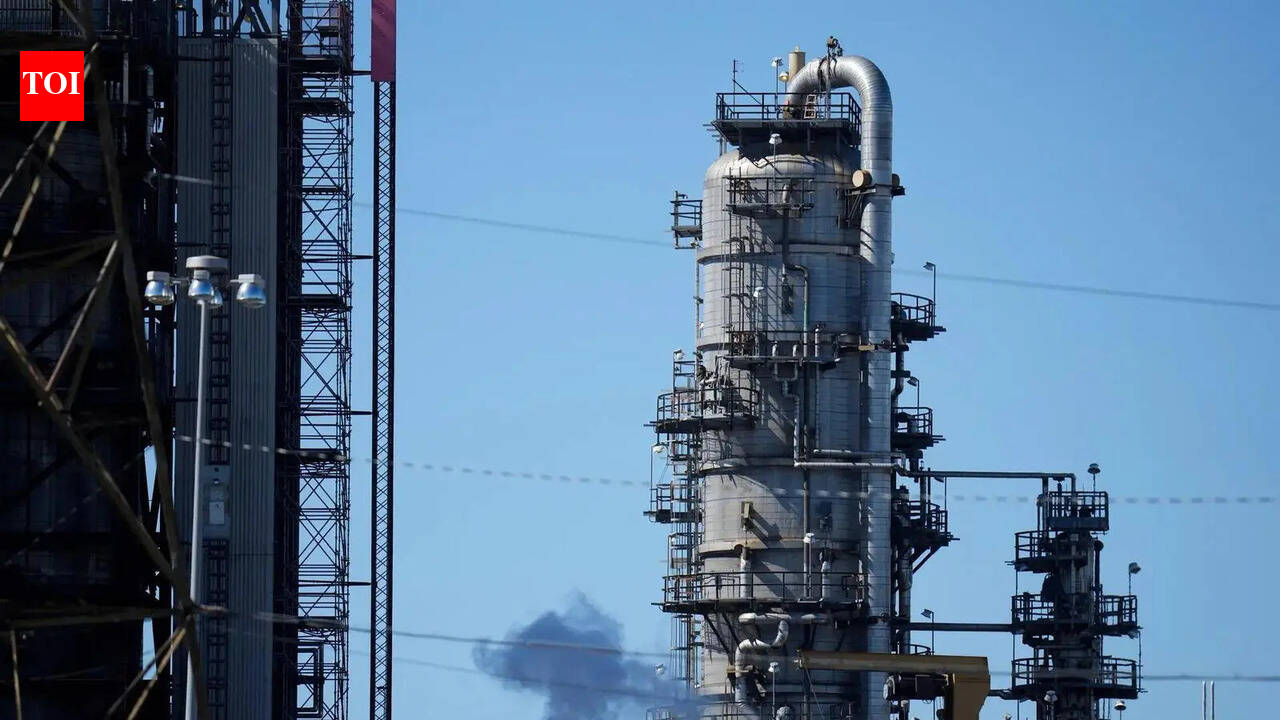
As the Middle East crisis escalates, crude oil prices could surge to $150 or $200 a barrel if the near-closure of the Strait of Hormuz continues over the next six to eight weeks. The disruption is a result of the ongoing war involving the US, Israel, and Iran, which has already prompted Persian Gulf producers to cut millions of barrels of daily supply.According to energy-market consultancy FGE NexantECA, the impact on the global oil market could be enormous. “Every week, 100 million barrels of oil is not going through, and every month, 400 million barrels are not going through,” Chairman Emeritus Fereidun Fesharaki told Bloomberg on Tuesday. “So, within a period of time, these losses to the market will be astronomical,” he said. Fesharaki highlighted that the physical reality of supply disruptions would determine oil prices, rather than political statements.“The market will choke, and the prices will go up. It doesn’t matter what the president says on the political front,” he added. His statement comes as US President Donald Trump has earlier suggested possibility to end the conflict. Oil prices have already surged sharply this month amid the conflict, with Brent crude climbing above $110 per barrel and US West Texas Intermediate (WTI) crude trading above $100. Brent crude rose $2.26, or about 2 per cent, to $115.04 a barrel in early trade, after hitting its highest level since March 19 in the previous session. US WTI crude gained $3.10, or around 3 per cent to $105.96 a barrel, marking its highest level since March 9.Analysts warn that if the Strait of Hormuz remains effectively closed, the global oil market could face further shocks, potentially pushing prices even higher.


Charleston hires Akron’s John Groce as men’s basketball coach

The $1 Million Aston Martin Valhalla Makes You Drive Better Than You Thought Possible
US gas price tops $4 for first time since 2022

-

 Politics1 week ago
Afghanistan announces release of detained US citizen
-

 Sports1 week ago
Broadcast industry CEO says consolidation is ‘essential’ to compete for NFL soaring media rights prices
-

 Entertainment1 week ago
UN warns migratory freshwater fish numbers are spiralling
-

 Tech1 week ago
Can a Home Appliance Fix the Problem of Soft-Plastic Waste?
-
 Business1 week ago
Property Play: Home flippers see smallest profits since the Great Recession, real estate data firm says
-
 Business1 week ago
Gold prices soar in Pakistan – SUCH TV
-

 Fashion1 week ago
ICE cotton slips on weaker crude, profit booking
-
 Business1 week ago
More women are entering wealth management, but few are in advisory roles, study finds