

Business
Indian Railways Expands Kavach 4.0 On Another 738 Km Route: Check Details

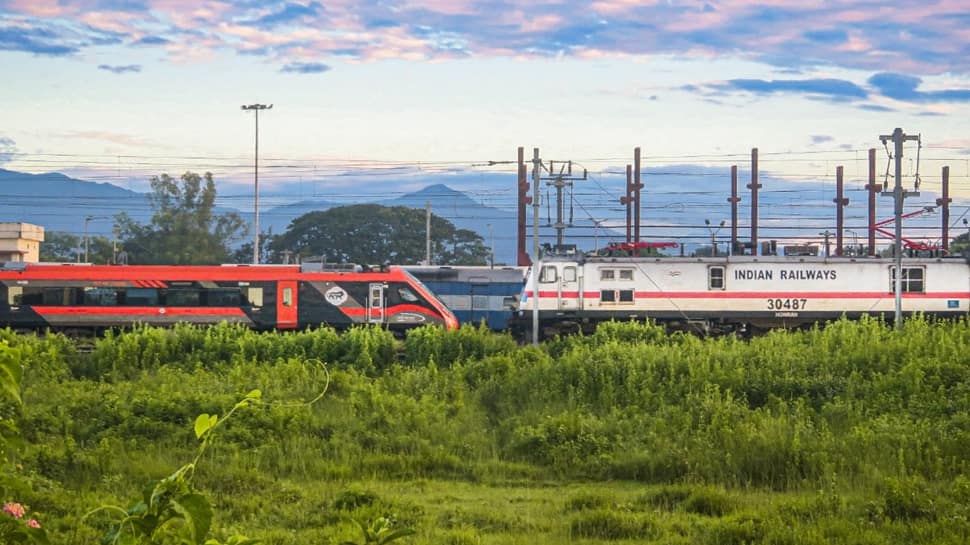
NEW DELHI: After extensive and elaborate trials, Kavach Version 4.0 has been successfully commissioned on 738 Route km on Palwal – Mathura- Nagda section (633 Rkm) on Delhi – Mumbai route and Howrah-Bardhaman section (105 Rkm) Delhi – Howrah route. Kavach implementation has been taken up in balance sections of Delhi – Mumbai & Delhi – Howrah corridors, the Ministry of Railways said.
Further, track side Kavach implementation work has been taken up on 15,512 RKm covering all GQ, GD, HDN and identified sections of Indian Railways.
Bids have been invited for equipping another 9,069 locomotives with Kavach version 4.0. Kavach is being provided progressively in a phased manner in locomotives.
Specialised training programmes on Kavach are being conducted at centralized training institutes of Indian Railways to impart training to all concerned officials. By now more than 40,000 technicians, operators and engineers have been trained on Kavach technology. This includes 30,000 Loco Pilots & Assistant Loco Pilots. Courses have been designed in collaboration with IRISET.
The cost for provision of Track Side including Station equipment of Kavach is approximately Rs. 50 Lakhs/Km and cost for provision of Kavach equipment on locomotives is approximately Rs. 80 Lakh/Loco. The funds utilised on Kavach works so far up to Oct’ 25 is Rs 2,354.36 crores. The allocation of funds during the year 2025-26 is Rs. 1673.19 Crores. Requisite funds are made available as per the progress of works.
This information was provided by the Union Minister for Railways, Information & Broadcasting and Electronics & Information Technology Ashwini Vaishnaw, in a written reply to a question in Rajya Sabha on Friday. Kavach is an indigenously developed Automatic Train Protection (ATP) system. Kavach is a highly technology intensive system, which requires safety certification of highest order (SIL-4).
Kavach aids the Loco Pilot in running of trains within specified speed limits by automatic application of brakes in case Loco Pilot fails to do so and also helps the trains to run safely during inclement weather. The first field trials on the passenger trains were started in February 2016. Based on the experience gained and Independent Safety Assessment of the system by Independent Safety Assessor (ISA), three firms were approved in 2018-19, for supply of Kavach Ver 3.2. Kavach was adopted as the National ATP system in July 2020.
Implementation of Kavach System involves installation of Station Kavach at each and every station, block section, Installation of RFID Tags throughout the track length, installation of telecom Towers throughout the section, laying of Optical Fibre Cable along the track and provision of Loco Kavach on each and every Locomotive running on Indian Railways.
Based on deployment of Kavach version 3.2 on 1465 RKm on South Central Railway and experience gained, further improvements were made. Finally, Kavach specification version 4.0 was approved by RDSO on July 16, 2024. Kavach version 4.0 covers all the major features required for the diverse railway network. This is a significant milestone in safety for Indian Railways. Within a short period, IR has developed, tested and started deploying Automatic Train Protection System.
Major improvement in Version 4.0 includes increased Location Accuracy, Improved Information of Signal Aspects in bigger yards, Station to Station Kavach interface on OFC and Direct Interface to existing Electronic Interlocking System. With these improvements, Kavach Ver.4.0. is planned for large scale deployment over Indian Railways.

The UK’s competition watchdog says it is looking at five firms in its investigation into misleading online reviews.
Source link
Business
Gold price today (March 25, 2026): How much 24K and 22K gold cost in Delhi, Mumbai & more- Check rates – The Times of India

Gold futures traded higher on the Multi Commodity Exchange (MCX) on Friday with key contracts registering gains of up to 1.6 per cent amid firm buying interest and supportive global cues.The April 2026 gold contract rose by Rs 2,290, or 1.64 per cent, to trade at Rs 1,41,783 per 10 grams. The contract moved between an intraday low of Rs 1,40,287 and a high of Rs 1,42,800. The June 2026 contract, which saw higher trading activity, gained Rs 1,921, or 1.35 per cent, to Rs 1,44,435 per 10 grams. During the session, it touched a low of Rs 1,43,652 and a high of Rs 1,45,773. Meanwhile, the August 2026 contract advanced by Rs 1,480, or 1.02 per cent, to Rs 1,47,100 per 10 grams, with an intraday range of Rs 1,47,040 to Rs 1,48,600.Here is how gold prices stand across major cities today:
Gold price in Delhi today
Gold prices in the national capital declined, with 24K gold quoted at Rs 14,486 per gram, down Rs 218, while 22K gold slipped Rs 200 to Rs 13,280 per gram.
Gold price in Mumbai today
Mumbai bullion markets also saw a drop, with 24K gold priced at Rs 14,471 per gram, down Rs 218, and 22K gold at Rs 13,265 per gram, lower by Rs 200.
Gold price in Chennai today
Chennai recorded a sharper decline, with 24K gold selling at Rs 14,651 per gram, down Rs 262, while 22K gold dropped Rs 240 to Rs 13,430 per gram.
Gold price in Kolkata today
In Kolkata, 24K gold was quoted at Rs 14,471 per gram, down Rs 218, while 22K gold stood at Rs 13,265 per gram, lower by Rs 200.
Gold price in Hyderabad today
Hyderabad markets reflected a similar trend, with 24K gold priced at Rs 14,471 per gram, down Rs 218, and 22K gold at Rs 13,265 per gram, slipping Rs 200.
Gold price in Bangalore today
In Bangalore, 24K gold was quoted at Rs 14,471 per gram, down Rs 218, while 22K gold was selling at Rs 13,265 per gram, lower by Rs 200.
Gold price in Ahmedabad today
Ahmedabad bullion markets showed declines, with 24K gold at Rs 14,476 per gram, down Rs 218, while 22K gold fell Rs 200 to Rs 13,270 per gram.
Gold price in Lucknow today
In Lucknow, 24K gold was priced at Rs 14,486 per gram, down Rs 218, while 22K gold moved lower by Rs 200 to Rs 13,280 per gram.
Gold price in Patna today
Patna markets also recorded weaker rates, with 24K gold quoted at Rs 14,476 per gram, down Rs 218, and 22K gold at Rs 13,270 per gram, lower by Rs 200.
Gold price in Jaipur today
In Jaipur, 24K gold was quoted at Rs 14,486 per gram, down Rs 218, while 22K gold stood at Rs 13,280 per gram, down Rs 200.

A key survey indicates growing doubt among shoppers over prospects for the UK economy in the next year.
Source link


Prince William bold decision keeps Harry up at night: ‘No mercy’

NCAA men’s tournament: Rick Pitino’s case for best men’s college basketball coach ever
Gold price today (March 25, 2026): How much 24K and 22K gold cost in Delhi, Mumbai & more- Check rates – The Times of India

-

 Entertainment1 week ago
Val Kilmer revived 1 year after death through AI
-

 Fashion1 week ago
US’ G-III Apparel’s FY26 sales fall 7% to $2.96 bn
-
 Business1 week ago
Brits cashing in jewellery as gold price hits record high
-

 Sports1 week ago
March Madness 2026 – How to watch in SA, start time, schedule, TV channel for NCAA championship basketball tournament
-

 Fashion6 days ago
China’s textile & apparel exports surge 17% to $50 bn in Jan-Feb 2026
-
 Business1 week ago
Video: The Effects of High Oil Prices
-
 Business6 days ago
Flipkart group CFO to leave co amid IPO plans – The Times of India
-

 Sports7 days ago
Rating Adidas’ 2026 World Cup away shirts: Argentina, Spain, Mexico and more