

Business
Indian Railways’ Twin Good News: Second Vande Bharat Sleeper Rollout; Reduced Journey Time for UP, Bihar, Bengal – Details


Indian Railways Good News: The Indian Railways is set to bring more good news for passengers in the coming days. While the Vande Bharat Sleeper may be inducted into regular service by the end of this month, the national transporter is also working to gradually increase its operational sectional speed to 160 kmph. Trials have already commenced on a 190 km stretch between Ghaziabad and Tundla, which will help reduce travel time between New Delhi and key destinations in Uttar Pradesh, Bihar, and West Bengal.
Vande Bharat Sleeper: Second Rake Ready
Passengers across India have been eagerly awaiting the launch of the Vande Bharat Sleeper. Railway Minister Ashwini Vaishnaw recently confirmed that operations will begin once the second rake of the train is ready, allowing the service to run from both ends of the designated route.
With the first rake already completed, anticipation for the second one is high. Videos circulating on social media show the second Vande Bharat Sleeper rake being rolled out from the BEML plant. However, reports suggest that this rake is still unfinished in terms of interiors and will be sent back to BEML after oscillation trials conducted jointly by the North Central Railway, West Central Railway, and Western Railway.
Exclusive & Breaking!
2nd Vande Bharat Sleeper has been dispatched from BEML
• This is an unfinished(interiors) rake, it will come back to BEML after oscillation trial
• The rake is shunted out of BEML and will/has reached ICF
• From ICF, it will go to trials in NCR,WCR & WR pic.twitter.com/8IBCVVdiJJ
— The Rail Tempest (@Harsh22301ER) October 13, 2025
For context, the Indian Railways has already completed trials of the first Vande Bharat Sleeper coaches, and if Minister Vaishnaw’s timeline holds true, the train could enter operations by the end of this month. The Delhi–Howrah (West Bengal) route, passing through Bihar, is expected to be the first corridor for the Vande Bharat Sleeper’s debut.
Efforts to Reduce Travel Time
Railway enthusiasts know that most Indian Railways express trains operate at an average speed of 80–110 kmph. Even the Vande Bharat Express — designed for 160–180 kmph — currently runs at a maximum of 120 kmph on select sections. These speed limitations often lead to congestion across the network, prompting the Railways to invest heavily in infrastructure upgrades.
To address this, the Railways has been steadily increasing sectional speeds. Currently, over 23,000 km of track support operations at around 130 kmph. The latest initiative involves 160 kmph Kavach trials on the Tundla–Aligarh section of the New Delhi–Howrah route, covering a 190 km stretch between Ghaziabad and Tundla Junction.
160 kmph Kavach Trials on Tundla–Aligarh Section of the New Delhi–Howrah Route!
Indian Railways is conducting high-speed and Kavach trials on the 190 km Chipyana Buzurg (Ghaziabad) – Tundla stretch to upgrade the sectional speed to 160 kmph.
If the trials prove success,… pic.twitter.com/VHXe6uAPQC
— Trains of India(@trainwalebhaiya) October 12, 2025
If these trials succeed, travel time between New Delhi and major cities in Uttar Pradesh, Bihar, and West Bengal could be reduced by several hours, marking a major leap forward in passenger convenience and rail efficiency.






The supply chain risk designation of the artificial intelligence firm is a first for a US company.
Source link

Thomas Fuller | SOPA Images | Lightrocket | Getty Images
UniQure needs to run another study to prove that its gene therapy “actually helps people with Huntington’s disease,” a senior U.S. Food and Drug Administration official said on a call with reporters Thursday.
The official, who requested anonymity before discussing sensitive information, confirmed the agency has asked the company to run a placebo controlled trial of its treatment, which is administered directly into the brain. UniQure has said that type of study isn’t ethical because it would require putting people under general anesthesia for hours, a characterization the official disputed.
“So what is really going on? UniQure is the latest company to make a failed therapy for Huntington’s patients,” the official said. “They likely acknowledge or understand at some deep level that their trial failed years ago, and instead of doing the right thing and running the correct clinical study, UniQure is performing a distorted or manipulated comparison in the mind of FDA.”
The comments mark the latest development in a messy public spat between UniQure and the FDA, and as the agency comes under fire for a number of recent drug approval application rejections, including some where companies have accused it of going back on previous guidance. FDA Commissioner Marty Makary in an interview with CNBC’s Becky Quick last week seemingly criticized UniQure’s gene therapy for Huntington’s disease. Makary didn’t name UniQure but described its treatment.
UniQure then accused the FDA of reversing its stance that the company’s clinical trial data would be sufficient to seek approval. UniQure’s study used an outside database to measure how patients with Huntington’s disease might decline without treatment, known as an external control. UniQure has said it wouldn’t be feasible to run a true randomized, double-blind placebo-controlled study, considered the gold standard, because it wouldn’t be ethical to make people undergo a sham hours-long brain surgery.
The FDA official said the agency “never agreed to accept this distorted comparison” and the FDA “never makes such assurances.” Instead, the “FDA will always say, ‘Well, we have to see the data when we get it.'”
UniQure didn’t immediately comment.
The company’s stock rose more than 10% on Thursday and has fallen 58% this year as of Thursday afternoon.
Business
US mortgage rates rise to 6% after three-week slide as oil-driven bond yields climb – The Times of India

The average long-term US mortgage rate edged higher this week, ending a three-week decline as bond yields rose amid oil-price pressures linked to the war with Iran.The benchmark 30-year fixed mortgage rate increased to 6% from 5.98% last week, mortgage buyer Freddie Mac said on Thursday. A year ago, the average rate stood at 6.63%, AP reported.The modest uptick breaks a three-week slide in borrowing costs, with mortgage rates having hovered close to the 6% mark for most of this year. Last week’s average had marked the first time the rate dipped below 6% since September 2022, reaching its lowest level in nearly three and a half years.Mortgage rates are influenced by several factors, including the Federal Reserve’s interest-rate policy, investor expectations about inflation and economic growth, and movements in the bond market.They typically track the direction of the 10-year US Treasury yield, which lenders use as a benchmark for pricing home loans.The 10-year Treasury yield rose to 4.14% at midday Thursday, up from around 4% a week earlier.Treasury yields have moved higher in recent days as rising oil prices added fresh inflation concerns, potentially complicating the Federal Reserve’s plans to cut interest rates.


US Senate backs Trump’s Iran operations after House vote

Harry Kane calf injury imperils Bundesliga record chase

Here’s Every Country Directly Impacted by the War on Iran

What are Iran’s ballistic missile capabilities?

India Us Trade Deal: Fresh look at India-US trade deal? May be ‘rebalanced’ if circumstances change, says Piyush Goyal – The Times of India

Attock Cement’s acquisition approved | The Express Tribune

-
 Politics1 week ago
What are Iran’s ballistic missile capabilities?
-
Business7 days ago
India Us Trade Deal: Fresh look at India-US trade deal? May be ‘rebalanced’ if circumstances change, says Piyush Goyal – The Times of India
-
Business1 week ago
Attock Cement’s acquisition approved | The Express Tribune
-

 Politics1 week ago
US arrests ex-Air Force pilot for ‘training’ Chinese military
-

 Fashion1 week ago
Policy easing drives Argentina’s garment import surge in 2025
-
 Business6 days ago
Greggs to reveal trading amid pressure from cost of living and weight loss drugs
-

 Sports6 days ago
LPGA legend shares her feelings about US women’s Olympic wins: ‘Gets me really emotional’
-
 Fashion7 days ago
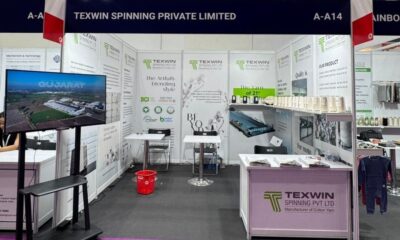
Texwin Spinning showcasing premium cotton yarn range at VIATT 2026