Connect with us

Business

India’s first electric car: Meet ‘Lovebird’ from 1993, which laid EV vehicles foundation in country

Published

on

India’s first electric car: Meet ‘Lovebird’ from 1993, which laid EV vehicles foundation in country


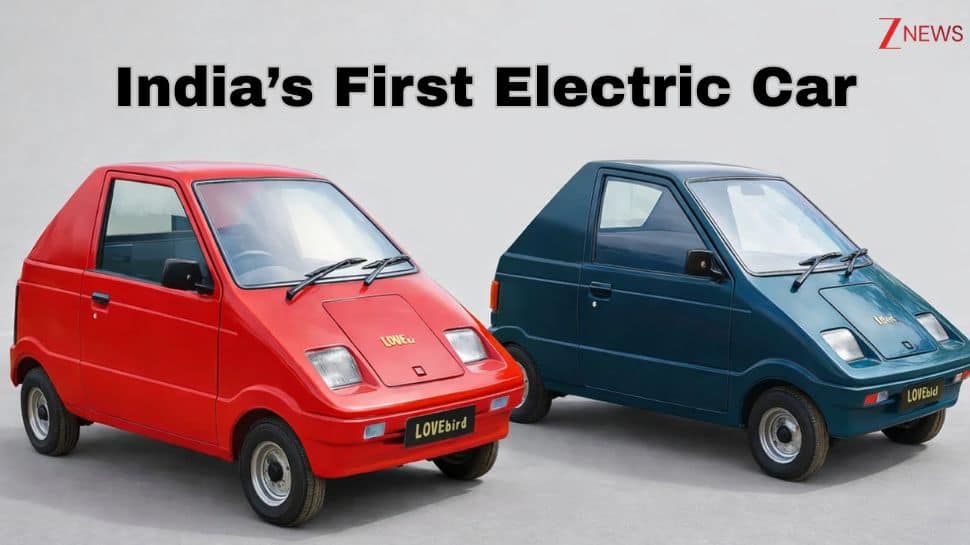
India’s first electric car: Today, India is a mass market for electric vehicles, with companies such as Tata Motors, Mahindra, Hyundai, Kia, and MG Motor offering several EV models. Long before electric vehicles became common on Indian roads, a small two-seater car named ‘Lovebird’ quietly marked the beginning of the country’s EV journey. It is widely regarded as India’s first electric car, introduced at a time when the concept of battery-powered mobility was unknown to most people.

The Lovebird was developed in 1993 by Eddy Current Controls (India), in collaboration with Japan’s Yaskawa Electric Mfg. Co. The car was first showcased at the Auto Expo in New Delhi, where it attracted attention and even received a few awards. The Indian government supported the initiative and gave it approval, seeing it as a step toward cleaner mobility.

At a time when petrol and diesel vehicles dominated the roads, the Lovebird stood out as a bold experiment. It would not be wrong to say that the car was ahead of its time.


Add Zee News as a Preferred Source


Lovebird specs

Production of the Lovebird took place in Chalakudy, Kerala, and Coimbatore, Tamil Nadu. It was a compact two-seater powered by a direct current (DC) electric motor and a rechargeable lead-acid battery pack. Since battery technology was limited in the early 1990s, the car relied on lead-acid cells instead of modern lithium-ion batteries.

On a full charge, the Lovebird could travel up to 60 kilometres, making it suitable for short urban commutes. Charging the battery took around eight hours. The car featured a four-speed transmission, a reverse gear, and an electronic chopper system that helped control speed smoothly. However, it was restricted from climbing steep gradients above 15 degrees.

(Also Read: Daddy of all SUVs? How Toyota Fortuner dominated Indian market for over last 16 years)

Why did it fail?

Despite its innovation, the Lovebird struggled in the market. Sales reportedly did not cross three digits. Limited charging infrastructure, frequent power cuts, and high costs made it difficult for buyers to accept electric cars in the 1990s. When government subsidies were withdrawn, the vehicle became even more expensive.

Although it did not achieve commercial success, the Lovebird laid the foundation for India’s EV journey – years before electric mobility became a mass priority for car manufacturers.



Source link

Business

‘I can do anything I want’: Trump warns of ‘even stronger methods’ after SC tariff blow – The Times of India

Published

on

‘I can do anything I want’: Trump warns of ‘even stronger methods’ after SC tariff blow – The Times of India


“I can do anything I want,” Donald Trump declared in his address as his first reaction to the Supreme Court’s landmark ruling on Friday, a major setback to his second stint in the presidency.“There are methods that are even stronger available to me,” he said in his White House address.Trump also said he was “absolutely ashamed” of the US Supreme Court justices who issued the “deeply disappointing” tariff decision.“The Supreme Court’s ruling is absolutely disappointing, and I am ashamed of certain members of the court for not having the courage to do what is right for our country,” he said.Frustrated and agitated by the Supreme Court ruling, Trump threatened to impose a 10 per cent global tariff. He added, “Today, I will sign an order to impose a 10% global tariff under Section 122, over and above our normal tariffs already being charged, and we’re also initiating several Section 301 and other investigations to protect our country from unfair trading practices.”The US top court on Friday struck down President Trump’s sweeping global tariffs, which were central to his second-term presidency and trade policies, handing him a major defeat.In a 6–3 ruling, the apex court examined tariffs imposed under an emergency powers law, including the broad “reciprocal” duties he placed on nearly all countries. The justices held that Trump’s use of emergency authority to impose import tariffs without congressional approval was unlawful.


Source link

Continue Reading

Business

FTSE 100 climbs on strong retail sales data

Published

on

FTSE 100 climbs on strong retail sales data


Stock prices in London closed higher on Friday, as a swathe of domestic economic data was well-received and the US Supreme Court ruled President Donald Trump’s tariff programme is illegal.

The FTSE 100 index closed up 59.85 points, 0.6%, at 10,686.89.

The FTSE 250 ended up 178.07 points, 0.8%, at 23,751.56, and the AIM all-share closed up 3.97 points, 0.5%, at 815.11.

In European equities on Friday, the CAC 40 in Paris closed up 1.4%, while the DAX 40 in Frankfurt ended 0.9% higher.

The pound climbed to 1.3492 dollars on Friday afternoon from 1.3455 dollars at the equities close on Thursday.

The euro stood slightly higher at 1.1780 dollars from 1.1768 dollars.

Against the yen, the dollar was trading marginally higher at 154.95 yen compared to 154.90 yen.

The US Supreme Court ruled that President Donald Trump exceeded his authority in imposing a swathe of tariffs that upended global trade, blocking a key tool the president has wielded to impose his economic agenda.

The conservative-majority high court ruled six-three in the judgment, saying the International Emergency Economic Powers Act “does not authorise the president to impose tariffs”.

While Mr Trump has long used tariffs as a lever for pressure and negotiations, he made unprecedented use of emergency economic powers upon returning to the presidency last year to slap new duties on virtually all US trading partners.

These included “reciprocal” tariffs over trade practices that Washington deemed unfair, alongside separate sets of duties targeting major partners Mexico, Canada and China over illicit drug flows and immigration.

The court on Friday noted that “had Congress intended to convey the distinct and extraordinary power to impose tariffs” with IEEPA, “it would have done so expressly, as it consistently has in other tariff statutes”.

The ruling does not impact sector-specific duties that Mr Trump has separately imposed on imports of steel, aluminium and various other goods.

Formal probes which could ultimately lead to more such sectoral tariffs remain in the works.

“The Supreme Court ruling on Trump’s tariffs will unlikely be a big game changer for markets,” said Ebury analyst Matthew Ryan.

“Not only was the decision broadly expected, but the president has already signalled that he will quickly pivot to other legal tools to achieve similar trade restrictions, and he has at his disposal multiple levers to pull in order to circumvent the verdict.”

“This means that while we could see some near-term disruption, his long-term tariff strategy is unlikely to be derailed so long as the White House can replicate the regime through alternative methods.”

Meanwhile, Mr Trump said he is contemplating a limited military strike on Iran, in case a deal on its nuclear programme is not reached.

Asked by a reporter if he is “considering a limited military strike if Iran doesn’t make a deal,” Mr Trump answered: “The most I can say – I am considering it.”

Back in the UK, a torrent of positive economic data was in focus.

Analysts said positive retail sales and purchasing managers’ index data for the UK provided further evidence that economic activity picked up in the new year as uncertainty from the Government autumn budget faded.

Retail sales increased 1.8% on-month in January, compared with a 0.4% rise in December and far outstripping the consensus forecast for a 0.2% rise.

The flash UK purchasing managers’ composite output index rose to a 22-month high of 53.9 points in February from 53.7 in January, beating the FXStreet-cited market consensus of 53.4 points, which would have meant a deceleration of growth.

Climbing further above the neutral 50-point mark separating growth from contraction, it indicates the pace of activity accelerated in February.

“Retail sales provide further evidence that economic activity is picking up smartly in the new year as budget uncertainty fades,” said Pantheon Macroeconomics analyst Rob Wood.

Stocks in New York were higher.

The Dow Jones Industrial Average was slightly higher, the S&P 500 index was up 0.4%, and the Nasdaq Composite 0.8% higher.

The yield on the US 10-year Treasury widened slightly to 4.09% on Friday from 4.08% on Thursday.

The yield on the US 30-year Treasury widened to 4.73% from 4.71%.

US economic growth was slower than expected in the final quarter of the year, though separate numbers showed inflationary pressure picked up in December, giving the US Federal Reserve some food for thought.

Gross domestic product rose 1.4% on an annualised basis quarter-on-quarter, the Bureau of Economic Analysis said, slowing from a 4.4% rise in the third quarter, and below FXStreet cited expectations of a 3.0% rise.

“The contributors to the increase in real GDP in the fourth quarter were increases in consumer spending and investment. These movements were partly offset by decreases in government spending and exports. Imports, which are a subtraction in the calculation of GDP, decreased,” the BEA said.

Back in London, Diageo ended 3.9% higher and led the FTSE 100 after the Financial Times reported Dave Lewis, who took over as chief executive at the start of this year, is planning major changes to his executive team.

Mr Lewis, who earned a reputation for cost-cutting as chief executive of UK grocer Tesco, wants to change the “fat and happy” culture at brewer and distiller Diageo, the newspaper said, citing “two people familiar with the matter”.

This will include replacing several members of the 14-person executive committee, the people told the FT.

Segro closed up 2.0% after it reported a decline in pre-tax profit for 2025, despite increased revenue, as lower valuation gains offset record rental income.

The London-based property developer reported £560 million in pre-tax profit for 2025, down 12% from £636 million in 2024.

Adjusted pre-tax profit, which strips out property valuations, increased 8.3% to £509 million from £470 million.

The weaker earnings amid the improved top line are owed to smaller realised and unrealised property gains, down 72% at £55 million, compared to £195 million a year earlier.

On the FTSE 250 index, TBC Bank closed up 7.0% as it said a positive final quarter of 2025 helped it reach strong full-year results, allowing for a double-digit increase in its annual dividend.

Pretax profit was 1.67 billion Georgian lari in 2025, up 8.4% from 1.54 billion lari in 2024, as total income before credit loss provisions and expenses rose 20% to 3.39 billion lari from 2.83 billion lari.

Within that, net interest income was 2.35 billion lari in 2025, up 24% from 1.90 billion lari in 2024.

TBC Bank declared a final dividend of 3.87 lari per share for a total dividend for 2025 of 8.87 lari per share, up 10% from 2024 and representing a payout ratio of 35%.

TBC also carried out a 75 million lari share buyback programme last year.

Aston Martin Lagonda shares closed down 1.4% after it issued a profit warning as it noted the impact of “heightened tariffs” in the US.

The Warwickshire-based luxury car maker said it expects to report a gross margin for 2025 of around 29.5%, down from 36.9% in 2024.

Aston Martin also anticipates adjusted earnings before interest and tax “slightly below” the lower end of the analyst expectations of a £184 million loss, widening from a £82.8 million loss.

Looking ahead, Aston Martin said it expects a “material improvement” in its 2026 financial performance.

This expectation is driven by a combination of an enhanced product mix, ongoing benefits from its transformation programme and a “continued disciplined approach to operations”.

On the AIM market, SkinBioTherapeutics closed 8.9% higher.

The stock has fallen 2.0% this week.

The Newcastle Upon Tyne-based life sciences firm said non-executive director Alyson Levett will oversee an independent investigation of the events that led to the departure of Stuart Ashman as chief executive officer.

Ms Levett, who chairs the board’s audit committee, will work with FRP Advisory, which the board has engaged to undertake a “forensic review”.

On Monday, SkinBioTherapeutics said Mr Ashman “misrepresented material information to the board, senior management, auditors and advisors” regarding accrued royalty income reported for the financial year that ended in June last year.

The resulting removal of £770,000 in accrued royalty income will reduce financial 2025 revenue to £3.9 million from the previously reported £4.6 million.

The stock has fallen 19% this week.

Brent oil was slightly lower at 71.33 dollars a barrel on Friday afternoon from 71.71 dollars late on Thursday.

Gold climbed to 5,066.90 dollars an ounce from 5,003.14 dollars.

The biggest risers on the FTSE 100 were Diageo, up 69.0p at 1,850.5p, Antofagasta, up 143.0p at 4,018.0p, Burberry, up 35.5p at 1,210.0p, British American Tobacco, up 97.0p at 4,570.0p, and Lloyds Banking, up 2.0p at 104.0p.

The biggest fallers on the FTSE 100 were BP, down 11.08p at 467.92p, DCC, down 65.0p at 5,135.0p, Associated British Foods, down 18.5p at 1,958.0p, Mondi, down 8.4p at 926.6p, and Convatec, down 1.8p at 228.8p.

On Monday’s global economic data are US factory orders figures and a reading on Germany’s business climate.

On the corporate slate for Monday are full year results from Mony Group, with major results due later in the week from HSBC, Diageo and Rolls-Royce among others.

– Contributed by Alliance News


Source link

Continue Reading

Business

US Top Court Blocks Trump’s Tariff Orders: Does It Mean Zero Duties For Indian Goods?

Published

on

US Top Court Blocks Trump’s Tariff Orders: Does It Mean Zero Duties For Indian Goods?


Last Updated:

The verdict does not overturn all of Trump’s tariff actions as duties imposed on steel and aluminium under separate legal provisions remain intact.

US President Donald Trump and PM Modi | File Image

US President Donald Trump and PM Modi | File Image

The US Supreme Court has struck down President Donald Trump’s sweeping global tariff regime, ruling that the measures were imposed without legal backing.

In a 6-3 ruling, the court held that the International Emergency Economic Powers Act (IEEPA) does not authorise the president to unilaterally impose broad, across-the-board tariffs.

The 1977 law allows the executive to regulate certain international economic transactions during a declared national emergency, but does not extend to blanket tariff actions, the court said.

Chief Justice John Roberts, who authored the majority opinion, said Congress has delegated tariff-setting powers only in limited and clearly defined circumstances.

He was joined by the court’s three liberal justices and conservative justices Neil Gorsuch and Amy Coney Barrett. Justices Samuel Alito, Clarence Thomas, and Brett Kavanaugh dissented.

Also Read: US To Refund Billions? What Next After Supreme Court Strikes Down Trump Tariffs

What The Ruling Means For India

The verdict does not overturn all of Trump’s tariff actions. Duties imposed on steel and aluminium under separate legal provisions remain intact. However, it invalidates two major categories of tariffs introduced using IEEPA.

These include the so-called “reciprocal” tariffs, which carried a baseline rate of 10 per cent for most countries, and a separate 25 per cent levy imposed on select imports from Canada, China and Mexico over fentanyl-related concerns.

India had been subject to the reciprocal tariffs, with a 26 per cent rate announced on Trump’s “Liberation Day” in April 2025, later revised to 25 per cent.

With the court ruling, these IEEPA-based tariffs no longer apply, effectively bringing reciprocal tariffs on most Indian exports down to zero for now.

Separately, India had also faced a 25 per cent “penalty” tariff linked to its imports of Russian oil, a measure the US had said was tied to the Ukraine war.

That levy was removed earlier this month after New Delhi and Washington reached a trade understanding. As a result, both the penal tariff and the reciprocal tariff on Indian goods now stand withdrawn.

Under the trade framework discussed earlier, the reciprocal tariff was expected to be reduced to 18 per cent, but the court’s decision renders that rate moot for the time being.

Tariffs That Still Apply

Despite the relief, US tariffs on Indian goods do not disappear entirely.

Duties on steel and aluminium exports, imposed under different statutory authority, continue to apply.

For other products, tariffs revert to pre-IEEPA levels, which are generally lower under the standard US tariff schedule, though sector-specific levies remain.

The ruling does not prevent Trump, or a future administration, from imposing tariffs using other laws.

However, such actions would face stricter procedural limits and could require congressional involvement.

US officials have indicated that alternative legal routes could still be explored to retain elements of the tariff framework.

For India, the decision comes at a critical juncture. Ongoing trade talks with Washington had been overshadowed by tariff uncertainty, particularly for exporters in textiles, pharmaceuticals and engineering goods.

Click here to add News18 as your preferred news source on Google.

Follow News18 on Google. Join the fun, play games on News18. Stay updated with all the latest business news, including market trends, stock updates, tax, IPO, banking finance, real estate, savings and investments. To Get in-depth analysis, expert opinions, and real-time updates. Also Download the News18 App to stay updated.
News business economy US Top Court Blocks Trump’s Tariff Orders: Does It Mean Zero Duties For Indian Goods?
Disclaimer: Comments reflect users’ views, not News18’s. Please keep discussions respectful and constructive. Abusive, defamatory, or illegal comments will be removed. News18 may disable any comment at its discretion. By posting, you agree to our Terms of Use and Privacy Policy.

Read More


Source link

Continue Reading

Trending