

Business
India’s New Four Labour Codes: From Gratuity After One Year To Free Annual Health Checkups; Who Will Receive Gratuity In Case Of Private Sector Employee’s Death?

 "India’s New Four Labour Codes: From Gratuity After One Year To Free Annual Health Checkups; Who Will Receive Gratuity In Case Of Private Sector Employee’s Death?")
New Labour Codes In India: The Government of India has introduced a major reform that will benefit lakhs of employees who frequently change jobs, including fixed-term employees, women, gig workers, MSME staff, and contract workers. Under the new Labour Codes, the minimum service required to receive gratuity has been reduced from five years to just one year. This means more workers will now be eligible for gratuity even if they don’t stay long in one organisation.
This major reform is part of the government’s plan to replace 29 old labour laws with four new Labour Codes. These include the Code on Wages, the Industrial Relations Code, the Social Security Code, and the Occupational Safety Code, replacing outdated regulations framed between the 1930s and 1950s. The goal is to make business processes smoother, improve worker welfare, update outdated rules, and create a more transparent and worker-friendly labour system.
Gratuity: What It Is And What Happens After Private Employee’s Death
It is a one-time amount that employers give to employees as a thank-you for their service. Under the Payment of Gratuity Act, private sector employees can receive gratuity when they leave a job (due to resignation or termination), retire, or become disabled. In case of an employee’s death, the amount is paid to their nominee. Earlier, employees had to complete at least five years of continuous service with the same employer to be eligible, except in situations of death or disability. (Also Read: What Is EPS-95 Scheme? If Employee Becomes Permanently Disabled, Will He Get Pension? Check Benefits, Eligibility Criteria, And How It Is Calculated)
New Labour Codes: How New Gratuity Rule Strengthens Worker Security?
With this reform, employees will not be penalised for having short job tenures, giving young workers who often switch jobs better financial security. It also benefits contractual, fixed-term, and gig workers by making gratuity easier to receive and more predictable. By offering gratuity to more people, the government is encouraging formal employment and improving the safety net for all workers. Overall, this change makes India’s workforce more secure and brings labour benefits closer to global standards.
New Labour Codes: Benefits Including Free Annual Health Check-Ups
For the first time, all workers, whether permanent, contractual, or fixed-term, must receive appointment letters, which improves job security and helps reduce disputes. The new Labour Codes also make preventive healthcare mandatory, requiring employers to provide yearly health checkups for workers aged 40 and above, helping with early detection and lowering long-term health risks.
Under the Code on Wages, every worker across all sectors is now entitled to minimum wages, ensuring that no one falls below a basic income level. Adding further, women are allowed to work in all types of jobs, including night shifts, giving them greater employment opportunities and flexibility.








Business
New data series: Real GDP growth data calculation methodology overhauled to improve accuracy – here’s what changes – The Times of India
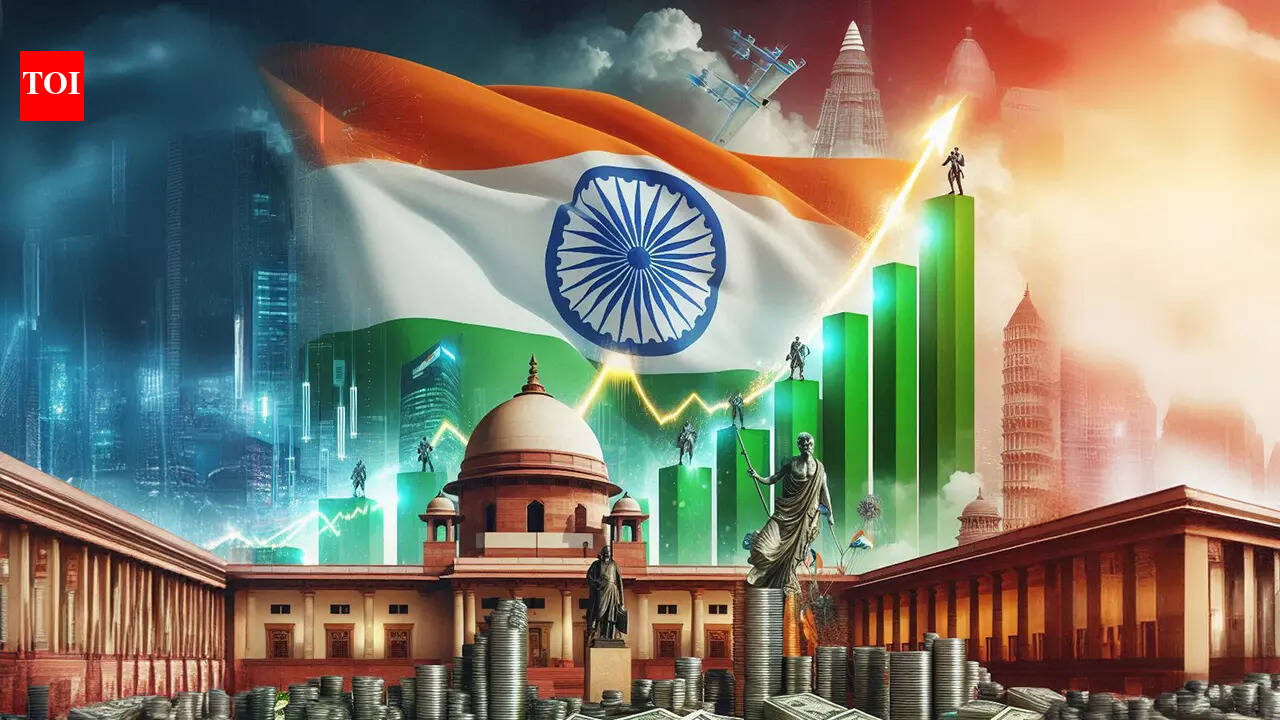
India is set to release its first set of GDP or Gross Domestic Product data on the basis of a new series that may also address recent criticism from economists. The government is revamping the methodology used to estimate real GDP growth under a new national accounts series scheduled to be released this week. The revised framework will incorporate more detailed price deflation techniques to respond to concerns raised by economists.Real GDP in India is calculated by adjusting nominal growth figures for inflation through the use of price indices. Critics have argued that the existing approach is outdated because it depends largely on the wholesale price index rather than the more widely followed consumer price index.In November, the International Monetary Fund highlighted shortcomings in India’s national accounts system. It pointed to the continued use of the 2011–12 base year, heavy dependence on wholesale price data and extensive reliance on single-deflation techniques. The IMF assigned the methodology a “C” rating.
New GDP data series: What changes
“We will now use about 500–600 items from the new CPI and the old WPI series, compared with about 180 earlier, to deflate the output and improve accuracy of the data,” Saurabh Garg, secretary in the Ministry of Statistics and Programme Implementation, said in an interview according to a Reuters report.He noted that this approach will remain in place until a revised WPI series is introduced, which is expected in the near term.Under the earlier system, periods marked by subdued nominal GDP expansion and low wholesale inflation often resulted in inconsistencies, as they tended to produce comparatively higher real growth estimates.As per the current data series, India’s economy, which is one of the fastest-expanding among major global economies, is projected to grow by 7.4% in 2025–26. This is compared with an estimated 6.5% growth in 2024–25.Nominal GDP, which measures economic output at prevailing market prices, is expected to increase by 8.0% during the current financial year.A revised GDP series with 2022–23 as the base year will be released on February 27, along with updated historical data covering the previous four years.These modifications form part of a wider overhaul of India’s statistical framework, following the introduction of a new retail inflation series earlier this month. Updates to the wholesale price index and industrial production data are also in progress.A key element of the revised framework is the adoption of double deflation, which adjusts both output prices and input costs separately to derive real value added.Garg said the changes are expected to enhance data precision, especially in the manufacturing sector, where differences between input and output price movements had previously raised concerns about distortions under the single-deflation approach.

Two stories from the past few weeks capture something essential about where we are with AI.The first concerns Salesforce, the enterprise software giant that aggressively embraced AI for customer service. CEO Marc Benioff proudly announced that AI deployment had allowed the company to cut support staff from 9,000 to roughly 5,000. Then reality intervened. Reports from late 2025 indicate that the company is now withdrawing from AI due to widespread failure. The AI agents confidently gave wrong answers, dropped instructions when given more than eight steps, and lost focus when users asked unexpected questions. Customers complained that AI support took longer than the simple old search function. Salesforce is now retreating to rigid, rule-based scripting–essentially admitting they were, in their own words, “more confident” than the technology warranted.The second story is a zeitgeist shift. Over the past couple of months, the conversation around AI and coding has transformed completely. People who were skeptical six months ago–senior developers who actually write code for a living–are now saying the age of human beings writing code is ending. Not in some distant future, but imminently. Entire features are being shipped by AI with minimal human intervention. The productivity gains are no longer incremental; they’re structural.How can both be true? How can AI fail comprehensively in customer service–seemingly straightforward–while revolutionising software development, which appears far more complex?The answer is that we’ve been thinking about AI wrong. We treat it as a single phenomenon that will sweep through the economy at roughly the same pace. However, AI in business is not a single story. It’s many parallel stories, moving at wildly different speeds. And the distinction has almost nothing to do with how intelligent the AI is.I’ve written about this tension before. A year ago, I argued that “the fact that a revolution is real doesn’t mean that every business claiming to be part of it will succeed.” More recently, I observed that “the gap between what AI demos well in controlled environments and what it actually delivers when confronting the messy real world remains enormous.” I now think there’s a more precise way to understand this gap. It’s not random. It’s structural.Consider what makes coding fertile ground for AI. Code is formally structured and machine-verifiable–it runs and passes tests, or it doesn’t. The feedback loop is immediate. When AI makes a mistake, a developer (or another AI agent) notices, fixes it, and moves on. Errors are private and reversible. Now consider customer service. Customers don’t speak in data schemas. Emotion, sarcasm, and cultural context matter enormously. One wrong answer can escalate to social media outrage or regulatory complaints. The failures are public and often irreversible.The difference isn’t intelligence. It’s what I’d call error economics. AI thrives where mistakes are cheap, private, and correctable. It struggles where mistakes are expensive, public, and permanent.We received a clear illustration of executive disconnect just a few days ago. During Bajaj Finance’s Q3 call, CEO Rajeev Jain announced that AI had listened to 2 crore calls and generated 100,000 new customer offers. “We’ll be able to listen to 100 million calls next year,” he said proudly. The response on social media was predictable hilarity. As the entire country, except apparently Mr Jain knows, Bajaj Finance’s incessant spam calls are the butt of countless jokes. Here was a CEO using sophisticated technology to optimize something customers actively despise. Machine learning works perfectly; the learning about customers is absent.For investors, the implications are significant. When you hear “AI” attached to a business function, ask: what happens when it’s wrong? If the answer involves customers, regulators, or reputations, progress will be slower than vendor PPTs claim. If the answer is “someone notices and fixes it,” that’s a different world entirely.The story of AI in business is not one of universal acceleration. It’s one of the selective escape velocities. Coding has left the atmosphere and gone into orbit. Customer service is still fighting gravity. Most other functions lie somewhere in between–mistakenly assumed to be closer to the rocket than they really are. The many worlds of AI are not converging. They’re diverging. And that divergence will determine which investments succeed and which disappoint.(Dhirendra Kumar is Founder and CEO of Value Research)
Business
IDFC First Bank share price today: Stock opens flat a day after 16% slump on Rs 590 crore fraud – The Times of India

IDFC First Bank share price today: IDFC First Bank stock opened in green on Tuesday a day after its shares recorded the worst crash since March 2020. At 9:18 AM, IDFC First Bank shares were trading at Rs 70.37, up 0.47%. The steep fall came on IDFC First Bank admitting to a Rs 590 crore fraud at its Chandigarh branch related to Haryana government accounts.IDFC First Bank on Monday said it expects to stay profitable despite a Rs 590-crore impact from fraudulent transactions involving Haryana government-linked accounts, even as its shares fell 16% during the day.Addressing analysts on a conference call, Managing Director and CEO V Vaidyanathan said the irregularities were traced to employee collusion at the bank’s Chandigarh branch. He said that KPMG has been appointed to conduct a forensic audit and noted that the bank has employee dishonesty insurance coverage of up to Rs 35 crore. According to officials, the fraud stemmed from forged cheques that were cleared at the branch.“This is a specific isolated incident that happened in one branch with one client group,” Vaidyanathan said, adding that it is confined to “a particular branch in Chandigarh and is confined to a limited set of Haryana govt-linked accounts.”He ruled out any digital compromise, saying that the episode involved physical cheque manipulation. “This is a physical transaction where the cheques have been forged. This is the oldest kind of fraud probably known to banking,” he said. “This looks to us on the basis of the work we’ve done clearly a case of employee fraud,” he added, noting that funds were transferred to beneficiary accounts outside the bank.Vaidyanathan said established safeguards such as maker-checker-authoriser controls, positive pay systems for cheques, scrutiny of high-value instruments, SMS alerts and monthly account statements were in place. However, he acknowledged that collusion among employees allowed the fraud to bypass these checks. “The issue in this case is that many of these people connived in making it happen.” The bank has decided to introduce pre-approval requirements for clearing all high-value cheques.In the Haryana Assembly, Chief Minister Nayab Singh Saini said on Monday that the funds involved in the IDFC First Bank Rs 590-crore fraud case will “definitely come back” and assured that appropriate action will be taken against those responsible.IDFC First Bank has suspended staff suspected of involvement. Vaidyanathan said KPMG’s forensic audit is expected to take “four to five weeks to conclude.”(Disclaimer: Recommendations and views on the stock market, other asset classes or personal finance management tips given by experts are their own. These opinions do not represent the views of The Times of India)

New data series: Real GDP growth data calculation methodology overhauled to improve accuracy – here’s what changes – The Times of India

Iranian military helicopter crashes into fruit market, four dead
Many worlds of AI: For investors, the implications are significant – The Times of India

-

 Entertainment7 days ago
Queen Camilla reveals her sister’s connection to Princess Diana
-

 Tech7 days ago
Rakuten Mobile proposal selected for Jaxa space strategy | Computer Weekly
-

 Politics7 days ago
Ramadan moon sighted in Saudi Arabia, other Gulf countries
-

 Entertainment7 days ago
Robert Duvall, known for his roles in "The Godfather" and "Apocalypse Now," dies at 95
-

 Politics7 days ago
Tarique Rahman Takes Oath as Bangladesh’s Prime Minister Following Decisive BNP Triumph
-
 Business7 days ago
Tax Saving FD: This Simple Investment Can Help You Earn And Save More
-

 Tech7 days ago
Businesses may be caught by government proposals to restrict VPN use | Computer Weekly
-

 Sports7 days ago
Usman Tariq backs Babar and Shaheen ahead of do-or-die Namibia clash